

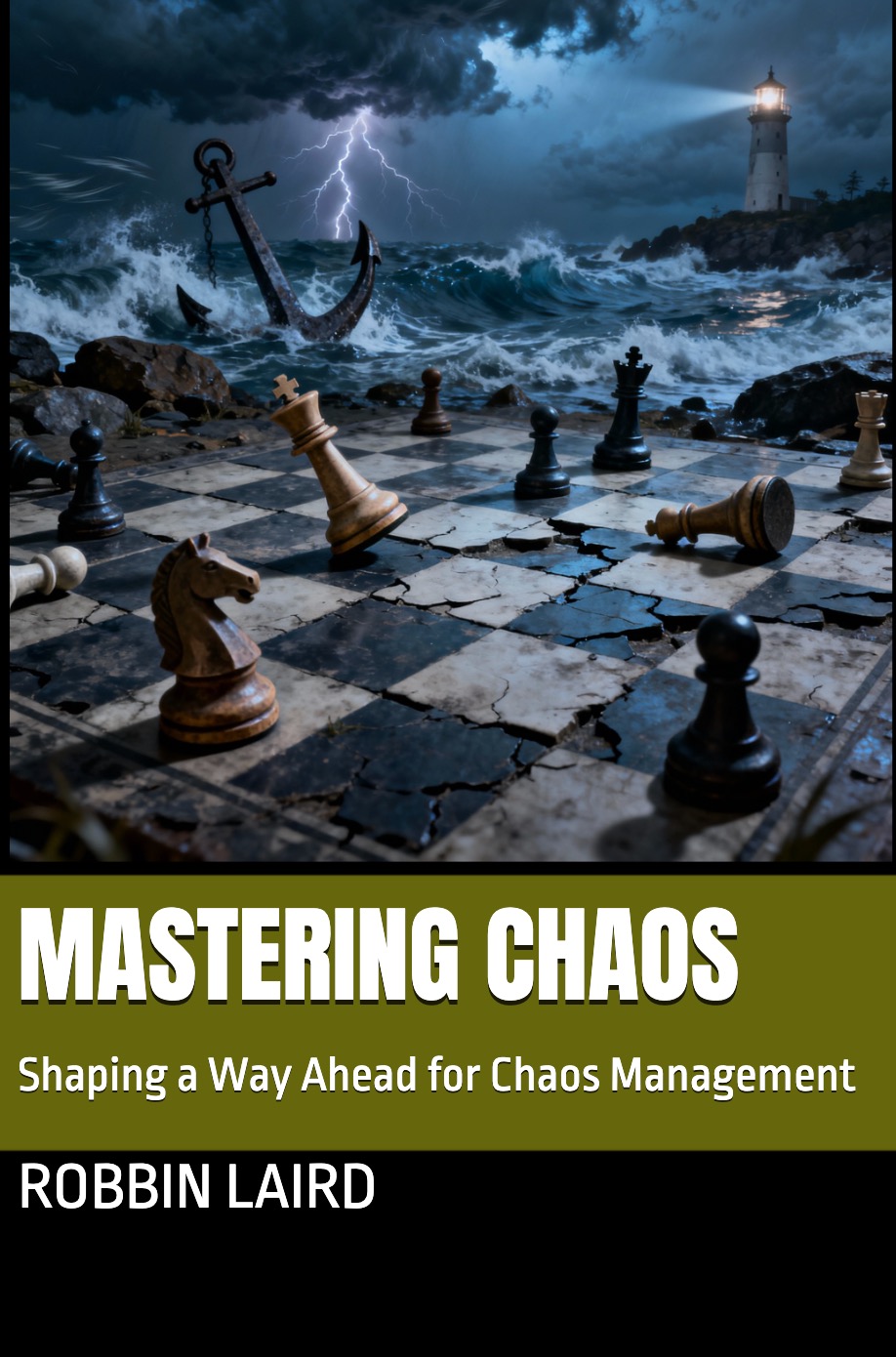
By Robbin Laird
My 2026 framework Mastering Chaos begins from a premise that most leadership literature still refuses to accept: traditional crisis management is not merely inadequate. It is actively dangerous. It was designed for a world of isolated, slow-moving systems with slack built into every layer. That world no longer exists.
The term that anchors the framework is deliberately provocative: the anarchy of the moment. Disorder is not a temporary disruption you ride out. It is not a storm that passes so you can return to normal operations. It is the system itself. The parameters of modern organizational life are in constant motion, shifting under our feet faster than any fixed-point analysis can track.
This is not simply a matter of having more bad news to process, though the 24/7 media environment certainly accelerates the sensation. The more important point is structural: the DNA of a crisis has mutated. We have built a world defined by deep, invisible interconnectivity, and that interconnectivity has a specific mechanical consequence. When a crisis erupts anywhere in this network, it refuses to stay in its lane. It bleeds across systems operating at different scales and different speeds, spawning secondary crises before the first one is even diagnosed.
The twin engines of modern chaos are what systems theorists call tight coupling and interactive complexity. In a loosely coupled system, you have slack, buffers, redundant inventory, breathing room to observe a failure, walk over, and fix it. Tight coupling eliminates that slack. Components are so closely packed that a failure in a single node propagates violently and immediately through the entire network.
The 2011 Tohoku earthquake is the canonical example. A geological disaster in coastal Japan shut down automobile assembly lines in the American Midwest — not because of any direct physical connection, but because just-in-time supply chains had eliminated every buffer between the factory floor in Japan and the production line in Ohio. There was no slack. When one domino fell, the entire table disintegrated.
The sociologist Charles Perrow called these “normal accidents” and the term is important precisely because it is counterintuitive. He did not mean ordinary accidents. He meant that when you design a system with zero slack and high complexity, catastrophic failure is not a bug. It is a structural feature. You have packed the dominoes so tightly together to save money and time that you cannot even see the first one fall before the whole table goes.
This structural fragility collides with what I call the transparency paradox. The BP Deepwater Horizon disaster illustrated it perfectly. There was unprecedented visibility, underwater cameras, drones, real-time global coverage. Everyone could watch the oil flow from that pipe. But the actual decision-makers were drowning in conflicting data, political pressure, and public outrage. Transparency accelerated the pressure to act immediately, to do something visible, to not look incompetent on camera. Acting blindly in a tightly coupled system almost always triggers secondary disaster.
What we are dealing with in these situations is not merely a hard problem. It is what theorists call a wicked problem, a fundamentally different category.
A tame problem, even a genuinely difficult one, has a structure: you find the leak, you patch it, you are done. A wicked problem has no definitive borders and no root cause. Every intervention spawns new crises at different scales. The Covid-19 pandemic is the obvious recent example: implementing school closures to slow viral spread instantly created cascading crises in child psychology, workforce participation, supply chains, and economic stability. Cut off one head, three more appear.
There is no stopping point. There is no victory declaration. The very notion of returning to normal, the operating assumption behind every linear crisis management model — becomes incoherent.
If the environment is fundamentally chaotic, leadership cannot be about crafting the perfect five-year plan. It requires developing specific cognitive skills to navigate through the fog. I call this the chaos navigator.
The first of these skills is adaptive thinking, what the poet John Keats, writing in the 1800s, called negative capability: the capacity to remain in a state of uncertainty, mystery, and doubt without irritably reaching after fact and reason. This goes against every instinct of a high-achieving professional. We are trained to resolve ambiguity quickly because ambiguity feels like a psychological threat. But a chaos navigator must hold multiple competing hypotheses simultaneously without prematurely locking onto a comforting but ultimately wrong story.
This is not paralysis. It is acting on provisional maps. You formulate three working hypotheses based on the weak signals currently available. You set trip wires, specific metrics that will tell you immediately when a hypothesis is failing. You make a move, but you actively hunt for disconfirming data. You want to prove yourself wrong in real time, so you can update the map before you drive off a cliff.
The second skill is pattern recognition under uncertainty. An experienced air traffic controller is not mechanically matching blips on a radar screen to textbook templates. They are sensing the space, noticing a slight wobble in an approach path, hearing a micro-hesitation in a pilot’s voice, forming a provisional map from weak signals and testing it immediately with a probing question or five more seconds of telemetry.
The third skill is emotional regulation and this is the biological bottleneck of the entire process. Under severe pressure, the autonomic nervous system hijacks the prefrontal cortex. Cortisol spikes, vision narrows, and the cognitive capacity required for adaptive thinking evaporates. A leader in physiological panic transmits that panic through the entire organization like an electric shock. Everyone drops their tools and starts vibrating at the same frequency. Emotional regulation is not pretending you are not afraid. It is the disciplined practice of recognizing your own physiological spike, breathing through it, and consciously returning authority to your rational brain.
Once regulated, the fourth skill becomes possible: collaborative sense mapping. The complexity of a wicked problem exceeds the processing power of any single human mind regardless of how talented that individual may be. The logistics officer, the legal advisor, the cyber specialist, the supply chain manager each hold a partial, incomplete view of the chaos. The crucial weak signal almost never appears in the boardroom. It appears at the periphery of the organization, in someone junior enough to be close to the ground. Distributed cognition overlapping those partial views through deliberate mechanisms is how the full pattern emerges.
Even the most capable chaos navigator will crash against a brick wall if the organization itself is designed for a different era. The cultural architecture matters as much as the individual cognitive toolkit.
The shift required is from brittle efficiency to adaptive resilience. I conceptualize this structurally as moving from a medieval stone fortress to a biological immune system. The fortress is optimized to block exactly one kind of threat, a frontal ground assault. It is useless against anything else. The immune system is distributed, constantly patrolling, learning from novel pathogens, and deploying specialized cells to wherever the infection actually is.
In organizational terms, this means core-versus-surge architecture. The core is your minimum viable organization: the essential processes that must persist to maintain identity, ensure compliance, and keep the lights on. The surge elements are modular, cross-functional teams that can be rapidly assembled, deployed against a specific wicked problem, and dissolved or reconfigured as the terrain changes.
Running surge teams effectively requires mission command, complete decentralization of execution. The leader provides a crystal-clear commander’s intent: what must be achieved and why it matters. The how belongs entirely to the teams on the ground, because they are the ones actually seeing the shifting terrain.
This in turn requires dynamic resource reallocation, maintaining roughly 10 to 20 percent of budget, personnel bandwidth, or supply chain capacity as an uncommitted reserve. Intentional redundancy. Alternative suppliers. Overlapping skill sets. Backup communication lines.
This is the hardest organizational argument to make. Financial markets reward lean, hyper-optimized operations and treat uncommitted reserves as wasted capital. The counterargument must reframe redundancy not as inefficiency but as existential insurance. The geopolitical sphere offers abundant proof of what happens when institutions optimize purely for short-term efficiency: they strip away resilience to fund immediately visible projects, and when the weather changes, they find themselves adrift with no slack in the system at all.
There is a final dimension that bears emphasis as we move further into the AI era. Artificial intelligence is rapidly absorbing the rigid, linear, technical problem-solving tasks that have historically constituted a large part of professional work. The algorithms can process data infinitely faster than any human mind.
But navigating the sheer ambiguity of a wicked problem, holding competing thoughts simultaneously, regulating physiological panic, acting courageously on a provisional map that you know is incomplete, that requires a human mind. Chaos literacy may become the only professional skill that cannot be automated away.
The underlying architecture of resilience rests on three pillars: human adaptability, intellectual flexibility, and institutional cohesion. Without those three, the mechanics of surge architecture and mission command and dynamic resource allocation are inert machinery. With them, organizations can do what tightly coupled, rigidly efficient systems cannot: change the tire while the car is still moving.