By Robbin Laird
Six photographs taken through night vision devices on April 6, 2026, at Marine Corps Logistics Base Barstow, California, document one of the most operationally consequential integration exercises in WTI 2-26: the nighttime off-load of an M142 High Mobility Artillery Rocket System from a KC-130J Hercules. The photographs exist entirely in the monochrome grain of NVG imagery — the circular aperture, the grainy texture, the high-contrast shadows — because this operation was conducted in darkness, by design, as part of Tactics VI in the WTI curriculum.
What the photographs document is not a display or a demonstration. It is a precision logistics and fires integration exercise: the delivery of a long-range precision fires system to a forward location by air, at night, under conditions that replicate the operational requirement for rapid, survivable repositioning of fires capability across the distributed battlefield the Marine Corps is designing for in the Indo-Pacific.
HIMARS and the KC-130J: The Airlifted Fires Combination
The M142 HIMARS — High Mobility Artillery Rocket System — is the Marine Corps’ primary long-range precision fires platform. It fires the M270-series rocket family, including the GPS-guided GMLRS with a range of approximately 70 kilometers, and the Army Tactical Missile System with a range exceeding 300 kilometers. In the context of the Marine Corps’ distributed operations concept for the Indo-Pacific, HIMARS is the fires system that can reach out across maritime distances to threaten adversary surface combatants, deny chokepoints, and hold fixed targets at risk from positions that are difficult to locate and strike.
The KC-130J is what makes HIMARS mobile across those distances. The combination of the HIMARS’s wheeled, air-transportable design and the KC-130J’s tactical airlift capability creates an airlifted fires system: a long-range precision strike capability that can be flown to a forward position, off-loaded, fired, and then reloaded and repositioned before the adversary can fix its location and respond. This is the shoot-and-scoot logic applied at the strategic scale of island-hopping mobility.
The night dimension multiplies the tactical value of both. A HIMARS off-loaded in daylight at a forward airfield is visible to ISR. A HIMARS off-loaded at night, by a crew that has trained the off-load procedure to the point where it can be executed under NVGs in darkness, is not. The Tactics VI exercise at MCLB Barstow was explicitly practicing that night window.
The Off-Load Sequence: What the Photographs Show
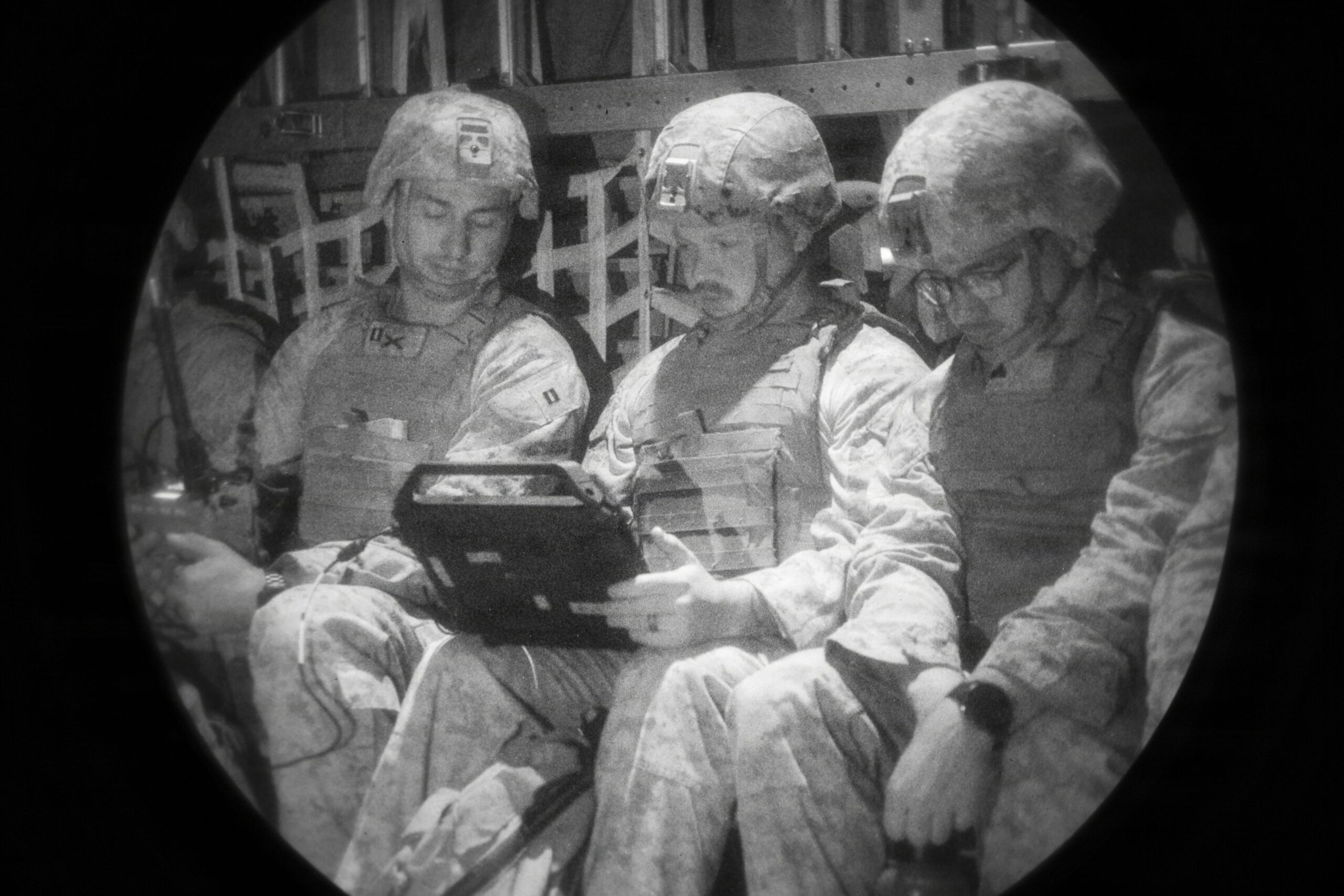
Image 1 establishes the pre-arrival phase. Three Marines are seated inside the KC-130J cargo cabin, NVGs mounted, reviewing a tablet together. The KC-130J’s aluminum cargo wall and cargo net are visible behind them. This is the coordination moment: the off-load team reviewing the sequence, confirming responsibilities, or updating the ground picture at the destination before the aircraft begins its approach. The tablet is the same digital coordination tool visible across WTI 2-26 — a persistent theme of how the course is integrating handheld digital devices into every phase of the operation.
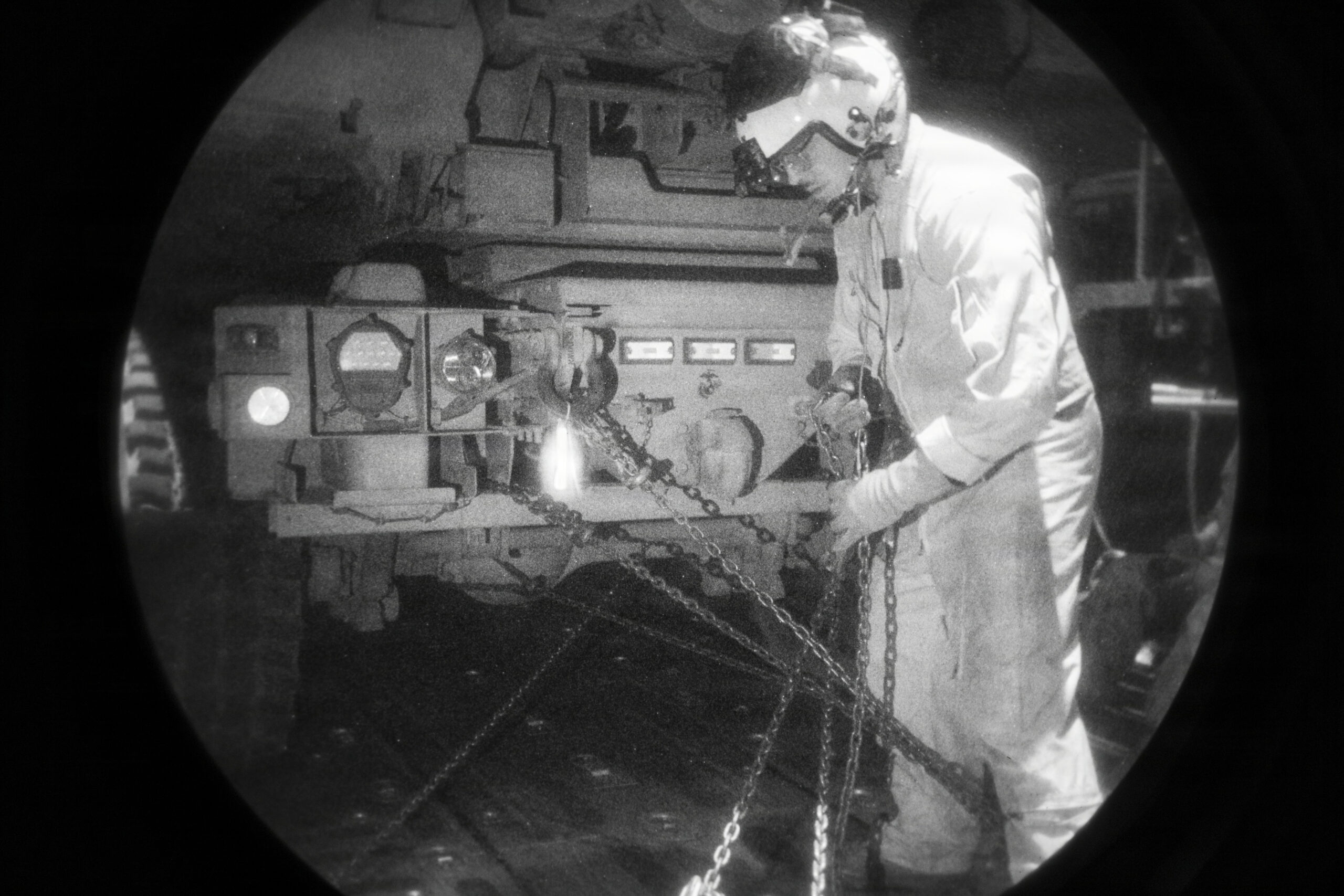
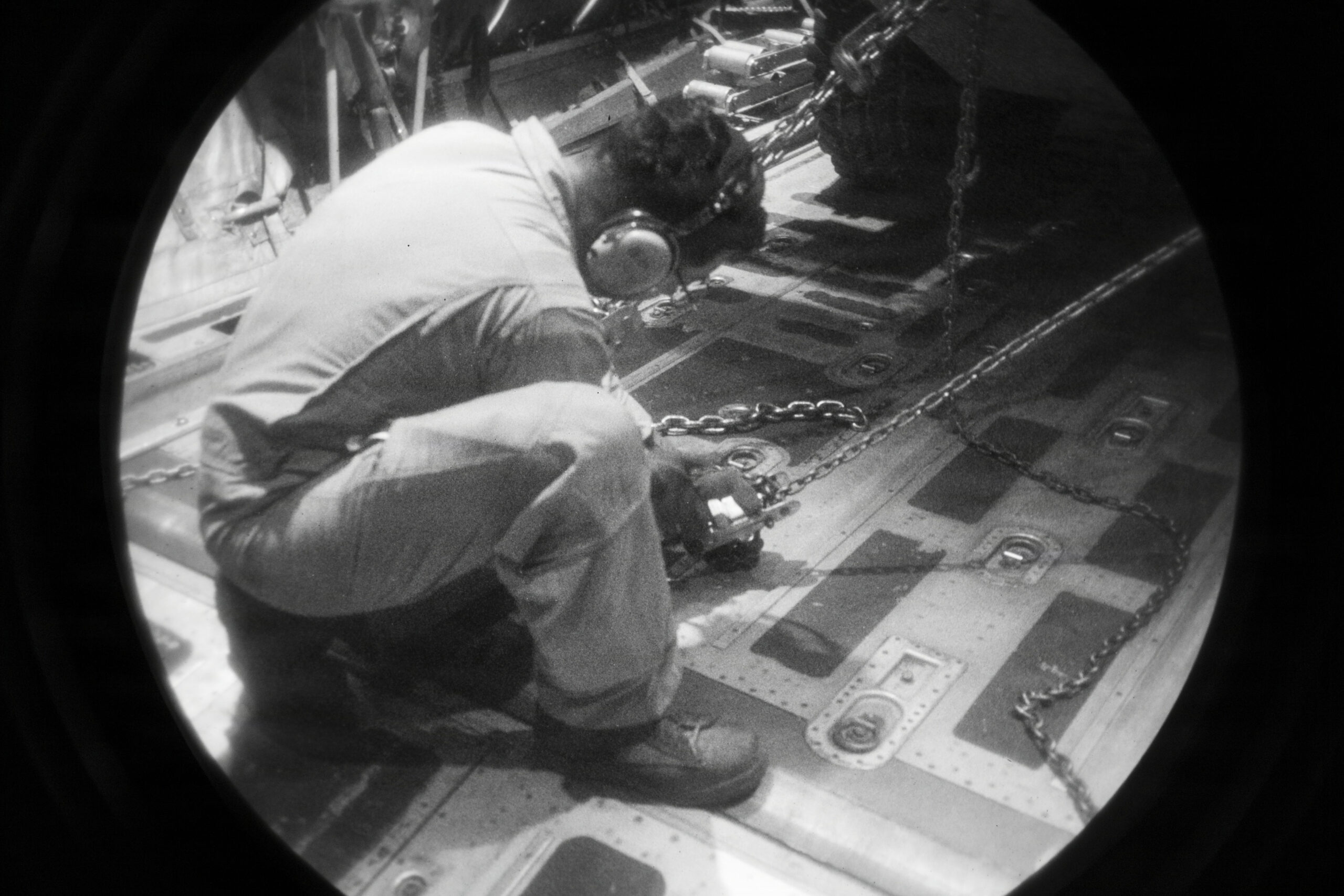
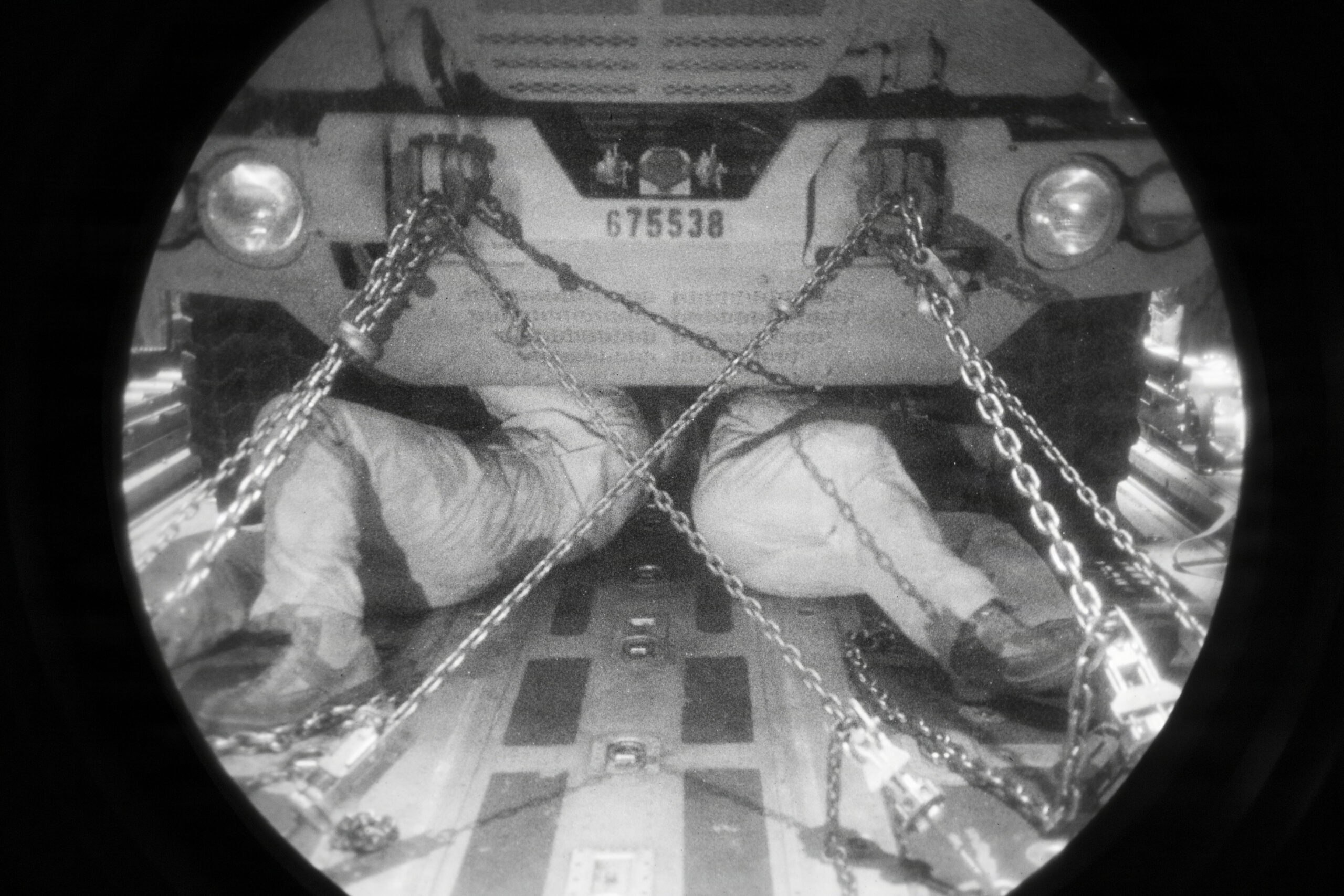
Images 2, 5, and 6 document the chain release sequence inside the cargo bay. Image 2 shows a Marine in flight suit, NVGs up, working the forward tie-down chains connecting the HIMARS launcher to the cargo floor anchor points. The HIMARS cab is clearly visible behind him, its size filling most of the cargo bay’s width. Image 5 shows a second crew member crouched at deck level, both hands on a chain tensioner at a floor tie-down ring. The crouch is tight — the chain runs close to the deck, and the tensioner requires leverage to release under load. Image 6 is the most physically striking: two crew members are lying flat on the cargo floor beneath the front axle of the HIMARS, working the under-vehicle tie-down connections that cannot be reached from a standing or crouching position.
This sequence matters operationally. The chain release is the most time-sensitive and error-sensitive phase of the off-load. A chain that is not fully released will prevent the vehicle from moving. A chain released in the wrong sequence can shift the vehicle’s weight unexpectedly. On a dark airfield, with engines running and the crew working entirely under NVGs, the margin for error is narrow. The crew members lying under the HIMARS axle in Image 6 are doing exactly what the job requires — and doing it in conditions that training explicitly designed to replicate.
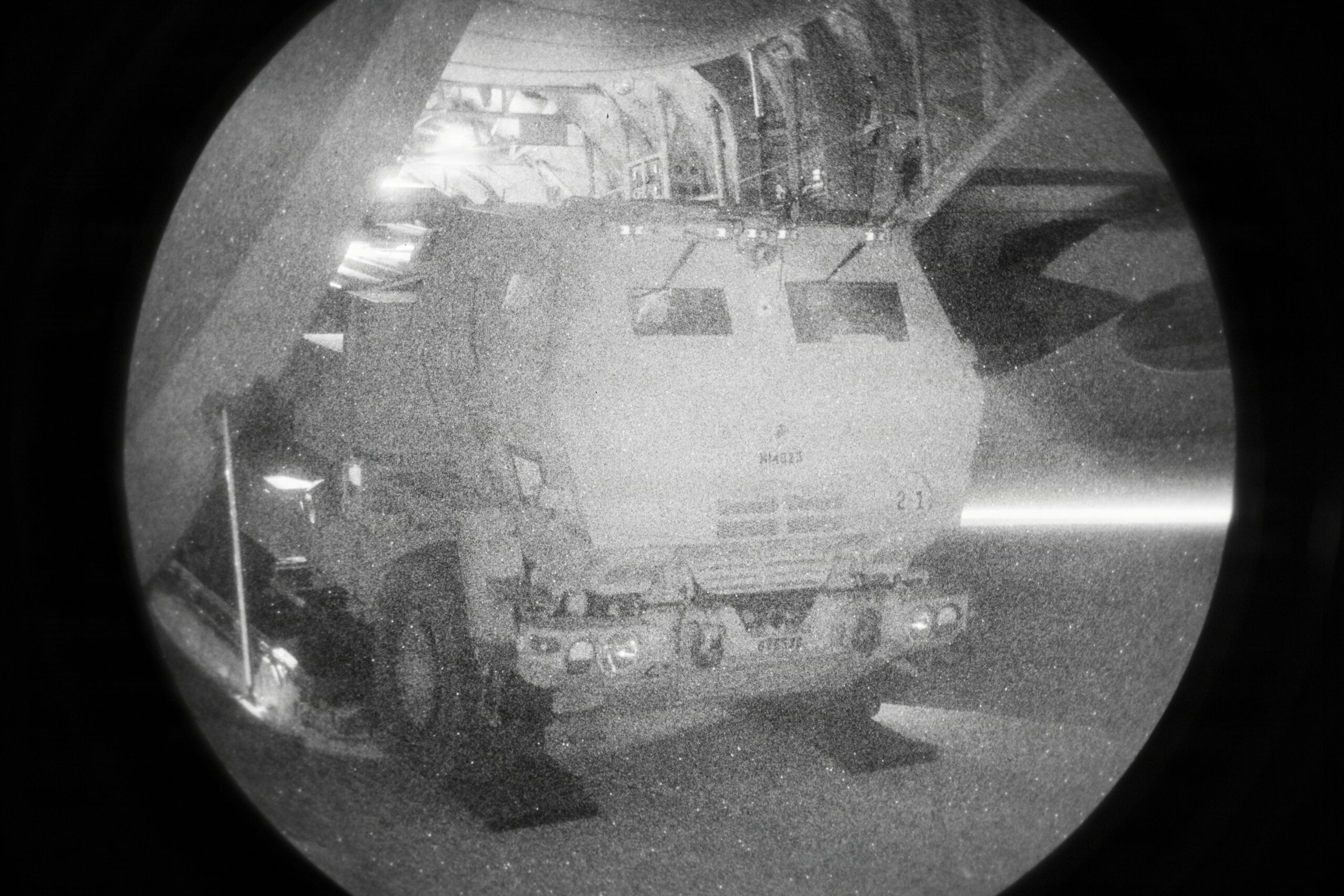
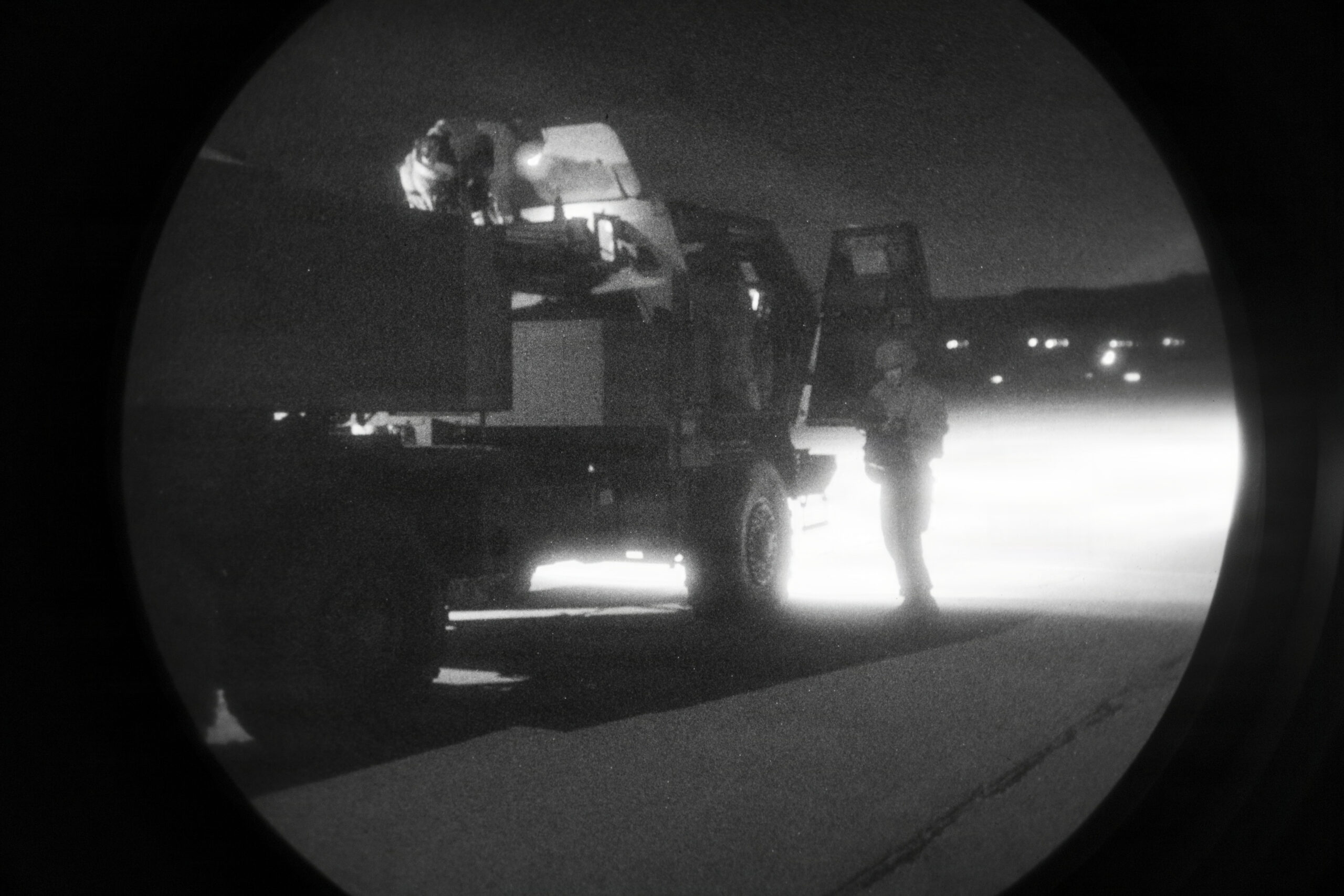
Images 3 and 4 complete the sequence. Image 3 shows the HIMARS at the moment of departure from the aircraft — the vehicle’s nose crossing the ramp threshold onto the Barstow airfield surface, the KC-130J’s cargo bay interior visible above and behind it, a Marine visible at the ramp edge guiding the exit. Image 4 shows the HIMARS fully off the aircraft and moving under its own power on the airfield, a Marine beside the cab, the distant lights of the Barstow area glowing in the NVG background. The aircraft is behind the frame. The HIMARS is free, mobile, and in the field.
MCLB Barstow: Why This Location Matters
The choice of Marine Corps Logistics Base Barstow as the off-load location for this exercise is analytically significant. MCLB Barstow is not a combat aviation installation — it is the Marine Corps’ primary West Coast logistics base, a depot-level maintenance and storage facility in the Mojave Desert. Its airfield is serviceable but not configured as a primary tactical aviation hub.
That is precisely the point. The distributed operations concept does not envision HIMARS being off-loaded at prepared military airfields with established facilities. It envisions HIMARS being off-loaded at any airfield — austere, improvised, or partially prepared — that a KC-130J can access. MCLB Barstow’s airfield represents that category of location: functional, serviceable, but not optimized for tactical aviation operations. Practicing the night off-load at Barstow rather than at a primary aviation installation is a deliberate training choice that replicates the conditions the crew will actually face in a contingency.
Tactics VI in the WTI Curriculum
Tactics VI is one of the later-stage integration exercises in the WTI course, positioned after the platform-specific and function-specific evolutions have been completed and before the large-scale combined exercises that close the course. By this point in WTI 2-26, the prospective WTIs have already practiced expeditionary airfield construction, FARP operations, assault support tactics, anti-air warfare, and the full range of platform-specific flight evolutions. Tactics VI integrates fires and aviation logistics into that picture.
The HIMARS KC-130J night off-load at Barstow is the fires integration exercise that asks the prospective WTI to understand the full logistics chain behind a long-range fires mission: not just the targeting and employment process, but the airlift that positions the system, the off-load procedure that delivers it to the field, and the night operations discipline that protects the entire sequence from observation. A future WTI who has personally overseen or participated in this sequence at night understands something that a fires officer who has only studied the targeting process does not: the fires timeline begins long before the launcher is in position, and it depends on aviation logistics executed to a standard that WTI is specifically certifying.
The Broader Significance: Aviation and Fires as an Integrated System
The photographs from MCLB Barstow on the night of April 6, 2026, document an integration that is easy to describe conceptually but difficult to execute operationally: aviation delivering fires. The KC-130J is not just a transport aircraft in this context. It is the mobility layer of the long-range fires system. The crew that loads, secures, flies, and off-loads the HIMARS is as much a part of the fires mission as the crew that operates the launcher.
This is the kill web logic applied to the aviation-fires relationship: the aircraft and the fires system are not separate capabilities that happen to interact at a transfer point. They are nodes in an integrated system whose collective output — a precision fires capability appearing at a forward location without warning, at night, faster than an adversary can track and respond to — is greater than either produces alone.
The Marine lying under the HIMARS axle on the KC-130J cargo floor at Barstow, releasing a chain tie-down in the dark, is part of that system. WTI 2-26 trained him to understand it that way.