

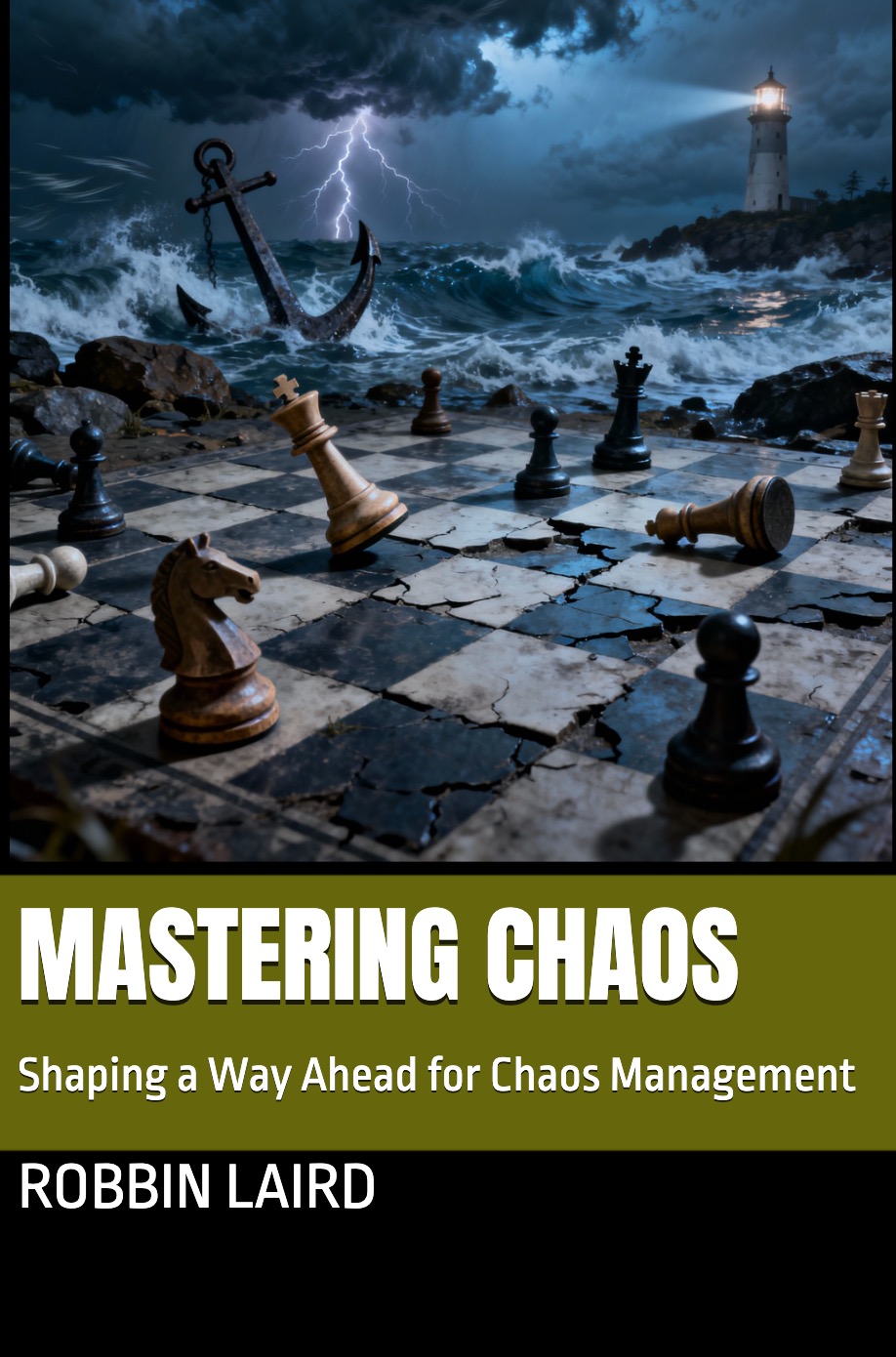
By Robbin Laird
In every sector today, leaders are discovering the same uncomfortable truth: they can no longer plan their way through genuine chaos. The familiar script, stabilize the crisis, restore normal, move on, no longer fits a world where disruption is constant, tightly coupled, and accelerating.
Mastering Chaos is written for that world. It is a book for senior leaders in government, business, civil society, and the military who are tired of operating in permanent triage mode and want a serious framework for building organizations that can function inside turbulence, not merely survive it.
From crisis firefighting to mastering chaos
Most leadership and management playbooks still assume that crises are temporary deviations from a stable baseline. They teach leaders how to respond to an event, close it down, and return to business as usual.
But what happens when business as usual is continuous volatility, overlapping shocks, contested information, and systems so interconnected that local disruptions become global within hours?
Mastering Chaos argues that this is the defining feature of our era, not a passing phase. It describes “the anarchy of the moment” as a world in which information moves faster than institutions, crises emerge from unexpected corners, and the time available to think keeps collapsing.
In this environment, the central question for leaders is no longer “How do I manage this crisis?” but “Have I built an organization capable of thinking and acting coherently when the situation will not sit still?”
The three pillars every modern organization needs
Drawing on four decades of work with military services, government institutions, and large organizations, the book identifies why some systems fracture under pressure while others adapt and emerge stronger.
The difference comes down to whether three pillars of adaptive capacity have been deliberately built before they are urgently needed.
- Intellectual flexibility. The ability to hold multiple interpretations at once, question inherited assumptions, and treat strategies as living hypotheses rather than fixed commitments.
- Institutional resilience. Structures that trade a measure of brittle efficiency for redundancy, backup options, and infrastructure designed to support multiple futures rather than a single forecast.
- Social cohesion. The trust, shared purpose, and internal bonds that prevent fragmentation when stress rises and information conflicts.
These are not soft virtues.
They are concrete design choices: how teams are structured, how information flows, how dissent is handled, how succession is managed, and how leaders are trained to think and decide under pressure.
This is not a theoretical meditation on complexity; it is a practical guide for flag officers, senior executives, C-suite leaders, and senior public servants working across a 12–24 month transformation horizon. Working through it, readers will be able to diagnose whether their organization is optimized for stability and efficiency or genuinely adapted for chaos.
They will also be equipped to reframe strategic planning from scenario prediction to capability building, design decision-making processes that function under uncertainty, shift culture from risk-aversion to adaptation-focus, distinguish complicated problems from truly complex ones, and preserve institutional knowledge across leadership transitions.
A playbook, not a manifesto
The book is organized to match how real leadership work actually unfolds.
Part One explains why today’s environment is structurally chaotic and why legacy crisis-management models keep failing.
Part Two moves to action with frameworks for leading through chaos, building chaos-ready organizations, designing playbooks, and developing what the book calls “Chaos Navigators.”
Part Three distills these lessons into a realistic 12–24 month agenda and a practical summary for working leaders.
Among the book’s strongest contributions is its emphasis on realistic simulation. Rather than treating exercises as procedural drills, Mastering Chaos shows how to design simulations that challenge assumptions, compress time, create cognitive and emotional load, and then use structured reflection to sharpen how leaders actually think.
Most leadership literature still treats disruption as a phase and equilibrium as the goal.
Mastering Chaos starts from a harder premise: chaos is now the operating condition of modern leadership.
That makes this book relevant well beyond defense or national security circles.
It speaks to any senior leader trying to hold an organization together while technology, politics, markets, and public expectations shift faster than legacy planning cycles can handle.
This is not a book to skim and shelve.
It is a working guide for leaders who need their institutions to think clearly, adapt quickly, and hold together under sustained pressure.