By Robbin Laird
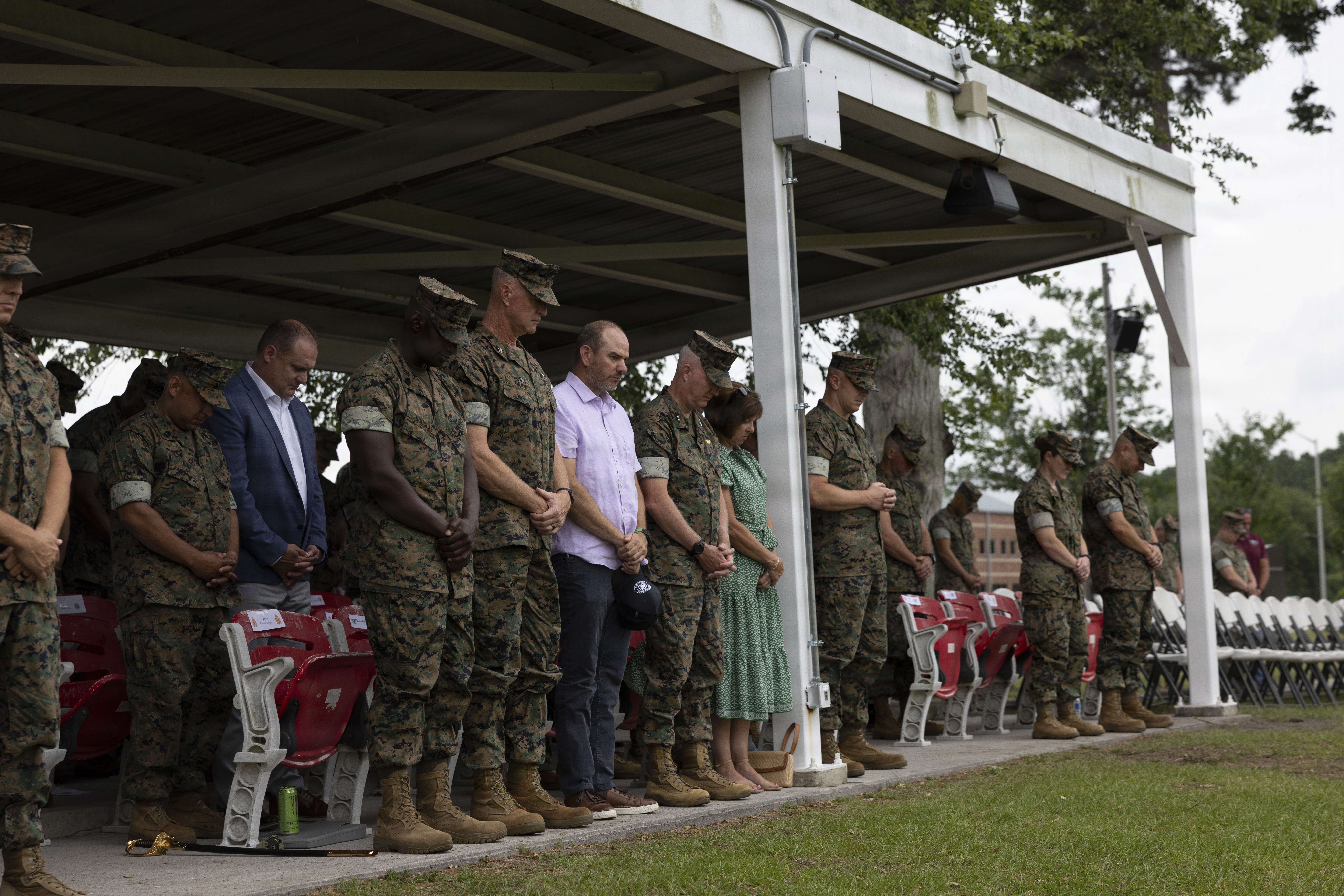
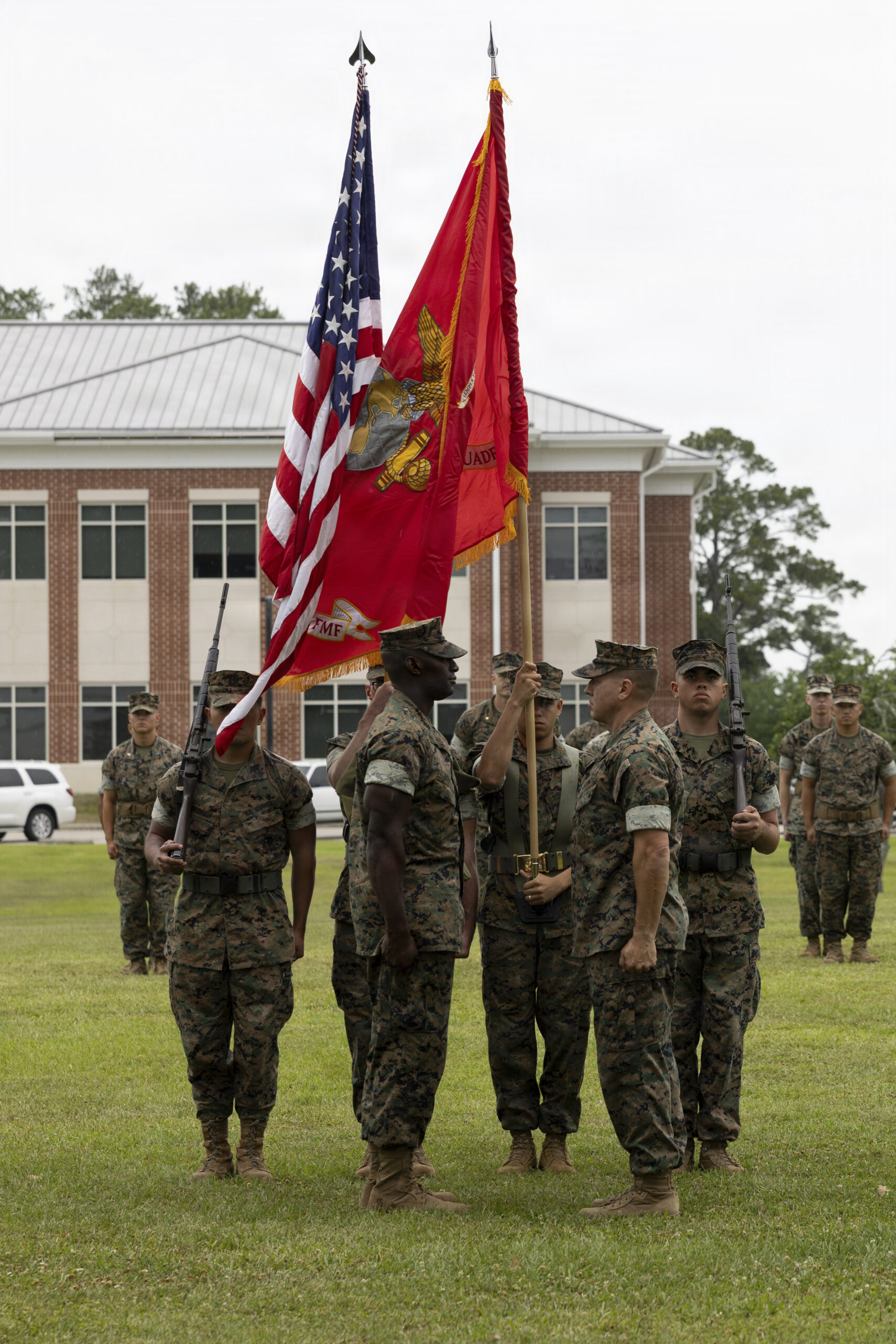
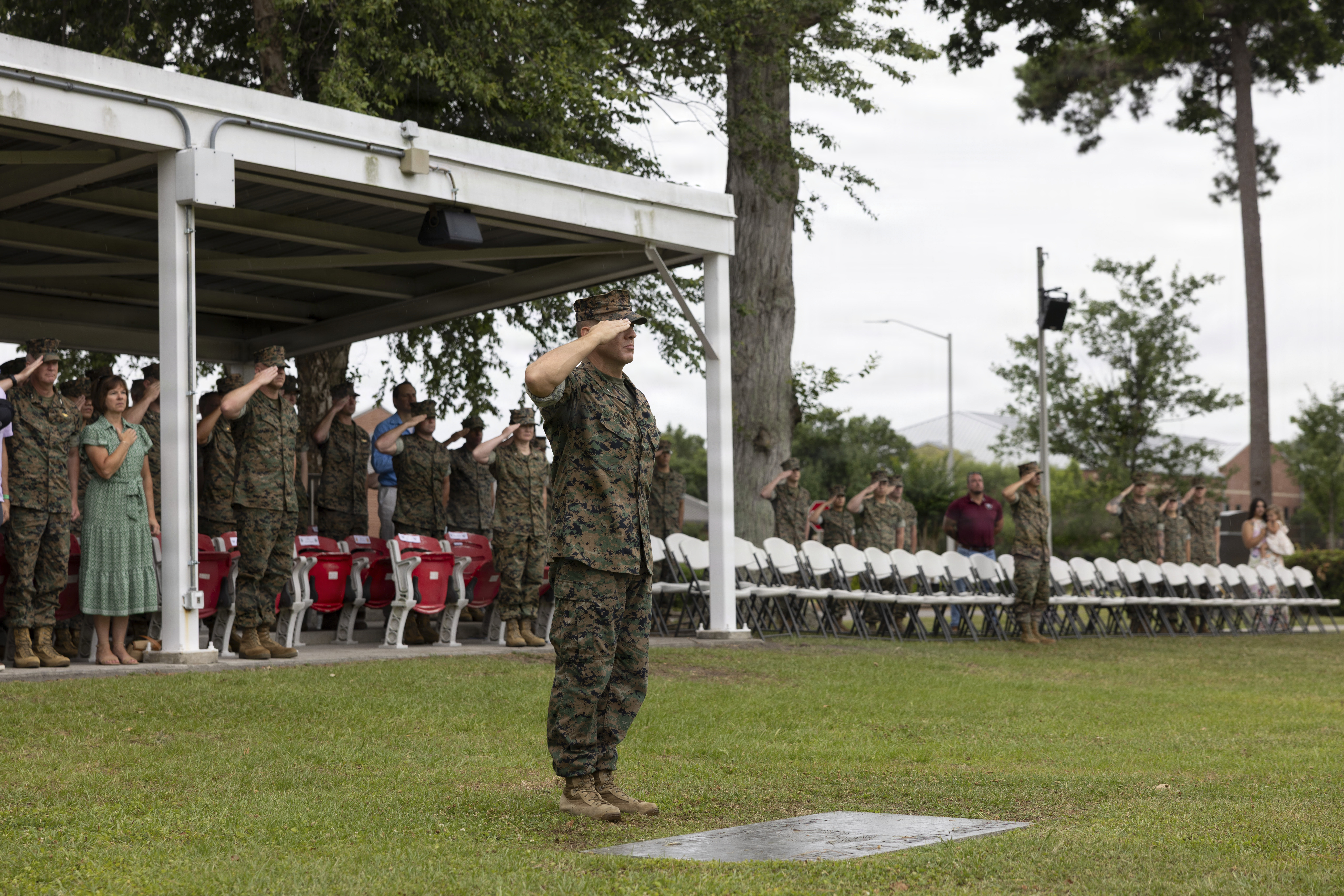
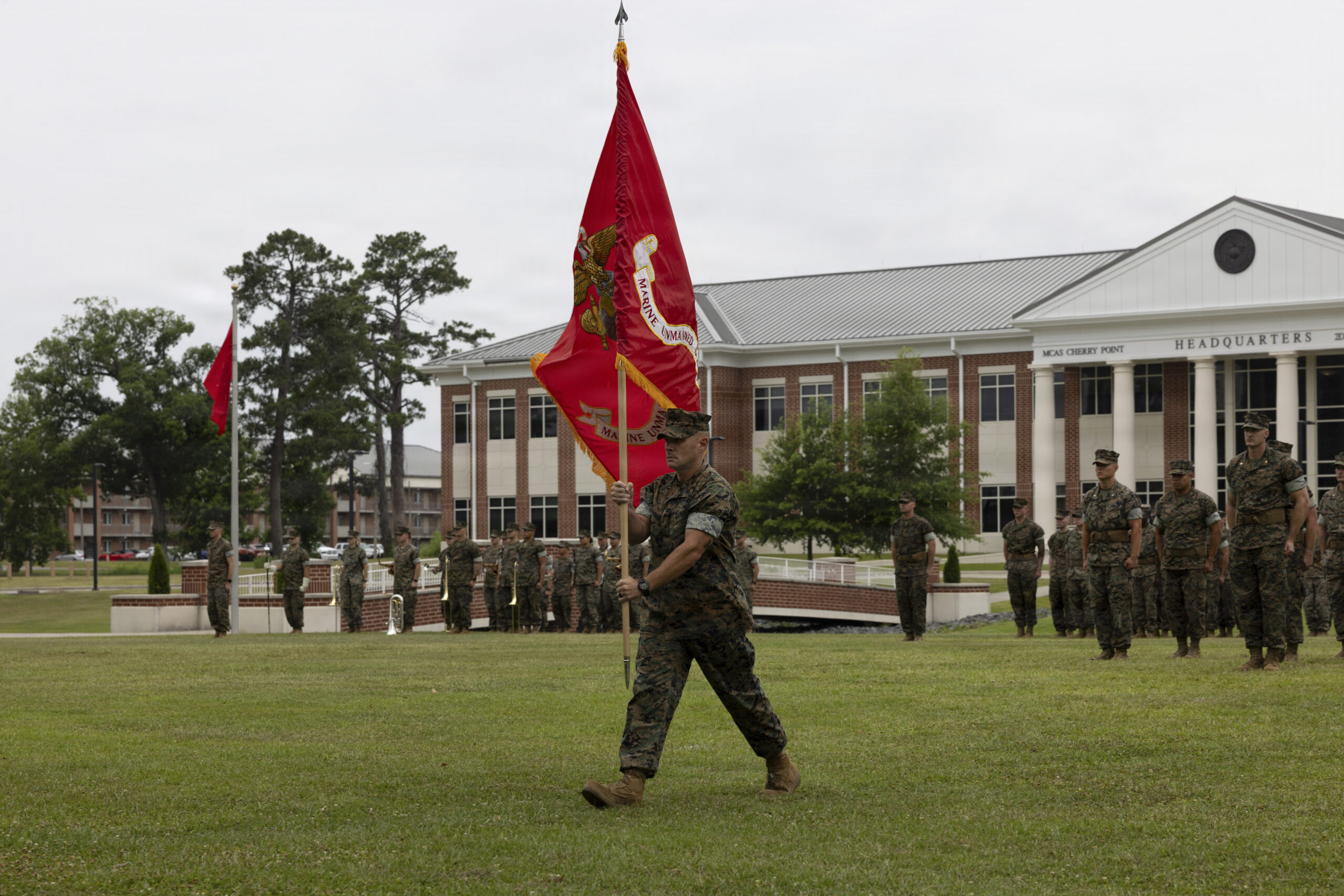
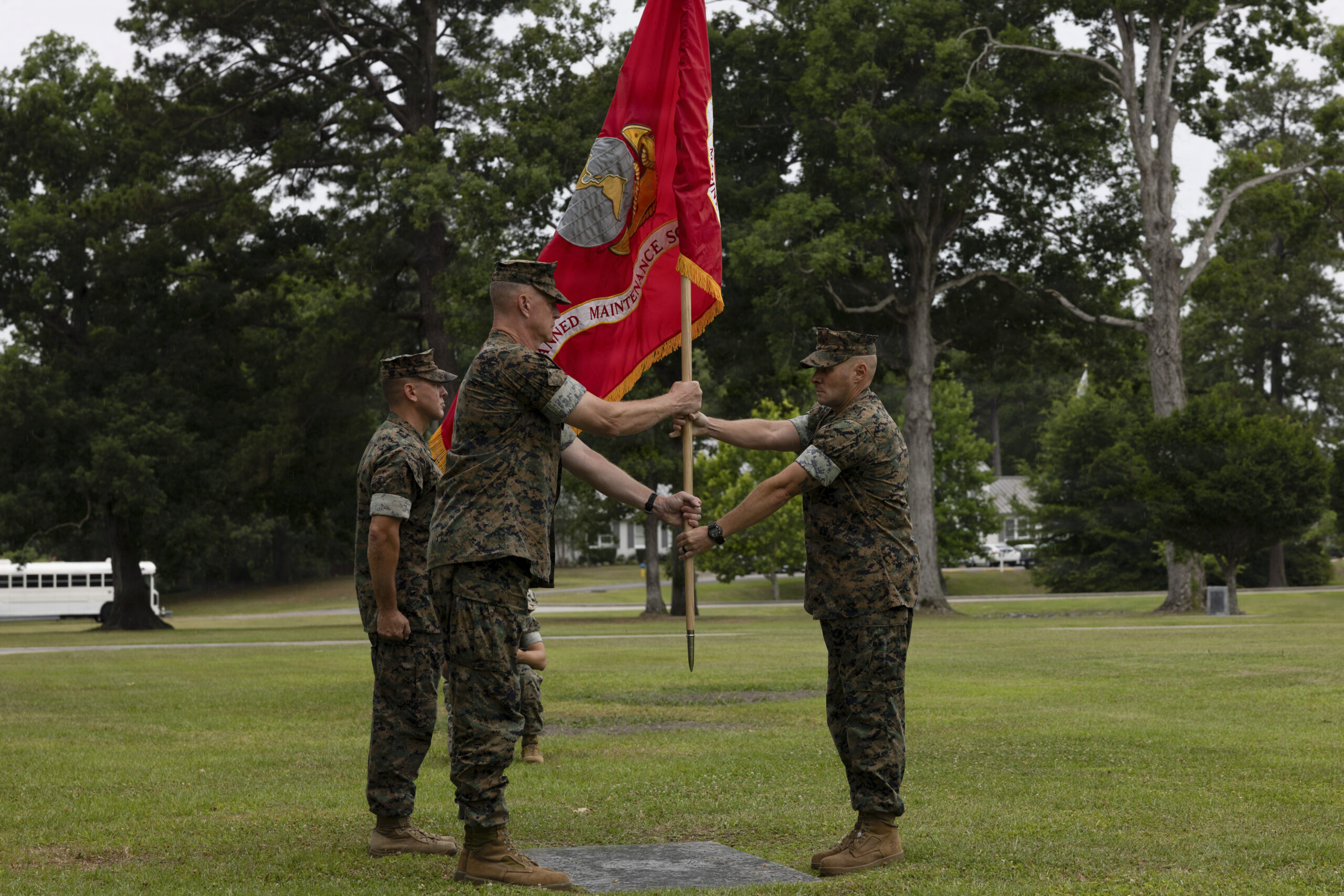
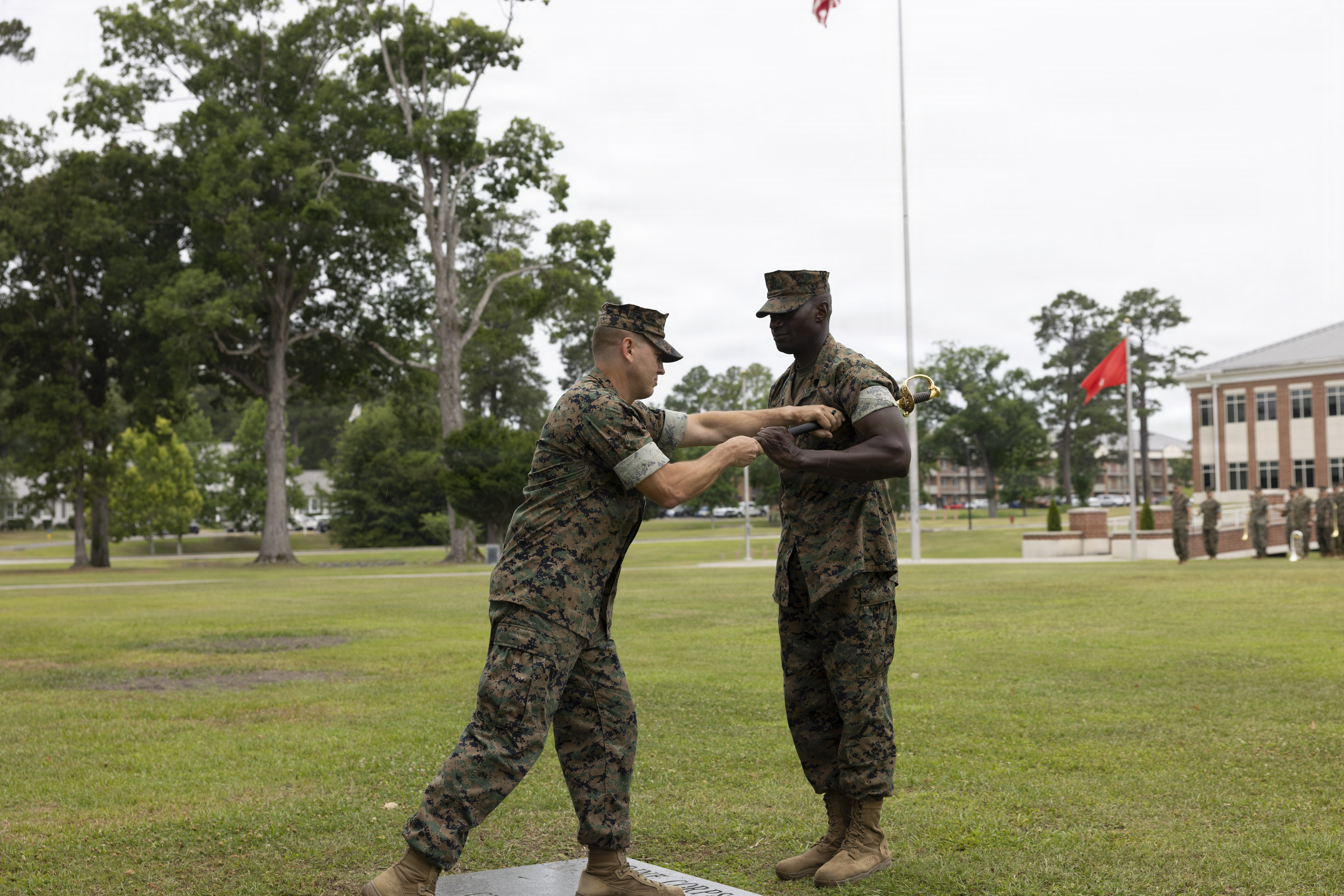
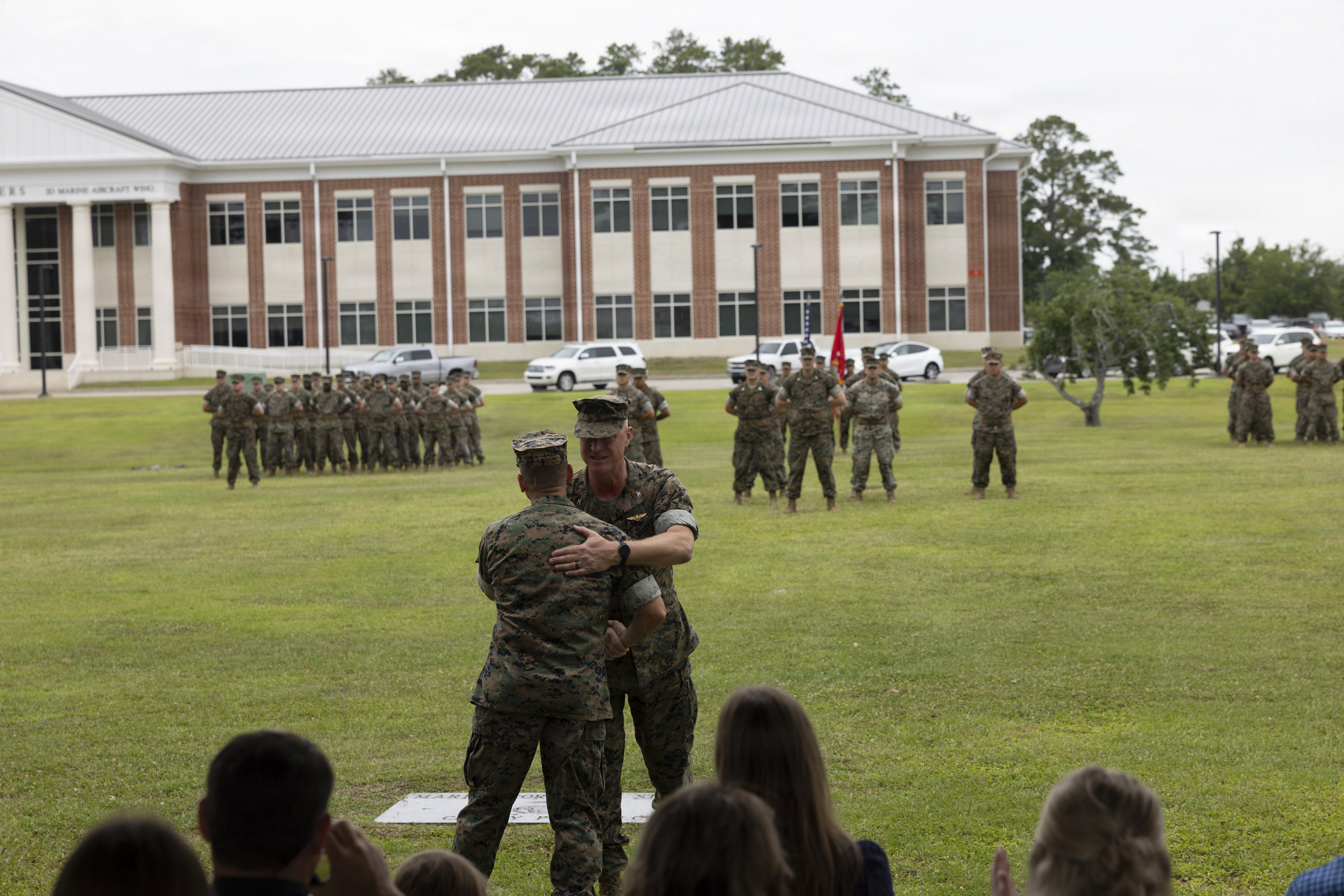
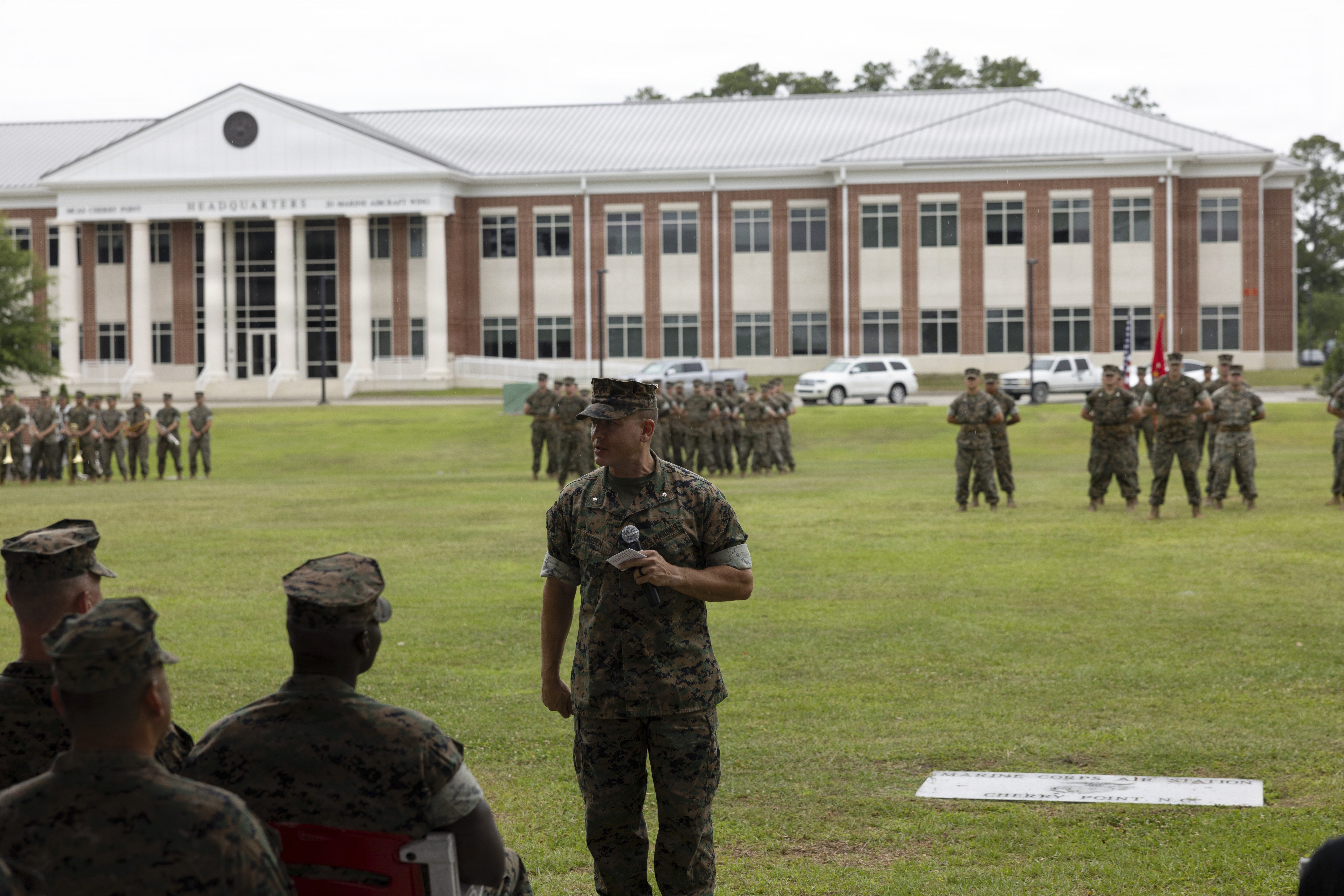
A light rain fell over the parade field at Marine Corps Air Station Cherry Point on the morning of June 16, 2026, but it did nothing to slow the proceedings. Under a covered pavilion ringed with the stadium-style red seats that mark official functions on the station, Marines and their families bowed their heads for the invocation, the band assembled on the brick footbridge near 2nd Marine Aircraft Wing headquarters, and a color guard stepped off across the wet grass carrying the National Colors alongside a crimson guidon embroidered with an eagle, globe and anchor and a scroll reading “Marine Unmanned Maintenance Squadron 14.” By the time the ceremony closed with a salute, a sword passed hand to hand, and an embrace between two Marine officers in front of the formation, the Corps had done something it had never done before: stood up a squadron built from the ground up to keep its Group 5 unmanned aircraft flying in the field.
Marine Unmanned Maintenance Squadron 14, or MUMS-14, was officially activated that day as a subordinate command of Marine Aircraft Group 14, itself part of 2nd Marine Aircraft Wing, the aviation combat element of II Marine Expeditionary Force. Lieutenant Colonel Jeffrey F. Carben, a Tennessee native, assumed command of the new squadron as part of the ceremony, while Sergeant Major Tavaris J. Douglas, of Virginia, stepped in as its first senior enlisted leader. Colonel Benjamin W. Grant, the Ohio-born commanding officer of MAG-14, presided, delivering remarks to the assembled Marines before passing the squadron’s colors to Carben. In a separate but parallel exchange, Sergeant Major Ryan N. McCrary, MAG-14’s command senior enlisted leader, passed the ceremonial sword of office to Douglas, the traditional gesture by which authority over the enlisted ranks changes hands.
What makes the day notable is not the choreography, familiar to anyone who has stood on a Marine parade field, but what the choreography was marking. MUMS-14 is now the Corps’ first and only unit organized, trained and equipped specifically to provide organic-level maintenance for Group 5 unmanned aerial systems, chiefly the MQ-9A Reaper, at forward locations. For an institution that has spent the better part of two decades treating unmanned aviation as an attachment to existing structures, that is a structural statement in its own right.
Force Design Logic Behind MUMS-14
The Corps has framed MUMS-14 publicly in almost exactly those terms: the first aviation unit built specifically to deliver organic aviation maintenance for Group 5 UAS at forward locations, rather than relying on the ad hoc support arrangements or contractor-heavy models that have characterized unmanned aviation sustainment up to now.
That framing matters because it signals a shift in how the Marine Corps intends to own this capability over the long term.
The logic traces directly back to Force Design. The MQ-9A is not a stopgap or a leased capability bolted onto the MAGTF for a single deployment cycle; it is replacing the RQ-21A Blackjack in 2nd MAW’s unmanned portfolio and is being built into the Marine Air-Ground Task Force as a standing, organic capability. A platform with that kind of institutional permanence needs an institutional maintenance structure to match it. Relying indefinitely on contractor logistics support or borrowed Air Force sustainment arrangements would have left the Reaper force structurally dependent on outside organizations precisely at the moment the Corps is trying to demonstrate that distributed, forward-postured unmanned ISR is something it can sustain on its own. MUMS-14 closes that gap.
It is the maintenance half of a decision the Corps already made on the operations side: that the MQ-9A is staying, and staying as a Marine-owned, Marine-maintained system.
The MQ-9A in 2nd MAW’s Concept of Employment
The operational half of that story has been building at Cherry Point for some time. Marine Unmanned Aerial Vehicle Training Squadron 2 — VMUT-2, the “Night Owls,” also a subordinate command of MAG-14 — has been assembling and flying 2nd MAW’s MQ-9A Reapers as the Wing transitions away from the RQ-21A, and now runs the Corps’ organic syllabus for MQ-9A pilots and sensor operators.
That training pipeline gives 2nd MAW a homegrown bench of aircrew rather than one borrowed from the Air Force’s existing Reaper enterprise, and it has positioned Cherry Point as the center of gravity for Marine MQ-9A expertise on the East Coast.
The aircraft itself is being cast in a role considerably larger than legacy notions of an unmanned reconnaissance asset. With its endurance, operating altitude and payload flexibility, the MQ-9A is being built into a multi-mission intelligence, surveillance, reconnaissance and targeting node for the MAGTF and the joint force, a platform meant to support distributed maritime operations and expeditionary advanced base operations across both land and sea, rather than simply loitering over a single objective area and sending back video.
That is a materially different employment concept than the one the RQ-21A was designed around, and it is one that assumes the aircraft will operate from dispersed, often austere locations rather than from a single established airfield with a deep contractor logistics tail sitting nearby.
Why a Dedicated Maintenance Squadron Matters
That distinction, a sensor platform built for distributed, forward operations rather than centralized garrison flying, is precisely why the training function and the maintenance function needed to be split into two separate organizations rather than left bundled together inside VMUT-2.
MUMS-14 is organized and resourced specifically around MQ-9A Reaper sustainment, providing organic-level maintenance to keep the air vehicle and its surrounding system of systems, sensors, communications relays, ground control stations — mission-capable when operating away from the flagpole. VMUT-2 owns training and operations; MUMS-14 owns forward maintenance. That separation of functions mirrors the institutional structure the Corps has long used for sustaining manned aviation, where a Marine Aviation Logistics Squadron such as MALS-14, also resident at Cherry Point, has historically separated intermediate-level maintenance from the flying squadrons it supports.
MUMS-14 essentially extends that same logic into the Group 5 unmanned world, with one important modification: it is purpose-built around a remotely piloted, geographically distributed platform rather than a manned aircraft tied to a single flight line.
This is the detail that elevates the June 16 ceremony from administrative housekeeping to something closer to a milestone. Stand-alone maintenance squadrons are not created reflexively. They are created when a platform has matured to the point that ad hoc or borrowed sustainment arrangements are no longer adequate to the demand being placed on it.
The Corps effectively decided that the MQ-9A had crossed that threshold, and that Group 5 UAS sustainment now needs the same kind of dedicated institutional home that fixed-wing and rotary-wing aviation have had for decades.
Implications for II MEF and 2nd MAW Operations
The practical payoff of that decision lands squarely on II MEF’s plate. As 2nd MAW completes its fielding of the MQ-9A across the Wing, the existence of MUMS-14 means II MEF can now deploy MQ-9A detachments with their own organic maintenance support, rather than depending on the Air Force or on contractor logistics arrangements to keep aircraft flying once they leave Cherry Point.
That is a meaningful change in how a stand-in force, dispersed across austere or contested locations under an expeditionary advanced base operations concept, would actually sustain a persistent unmanned ISR and targeting capability in the field. A detachment that carries its own maintainers does not need to wait on a sustainment contract to catch up with it, and it does not need to coordinate access to someone else’s depot-level support structure in a theater where access itself may be contested.
That, in turn, feeds directly into the broader concept MUMS-14 was built to support: MQ-9As providing continuous intelligence, surveillance and reconnaissance, targeting data, communications relay, and networking for distributed Marine and naval forces operating in contested maritime regions. The value of that kind of persistent unmanned coverage is not theoretical. It underpins the kind of deterrence and crisis-response posture the Marine Corps has been trying to build into its Indo-Pacific and broader maritime concepts, sensors and shooters networked together across a dispersed force, with the unmanned layer providing much of the connective tissue.
None of that works, however, if the aircraft providing that coverage cannot be kept mission-capable once it leaves a fixed installation. MUMS-14 is the institutional answer to that maintenance question, and its activation suggests the Corps now regards Group 5 unmanned sustainment as permanent infrastructure rather than an experiment.
A New Chapter, Quietly Begun
Back on the field at Cherry Point, the ceremony’s closing moments captured the stakes in human terms rather than institutional ones. After the colors had been presented and the sword of office passed to Sergeant Major Douglas, Colonel Grant and Lieutenant Colonel Carben came together in a brief embrace in front of the formation, the kind of gesture that, on a Marine parade field, signals less a handoff than a shared investment in what comes next. Carben told those gathered that standing up the squadron marked a significant step forward for Marine Corps aviation, and that the unit’s job was to give the Corps a persistent, expeditionary maintenance capability that strengthens deterrence and supports Marines operating forward. He added that it would take disciplined, technically skilled Marines to keep these systems flying, and that the day’s activation was the start of a new chapter for Marine aviation rather than simply a ceremony to be checked off a calendar.
That framing is not overstated.
MUMS-14 is a small unit by personnel count, but it closes a structural gap that has existed since the Marine Corps first began flying the MQ-9A: the absence of an organic, forward-deployable maintenance organization built specifically around Group 5 unmanned aircraft. With VMUT-2 handling training, MALS-14 providing the broader logistics architecture already in place at Cherry Point, and MUMS-14 now filling the maintenance gap in between, 2nd Marine Aircraft Wing has assembled the full institutional chain needed to operate the MQ-9A as a standing, organic, expeditionary capability rather than a borrowed or contracted one.
For a Marine Corps trying to demonstrate that distributed maritime operations and expeditionary advanced base concepts can be sustained rather than merely exercised, that is precisely the kind of unglamorous, structural work that determines whether the broader strategy holds up under actual operational demand.
Note: This is the first of three articles on the significance of establishing MUMS-14.