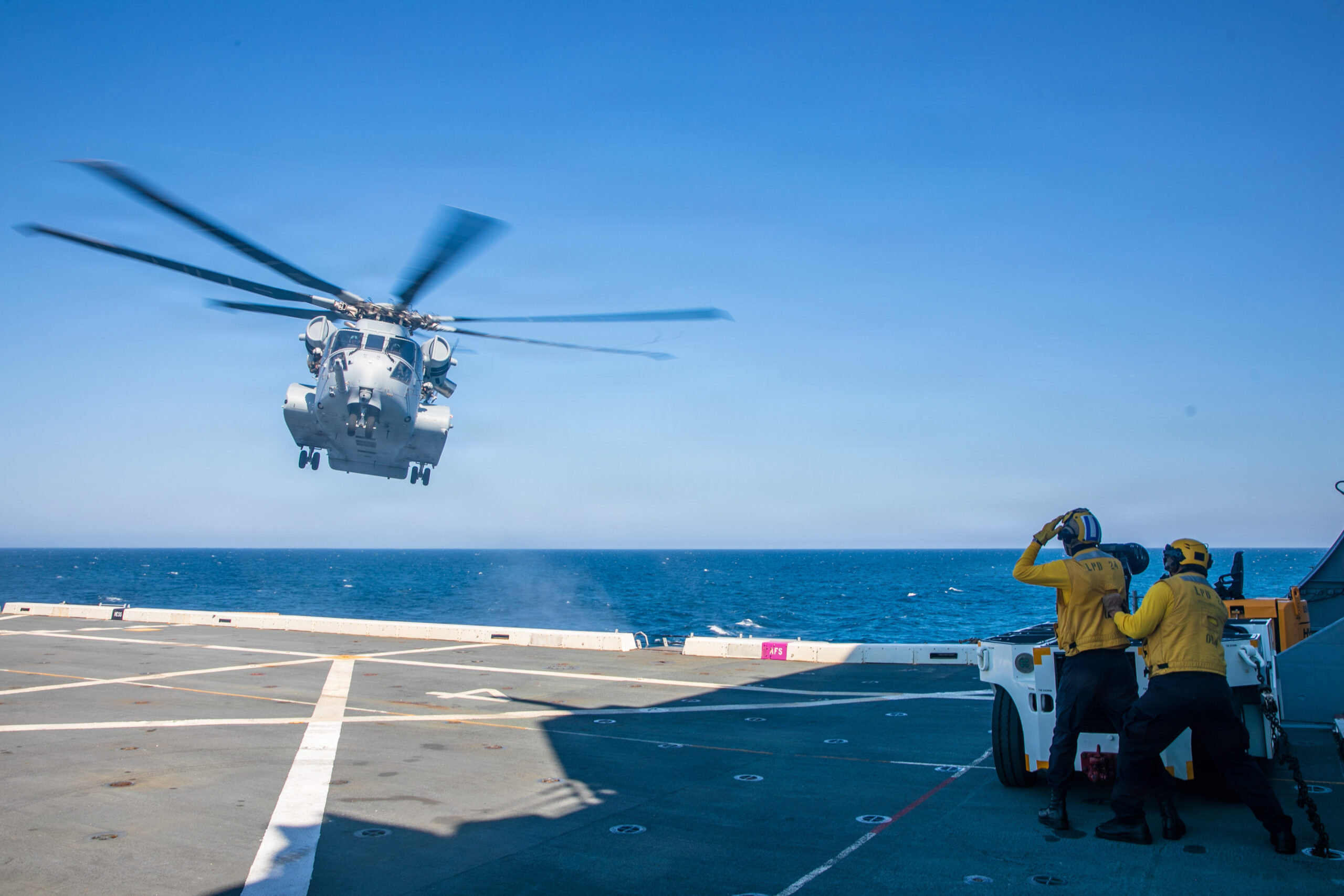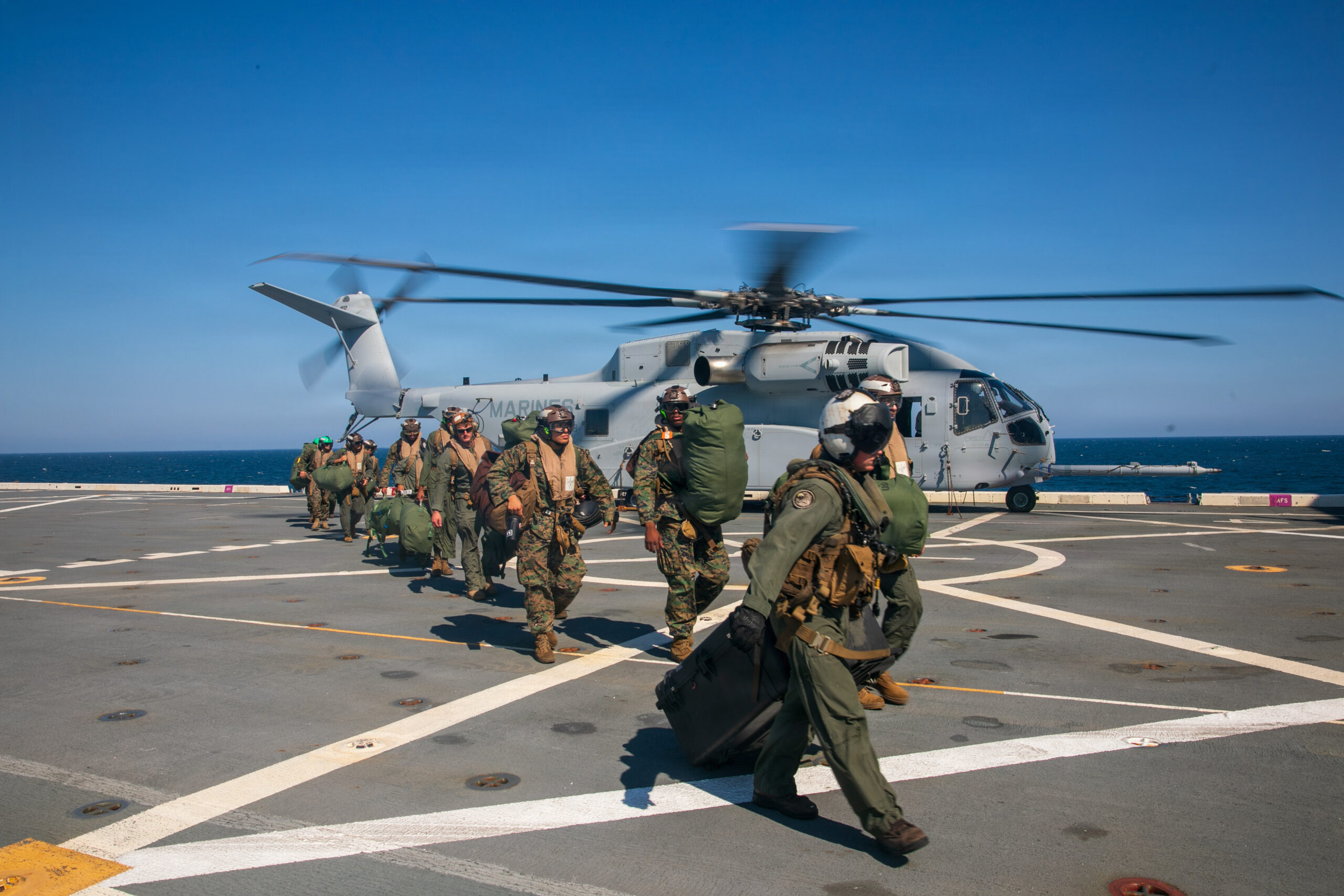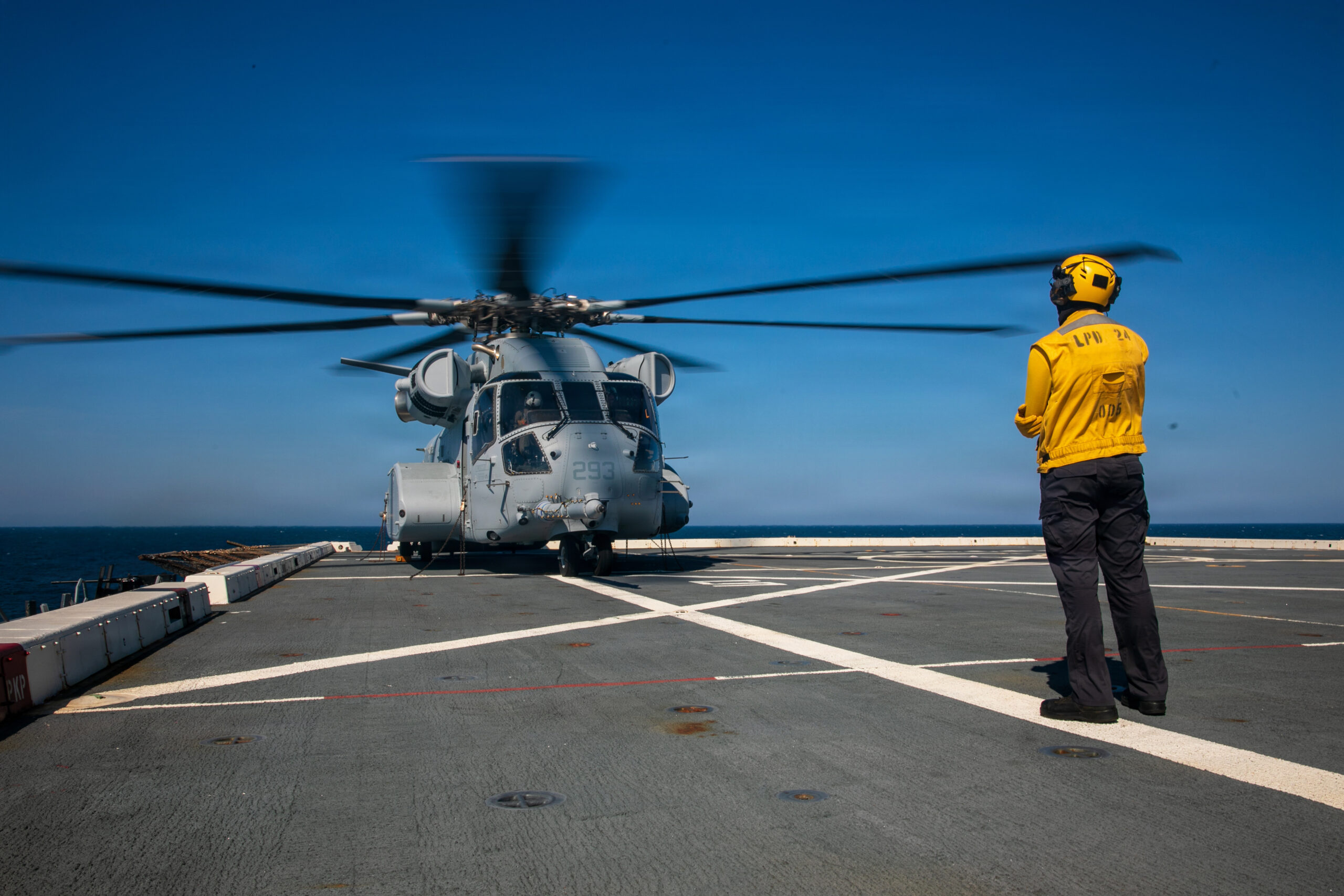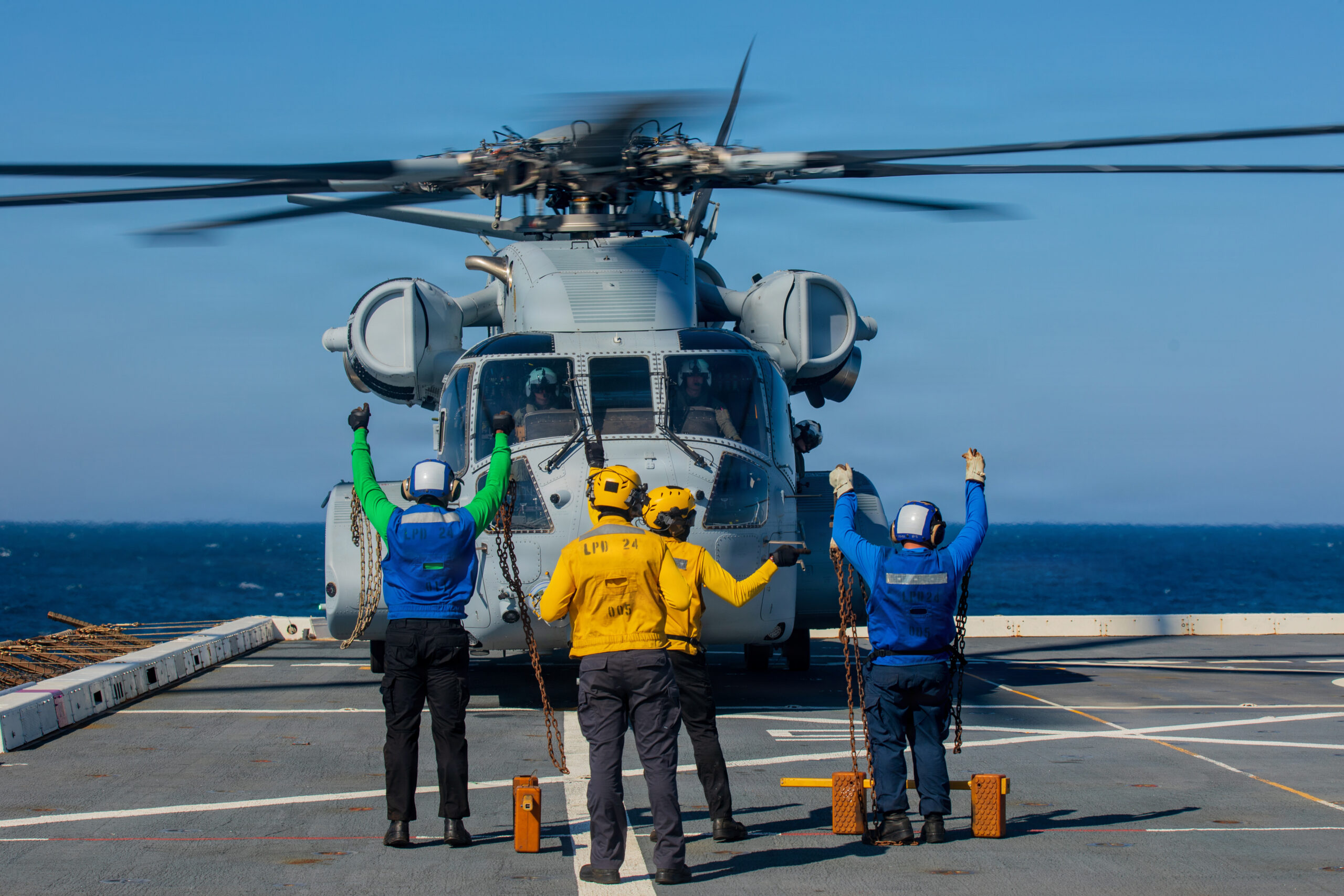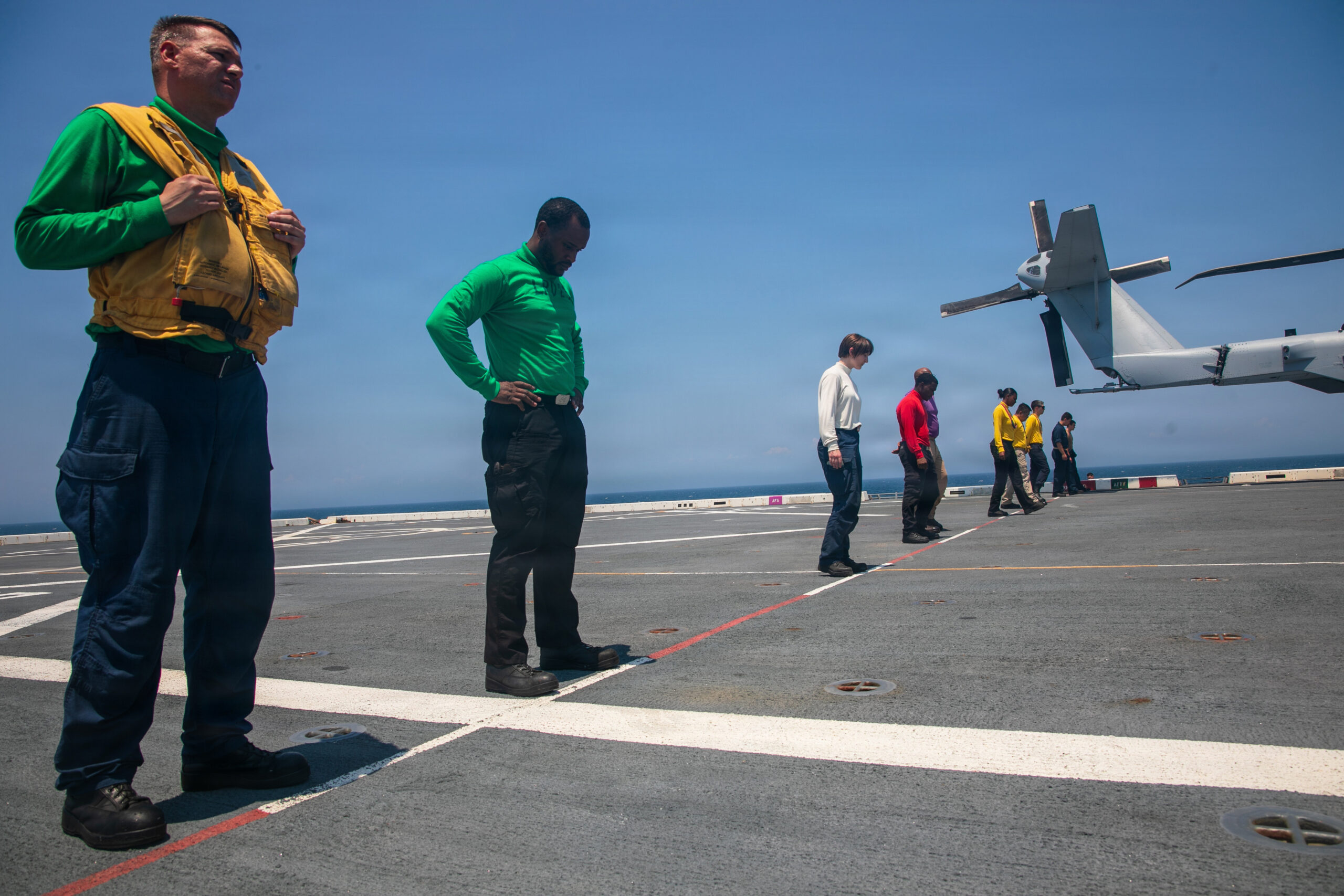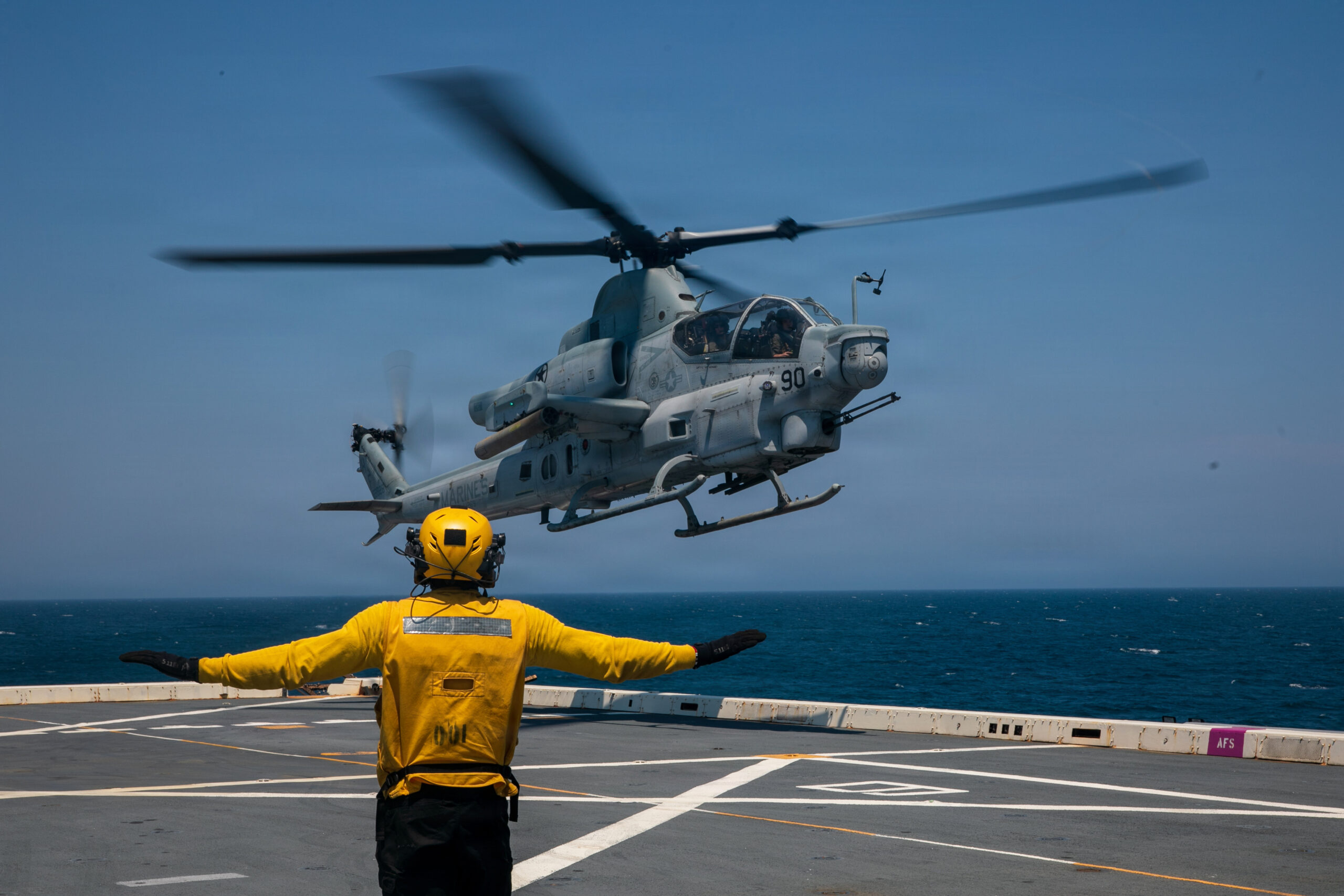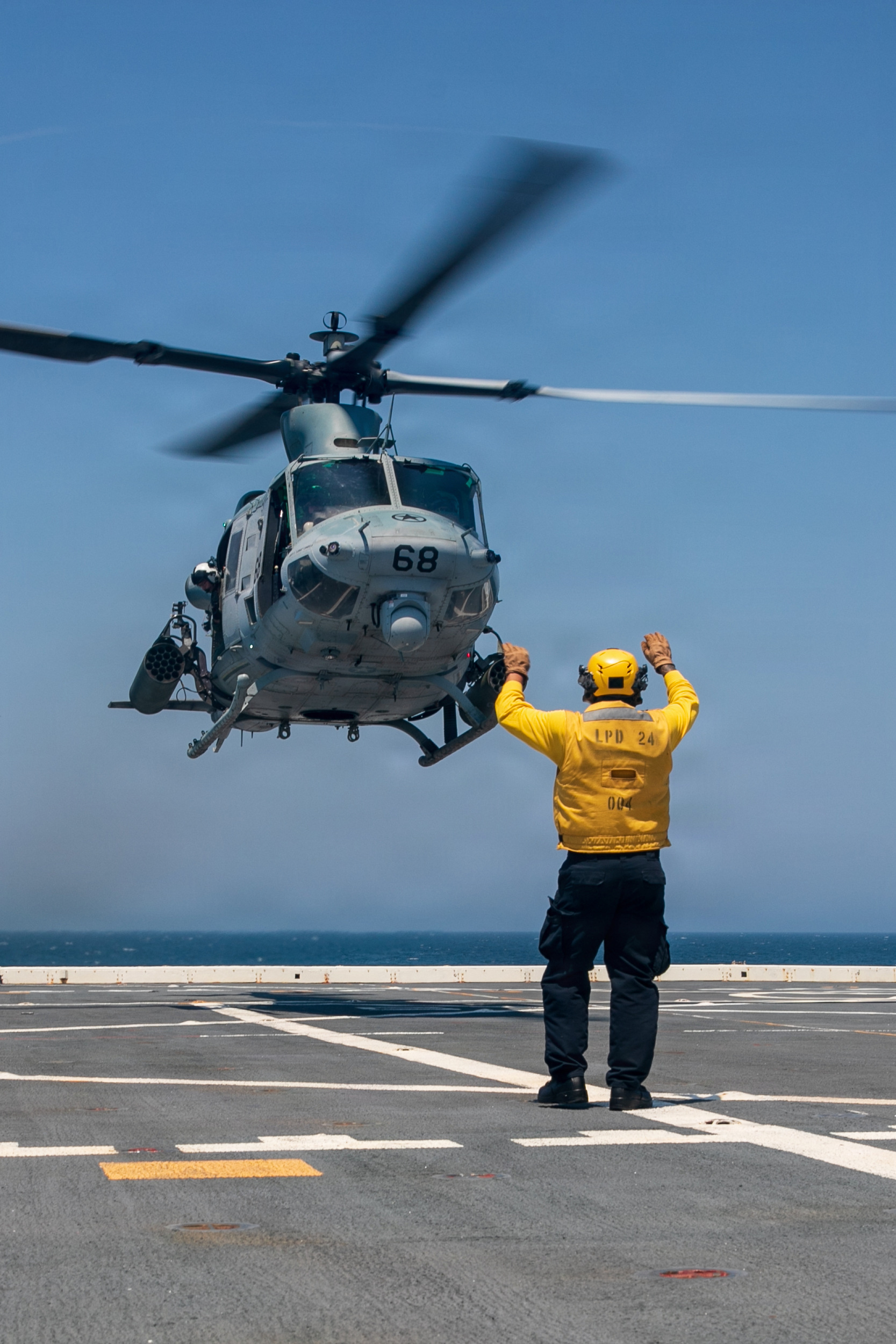
Sailors signal to a CH-53K King Stallion helicopter, assigned to Marine Heavy Helicopter Squadron (HMH) 461, during flight operations aboard San Antonio-class amphibious transport dock ship USS Arlington (LPD 24) June 11, 2026.
Arlington is underway conducting Type Commander’s Amphibious Training, a military exercise designed to enhance mobility and integration between the U.S. Marine Corps and the U.S. Navy.
The amphibious force is an integrated powerhouse providing sea, land, and air operations, giving geographic combatant commanders a more flexible, agile force for aggregated or dis-aggregated operations across the globe.
06.11.2026
USS Arlington (LPD 24)
Now let us put our imagination’s to work and generate a creative narrative putting is on deck.
The Atlantic was a hard blue line around USS Arlington, a horizon so clean it looked drawn with a ruler. Midday sun hammered the non‑skid of the flight deck until the gray surface shimmered, but the sailors in yellow, green, blue, red, and white spread across it treated the heat as just another condition to manage. To them, the ship was not just steel and systems; it was a stage, and today’s performance was amphibious integration. Marines and sailors testing how quickly they could assemble combat power from sea and sky.
The Boatswain’s Mate Second Class Reyes rolled his shoulders under his yellow float coat and checked the reflective tape across his chest out of habit, not vanity. The tape caught the sun as he lifted his arms out to his sides, palms down, signaling the AH‑1Z Viper off his port beam to slide left and hold clear of the deck edge. The gunship’s rotor wash beat against him in hot, rhythmic pulses, tugging at his cranial and float coat. The pilot, visor down, watched the Boatswain’s Mate’s hands as closely as any instrument panelon this small patch of ocean, the yellow shirts were law.
The Viper hung there, nose dipping slightly, tail stinger shivering over the water. Reyes felt, more than heard, the subtle change in pitch as the pilot adjusted collective. Behind his goggles, his eyes were already skipping ahead: once this bird cleared, the next inbound would be the big one, the CH‑53K King Stallion from HMH‑461. The King Stallion was new enough that some of the old salts forward still called it “that space‑age bird,” but on Arlington’s deck today it was just another player in the choreography.
Within minutes, the deep thrum of the CH‑53K rolled across the ship like distant thunder. Reyes pivoted, scanning for the green jerseys of the aircraft handlers and the blues of the chock and chain crew. They were already moving into position, boots clanking, chains slung across their shoulders, bodies angled low against the growing rotor wash. The King Stallion’s massive rotors blurred into a disk as it approached, nose slightly high, stabilizing over the landing spot marked with white geometric lines that only flight deck crews truly understood.
“LPD Two‑Four, signal in sight,” the crew chief called over the internal comms as he looked down through the CH‑53K’s side window at Reyes’ raised hands. Reyes brought his arms up, palms facing each other, framing the enormous helicopter between them. The pilot translated the gestures into movement: easing down, down, the gear searching for the deck. The ship’s own slow roll complicating everything by a few degrees. To the untrained eye, it was chaos, steel pitching, rotors beating, men and women scattered across the deck, but Reyes knew it was closer to a symphony.
The King Stallion’s wheels kissed the non‑skid with a muted thud. Instantly, the chains came alive. Green and blue jerseys surged forward, arms up to show they carried the heaviest lengths of steel, then knelt as one to capture the aircraft to the deck. The pilot kept the rotors engaged, blades still scything the air, while the crew chief checked his instruments and waited for the all‑clear from below. Reyes dropped his arms, pivoted out of the rotor arc, and raised one fist. the signal that the bird was chocked and chained, secure against anything the Atlantic might throw at it.
At the aft edge of the deck, a different vignette played out. A line of sailors, in greens, whites, reds, and yellows, stood along a red‑painted seam in the deck, watching the tail of an MV‑22B Osprey. The Osprey’s rotors were still, but its bulk loomed over them like a promise of future lift. Today, though, it served as a backdrop for instruction. The air boss’s representative, a senior chief in a green jersey, walked the line, pointing out safe lanes of movement, blast zones, and the invisible lines in the deck’s paint that marked danger from air intakes and exhausts. Integration was not just in the exercise name; it was embedded in every safety brief, every repeated phrase about “no lone rangers on the flight deck.
Another evolution spun up. The UH‑1Y Venom angled in from starboard, nose canted slightly as the pilot held hover over the deck edge. A yellow shirt, LPD 24 stitched in black across his back, raised his arms, palms high, eyes locked on the Venom’s cockpit. This was a passenger transfer drill, the type that looked routine on paper but, in contested waters, could mean the difference between life and death for Marines moving from sea base to shore. The Venom’s landing skids floated inches above the deck before settling as the signalman drove the pilot down with precise, economical gestures.
Once the smaller helicopter was secured and moved off the spot, the deck boss called for the next major movement. The King Stallion’s side door rolled open, and Marines began to spill out, camouflage utilities, rucksacks cinched tight, helmets strapped, eyes narrowed against the wind. They formed an immediate column, packs dragging at their shoulders as they stepped away from the helicopter and followed the path marked by yellow‑shirted guides. The rotor wash pushed against them, but their faces were lit with that curious mix of focus and anticipation that comes when training edges close to the reality it’s meant to prepare you for.
For Captain Malik, the Marine company commander, this shipboard interlude was both familiar and new. He’d flown on older CH‑53 variants, helicopters that had carried generations of Marines from ships to hostile shores. The King Stallion behind him had more power, more lift, and more digital control than those veterans, yet its purpose remained exactly the same: deliver Marines, their gear, and their will to fight, wherever a joint force commander needed them. Malik glanced back once, watching the sailors swarm around the helicopter to begin the next cycle of refueling and inspection, then turned his attention inward. He needed to get his people inside, briefed, and ready for the next lift.
On the starboard side, near the deck tractor, two yellow‑shirted sailors braced themselves as another CH‑53K clawed into the sky, the aircraft’s shadow sliding across them and the white lines of the deck. One sailor instinctively raised a hand to his cranial, the rotor wash tugging at the helmet’s strap, while the other steadied him with a hand on the shoulder. In the noise and apparent disorder, that simple touch spoke volumes about the culture of the amphibious force: you never stood alone in the blast and roar; someone always had a hand on you, literally or figuratively.
Over the course of the afternoon, the deck transformed from relatively empty gray to a constantly shifting mosaic of metal and motion. Vipers and Venoms cycled through gun runs and approach patterns, each landing and takeoff another data point in the Type Commander’s Amphibious Training calculus: launch rates, recovery times, deck cycle efficiency. The King Stallions moved Marines and cargo in practiced waves, bosses measuring how quickly the ship could surge combat power forward or redistribute it when missions changed.
But numbers were only part of the story. Integration lived in the shared language of hand signals, colored jerseys, and mutual trust between aviators, deck sailors, and embarked Marines. When Reyes brought his arms up to signal the last King Stallion in for the day, he felt, as he always did, that he was not merely guiding an airframe. He was guiding an idea: that from a single deck on a rolling ocean, an entire combined‑arms team could be assembled, moved, and projected outward at need.260/
The final CH‑53K settled, chains flashed, rotors wound down from blur to discrete blades, and an almost eerie hush fell over the flight deck. Sailors in every colored jersey stepped back behind foul lines or turned toward the ladders that would take them down into the ship’s quieter spaces. Marines hoisted packs and disappeared through hatches toward ready rooms and planning spaces. The Atlantic kept pacing outside, indifferent to the day’s achievements.
Reyes paused at the deck edge, eyes tracking the fading white wake that trailed behind Arlington. He knew that somewhere in the ships’ command spaces, officers were already turning the day’s movements into metrics, writing reports about readiness and integration. That was necessary, the language of budgets and future decisions. But for him, the proof lived in small things: in the way the King Stallion’s crew chief had given him a thumbs‑up through the window; in the steady line of Marines walking off the deck without a single misstep into danger zones; in the simple, practiced confidence with which his fellow sailors handled chains, tractors, and signals in the midst of organized chaos.
Tomorrow, the flight deck would host another set of evolutions, perhaps night operations, perhaps mixed serials with MV‑22s joining the pattern, but the essence would be the same. A gray deck in the middle of blue water, rotating blades carving the air, colored jerseys threading between steel and wind, all in service of a central fact: the amphibious force, when integrated and trained, is a flexible, agile powerhouse for commanders across the globe. And on days like this, under a hard Atlantic sun, that fact was not just an abstraction in a briefing slide. It was written in rotor wash, sweat, and the quiet satisfaction of sailors and Marines who had made the symphony play on time.