By Robbin Laird
A series of photographs taken on April 6, 2026 in the early weeks of Weapons and Tactics Instructor Course 2-26 documents an Osprey assault support tactics evolution in the desert near Yuma, Arizona. Taken together, the images tell a complete operational story: departure from the flight line, low-level formation flight, arrival at an expeditionary desert site, planning and debrief under the aircraft’s wings, and then the night phase, with the flight line and the terrain below visible only through the circular aperture of a night vision device.
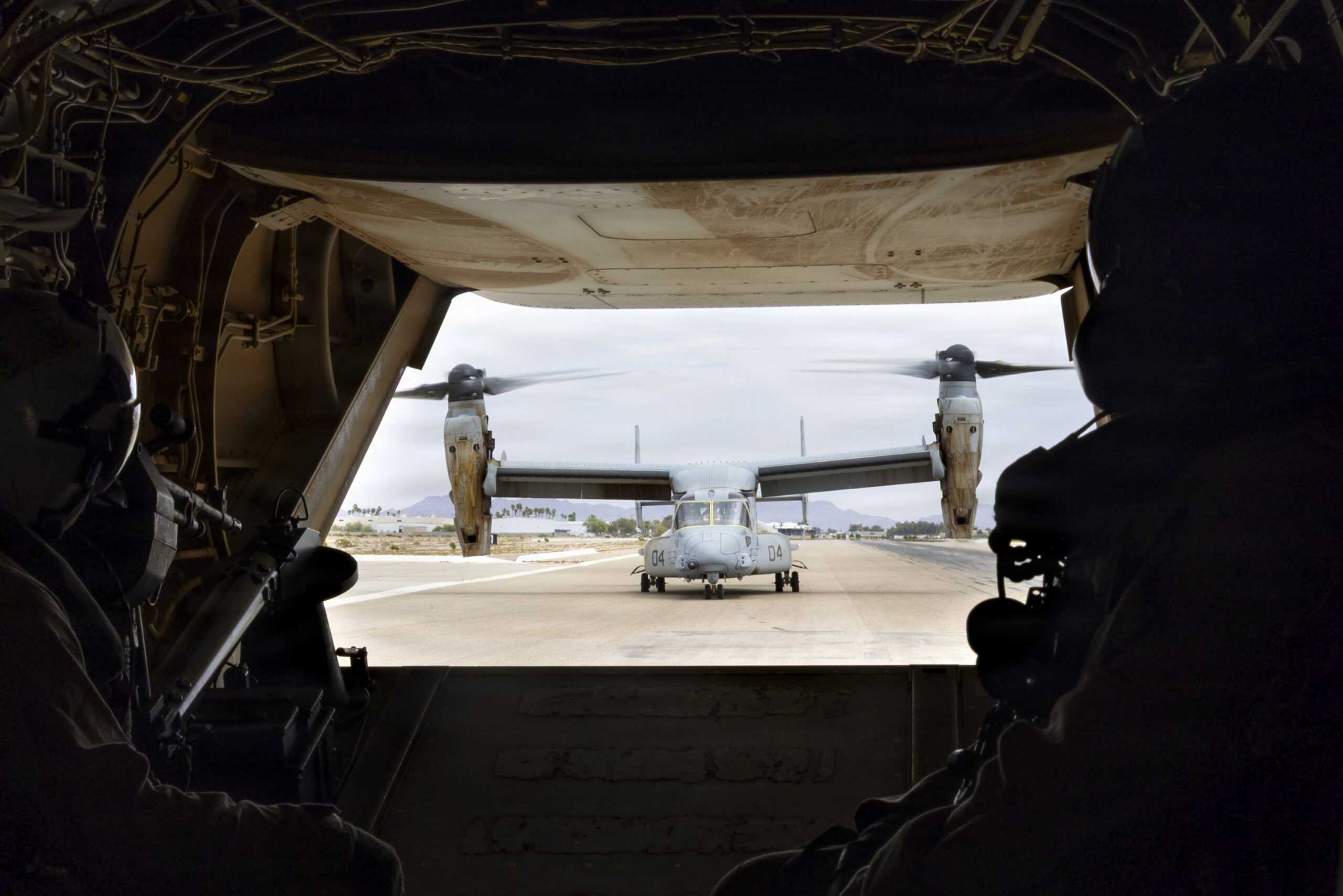
The opening image is shot from inside the ramp of one MV-22B looking out at a second aircraft — aircraft 04 — on the taxiway behind, nacelles tilted in helicopter mode, ready to lift. Two crew chiefs flank the ramp opening, weapons ready, scanning. The composition captures the inherent discipline of a multi-ship departure: each aircraft in sequence, each crew oriented outward, the whole package coordinated before the first aircraft lifts.
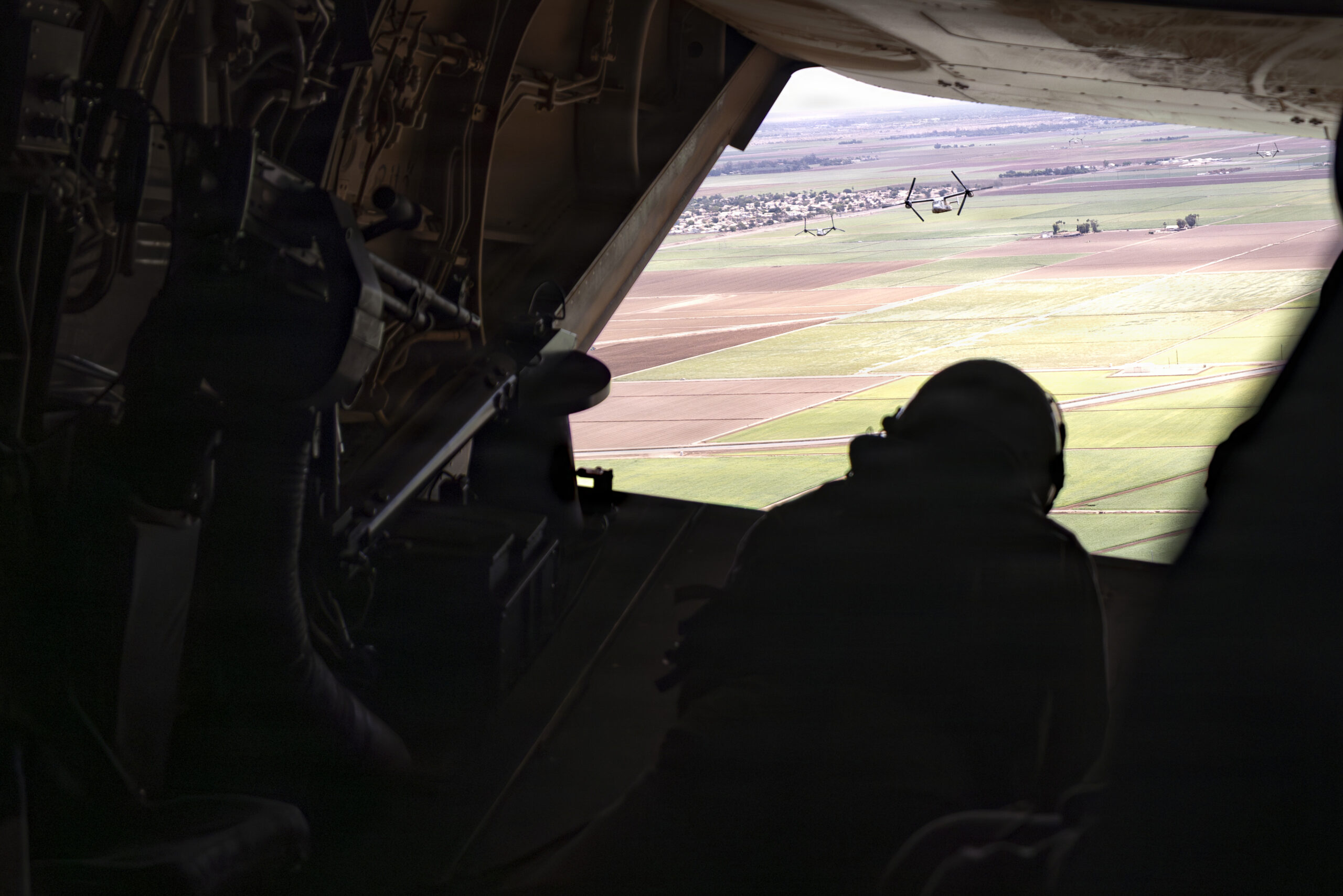
The follow-on image shows the transit phase from inside the cabin: a crew chief silhouetted against the open ramp window, watching a second Osprey flying low across irrigated agricultural fields. The aircraft are in close formation, low and fast, over terrain that reads as the Yuma Valley corridor, flat, green-patched farmland against the broader desert. Formation flight at low altitude under tactical conditions is one of the core competencies being evaluated and refined in the early assault support tactics evolutions of WTI.
The Expeditionary Site: Planning, Power, and the JTAC Integration
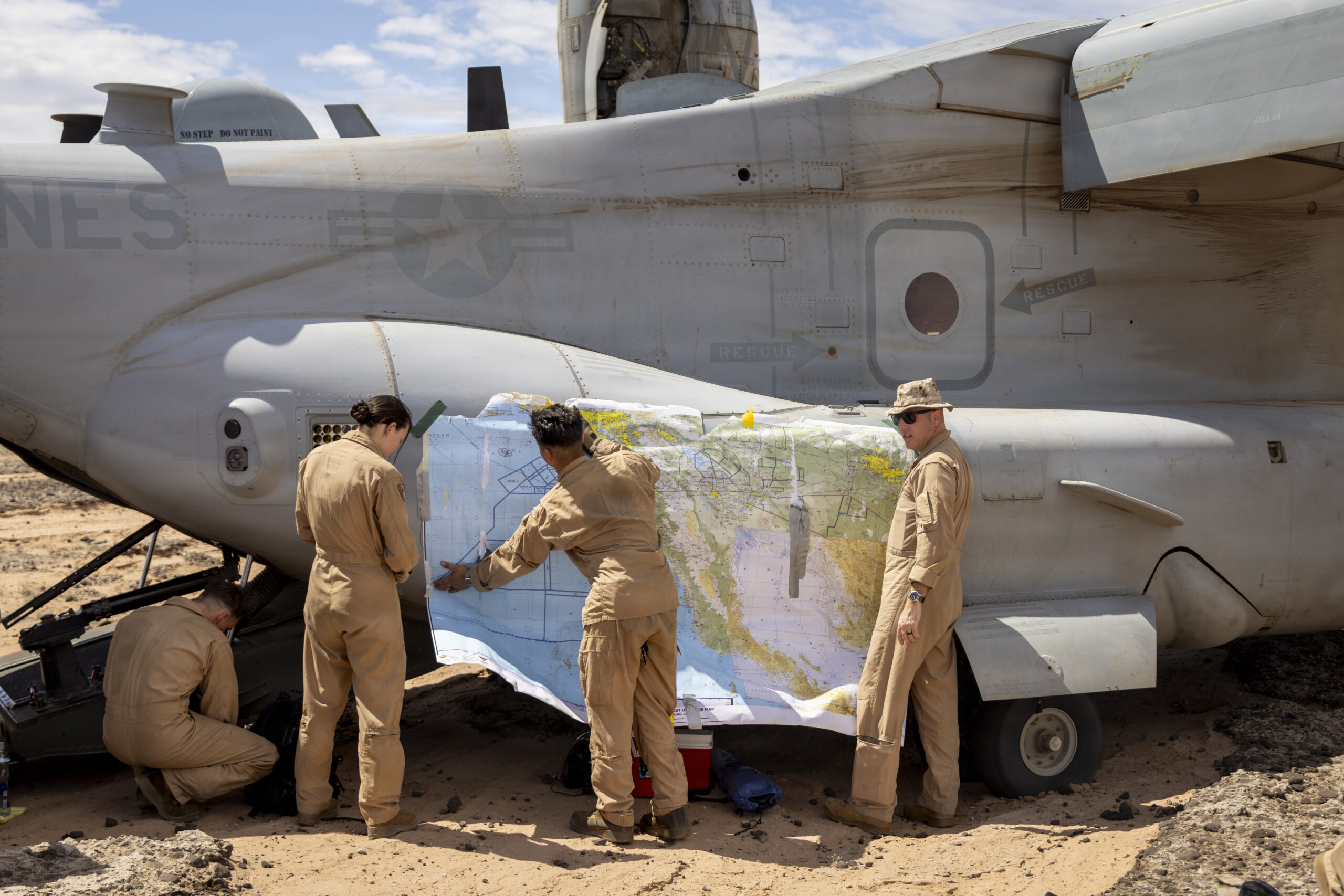
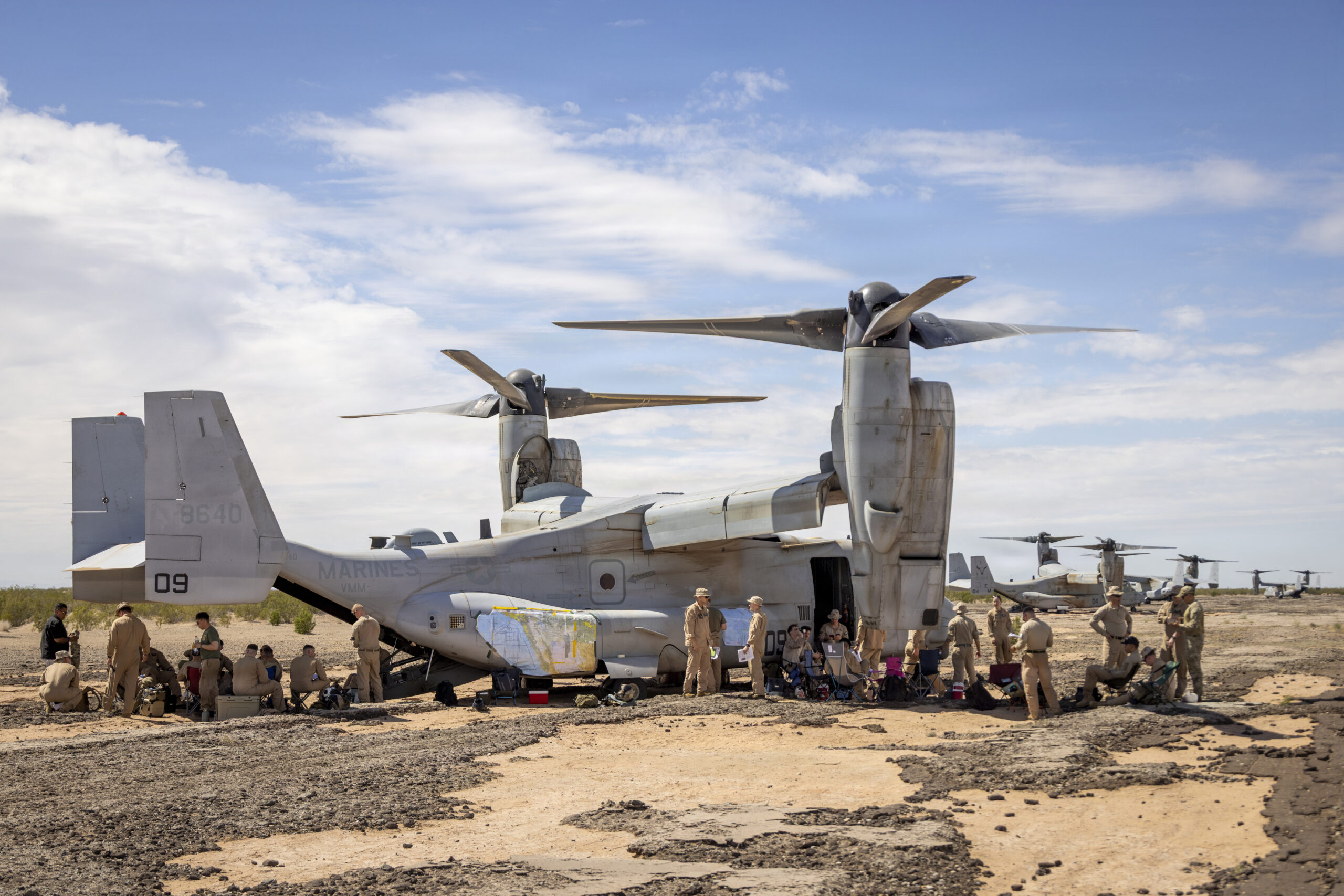
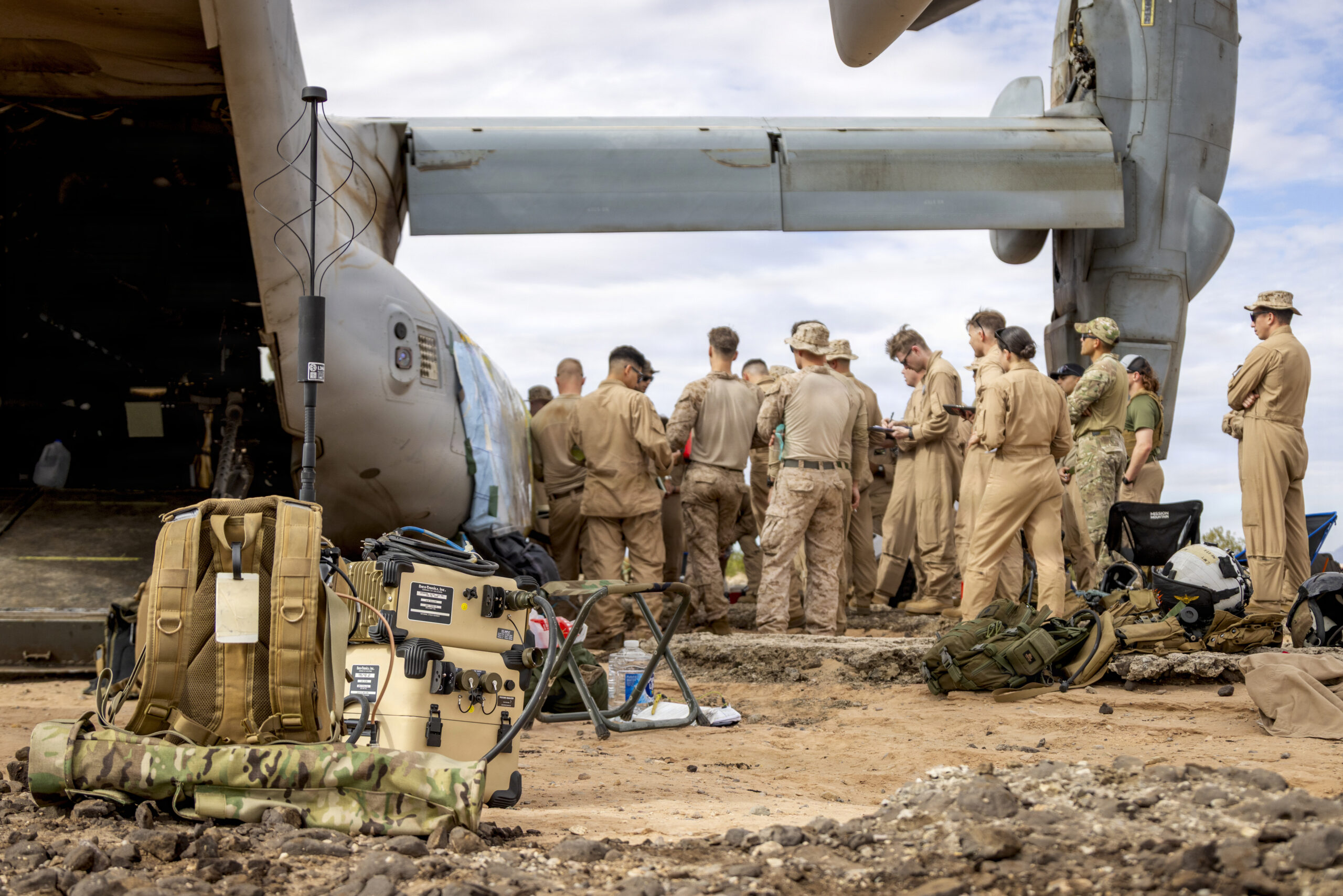
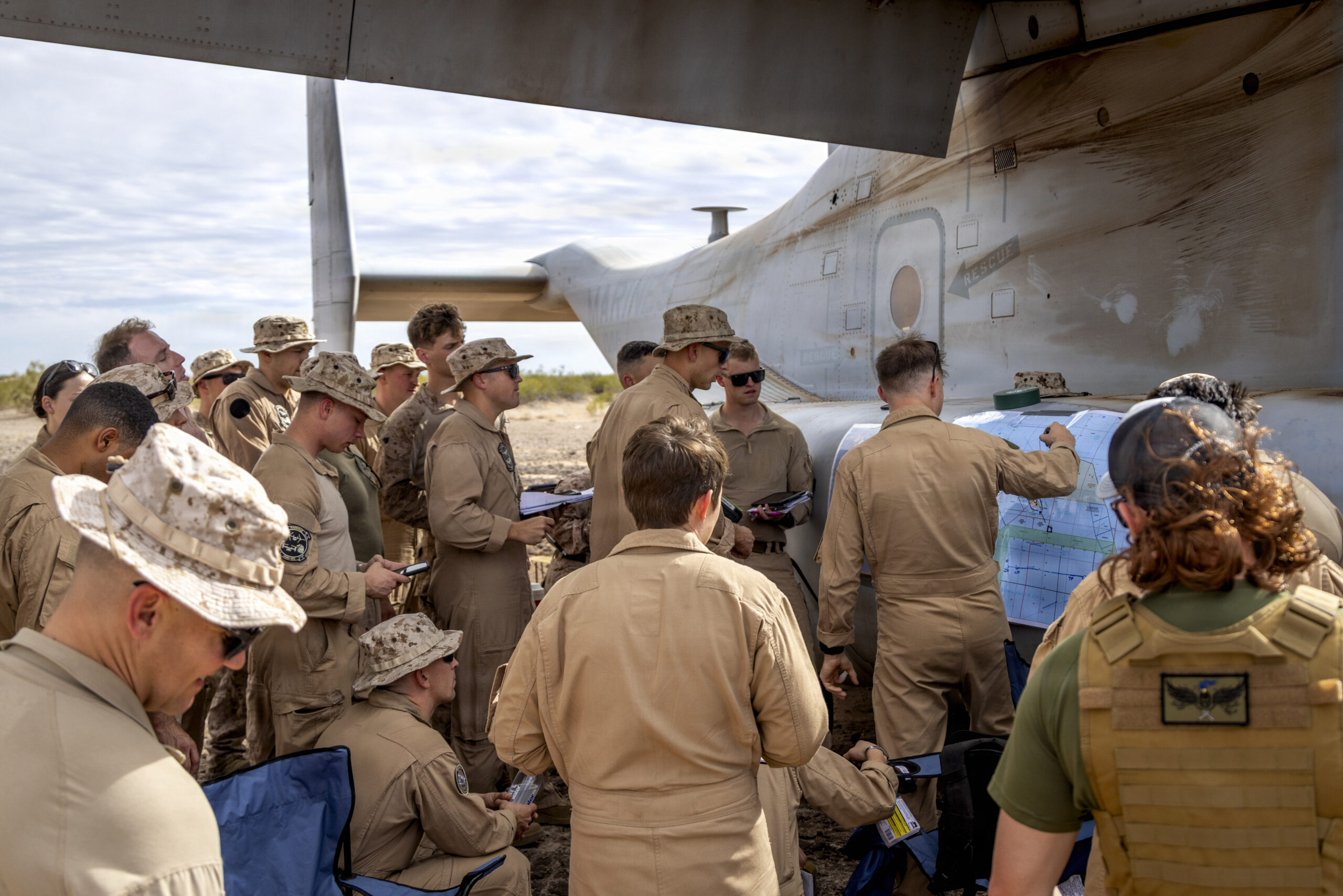
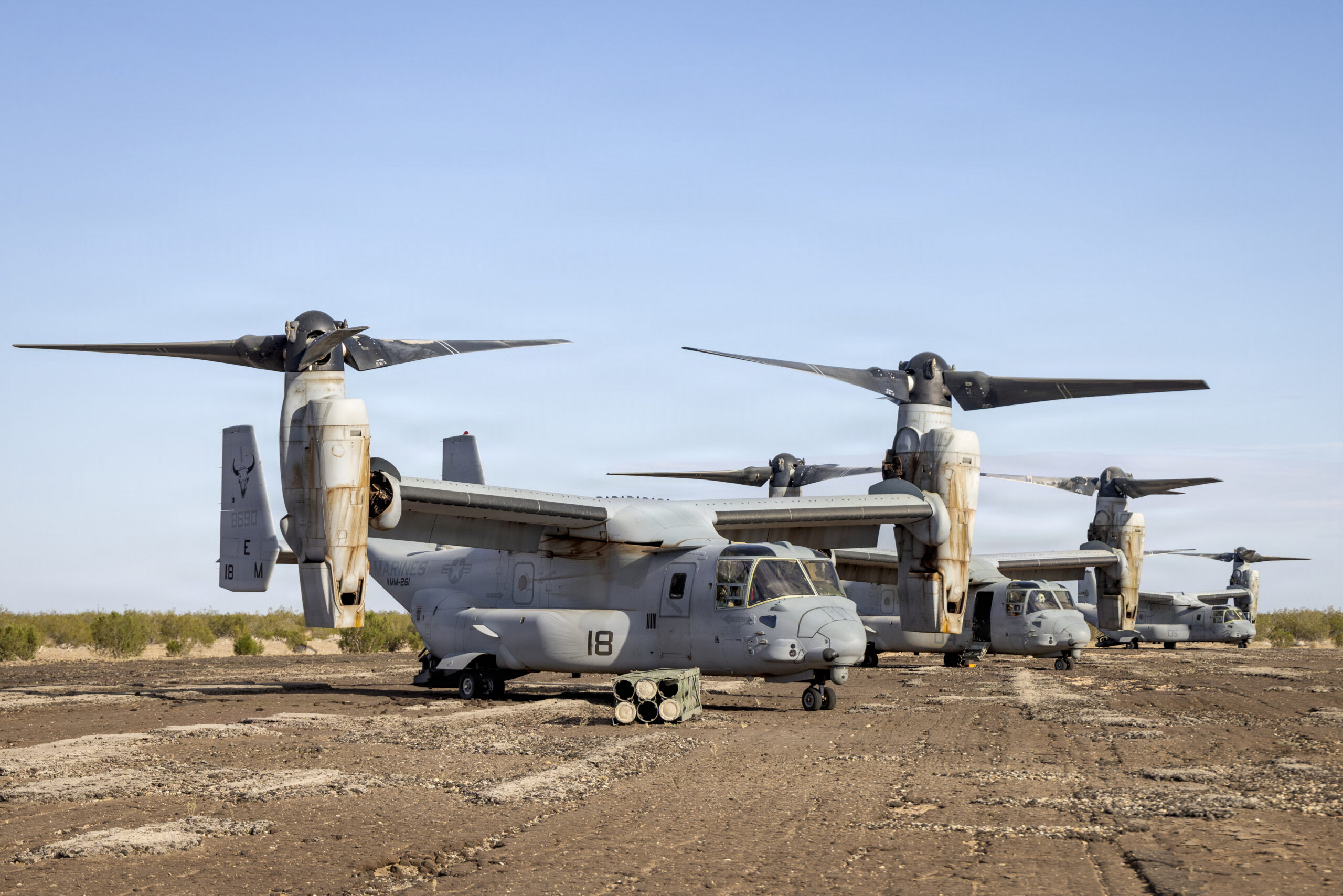
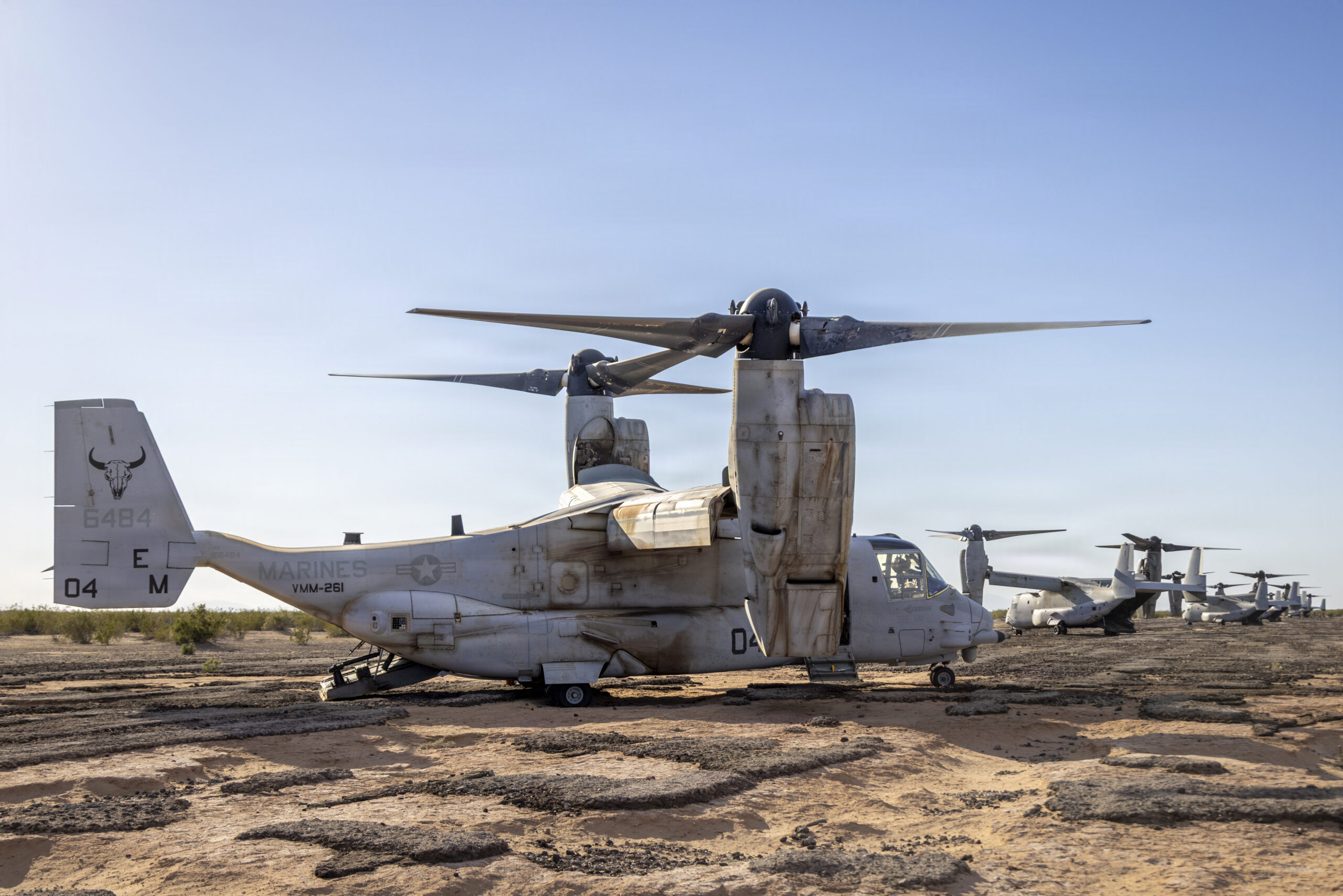
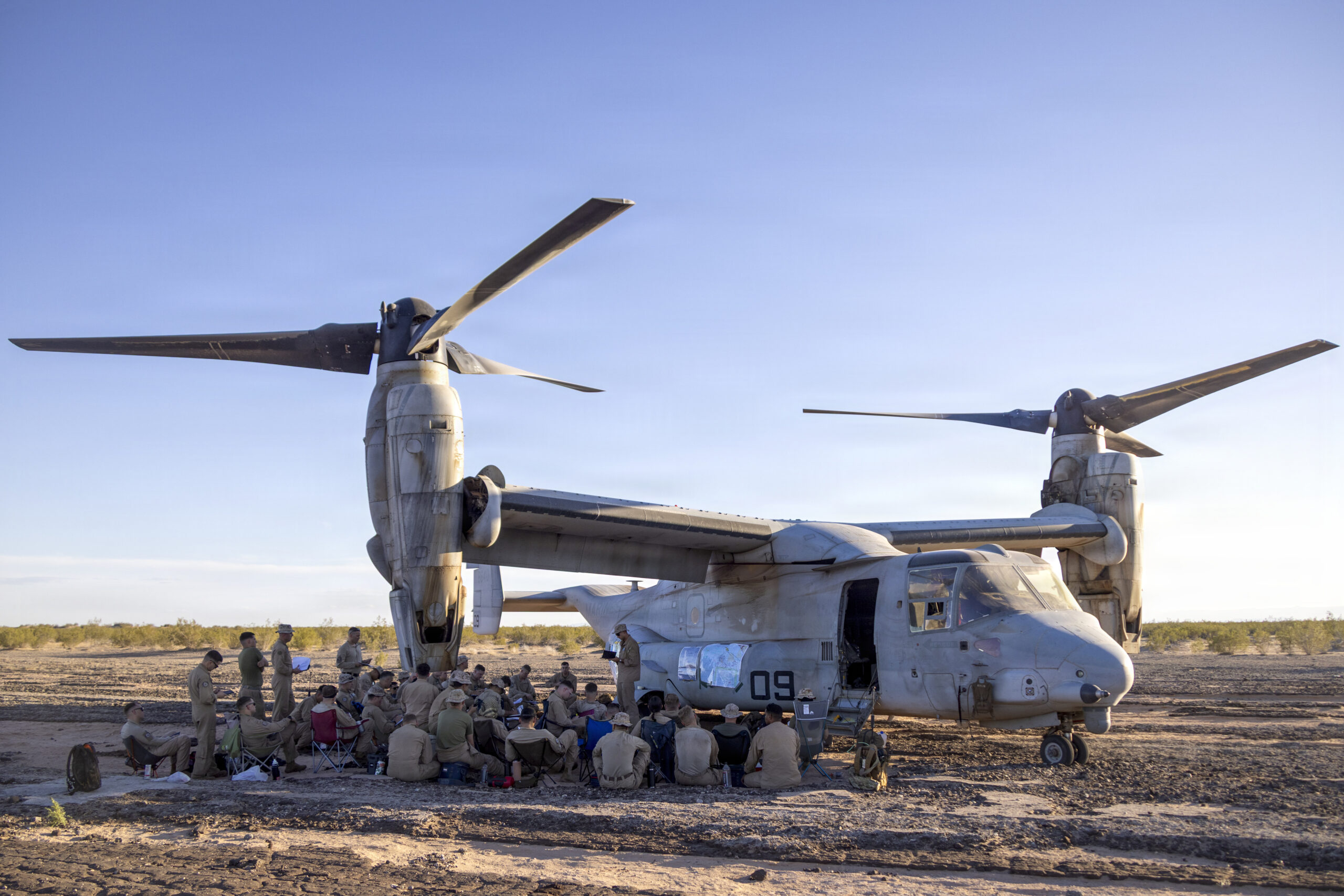
The photographs from the desert landing site are the analytical center of this set. Multiple MV-22Bs are down at what is clearly an unimproved expeditionary location, no paved surface, no fixed infrastructure, loose volcanic rock and sand underfoot. Aircraft 09 serves as the hub around which planning unfolds: in one image, roughly thirty personnel are gathered in a semicircle beneath the aircraft’s wing while an instructor briefs at the map; in another, a smaller group of four works through a chart spread against the fuselage while a fourth crewman crouches at a ground power unit.
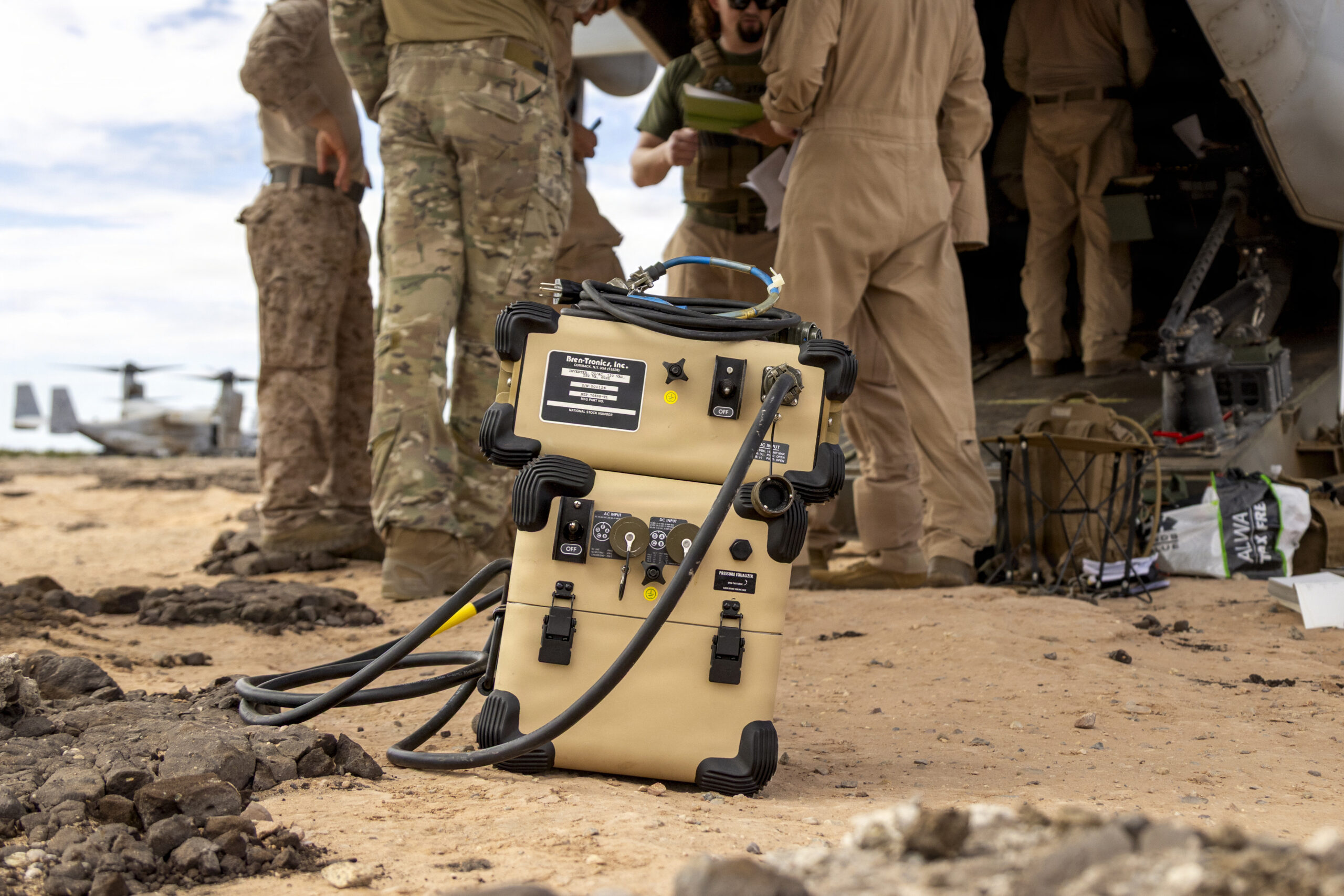
The Bren-Tronics battery charger units visible in two photographs are worth noting specifically. They represent the forward power infrastructure that makes expeditionary operations at unimproved sites viable, the ability to charge and sustain communications, navigation, and sensor equipment without fixed facilities. In a distributed operations context, the ability to sustain electronic capability at austere sites is as operationally important as the aircraft itself. These are not incidental details in the photographs; they are evidence that the logistics tail of the kill web has to be practiced as deliberately as the flight tactics.
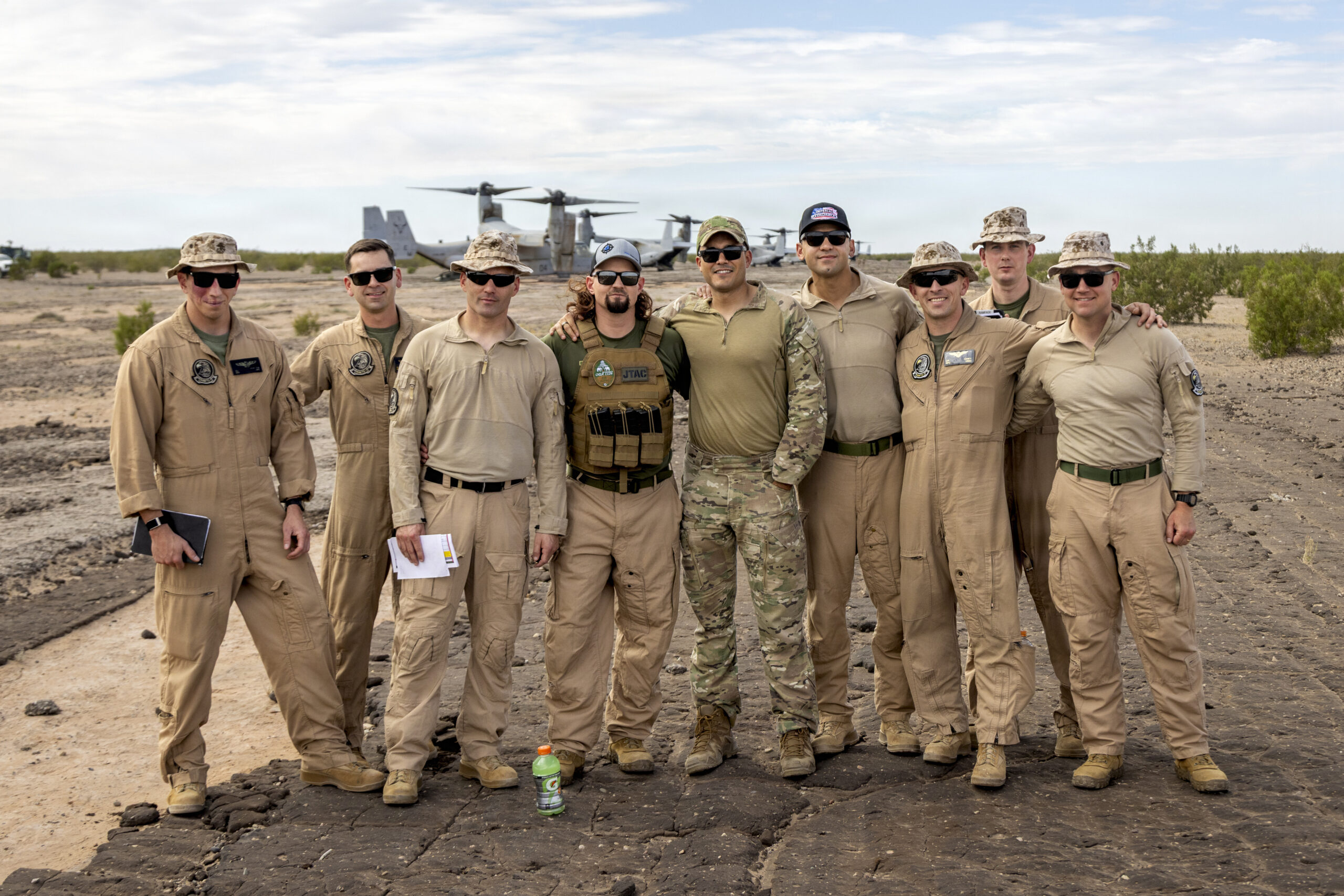
The group photograph — nine personnel standing together with Ospreys on the ground behind them — is notable for what it reveals about the joint integration at WTI 2-26. Two individuals are clearly not in Marine flight suits: one in Army-pattern multicam with a JTAC vest, another in a civilian-style kit alongside. This is consistent with WTI’s deliberately joint and interagency character. The prospective WTI must be able to plan and execute missions that integrate Air Force and Army terminal attack controllers, Special Operations Forces, and in some evolutions, interagency partners. The photograph captures that reality without narrating it.
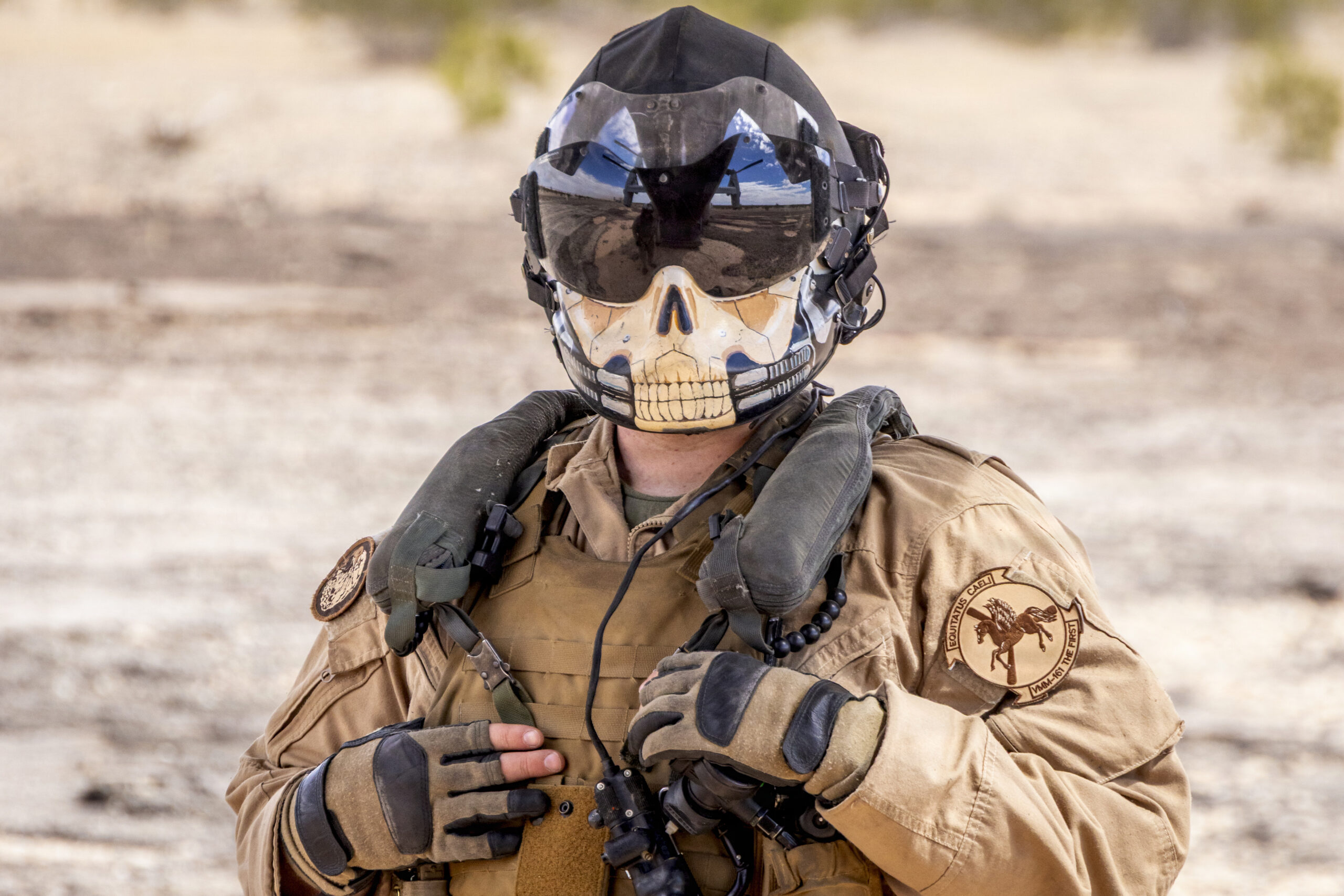
Image 3 shows a crew member in a skull-faced tactical mask, one of the MAWTS-1 cadre instructors who fly and evaluate the evolutions rather than merely observe them from a distance. MAWTS-1 instructors are embedded throughout the exercise, assessing every phase from planning through debrief. The skull mask and hardened tactical kit are characteristic of the cadre’s operational ethos: these are not classroom evaluators but experienced practitioners who fly the same profiles they are grading.
The Debrief: Learning Inside the Aircraft
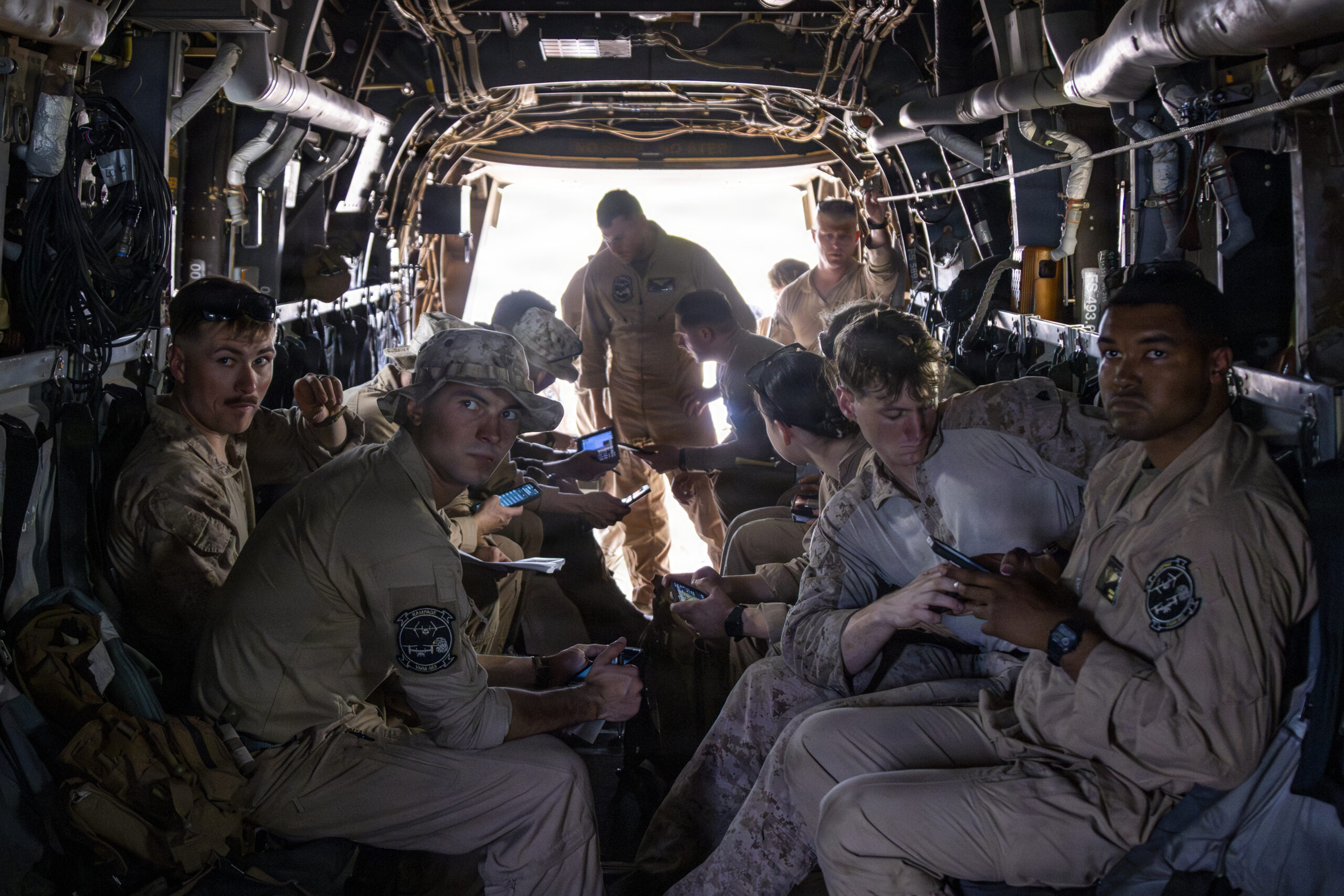
One of the most analytically significant photographs in the set shows the interior of an MV-22B cabin filled with WTI students during what is clearly an in-field debrief. Personnel are seated facing forward and backward along the cabin sides, most holding tablets or small notebooks, some comparing notes with the person beside them. A crew chief stands at the ramp, managing the space. The cabin is lit by natural light through the open ramp.
This photograph captures something important about how WTI actually works. The debrief is not deferred to a classroom back at the airfield — it happens at the site, in the aircraft, immediately after the evolution while the details are fresh. Students cross-reference their notes against what they observed, instructors walk through decision points, and the lessons are captured before the tactical picture fades. This is the WTI pedagogical method made visible: learning is embedded in the operational environment, not separated from it.
The Night Phase: Owning the Dark
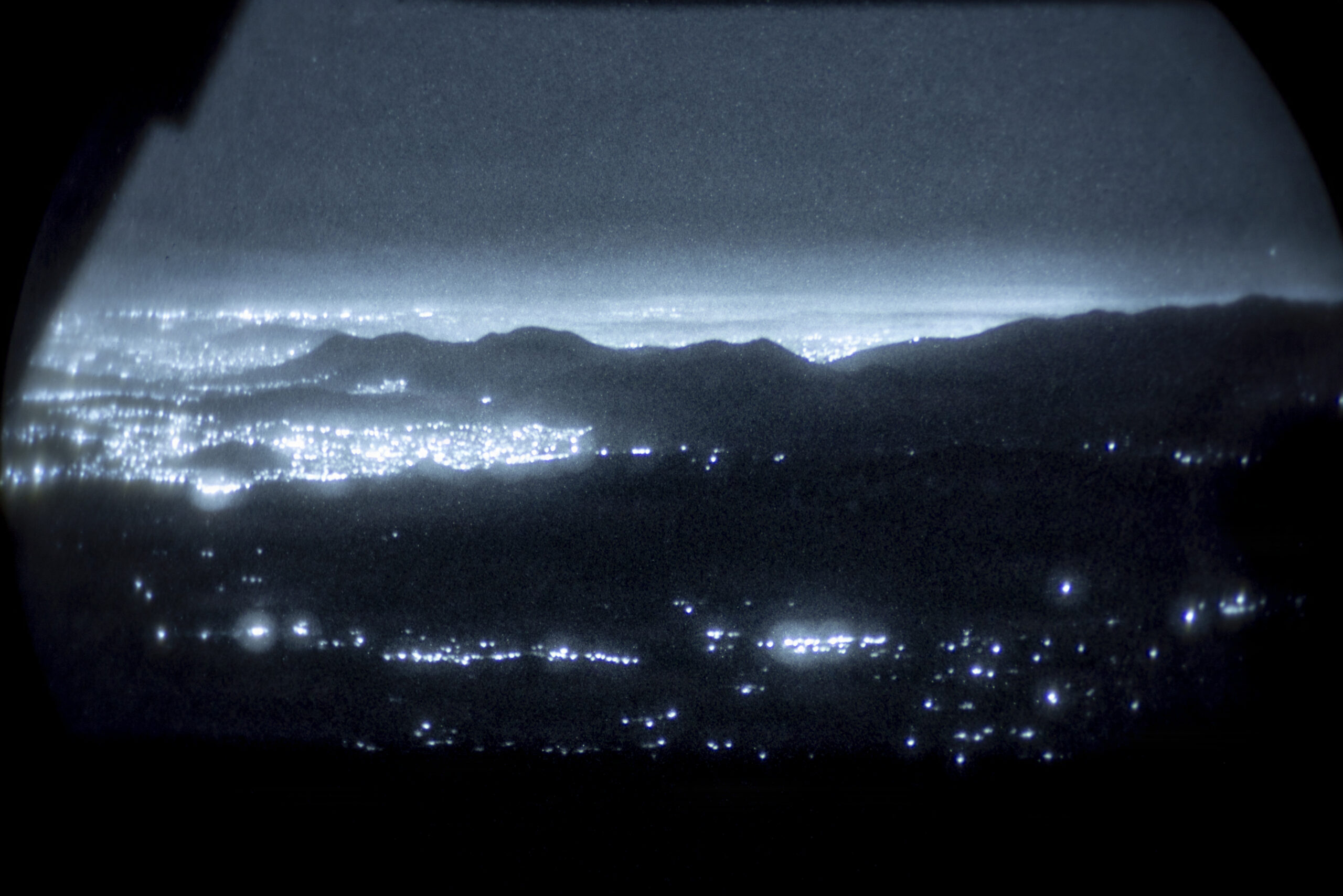
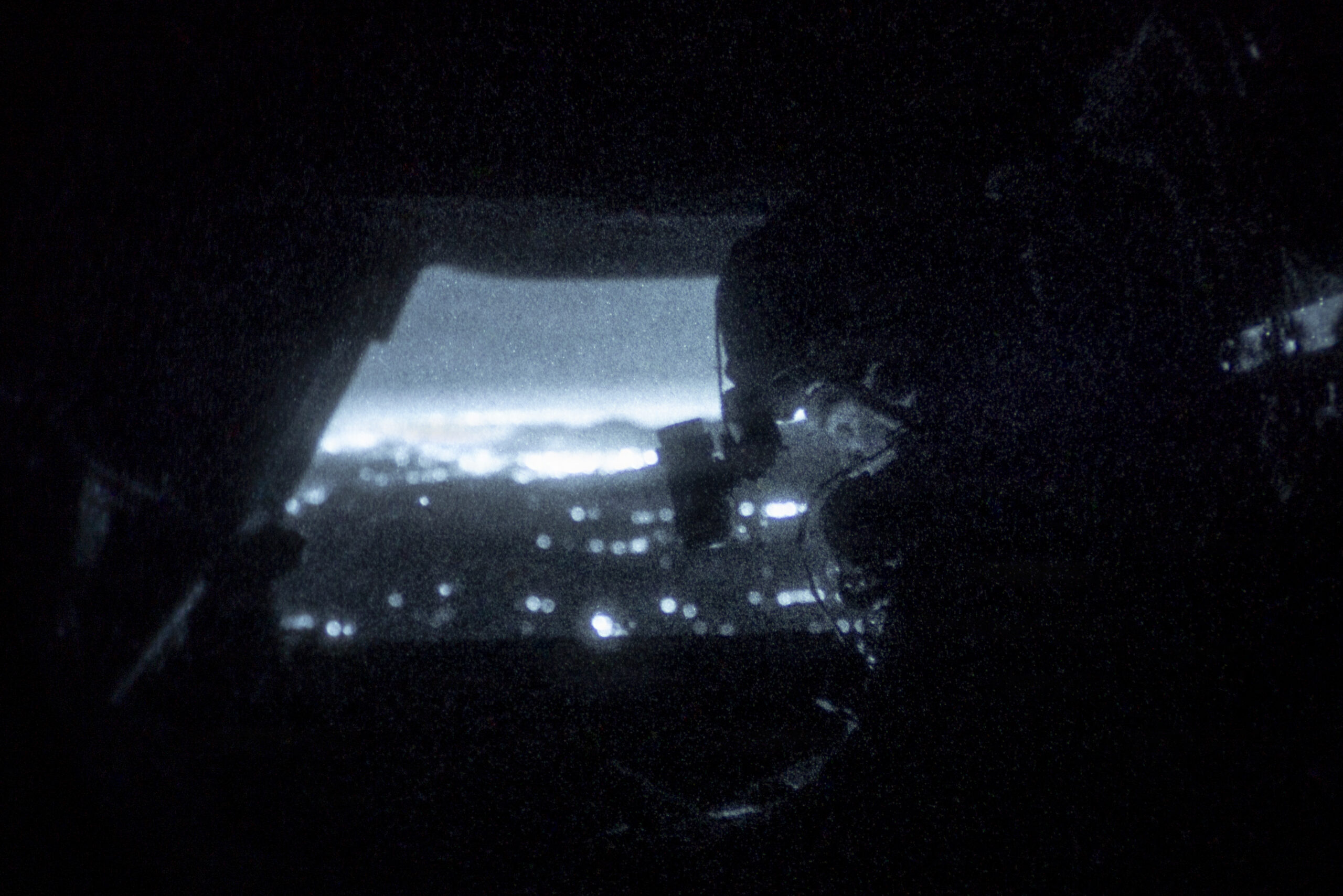
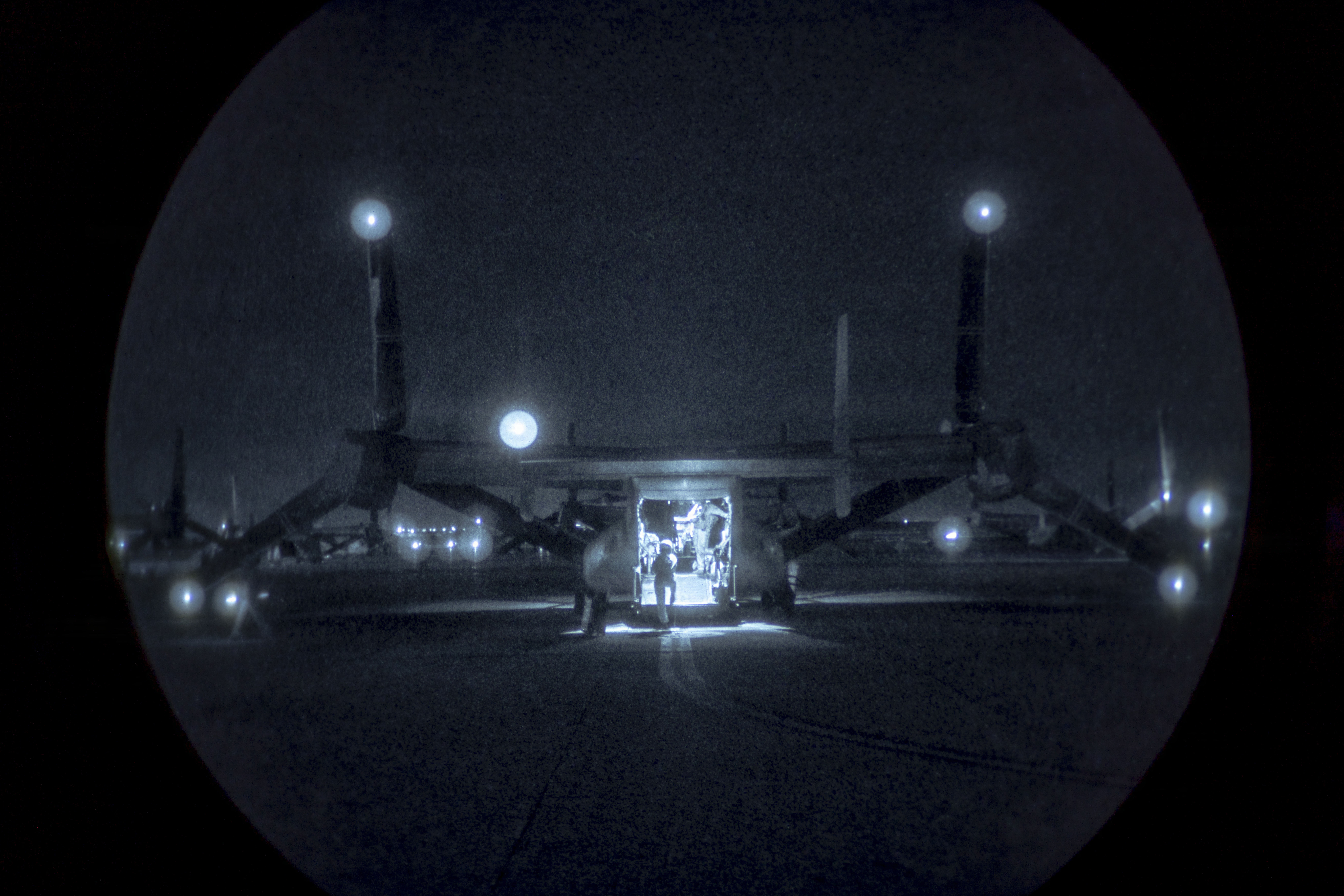
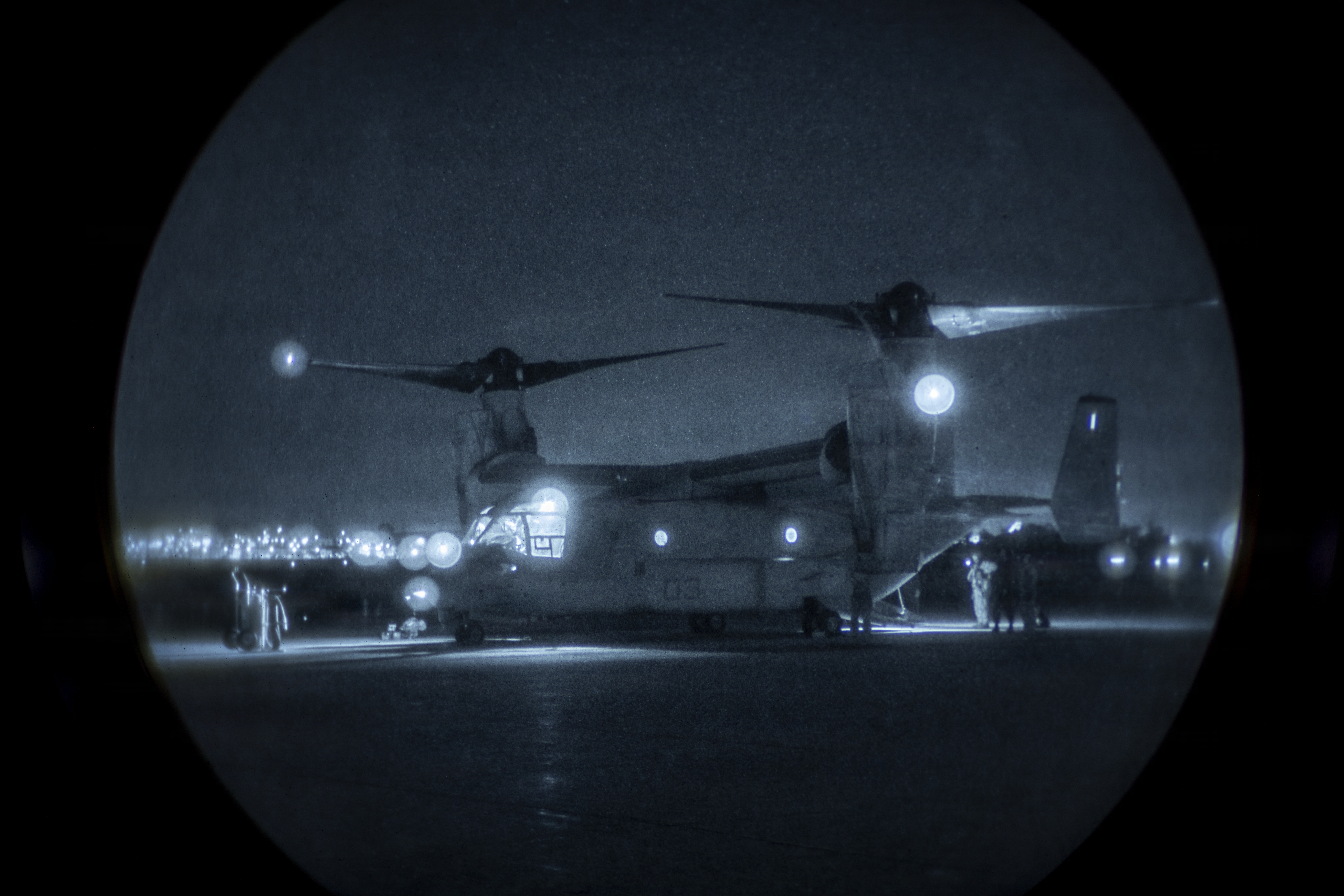
The final four photographs shift to a completely different register. The night images, all captured through NVG optics, framed in the characteristic circular field of a monocular or binocular device, show the flight line and the terrain below from an entirely different perspective.
Image 14 shows a city viewed from altitude through the NVG aperture, a constellation of lights spread across a valley floor and climbing into the mountains beyond. The aircraft is at altitude, the crew navigating by the same NVG system that turns this luminous landscape into a navigable terrain picture. Image 15 shows a crew chief at the cabin window, NVG-equipped, scanning outward against the same lit landscape below.
Images 16 and 17 are the flight line itself seen through NVGs: multiple Ospreys on the ramp at night, ramp doors open, ground crews working in the sodium-vapor pool of light that bleeds through the NVG field as overlapping halos. A lone figure stands at the base of the open ramp in Image 16, framed by the rectangle of interior light behind him, the two aircraft on either side, and the dark airfield stretching away. It is one of the most arresting images in the set: the human scale of a single Marine against the full operational weight of what surrounds him.
The night photographs close the loop that the day photographs opened. The MV-22B’s operational value is not bounded by daylight. Its speed and range make it effective around the clock, and WTI explicitly trains and certifies that full-spectrum capability. The student who plans and executes a desert landing zone evolution in the morning is flying over lit cities at altitude and preparing for a night insertion by the same evening. That is the WTI tempo, and it is also the tempo that combat will demand.
What This Set of Photographs Tells Us
Taken as a whole, this set of seventeen photographs from April 6, 2026 documents something that is rarely captured in a single coherent sequence: the full operational cycle of an MV-22B assault support tactics evolution, from flight line departure through in-field planning and debrief to night operations.
Several things stand out analytically.
- First, the joint integration is not add-on: the JTAC is embedded in the planning and debrief, not a separate element that shows up at a designated coordination point.
- Second, the expeditionary logistics, the power infrastructure, the austere site, the in-field sustainment — are treated as part of the tactics problem, not as a support function handled elsewhere.
- Third, the debrief is conducted at the site and in the aircraft, which embeds learning in the operational environment rather than abstracting it into a classroom.
These are not small points. In a distributed operations environment, the kind the Marine Corps is explicitly designing for across the Indo-Pacific, the ability to sustain joint-integrated, logistically austere, twenty-four-hour tiltrotor operations is a core capability requirement.
WTI 2-26, on a single day in early April in the Arizona desert, was rehearsing exactly that.