

By Robbin Laird
South Korea has spent the past four years converting itself from a net importer of weapons into one of the ten largest arms exporters on Earth, and it has done so with a speed that has unsettled established Western suppliers and delighted frontline states looking for equipment now rather than in five years.
But the more interesting story is not simply that Seoul sells tanks and howitzers well.
It is that South Korea is using its defense-industrial base as the connective tissue of a broader foreign policy project: an attempt to define itself as a middle power. Arms sales are the visible surface of a deeper strategy of industrial statecraft, hedging, and diplomatic diversification that Seoul is only now beginning to articulate as a coherent whole.
From Importer to Exporter, and What That Change Signals
For most of its postwar history, South Korea imported the weapons it needed to deter North Korea, relying overwhelmingly on the United States. That pattern has not disappeared for Washington remains Seoul’s primary source of high-end imports such as the F-35 but it has been supplemented by a second, outward-facing track.
By 2024 South Korea held roughly a 2.2 percent share of the global arms trade, placing it among the world’s top ten exporters, and its four largest defense manufacturers, Hanwha Aerospace, Hyundai Rotem, Korea Aerospace Industries, and LIG Nex1, posted combined revenues that grew more than 80 percent year over year heading into 2026, with analysts projecting the group would clear roughly $37 billion in 2026 alone. That is a fourfold increase over 2021 revenues in the space of five years.
This is not an accident of market timing.
It reflects a deliberate government decision, formalized over the past decade, to treat the defense industry as a pillar of the national economy on par with shipbuilding, semiconductors, and automobiles. Increased state defense spending up 8.2 percent in the 2026 budget to roughly $47.1 billion has been paired with export promotion, financing support, and a willingness to offer technology transfer and local production that most competitors are reluctant to match. The result is a Korean model of arms exporting built less on any single superior weapon system than on a package: competitive pricing, unusually fast delivery timelines, and a genuine offer of industrial partnership to the buyer.
Europe: Speed as a Strategic Asset
Nowhere is that model clearer than in Europe, where Russia’s invasion of Ukraine created urgent demand that established European and American suppliers could not fill quickly enough. Poland has been the pivot of this relationship. In 2022 a Polish delegation signed framework agreements worth billions for K2 Black Panther tanks, K9 Thunder self-propelled howitzers, and FA-50 light combat aircraft, at a moment when comparable Western contracts typically required three to five years of lead time that Warsaw did not have. By 2024 Poland alone accounted for roughly 46 percent of all South Korean defense exports, and Seoul has since become the second-largest supplier of arms to NATO’s European members, trailing only the United States and providing nearly half of Poland’s total imported weaponry.
The relationship has moved well beyond a simple buyer-seller transaction.
Warsaw has pursued what analysts describe as the “Polonization” of its defense sector, and roughly 146 of the K9 howitzers on order are being configured to Polish specifications as the K9-PL variant, produced with substantial local content. Hanwha Aerospace has extended the same logic into Romania, breaking ground in February 2026 on a production center, the Hanwha Armoured Centre of Excellence, built around a Romanian order for K9 and K10 vehicles, with a targeted localization rate of up to 80 percent involving more than thirty Romanian companies.
Similar arrangements have followed with the Baltic and Nordic states: Estonia has contracted for Chunmoo multiple rocket launchers with Hanwha committing to invest a fifth of the contract value in Estonian industry, Norway has signed roughly a billion-dollar Chunmoo deal that will also fund European maintenance infrastructure, and Finland has steadily expanded its K9 fleet since first receiving the system in 2017.
What Korean industry is selling into Europe, in other words, is not just hardware but a template for co-production that mirrors on a compressed timeline what European governments say they want from their own rearmament: speed, cost control, and local industrial participation. The tradeoff, as Polish officials have quietly acknowledged, is interoperability with legacy NATO systems, a friction that speed has so far outweighed.
The Trust Gap: From Exporter to Partner
Even so, Korean analysts and Western observers alike have begun to argue that rapid, transactional export success does not by itself make South Korea a trusted long-term defense partner of the trans-Atlantic alliance merely a very effective supplier.
A recent Carnegie Endowment assessment frames Korea’s European engagement as unfolding in phases: an initial phase of rapid delivery to frontline and Nordic states, now largely complete, followed by phases requiring much deeper defense investment inside Europe and collaboration on frontier technologies such as AI-enabled platforms. A Korean academic writing after visiting the Eurosatory exhibition outside Paris in June 2026 made a similar point more bluntly, arguing that Korean industry has to move past being a fast, low-cost supplier and instead build the kind of strategic trust, industrial partnership, and NATO-EU institutional ties that would put it in a genuinely different category from a purely commercial arms vendor.
That distinction matters for South Korea’s middle-power ambitions specifically because Brussels is actively debating whether Korean-made equipment assembled inside the European Union, in Poland or Romania, for instance, will qualify as “European” content for the purposes of EU defense-industrial incentives. How that question is resolved over 2025 and 2026 will shape whether Korean firms are treated as embedded members of Europe’s defense-industrial base or as convenient outsiders who can be squeezed out once European capacity catches up.
Seoul’s answer has been to lean further into co-location and joint ventures rather than pull back, betting that embedded manufacturing capacity is harder to displace than a shipping contract.
The same Korean commentary has connected this industrial question to a wider diplomatic one: the NATO framework that already links the alliance with its four Indo-Pacific partners, South Korea, Japan, Australia, and New Zealand, is, in this reading, a form of leverage
Seoul can use both to deepen European ties and to signal to Beijing and Moscow that its diplomatic autonomy rests on carefully built networks rather than on isolation.
That is precisely the language of middle-power statecraft: influence built through coalition membership and industrial entanglement rather than through size or a single alliance relationship alone.
The United States: Shipbuilding as the New Frontier
If Europe is where South Korea has demonstrated speed, the United States is where it is now attempting something structurally different: embedding itself inside the American defense-industrial base rather than simply exporting into it. The vehicle for this is MASGA “Make American Shipbuilding Great Again” a shipbuilding cooperation initiative that emerged out of the broader trade and investment negotiations between Seoul and the Trump administration. Under the arrangement, South Korea committed roughly $150 billion of a larger $350 billion investment package specifically to American shipbuilding: shipyard modernization, workforce training, joint research, and maintenance, repair, and overhaul work on U.S. Navy vessels.
The Korea-U.S. Shipbuilding Partnership Center opened in Washington in July 2026, accompanied by fifteen memoranda of understanding involving South Korea’s three major shipbuilders, HD Hyundai Heavy Industries, Samsung Heavy Industries, and Hanwha Ocean alongside American shipyards, universities, and research institutions. Michelle Steel, the newly confirmed U.S. ambassador to Seoul, described the effort as expanding the alliance into a genuinely new territory beyond its traditional security core.
South Korea’s Defense Acquisition Program Administration has said explicitly that it intends to use the initiative to help Korean firms enter U.S. naval shipbuilding and defense supply chains, not merely commercial ones, and the U.S. Navy has already issued requests for information touching destroyer-class surface combatants and fleet tankers, a signal that Washington is testing whether Korean yards, which have spent years quietly performing MRO work for the U.S. Navy, might eventually build or repair actual warships on Korean or American soil.
For a middle power, this is a distinctive way to manage dependence on a superpower ally.
Rather than simply consuming American security guarantees, Seoul is positioning its industrial capacity as something the United States itself now needs, particularly as American shipyards struggle to keep pace with naval modernization demands set against Chinese fleet expansion.
That reframes the alliance relationship, at least partially, from patron-and-client toward mutual industrial dependence, precisely the kind of leverage a middle power seeks when its formal security guarantees rest on a much larger partner.
Reaching Beyond the Traditional Axis: Brazil and the Middle-Power Network
The clearest evidence that Seoul is thinking beyond its traditional Washington-Brussels axis came in late July 2026, when President Lee Jae-myung traveled to Brasília for a state visit and summit with Brazilian President Luiz Inácio Lula da Silva. The two leaders declared 2026 the inaugural year of a Korea-Brazil strategic partnership and agreed to expand cooperation across critical minerals, energy, aerospace, semiconductors, and defense. Concretely, the two governments agreed to launch a joint defense industry committee in the second half of the year and to pursue a General Security of Military Information Agreement, the kind of framework instrument that typically precedes deeper defense-industrial collaboration rather than one-off sales.
The Brazil relationship illustrates a different register of South Korea’s middle-power strategy than either Europe or the United States. Brazil is not a NATO ally seeking fast delivery against an active threat, nor a superpower patron; it is a fellow middle power with its own claim to strategic autonomy, its own commodity leverage, Brazil supplies roughly nine-tenths of the world’s niobium, a mineral critical to the specialized steel alloys used in Korean shipbuilding — and its own history of resisting bloc alignment.
The two countries also agreed to revive stalled negotiations toward a trade agreement with Mercosur, the South American trading bloc anchored by Brazil, Argentina, Paraguay, and Uruguay, framing the defense and minerals cooperation as part of a broader economic-security relationship rather than an arms sale. Brazilian defense officials had already begun exploring Korean capability the previous autumn, sending a delegation from the Ministry of Defense to the Seoul International Aerospace and Defense Industry Exhibition to examine Korean unmanned systems, air-defense technology, and cybersecurity offerings.
This kind of outreach fits a pattern visible elsewhere in Seoul’s diplomacy.
Commentary from the East Asia Forum has described South Korea’s middle-power diplomacy as shifting from a prestige-oriented project tied to the liberal international order into a more pragmatic hedge against an unpredictable United States and an intensifying U.S.-China rivalry, a shift expressed through summit diplomacy well beyond Washington and Seoul’s immediate neighbors, including outreach to Italy, Ghana, Indonesia, France, and a planned inaugural Korea-Central Asia summit.
Analysts have also noted South Korea’s growing defense relationship with the Philippines, which has ordered additional FA-50 light combat aircraft and is reportedly weighing a KF-21 purchase, making Manila Korea’s most advanced defense partner among the ASEAN states. Taken together, these relationships describe a deliberate attempt to build a portfolio of partnerships with other capable, non-great-power states, Brazil, the Philippines, Poland, the Baltic and Nordic states, rather than betting everything on a single alliance relationship, however important that relationship remains.
The distinguishing feature of the Brazil relationship, compared with Europe, is that it is explicitly framed by both governments as a partnership between two middle powers navigating the same structural problem: how to preserve room for independent maneuver in a world increasingly organized around U.S.-China competition, without simply choosing a side.
That framing, a South American commodity power and an East Asian industrial and technology power finding common cause, is itself a middle-power signal, one that distinguishes Seoul’s version of hedging from a purely alliance-bound posture.
Australia: Deepening a Middle-Power Partnership Inside the Alliance Network
Australia represents a fourth track in Seoul’s middle-power strategy, and in some ways the most instructive one, because it is neither a NATO buyer scrambling to rearm after Ukraine, nor a superpower patron, nor a non-aligned partner reached from outside the bloc, as Brazil is. Australia is a fellow treaty ally of the United States and, alongside Japan and New Zealand, one of the four Indo-Pacific partners already folded into NATO’s own outreach network. The relationship with Seoul is therefore less a matter of building trust from a standing start than of deepening a partnership between two American allies that increasingly see China, rather than each other’s markets, as the reason to work together.
That deepening has been institutionalized for well over a decade.
A 2009 joint statement and a 2015 defense and security blueprint gave the relationship its early architecture, and biennial two-plus-two foreign and defense ministers’ meetings, the first of which in 2013 was South Korea’s inaugural such dialogue with any country besides the United States, have become a fixture even through periods of leadership turnover in both capitals.
The 2021 meeting, held as the two countries marked sixty years of diplomatic relations, explicitly named freedom, democracy, human rights, and the rule of law as shared values for the first time, an enunciation that past statements had left implicit, and folded in a new section on the two countries’ respective alliances with Washington, describing them as part of a broader network of alliances and partnerships rather than purely bilateral arrangements.
China was never named in that statement, but its shadow ran through sections on supply-chain diversification, vaccine cooperation, and energy security, areas where both governments had by then experienced their own version of Beijing’s economic coercion.
On land systems, Australia has already delivered Seoul’s most concrete middle-power win outside Europe. In December 2023 the Australian government awarded Hanwha Defence Australia a $2.4 billion contract for 129 Redback infantry fighting vehicles, the largest contract of its kind and, according to Hanwha Aerospace’s leadership, the first time a Korean defense firm has developed a solution specifically for the Australian Army. All 129 vehicles are being manufactured domestically at an expanded Hanwha Armoured Vehicle Centre of Excellence in Victoria, built on a facility first established to produce Huntsman AS9 self-propelled howitzers and AS10 resupply vehicles, with deliveries running from 2027 to 2028. The contract follows precisely the co-production template Hanwha has since exported to Poland and Romania: competitive pricing, a fast timeline, and local manufacturing content rather than a simple shipped order.
Not every Korean pitch has landed. In 2022 Hanwha and Korean officials mounted a determined campaign in Canberra to offer an advanced conventional submarine, built around Korea’s KSS-III design, with a promise of seven years from signature to delivery as a hedge against a possible capability gap between the retirement of Australia’s Collins-class boats and the arrival of the first AUKUS-derived nuclear attack submarines. That offer went nowhere once Canberra committed to the AUKUS pathway, a reminder that Seoul’s speed-and-price model, so effective in Europe and increasingly useful in the United States, has real limits when the underlying decision is about alliance architecture rather than procurement economics.
Maritime and air cooperation has expanded on a steadier track. The biennial Haedoli Wallaby naval exercise has anchored the relationship for years, and in 2022 the Anzac-class frigate HMAS Parramatta made a port visit to Busan as part of a regional presence deployment, exercising alongside the Republic of Korea Navy ship Gyeongnam and receiving what the Australian commanding officer described as a warm welcome from Korean hosts.
Since then the Republic of Korea Navy has taken part in the Australia-United States Talisman Sabre exercise, the Republic of Korea Air Force has begun participating in the Australian-hosted Pitch Black air exercises, and Korean Army participation in exercises on Australian soil is expected to follow, alongside a more prominent role for the United Nations Command in the bilateral security relationship.
Space is where the Australia relationship looks least like a seller-buyer arrangement and most like genuine two-way middle-power cooperation. Both countries describe themselves as “new space powers,” and in September 2024 Hanwha Defence Australia, Hanwha Aerospace, and Gilmour Space Technologies signed a memorandum of understanding to pursue joint research, co-developed launch technology, and Korean payload launches from Australian soil, building on Gilmour’s sovereign Eris rocket and Queensland launch facilities. South Korea’s INNOSPACE separately contracted with Equatorial Launch Australia for orbital launches from the Arnhem Space Centre in the Northern Territory.
The logic runs in both directions: Australia’s equatorial-adjacent, sparsely populated territory offers safer and cheaper launch conditions than Korea’s crowded, rival-encircled peninsula, while Korea’s satellite manufacturing and small-satellite expertise gives Australia a partner for sovereign Earth observation and surveillance capacity. The two countries are also aligning positioning, navigation, and timing infrastructure, with ground stations in Australia potentially supporting Korea’s planned KPS and KASS satellite systems alongside Australia’s own SouthPAN network, and have begun cooperating on space situational awareness as the orbital domain grows more contested.
Taken together, the Australia relationship shows Seoul building its middle-power network on both sides of the alliance line at once.
Where Brazil illustrates reaching outward to a non-aligned partner and the United States illustrates embedding inside a superpower’s own industrial base, Australia illustrates something closer to horizontal coordination between two American allies who are hedging in parallel, each managing a dependence on Washington while diversifying its own industrial and security relationships.
That the submarine offer failed while the infantry vehicle contract, exercise program, and space partnership have flourished suggests Canberra is willing to treat Seoul as a genuine industrial and technological partner up to the point where a decision touches the core architecture of its American alliance, a boundary Seoul is still learning to read.
Building the Skills at Home
None of this outward-facing strategy would be credible without a parallel, and in some ways more difficult, domestic effort to build the underlying industrial and technological capability. The clearest test case is the KF-21 Boramae fighter program. Conceived in 2015 as an indigenous alternative to importing another generation of foreign combat aircraft, the KF-21 completed its development program in July 2026 after roughly 1,600 test sorties without a single lost aircraft, making South Korea only the eighth country to have independently developed an advanced supersonic fighter. The first production aircraft rolled out in March 2026, with deliveries to the Republic of Korea Air Force beginning later in the year and a total planned fleet of 120 aircraft by 2032.
The program is deliberately being used to close a deeper capability gap: engines. The KF-21 currently flies on licensed General Electric turbofans, and South Korea has committed roughly $3.4 billion to an Advanced Aviation Engine Development Project, led by Hanwha Aerospace, intended to produce a fully indigenous engine in the 16,000-pound thrust class for a future stealth-optimized Block III variant with internal weapons bays. A new interagency task force has been created specifically to coordinate this effort, with officials describing the goal explicitly as achieving technological self-reliance in advanced propulsion and reducing dependence on foreign suppliers for maintenance and overhaul.
Engines have historically been the hardest technical barrier separating genuine aerospace powers from assemblers of other countries’ designs, and Seoul’s decision to fund a decade-long indigenous program with prototype work expected through the 2030s signals that it sees this gap as a strategic vulnerability worth closing regardless of cost or timeline.
A parallel skill-building effort is underway in shipbuilding, where MASGA is not simply a market-access arrangement but a mechanism for absorbing and adapting American naval standards, workforce practices, and design requirements that Korean yards will need if they are ever to build or sustain U.S. Navy vessels rather than only commercial ships. South Korean shipbuilders’ recent loss of Canada’s submarine competition to a rival bid was a reminder that scale and price are not always sufficient to win frontline naval contracts; converting Korean shipyards into credible naval-warship partners for the United States, rather than only commercial and MRO providers, requires building trust, security clearances, and technical integration that go well beyond current capability.
Underlying both efforts is a broader industrial policy choice: treating defense as a strategic sector of the national economy, backed by rising R&D and procurement budgets, state-supported export financing, and close coordination between the Ministry of Trade, Industry and Energy, the Defense Acquisition Program Administration, and the major conglomerates, Hanwha, Hyundai, Samsung, LIG Nex1, and Korea Aerospace Industries, that now function as instruments of Korean statecraft as much as they are commercial firms.
Conclusion: A Middle Power Still Defining Itself
South Korea’s arms strategy is best understood not as an export success story that happens to have foreign-policy implications, but as a foreign-policy strategy that happens to be built primarily out of arms. It runs on four simultaneous tracks: supplying Europe fast enough to matter while working to convert transactional trust into institutional trust; embedding itself inside America’s own industrial base through shipbuilding rather than simply consuming American security guarantees; deepening a two-way middle-power partnership with Australia that spans land systems, naval exercises, and space cooperation; and reaching out laterally to other middle powers such as Brazil and the Philippines to build a portfolio of relationships that does not depend entirely on Washington or Brussels. None of these tracks would carry weight without the harder, slower domestic work of building indigenous capability, an engine program measured in decades, a fighter program measured in a spotless decade-long flight-test record, and a shipbuilding sector being asked to absorb an entirely new set of naval standards.
Analysts inside and outside Korea describe this as a moment of genuine opportunity rather than settled achievement.
Seoul’s middle-power diplomacy remains constrained by its deep security and economic dependence on the United States, and its overtures toward other middle powers, while expanding, are still described as tentative rather than institutionalized.
Whether South Korea converts its current arms-export momentum into the kind of durable, trusted, multi-directional partnership network that middle-power status implies rather than remaining, as one Korean analyst put it, simply a very good arms supplier is likely to be decided over the next several years, as the KF-21 enters service, MASGA moves from memoranda to shipyards, and the Brazil relationship either deepens into the joint defense-industrial committee both governments have promised or fades into another unfulfilled summit communiqué.
Bibliography
Aerotime. “South Korea to Deliver First KF-21 Boramae Fighters in 2026.” January 4, 2026. https://www.aerotime.aero/articles/south-korea-first-kf-21-boramae-delivery-2026
Asia News Network. “South Korea President Lee, Brazil Counterpart Lula Broaden Ties into Defence, Space and Minerals.” July 28, 2026. https://asianews.network/south-korea-president-lee-brazil-counterpart-lula-broaden-ties-into-defence-space-and-minerals/
ASPI Strategist. “Ministerial Meetings Show Deepening Ties Between Australia and South Korea.” September 17, 2021. https://www.aspistrategist.org.au/ministerial-meetings-show-deepening-ties-between-australia-and-south-korea/
Breaking Defense. “South Korea Offers Aussies New Subs in 7 Years to Close Collins Gap.” July 25, 2022. https://breakingdefense.com/2022/07/south-korea-offers-aussies-new-subs-in-7-years-to-close-collins-gap/
Carnegie Endowment for International Peace. “Are Long-Term NATO–South Korea Defense Ties Possible? Transitioning From an Arms Exporter to a Trusted Defense Partner.” February 18, 2026. https://carnegieendowment.org/research/2026/02/are-long-term-nato-south-korea-defense-ties-possible-transitioning-from-an-arms-exporter-to-a-trusted-defense-partner
The Defense Post. “S. Korea Ramps Up Homegrown Fighter Engine Initiatives With New Interagency Task Force.” December 1, 2025. https://thedefensepost.com/2025/12/01/korea-jet-engine-task-force/
DefenseFeeds. “South Korea Advances KF-21 to Full 5th-Gen Stealth Fighter by 2030.” January 9, 2026. https://defensefeeds.com/news/aerospace-news/south-korea-advances-kf-21-boramae/
East Asia Forum. “South Korea’s Middle Power Diplomacy at an Inflection Point.” June 18, 2026. https://eastasiaforum.org/2026/06/18/south-koreas-middle-power-diplomacy-at-an-inflection-point/
Global Defense Corp. “South Korea Emerged as a Major Arms Supplier to Europe.” 2026. https://www.globaldefensecorp.com/2026/07/23/south-korea-2/
The Guide. “Brazil and South Korea Strengthen Partnership in the Defense Sector.” November 1, 2025. https://theguide.com.br/relevant/brazil-and-south-korea-strengthen-partnership-in-the-defense-sector/
Korea Herald. “S. Korea, US Open Shipbuilding Partnership Center to Advance MASGA Initiative.” July 2026. https://www.koreaherald.com/article/10818737
Korea JoongAng Daily. “Korea’s Defense Industry Needs a Strategy for After the Party.” July 1, 2026. https://www.koreajoongangdaily.com/opinion/koreas-defense-industry-needs-a-strategy-for-after-the-party/12748384
Korea JoongAng Daily. “Lee, Lula Agree to Cooperate on Critical Minerals, Speed Along Korea-Mercosur Trade Pact in Brazil Summit.” July 28, 2026. https://www.koreajoongangdaily.com/korea/lee-lula-agree-to-cooperate-on-critical-minerals-speed-along-koreamercosur-trade-pact-in-brazil-summit/12794521
Korea Times. “Korea-U.S. Open Shipbuilding Center to Advance MASGA Initiative.” July 24, 2026. https://www.koreatimes.co.kr/amp/foreignaffairs/20260724/korea-us-open-shipbuilding-partnership-center-to-advance-masga-initiative
Korea Times. “South Korea’s ‘Middle Power’ Moment Has Arrived — Will It Seize It?” July 2026. https://www.koreatimes.co.kr/amp/opinion/20260707/south-koreas-middle-power-moment-has-arrived-will-it-seize-it
Marine Link. “KUSPC: Commercial Shipbuilding’s New Partnership or an Outlet to Support Defense Acquisitions?” July 2026. https://www.marinelink.com/news/kuspc-commercial-shipbuildings-new-541549
Migflug. “KF-21 Boramae: South Korea Finishes Its Fighter.” July 2026. https://migflug.com/jetflights/south-korea-kf-21-boramae-development-complete-2026/
Militarnyi. “Europe Under the Influence of South Korea’s Defense Industry: What Makes Korean Weapons So Attractive?” 2026. https://militarnyi.com/en/articles/europe-south-korea-defense-industry/
Militarnyi. “South Korea Joins the World’s Top 10 Arms-Exporting Nations.” June 21, 2026. https://militarnyi.com/en/news/south-korea-joins-the-world-s-top-10-arms-exporting-nations/
Monocle. “South Korea Is Up in Arms – And That’s a Good Thing for European Defences.” November 3, 2025. https://monocle.com/affairs/defence/south-korea-defence-sector/
National Defense Magazine. “South Korea Leverages Industrial Might to Make Arms Market Inroads.” November 20, 2025. https://www.nationaldefensemagazine.org/articles/2025/11/20/south-korea-leverages-industrial-might-to-make-arms-market-inroads
National Interest. “South Korea’s KF-21 Boramae Fighter Jet Is Now Fully Home-Grown.” May 27, 2026. https://nationalinterest.org/blog/buzz/south-koreas-kf-21-boramae-fighter-jet-now-fully-home-grown-bw-010926
National Security Journal. “South Korea Built a Fighter That Costs Less Than the F-35 and Can Carry More Weapons Under the Wings — And It Just Entered Production.” May 19, 2026. https://nationalsecurityjournal.org/south-korea-built-a-fighter-that-costs-less-than-the-f-35-and-can-carry-more-weapons-under-the-wings-and-it-just-entered-production/
RAND Corporation. “Missiles, Markets, and Mutual Interests: Poland and South Korea’s Evolving Defence-Industrial Cooperation.” September 4, 2025. https://www.rand.org/pubs/commentary/2025/09/missiles-markets-and-mutual-interests-poland-and-south.html
Seoul Economic Daily. “MASGA Sets Sail as US Weighs Building Warships in Ulsan, Geoje.” July 16, 2026. https://en.sedaily.com/finance/2026/07/16/masga-sets-sail-as-us-weighs-building-warships-in-ulsan
Seoulz. “Korea Defense Industry 2026: The $37B K-Arms Export Boom.” April 23, 2026. https://www.seoulz.com/korea-defense-industry-2026/
The World Korea. “Korea–Brazil Summit Set to Deepen Strategic Partnership.” February 22, 2026. https://www.twk.co.kr/news/articleView.html?idxno=1675
UPI. “South Korea, U.S. Open Shipbuilding Center in Washington.” July 24, 2026. https://www.upi.com/Top_News/World-News/2026/07/24/masga-investment-plan/8231784928357/
UPI. “U.S. Navy Inquiries Open Door for South Korean Shipbuilders.” July 14, 2026. https://www.upi.com/Top_News/World-News/2026/07/14/shipbuilders-us-navy/9191784072775/
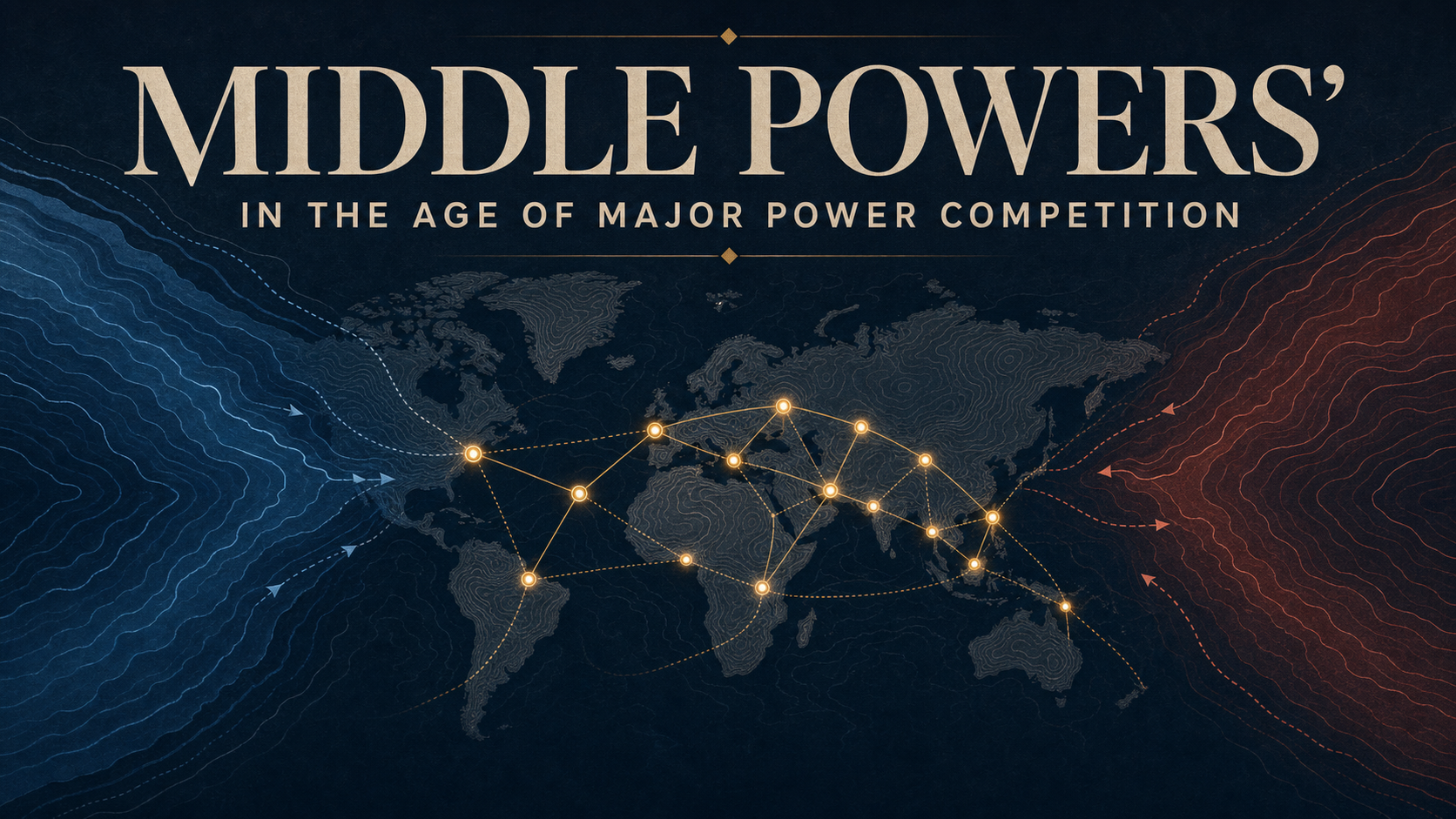
Note: This is part of our ongoing look at the role of middle powers in the age of major power competition.
For a comprehensive look at the strategy of the PRC see in this context, see the following: