By Robbin Laird
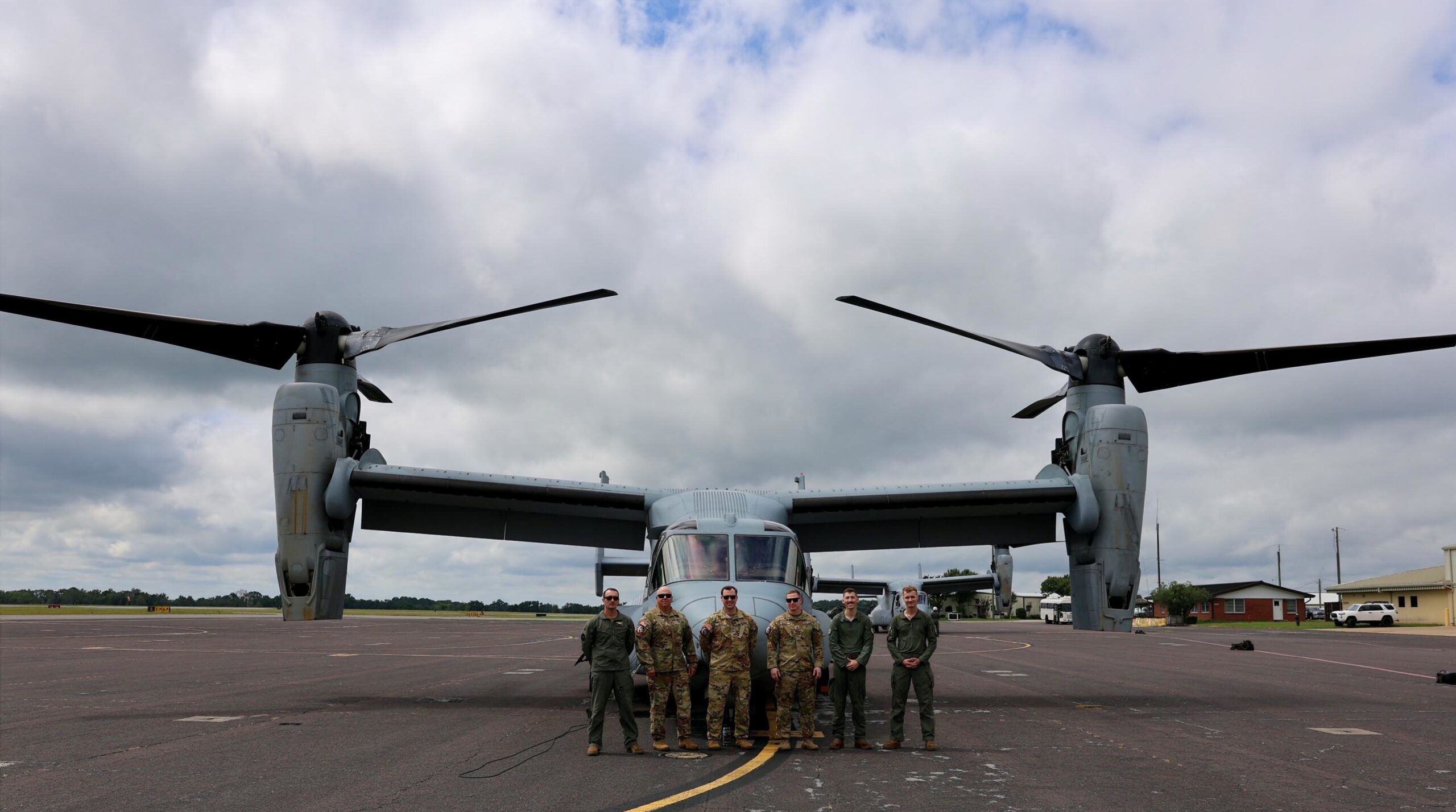
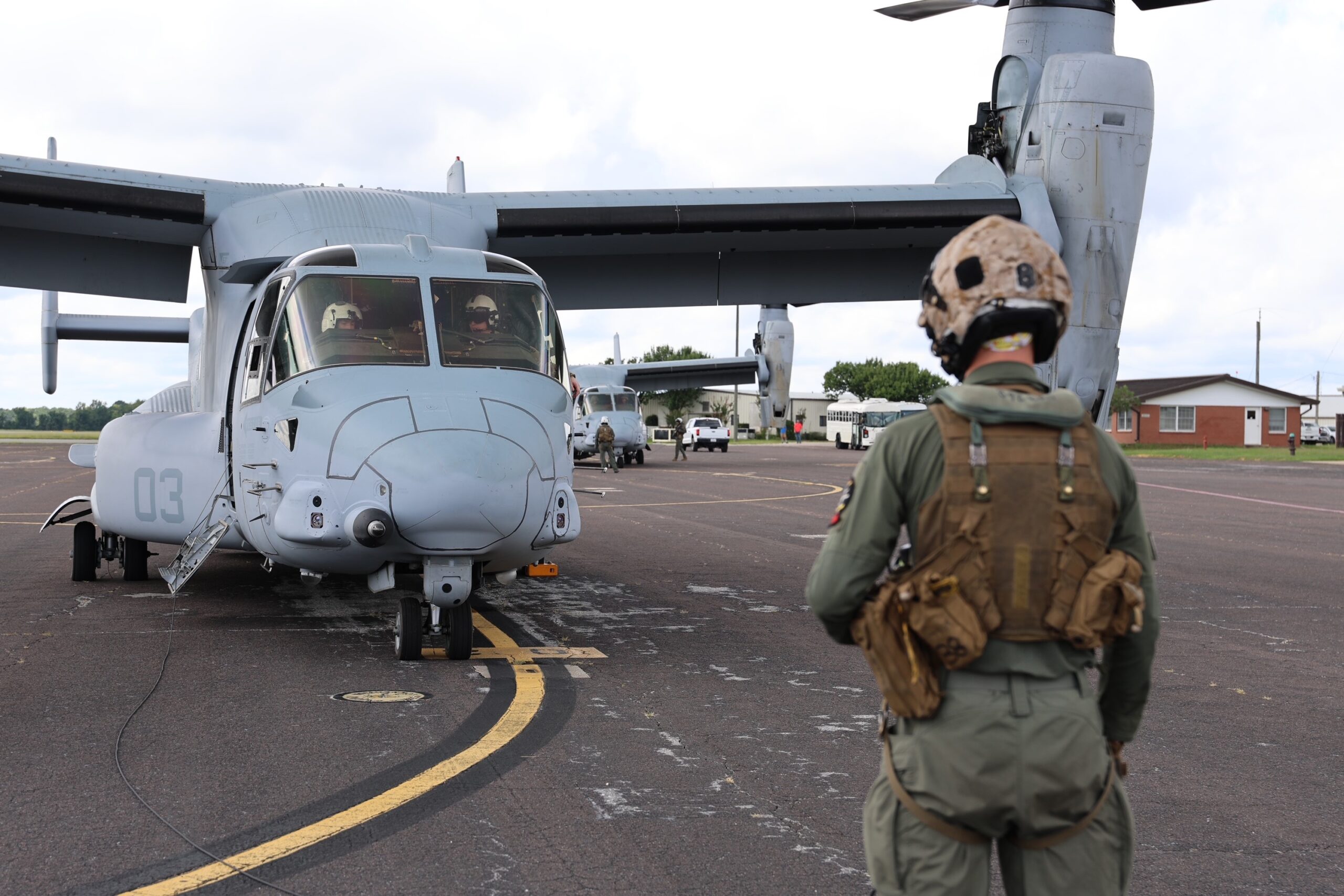
Every aircraft community has a place where the airplane stops being an idea and becomes a skill. For the MV-22 Osprey, that place is Marine Medium Tiltrotor Training Squadron 204 at Marine Corps Air Station New River, North Carolina. The Raptors of VMMT-204 are the Osprey’s fleet replacement squadron. Their official mission is to deliver the core introduction phase of tiltrotor training for pilots and aircrew. Marine pilots and crew chiefs pass through it. So do Air Force pilots, a trickle of Navy personnel, and now, in carefully tailored packages, the Army aviators who will one day fly the MV-75 Cheyenne II.
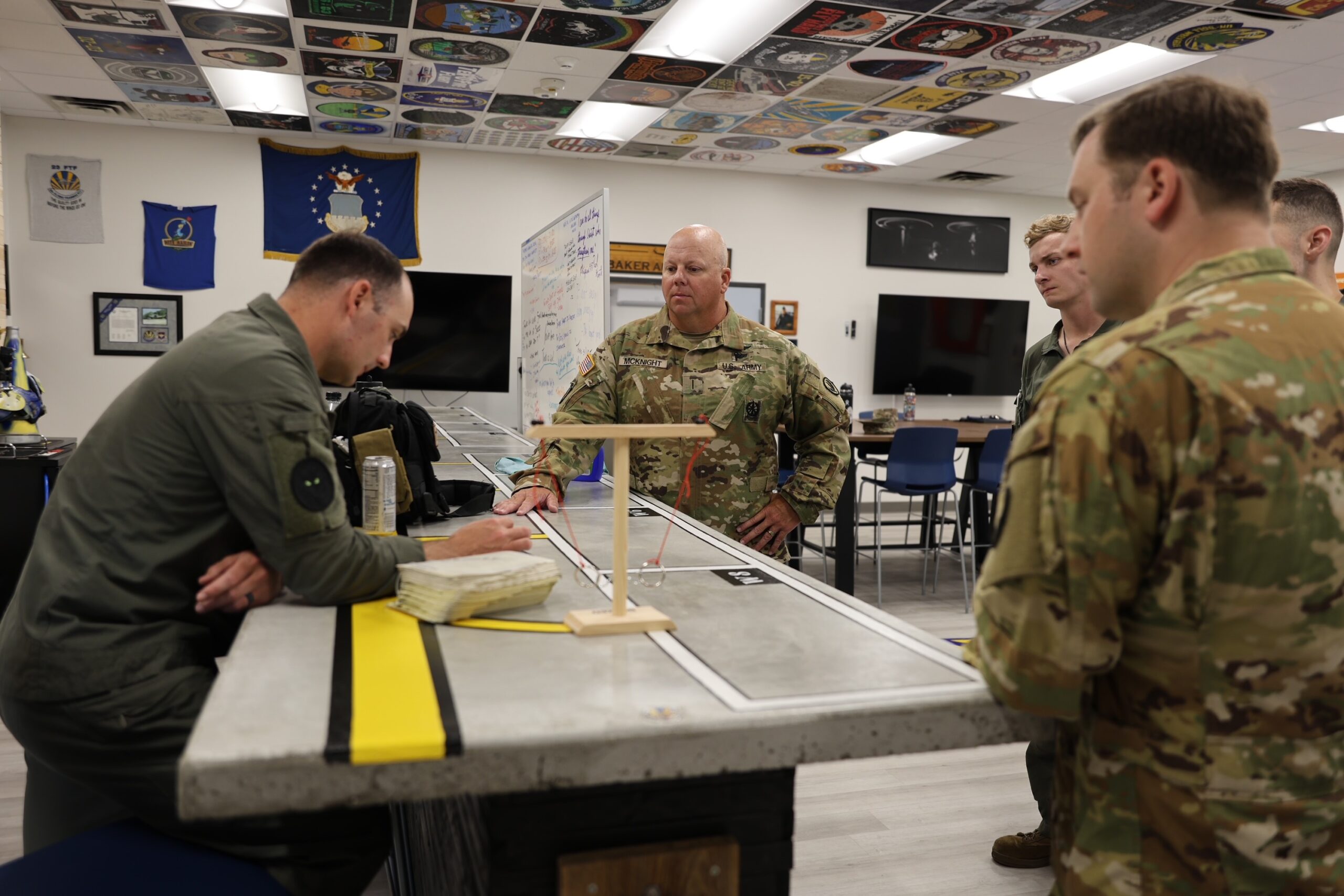
On 17 November 2026 I sat down at the squadron with two of its leaders: Major John Albertini, the executive officer, and Lieutenant Commander Barry Barkley of the Royal Navy, a United Kingdom exchange officer who serves as the squadron’s operations officer. Their account of what the schoolhouse teaches, and just as important what it deliberately does not teach, is one of the clearest statements I have heard of how a revolutionary aircraft becomes a mature one.
What follows is built on what they told me. I have set it against my two Osprey books, A Tiltrotor Enterprise: From Iraq to the Future and A Tiltrotor Perspective: Exploring the Experience, and against a few outside sources, because the schoolhouse has been part of the Osprey story from the beginning and is about to become part of the Army’s.
Two Officers, Two Vantage Points
The two men bring different careers to the same hangar, and they use that difference as a tool.
Albertini is a Miramar Marine. He flew with VMM-161 in Southern California (the squadron features in my coverage of Steel Knight 25 in Building the Impact Force), selected the Osprey in 2019, and did an AFRICOM deployment in 2021 and 2022 that stood up a detachment in Djibouti. He has been at VMMT-204 for about two and a half years. He serves as one of the squadron’s NATOPS evaluators, which makes him one of the chief standardization instructors for the squadron and for the fleet. He also ran the enlisted aircrew training department, the schoolhouse’s crew chief side, before taking over as XO. He has kept the evaluator role while serving as XO.
Barkley described his own job as a “medium lift exchange.” The point of the program, he said, is “function, not form.” Britain does not fly the Osprey, but a Royal Navy helicopter pilot with thousands of hours on rotorcraft can spend a tour teaching tiltrotor pilots how to fly. His counterpart in the UK flies the Merlin Mk4. By Barkley’s account, roughly 800 British officers and other personnel serve in the United States under the wider exchange program, with U.S. counterparts in the UK, across all the services.
Barkley is an unusual case even within that program. His normal billet is a fleet job, and he has served with VMM-365. He came through 204 as a student more than four years ago, was extended in post, and returned to 204 as an instructor. He has been there nearly two years, most of it as operations officer, with responsibility for all pilot and crew chief training across the Marine Corps, Air Force and Army students, plus two U.S. Navy personnel in the pipeline this year.
I had visited the Osprey community many times, and I knew the Marine side of this story from the fleet. What was new was hearing the schoolhouse describe itself.
“Driver’s Ed”: What 204 Teaches and What It Leaves to the Fleet
I asked how training has evolved as the aircraft has matured, and Albertini’s answer reframed the question. VMMT-204, he said, has stayed deliberately standardized, because it is not the place where tactics are taught.
“The tactics component to the MV-22 is entirely taught by fleet units,” he explained, meaning how to fight the aircraft as a weapon system. “I equate 204 to driver’s ed. We are going to teach you how to fly this thing in accordance with the NATOPS flight manual. You’re going to know the aircraft inside and out. You’re going to know the limitations of the aircraft.”
The evolving tactics, he said, are the fleet’s business, and the focus has shifted considerably since he entered the fleet in 2019. Barkey offered the image that ran through the whole conversation. The schoolhouse and the Marine Aviation Weapons and Tactics Squadron (MAWTS-1) are “the bookends of the fleet.” One end teaches “air vehicle with basic principles and the foundations of the skills that they’ll take later on”; the other does “all the tactics, future development, future employment of the aircraft,” and the operating fleet sits in the middle. Then came the sentence that explains the whole institution: “If the two bookends aren’t speaking to each other, then it doesn’t work.”
Albertini returned to the point later, near the end of our discussion, in terms that were nearly a mission statement. “You can’t do tactics in an advanced level unless you have a mastery of the fundamentals.” Anyone who comes through the schoolhouse, he said, is there to be given the fundamentals of tiltrotor aviation, and the instructors take that personally. The commanding officer, he added, calls the squadron the Tiltrotor Center of Excellence, and Albertini’s gloss was simple: “Well, we are because we’re the only one.”
The Problem Nobody Else Has: Training Tiltrotor
The reason the fundamentals matter so much is structural, and Barkley laid it out clearly. Other platforms feed their schoolhouses with students who already have experience in a closely related aircraft. Students headed for the CH-53, he noted, arrive with many hours in a helicopter. Students headed for the F-35 have many hours in a jet trainer. “Students that come in here, there is no such thing as a training tilt rotor.” The first time a Marine or Air Force pilot flies a tiltrotor is at 204.
Albertini walked through the path that produces those students. They finish at VT-35 in Corpus Christi, having done primary training in single-engine turbines, and they select the Osprey after primary. They then attend an intermediate helicopter school, not the full rotary-wing syllabus a CH-53 or H-1 pilot gets, and then a “top off” syllabus in a multi-engine turbine aircraft, which is fixed wing. The design logic, as Albertini described it, is that this syllabus gives the student both halves of the Osprey’s physics. Rotorcraft principles such as translational lift, the loss of translational lift, and power required versus power available are, in his words, “extremely important to this aircraft.” So are multi-engine and single-engine operations. He called it “an extremely effective syllabus” and recalled how it served him when he went through it himself.
The result is a student who arrives with two partial skill sets and has to be turned into a tiltrotor pilot. Barkley, a career helicopter pilot with thousands of hours who had only about sixty hours of fixed-wing time from 2010, described the conversion as a step change in how a pilot has to think. One of the cleanest ways to explain it, he said, is to count the controls. “Every other aircraft in the world has three control inputs. We’ve got four.” The fourth is the nacelle. Albertini put the same idea in a first-person voice: a young lieutenant who understands power, pitch and yaw suddenly has “this weird additional control surface that I’ve never had to manipulate or modulate.”
A Simulator-Heavy Front End
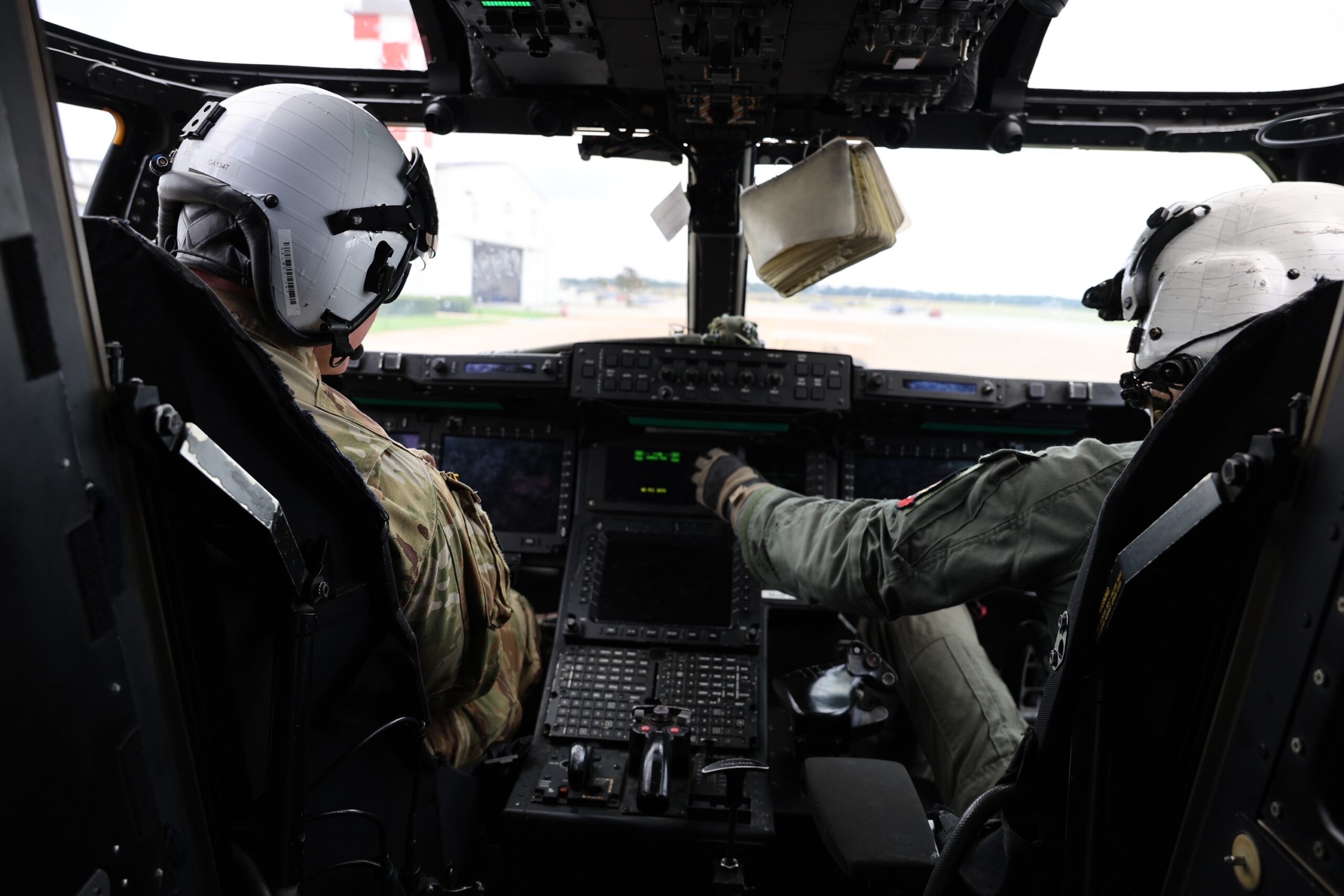
The consequence of that fourth control input is a syllabus built around the simulator. Barkley’s rule is simple: students “should never do anything in the aircraft that they haven’t already done in the sim.” Approximately two thirds of the course is in the simulator and one third in the aircraft. Albertini said students complete 15 simulator events before they touch the airplane, in a building-block progression that begins with systems and checklists and moves on to the maneuvers.
Barkley made the practical case for this. In the simulator, an instructor can pause an event, reset it, and put the student “back five miles” to fly an approach again, which cannot be done in the airplane. Albertini described the way the schedule uses that flexibility. Before an event, the student is guaranteed a discussion with an instructor. The event itself is a two-hour instructional block with an instructor, and an evaluation report follows. Once students pass an event they can sign up for practice sessions whenever they like and repeat the maneuver as many times as they want.
I asked who runs the simulators, and who writes the code that makes them behave as the curriculum requires. The answer showed how much of the system depends on people rather than software. The physical simulators are operated through the V-22 Joint Program Office, PMA-275, by a contractor, Barkley said, with Fidelity as the company named in our conversation. The sim instructors are contract employees, and all of them, Albertini said, are retired military Osprey operators. The squadron does not write simulator code. The instructor sits in the right seat as the aircraft commander, and the simulator is not running a pre-programmed script. “It’s not pre-programmed,” Albertini said. “It’s on the instructor to throw all that in there.” Any task or mission set can be worked, with real-time feedback as the student flies it.
The syllabus ties it together. Barkley opened the manual to show how each simulator event specifies the time required, who may attend, the profiles to be flown, what is to be discussed in the brief, and the prerequisites, and how the next flight follows from the last simulator event in one connected document. Sim and flight are not separate programs. The squadron recently fixed an inefficiency in that document as well. Pilots and crew chiefs used to follow syllabi that were not fully aligned. “The pilots used to have five flights for basic maneuvers, but the crew chiefs only had four,” Barkley said, which meant the crew chiefs began to run ahead of the pilots they would fly with. In the rewrite the two syllabi are a fully joined-up pair, so that the pilot and the crew chief “do opposite sides of the same syllabus all the way through.”
What Changed, and Why: The Training-and-Readiness Loop
Both officers were clear that the schoolhouse does change. The mechanism is the Training and Readiness (T&R) manual cycle, which Albertini said runs every two to three years. Barkey described the last one. The conference takes a few days, with a long build-up. The fleet submits what it wants the syllabus to look like in the future, and the Marine Aircraft Wings, the training commands, MAWTS-1 and 204 all take part. The last major round was about sixteen months ago. The aim, he said, is to make sure that “from day one here at 204, all the way through the fleet,” students are taught the foundations they will need later.
The changes the officers cited are revealing because each one comes from the fleet and each one has to do with people rather than hardware.
Crew resource management and field carrier landing practice. Albertini said the squadron “just brought back FCLPs,” the simulated landings to a ship that had been dropped for a few years, “to reintegrate better crew resource management.” Barkley explained where the request came from. Fleet squadrons reported that the young lance corporals arriving from the schoolhouse were being asked to give instructions to very senior officers, “potentially their [CO], a lieutenant colonel,” and there was sometimes a barrier between a lance corporal in the back and senior pilots up front. The instructor cadre, front seat and back seat alike, concluded that field carrier landing practice would be “a forcing function” that made crew chief students more vocal and more engaged in the crew. Barkey said the fleet also changed its mission-essential tasks and asked for a more maritime focus, and the two changes dovetailed.
Night flying. Albertini said that last year the squadron obtained an exemption to policy that lets it fly students at low light levels as well as high light levels, so that training “never” has to stop at night. His reasoning was operational: low light “is how operationally we do things.” Barkley added that teaching low-light capability from the first day gives students an earlier introduction to it before they reach their fleet squadrons.
Digital training, mostly for crew chiefs. Albertini was candid that modernization has gone further on the enlisted side than on the pilot side. The crew chiefs now have digitized publications and digital training methods. At the other end of the hall, he said, there are multiple screens and a very large touchscreen that lets students take components apart virtually, in the maintenance-side training.
The basic flying manual. The squadron is also in the middle of rewriting the Maneuver Description Guide, which Barkey described as “the basic how-do-you-fly-an-Osprey manual.” What he stressed was who is writing it: a wide spectrum of people. When the squadron redesigned its portion of the T&R, it used working groups with at least one pilot, one crew chief and one simulator instructor each, brought together under the director of safety and standardization. The instructor pool behind those groups is about forty-five instructors drawn from nearly every corner of the MV-22 community, plus a smaller element from the CV-22 community.
One Schoolhouse, Every Perspective
This is the point on which I pressed the two officers, because I have rarely heard of a training command that gets this kind of feedback. The answer is a function of the Osprey’s institutional design.
Instructors come from Okinawa, from the West Coast and East Coast squadrons, and from the Air Force. Barkey noted that their deployment experience is very different, and that both feed into the training: his own was afloat with the fleet, Albertini’s included the “dirt” deployment to Djibouti. Albertini noted that the Osprey community is unusual among rotary-wing communities. Marines in other helicopter communities generally go either east or west, but Osprey squadrons are at Kaneohe Bay, in Okinawa, on the West Coast and on the East Coast, and they have permanent air groups in each. All of that experience flows back into the same room.
One of the officers then added the “law of recency.” Instructors who checked in five months ago have seen what the new T&R does to a new student arriving in a fleet squadron, and they report it. The officers also made a structural point that explains why the feedback is so quick. Unlike the F-35 community, which has several training squadrons, a single squadron produces the Osprey force. As one of them put it, every pilot and every crew chief in Marine Corps aviation, and every Air Force Osprey pilot, came through 204. The community is large, but “everybody knows at least somebody at 204,” so the informal feedback from fleet pilot training officers, operations officers and executive officers arrives almost at once, well ahead of anything in the formal cycle.
Barkley offered a candid reflection on what this has meant for him. He and Albertini have had very different experiences of the aircraft, and both feed into the syllabus. That, he said, is “a huge benefit.”
A Multi-Service Center of Excellence
The schoolhouse also serves as an unusual lens on the Osprey as a joint enterprise, because each service has chosen differently about how closely to tie itself to it.
Barkley summarized the arrangements this way. The Air Force “decided long ago” not to build its own initial training, so its pilots come through 204 for the base course and then go on to the Air Force’s follow-on training at Kirtland Air Force Base. The Navy built up its CMV-22B force through 204 and has since “separated off.” It now runs its own fleet replacement squadron, VRM-50, in San Diego, a “single service decision.” Even so, Barkey said, the Navy “still buy into the Marine Corps Center of Excellence here.”
The NATOPS point deserves emphasis. The common flight manual, and the amendments that Albertini and the other evaluators work on, is a thread that ties the services and a foreign partner to one set of standards. That is what a center of excellence looks like in practice.
The Army Arrives: Fundamentals, Not Qualification
The most forward-looking part of the conversation concerned the U.S. Army. The Army has a tiltrotor of its own coming, the MV-75 Cheyenne II, and its aviators have never flown anything like it. The question is what 204 does for them.
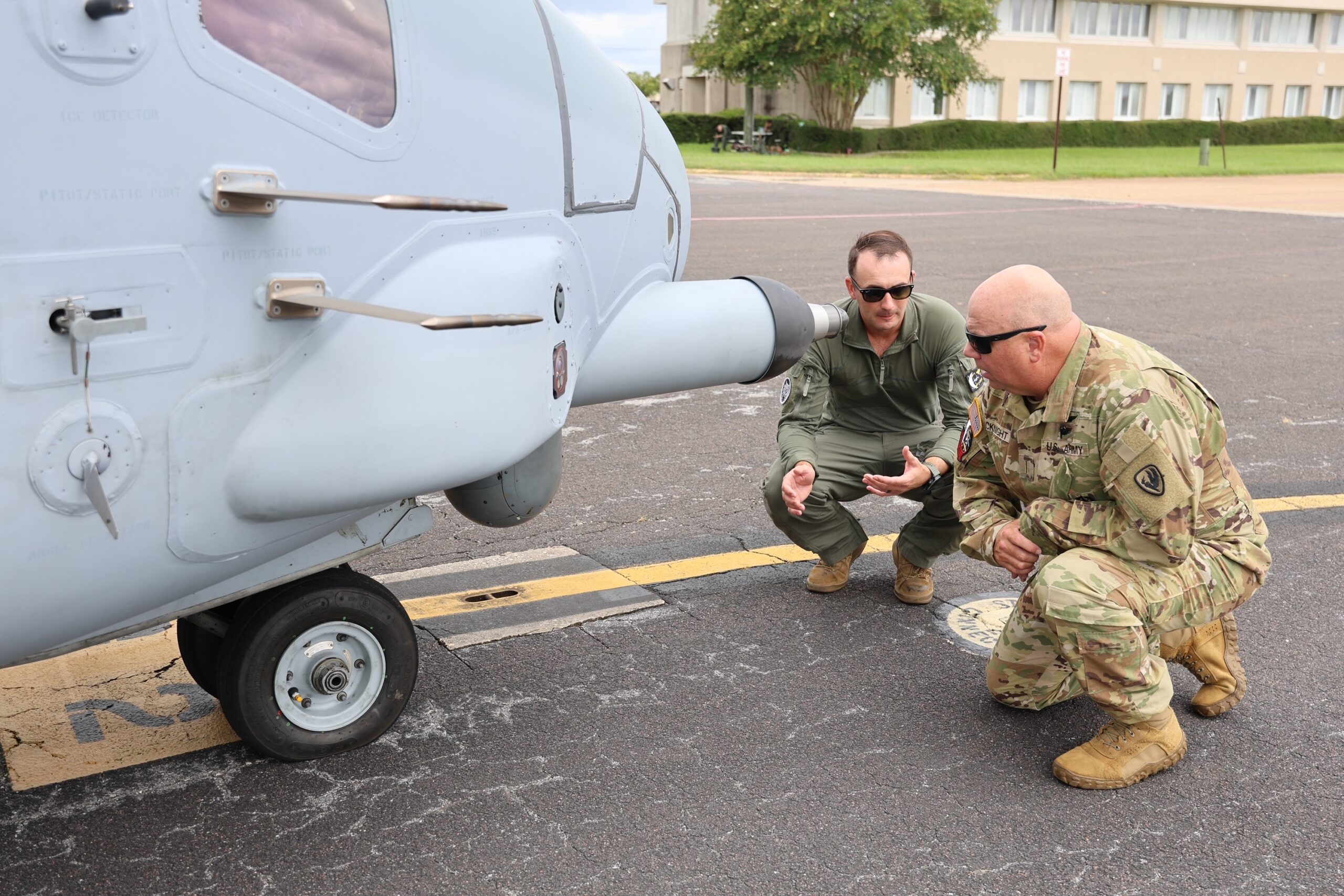
Albertini was clear about the character of the relationship: “it’s more exposure than anything.” The numbers are small. Barkley said that only two Army test pilots a year come through, from Redstone Test Center in Alabama, as part of the MV-75 program. They take a bespoke package, not the full syllabus. “They’re not here to learn to be Osprey pilots,” he said. “They’re here to get tilt rotor appreciation and tilt rotor fundamentals.” The test pilots are there “to de-risk their test program.”
A separate group from the Army’s Directorate of Training and Doctrine came for ground school and a simulator-only package, and went back to the Army to think about future employment of the aircraft. By Barkley’s account those visitors “never did any live flying” in the squadron’s program. (Army reporting from July 2025 describes training developers from the same directorate flying in squadron-provided MV-22s at Fort Rucker, a separate familiarization event.)
Because 204 awards the Army pilots no qualification or designation, the schoolhouse has room to adapt. Barkey called the syllabus “a handrail.” Each test pilot receives it beforehand as a statement of what the squadron plans to deliver, with about fourteen flight hours each, and then the two sides talk. The requests have varied. One year a test pilot wanted work on hover and translational lift. Another asked for higher-speed maneuvers and high altitude. The squadron does not redesign anything. Albertini described the arrangement as “familiarization in the fundamentals of tilt rotor aviation,” and was honest about the limits of what 204 knows: “We don’t know what they do with it when they go back.”
Albertini also noted that 204 has been through this kind of conversion problem before. The squadron has taught CH-53 transition majors and H-1 transition majors, and when the Navy’s C-2 community began to fade, former C-2 pilots with no tiltrotor background arrived to fly the V-22. The syllabus, he said, “works fundamentally well for anybody without any tilt rotor experience.”
But it is clear that VMMT-204 with its rich multi-service training heritage can provide significant input to accelerating the Army’s ability to train in what will be for Army aviators the new world of tiltrotor aviation.
The Mental Leap
Both officers returned to what experienced rotary-wing pilots must unlearn. Albertini said Army aviators who get into the aircraft are struck by the speed. “Every single guy that I’ve flown with that has gotten in the aircraft has just been like, ‘Wow, this is awesome.’” He recalled an example from his own training days on the West Coast. The Osprey would get to the Yuma range in about twenty minutes, while CH-53s took an hour and a half or more. They would take off at the same time, and the Osprey crews would be working through their training when the helicopters checked in on the common frequency.
Barkley made the deeper point with two concrete examples. The first was about the pilot’s habits. “It’s very easy to say, ‘Oh, it flies twice as fast,’” he said. “Like, yeah, but what does that do?” Flying 200 feet above the trees at 220 knots in eastern North Carolina, a pilot cannot see the landing zone until perhaps a mile out. In a helicopter, he said, ninety-nine percent of the flying is visual and the instruments are a backup check. In the Osprey the pilot must rely much more on instruments for lineup, distance to go, speed and deceleration points, because by the time the zone is visible, a pilot who waits to begin slowing will fly past it. “The headwork that you have to do,” he said, is a big jump from helicopter pilot to tiltrotor pilot.
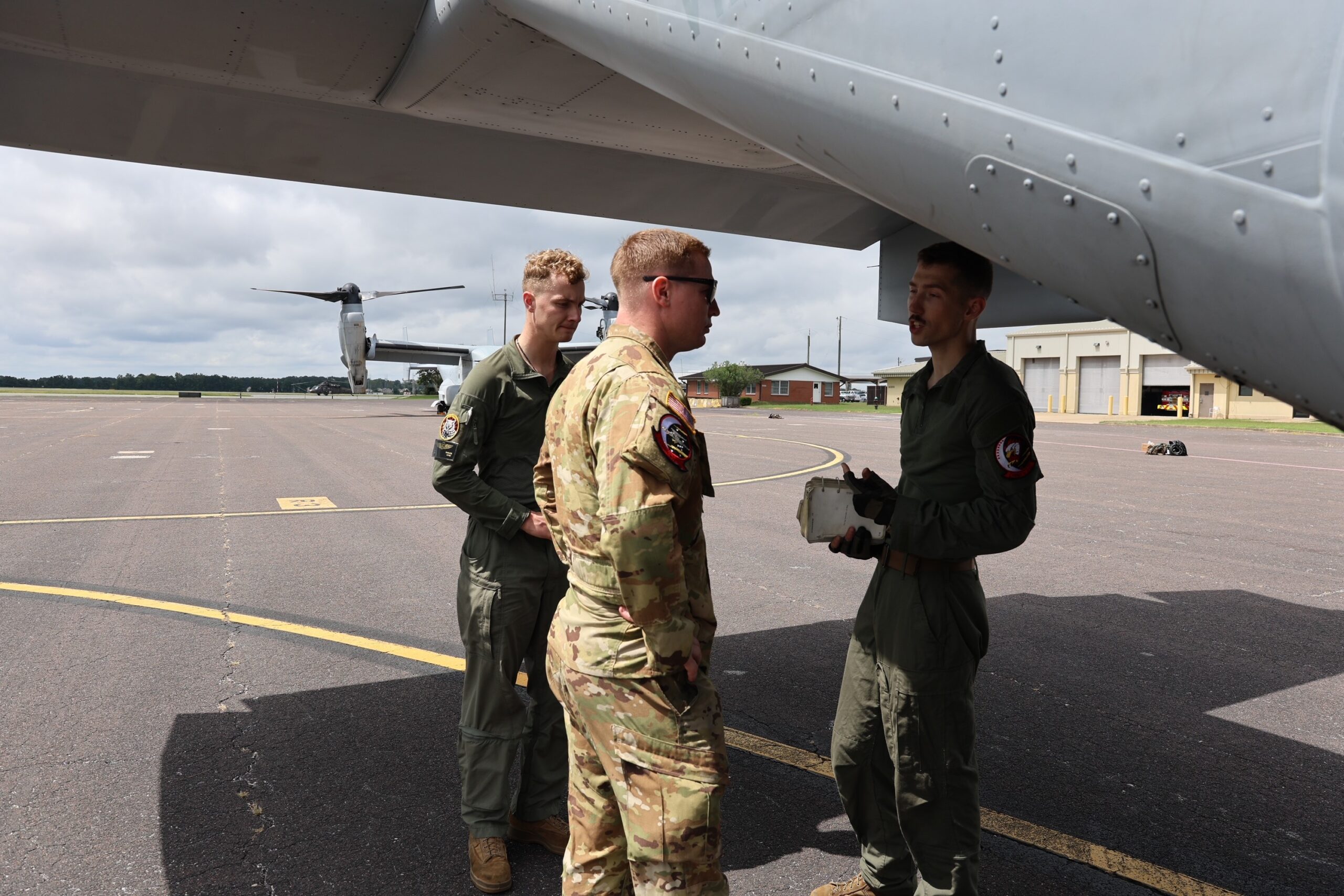
The second example was about the crew chief, and it was one of those small details that reveal a whole way of working. In a Black Hawk or a Chinook, Barkley said, the crew chief can open the door whenever he likes. In a tiltrotor you cannot just open the side door, because the blades are “nine inches from your face.” Crew chiefs “have to be fully immersed in this whole step change as well.” The Army test pilots, he noted, are carrying some of those crew resource management lessons home, even though the Army crew chiefs have not been through 204.
He summed up the experience from the standpoint of someone who made the conversion himself. It is a step change, “not just in physicality, but in the way your mental modeling has to work to fly this aircraft.” The skid-aircraft pilots who pass through the squadron, he added, all say the same thing: “Whoa, this is a mental leap.”
Albertini was clear that none of this touches tactics: “we haven’t even touched tactics.” What the Army visitors get is a look at the machine and an understanding of what it is capable of. Barkley agreed that the squadron is “not touching the tactics,” only supplying “the foundation to those skill sets in the future.”
Where the Fundamentals Meet the Larger Tiltrotor Story
The 204 story fits the arc I traced in my two books, and in several places the officers’ words echo what earlier generations of Osprey Marines told me.
The schoolhouse has been central from the start. In A Tiltrotor Enterprise, Lieutenant General Karsten Heckl recalled that when he left MAWTS-1 in 1999 he had been selected as one of the initial members of the new VMMT-204 squadron that was to replace HMT-204, and that the two accidents in 2000 delayed the launch. When I visited New River in 2010 for interviews with Osprey pilots and maintainers, which I published in A Tiltrotor Perspective, Major Lee York described his path from CH-46 pilot to a deployment in Iraq with VMM-263 and then a tour at VMMT-204 training new V-22 students before returning to 263. The pipeline that Albertini and Barkley now run is the same pipeline that has produced the force since the first deployments.
Barkley’s mental leap is the “fast helicopter” problem seen from the classroom. In the same book, I recorded Carl Forsling’s view that the core challenge for the first Osprey Marines was to stop thinking of the aircraft as a fast helicopter and start thinking of it as a plane that lands vertically. That shift, he said, meant new insertion tactics, new approaches to brownouts, and a different understanding of what speed and range allow. Barkley’s account of the helicopter pilot who must now trust his instruments at 220 knots is that insight embedded in a syllabus. The first generation of Osprey Marines had to discover this in the field. The schoolhouse now has to teach it before anyone leaves the ground. Master Sergeant Jeremy Kirk made a related point about maintenance in 2010: “it takes time to learn how to maintain a new aircraft.”
The sim-heavy front end and the fleet’s flying hours are two halves of one problem. In November 2024 I spoke with “Cowboy” Nelson, whom I had interviewed in 2016 when he was executive officer of MAWTS-1. He argued that a lower number of annual flying hours for Osprey pilots, roughly 150 a year compared with the 300 he flew as a young helicopter pilot, affects proficiency in demanding maneuvers such as confined area landings. His view was that the simulators are very good but “nothing will replace the time in the airplane.” Those comments are not in tension with what Albertini and Barkley described. A schoolhouse with a simulator-heavy front end is building the foundation. Whether the fleet then has the hours, the aircraft and the maintainers to keep that foundation sharp is a resourcing question that the schoolhouse cannot answer by itself.
The sustainment thread. Albertini’s observation that the schoolhouse has modernized crew chief training faster than pilot training connects to the sustainment arc I laid out in the same book. Nearly sixty percent of maintenance actions on the V-22 occur in the nacelle area, which is why the Nacelle Improvement program, begun on the Air Force’s CV-22s, matters so much. As of April 2025, twenty-seven aircraft and 6,700 flight hours had been recorded under that program.
According to Stars and Stripes, Bell’s MV-75 takes the lesson further with fixed nacelles that keep the engines in place. The Army has also been using the Osprey community as a source of knowledge about training. The Aviationist reported that in July 2025, Army training developers who had completed ground school and simulator work with VMMT-204 flew in squadron-provided MV-22s at Fort Rucker, Alabama, and that an Army maintenance training team audited the squadron’s maintenance course. One Army training developer said there was “no reason to start from scratch.”
Between the two services, a shared pedagogy for tiltrotor training is taking shape that could outlast any single aircraft.
What the Schoolhouse Tells Us
Three conclusions follow from what Albertini and Barkley described.
First, the Osprey’s institutional maturity shows up in how it separates teaching and tactics. A new aircraft almost always starts with the same people teaching how to fly it and how to fight it. After nearly two decades of operations, the Marine Corps has been able to separate the two, giving the fundamentals to a single, standardized schoolhouse and the evolving tactics to the fleet and MAWTS-1. The bookend model works because each end has a different clock. Tactics change with every exercise and deployment. Fundamentals change only when the T&R conference concludes that the baseline has to move. That separation is a sign of a program that has had time to learn what it is.
Second, the feedback loop is the point. The formal T&R cycle matters, and the fact that every Osprey pilot and every Marine crew chief comes through one squadron makes informal feedback unusually fast. The instructor pool, drawn from MEUs, Okinawa, Djibouti, the Air Force and the CV-22 community, brings the whole force’s experience into the syllabus rewrite. Barkey’s formulation, that the bookends must speak to each other, is the discipline that keeps the system honest.
Third, the Army has chosen the right starting point. What Albertini and Barkey described is not a conversion course. It is an introduction to what a tiltrotor is and what it asks of its crew, with the pilot’s perception, crew resource management and the sense of speed and range at the center.
The Army’s own timeline is still in flux but whenever the aircraft arrives, the Army’s test pilots and training developers will have started from the same fundamentals as the Marines. They will not be learning tactics from 204. They will be learning how a tiltrotor is flown, and Barkley’s point is that this changes how a helicopter pilot has to think, not only what he does with his hands.
In my own work on military transformation I have argued that a new platform takes years even to begin to show what it is, and many more before its users discover what else it can do. A schoolhouse that gives every new community the same grounding in the fundamentals is how that learning is carried forward.
Barkley closed with a point addressed to the young pilots and crew chiefs in his squadron. On the flight line at New River there are twenty-three Ospreys, and in the Marine Corps that is simply normal, because the Osprey is the core assault platform. It is not normal for anyone else. On deployment, he said, the range and speed at which the Osprey operates would take days in a helicopter. A tiltrotor unit can go out, do the job and be back in the same cycle of darkness or daylight. “The Osprey is not a normal platform,” he told them, “and it is an incredible bit of kit.”
It is a fitting summary.
The Osprey is not a normal platform, and for that reason VMMT-204 is not a normal schoolhouse.