By Robbin Laird
On April 17–18, 2026, the high desert terrain around Twentynine Palms, California became the operational environment for Assault Support Tactics 3, one of the defining field evolutions of Weapons and Tactics Instructor Course 2-26. The photographs from those two days capture what WTI is at its best: a realistic, multi-domain test of how Marine aviation and ground forces integrate under conditions designed to stress every assumption.
AST-3 is not a single-mission exercise. It is a compressed operational sequence built around two distinct and demanding mission sets: a Noncombatant Evacuation Operation and a Foreign Humanitarian Assistance mission. Prospective Weapons and Tactics Instructors are required to plan, brief, and execute both, shifting between the different rules of engagement, military authorities, and civil-military considerations each demands. The point is not simply to fly the missions. It is to think through them at instructor depth.
The MV-22B at the Center of the Evolution
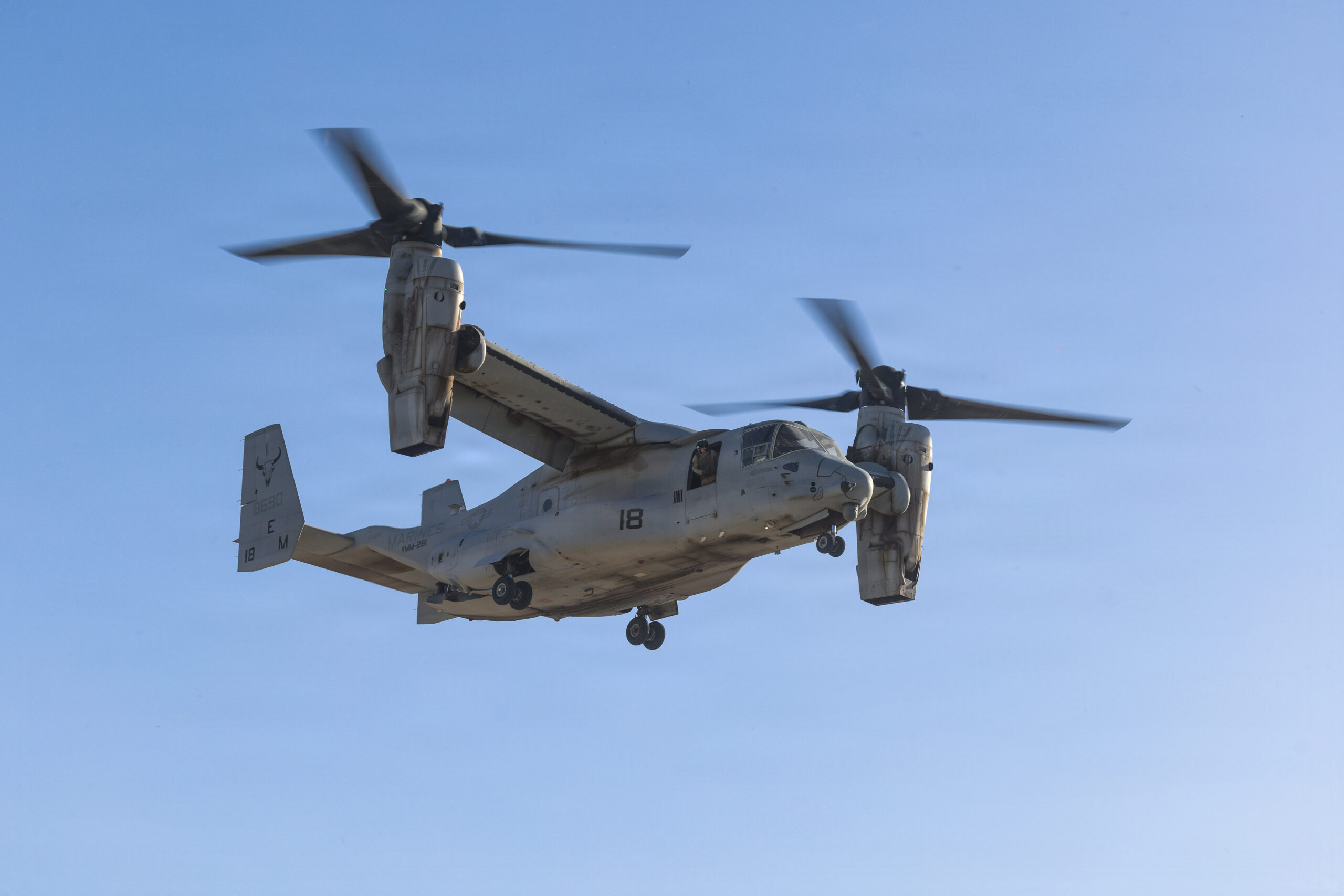
The MV-22B Osprey is the connective tissue of AST-3.
Its combination of range, speed, and vertical lift capability makes it the primary insertion and extraction platform for both the NEO and FHA mission sets.
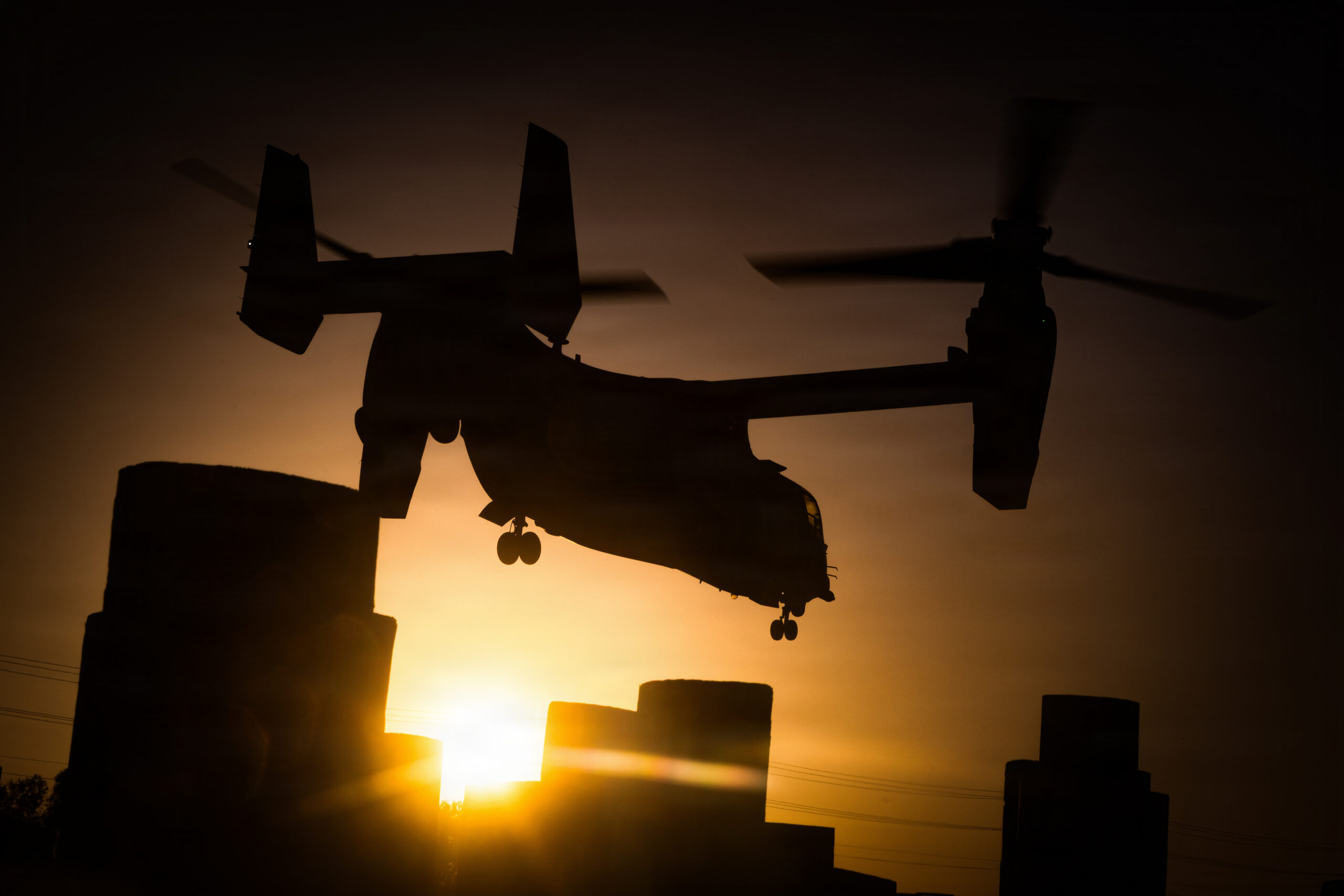
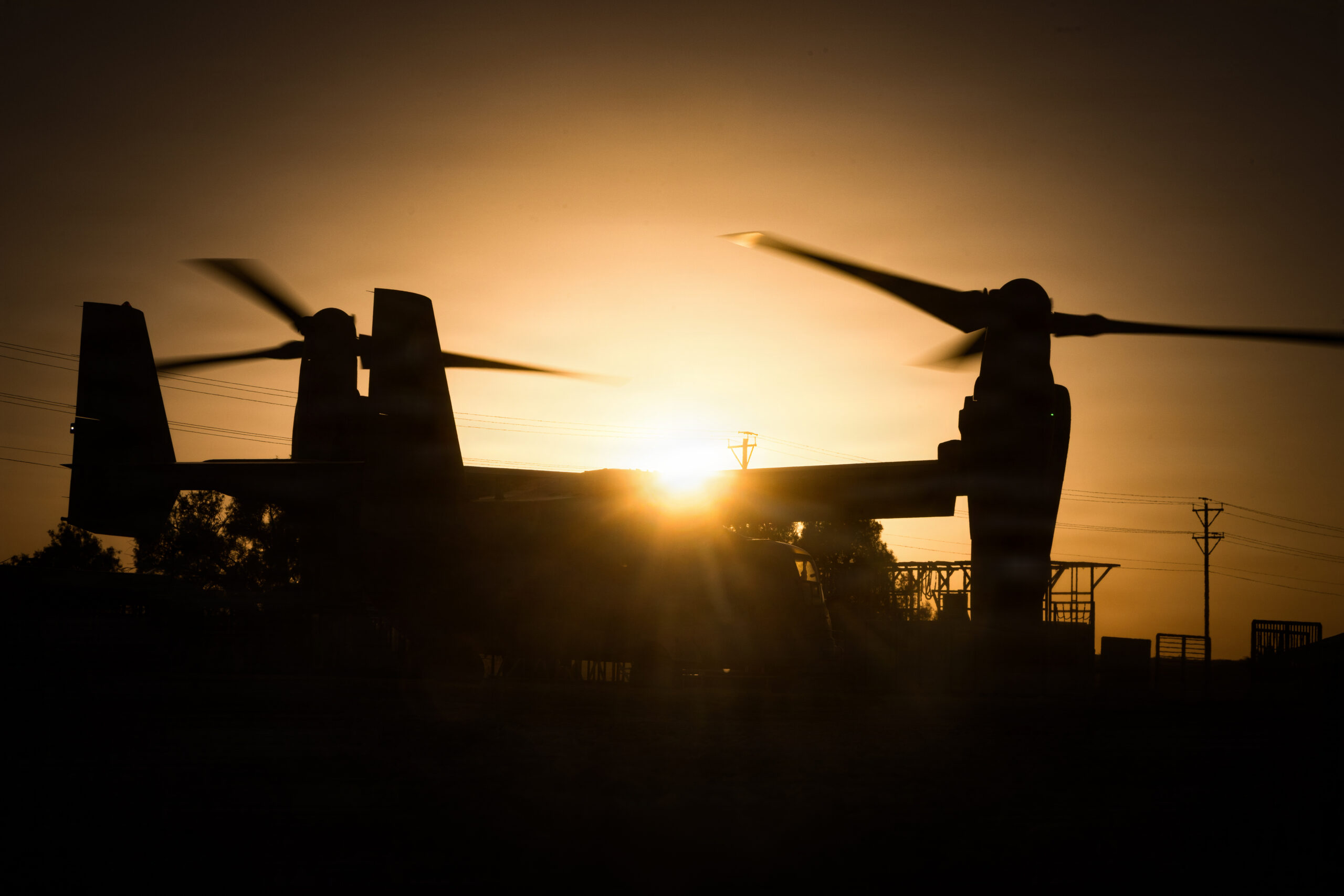
But the photographs from Twentynine Palms show something beyond the aircraft in flight: they show the Osprey operating across the full operational envelope, dawn insertions, low and fast over the deck at dusk, and, most tellingly, night operations with Marines loaded in the back under green-tinted illumination, navigating by night vision.
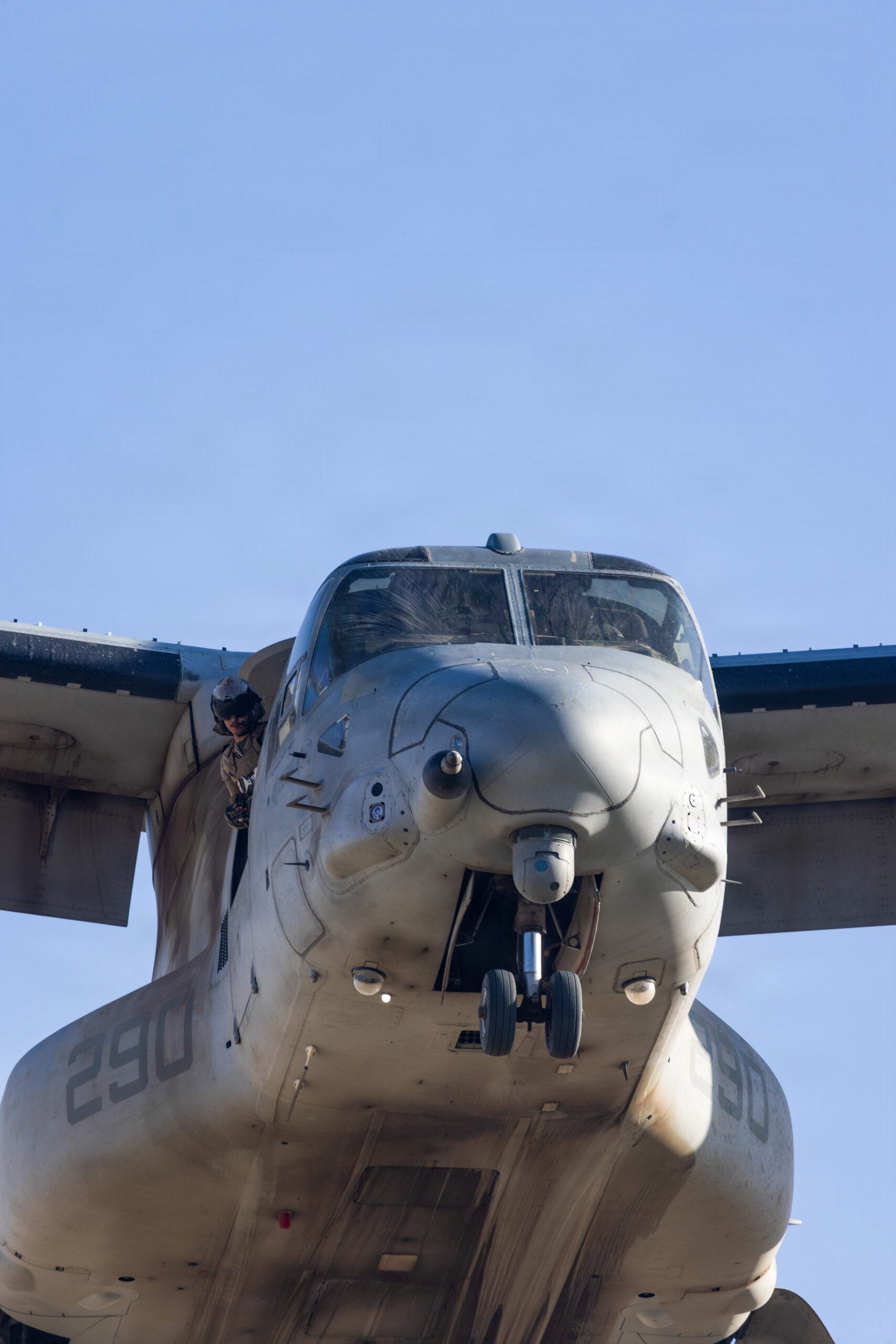
The close-up nose-on image of aircraft 290 is worth attention. The EO/IR sensor pod mounted beneath the nose is a reminder that the MV-22B in the MAWTS-1 configuration is not simply a transport aircraft. It carries its own situational awareness tools, allowing crews to assess landing zones, identify threats, and pass targeting data into the broader kill web before troops ever step off the ramp.
The Escort and Fire Support Layer: UH-1Y and the Integrated Package
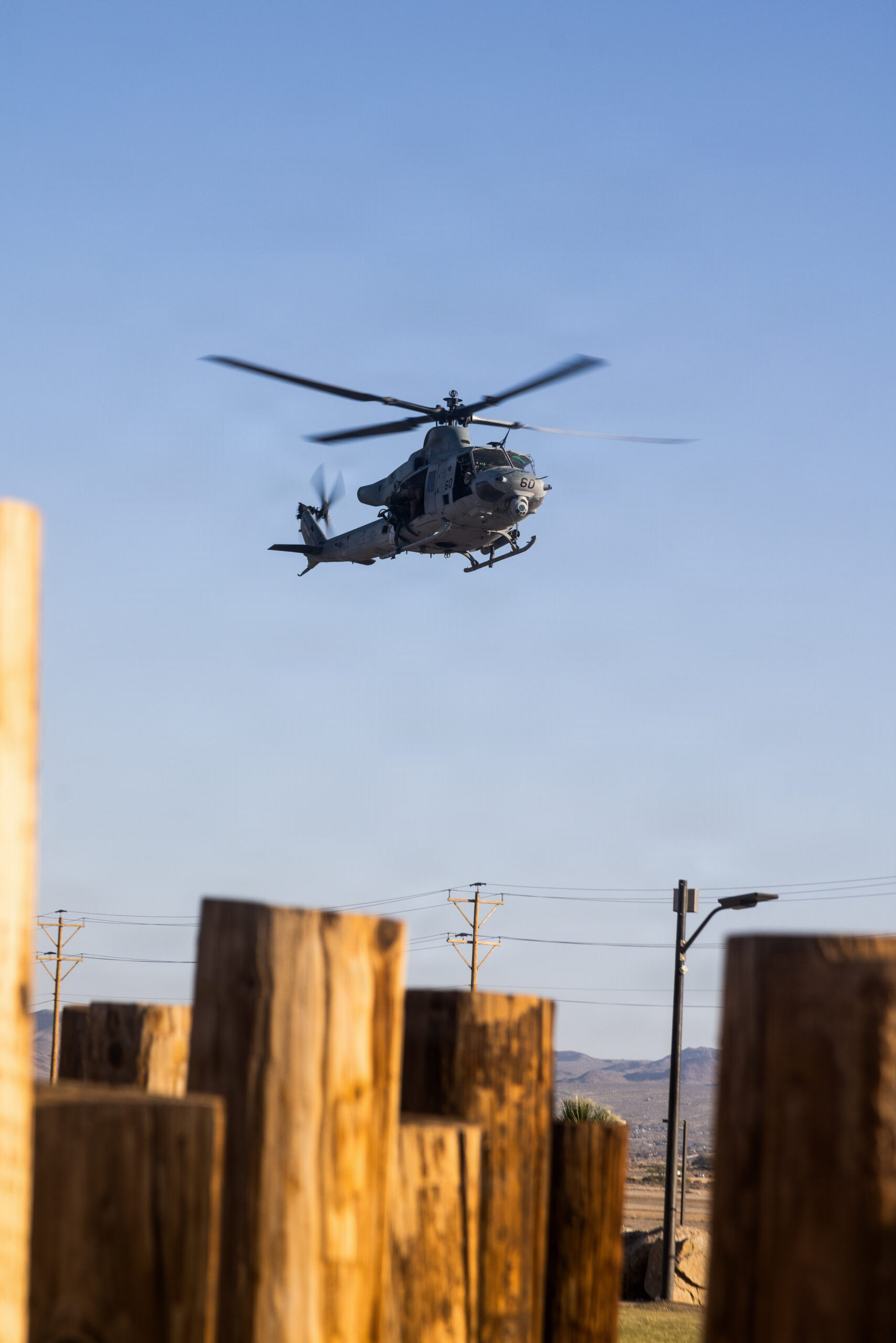
No assault support evolution at WTI operates in isolation. The photographs include a UH-1Y Venom working the same low-altitude environment as the Ospreys, its nose sensors active, framed against the wooden obstacle field that defines the Twentynine Palms training complex.
The Venom’s role in AST-3 is the escort and immediate fire support function: holding off threats to the landing zone, providing reconnaissance ahead of the assault element, and giving the ground force commander an aerial platform that can act on short timelines.
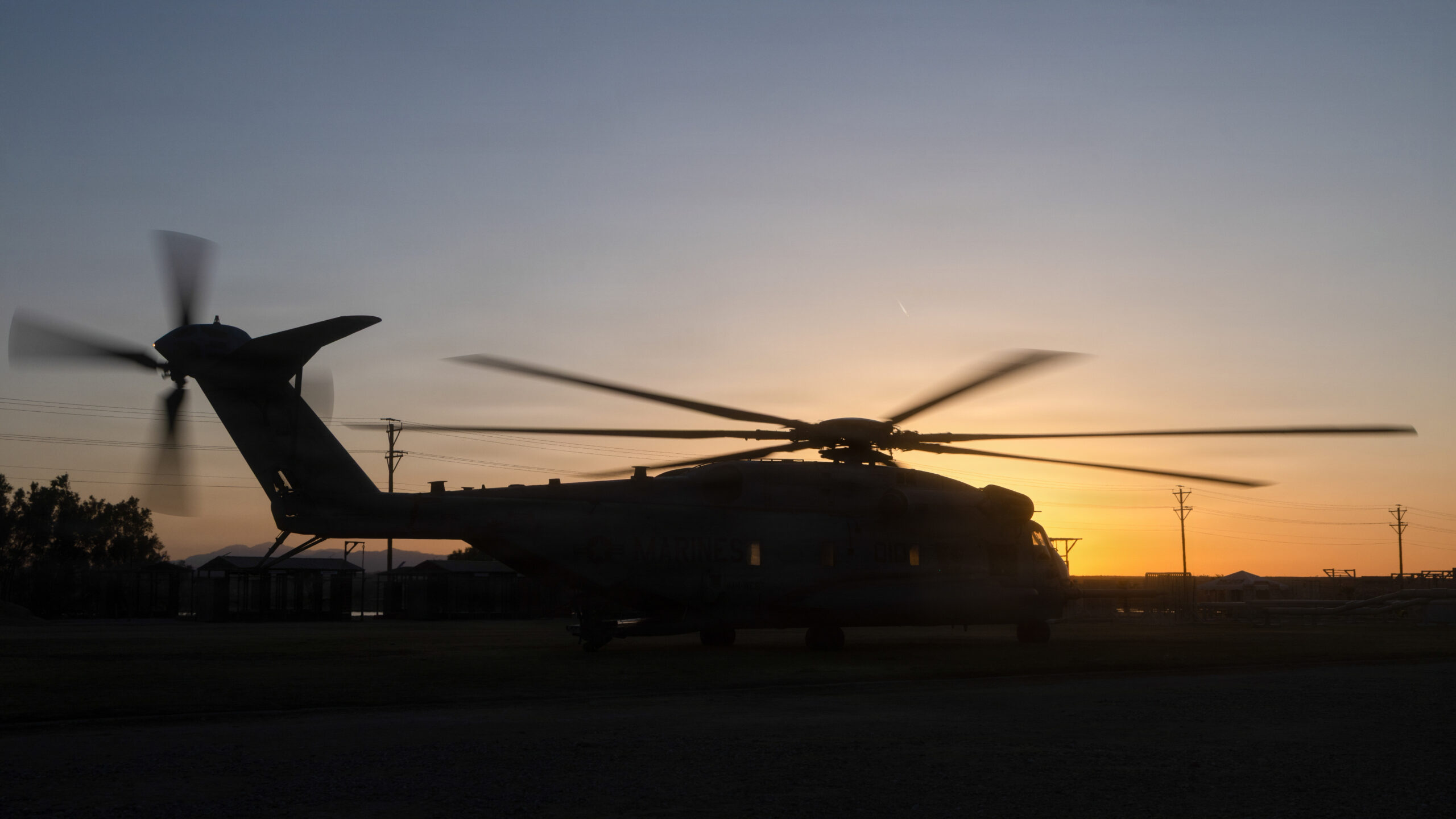
The CH-53K silhouetted on the ramp at sunset rounds out the aviation picture. Heavy lift in this context serves the logistics backbone of both NEO and FHA operations,moving evacuees, equipment, or humanitarian supplies that exceed the MV-22B’s cargo capacity.
The fact that multiple platform types appear across these two days is consistent with AST-3’s design: it is explicitly a multi-platform integration exercise, not a V-22 tactics event with other aircraft in supporting roles.
The Ground Force: Security, Snipers, and Night Operations
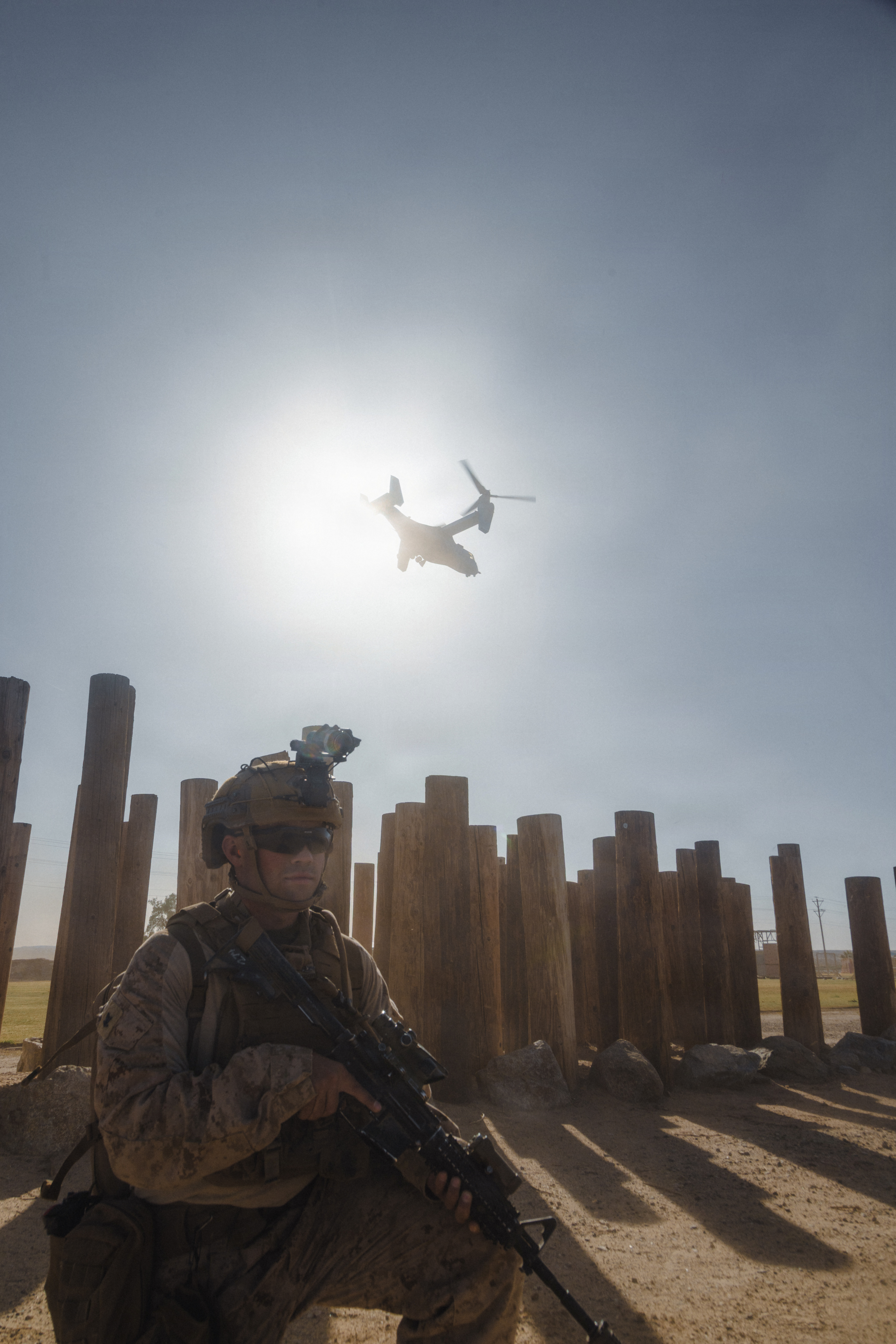
The ground element photographs are as analytically interesting as the aviation imagery. The opening image, a Marine rifleman in the foreground with an MV-22B passing directly overhead against a bright midday sky, captures the essential relationship of AST-3: the ground force is simultaneously the mission objective, the security element, and the terminal guidance platform, all at once.
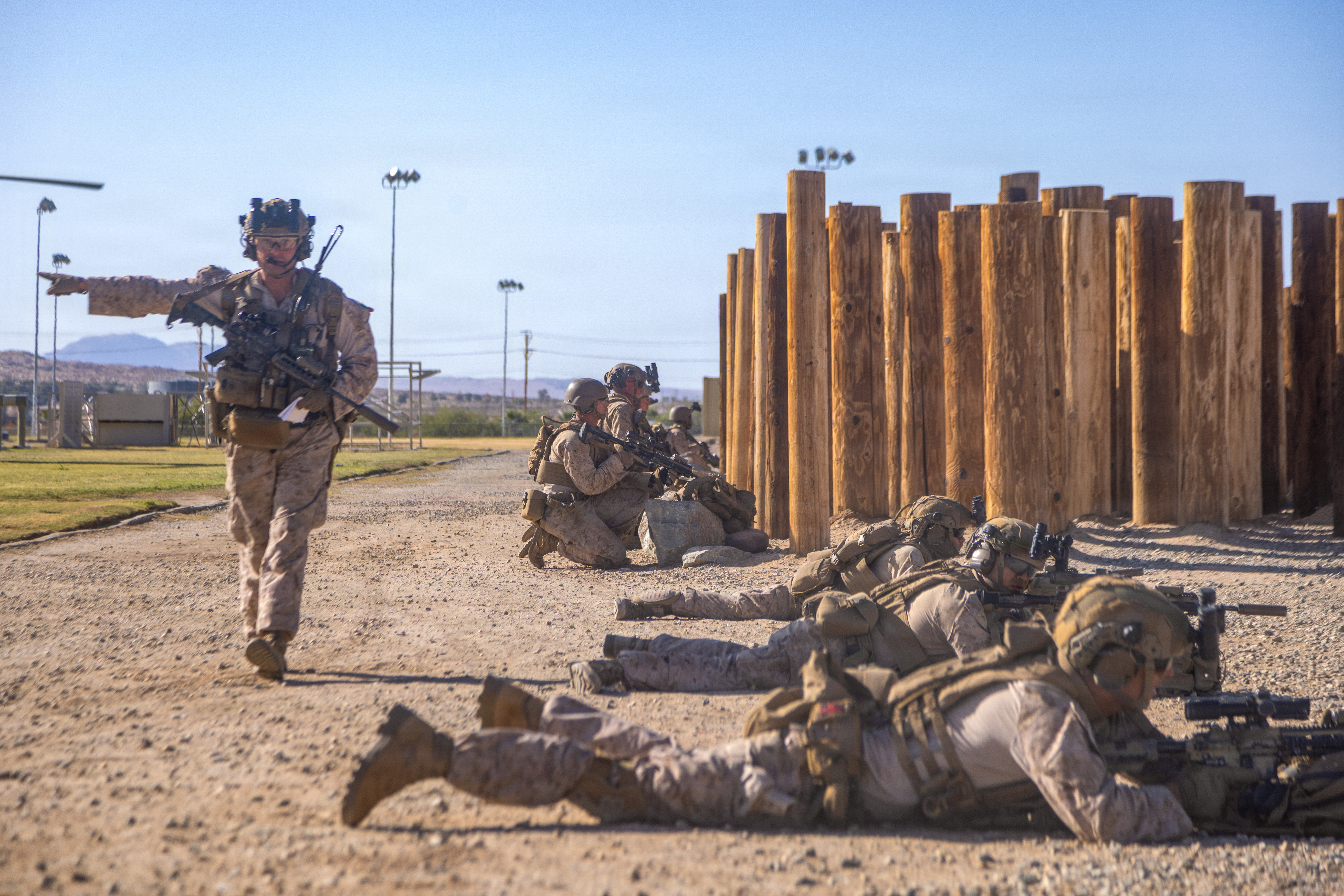
The fire team photographs in the log-obstacle complex show Marines in well-practiced tactical positions: some prone at the perimeter, weapons oriented outward; a team leader standing and directing movement with an outstretched arm. This is the close-in security posture that keeps a landing zone open long enough for the Osprey to come in, load, and depart. It requires precise coordination between the ground element and the aircraft crew, the kind of coordination that WTI is specifically designed to train and certify.
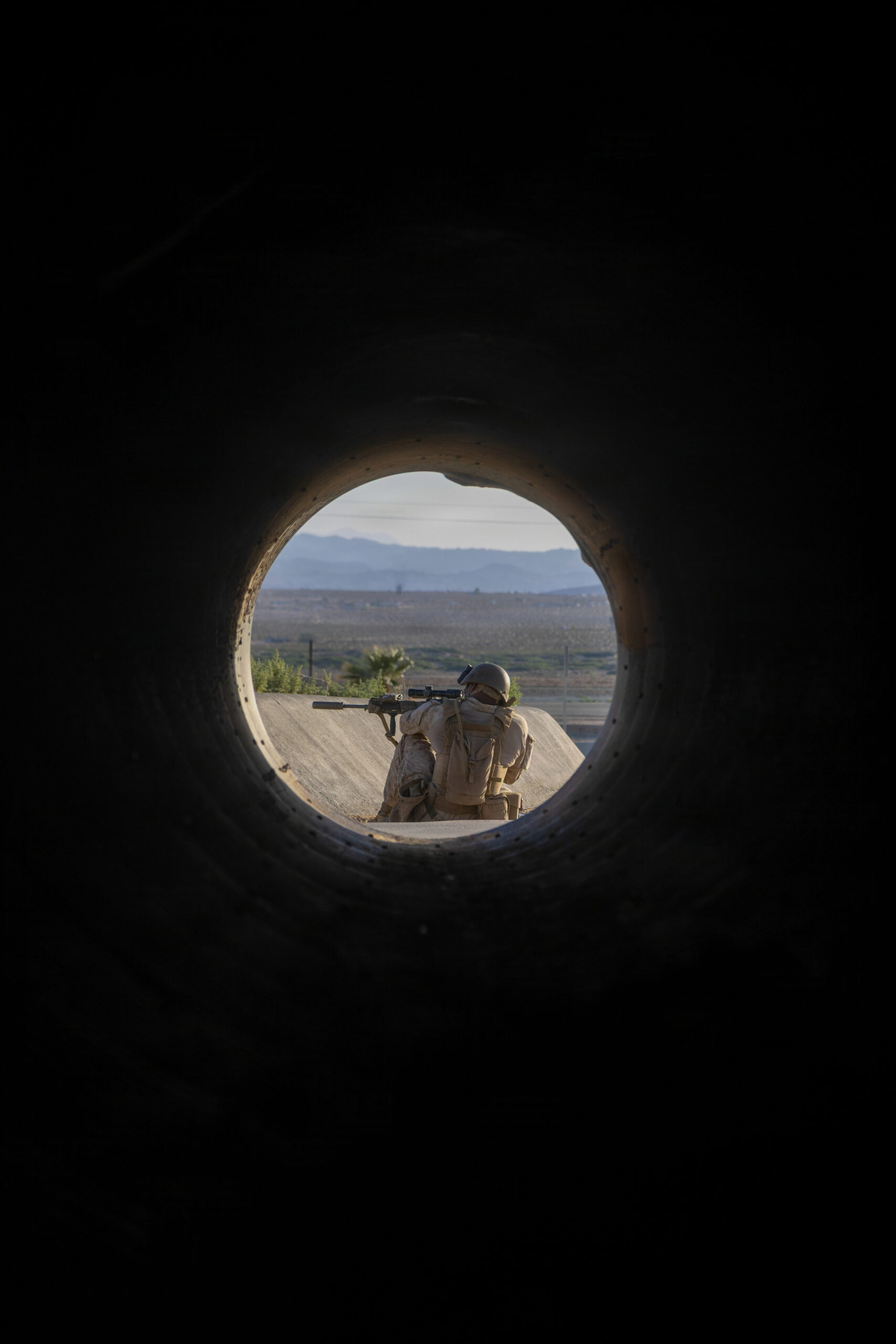
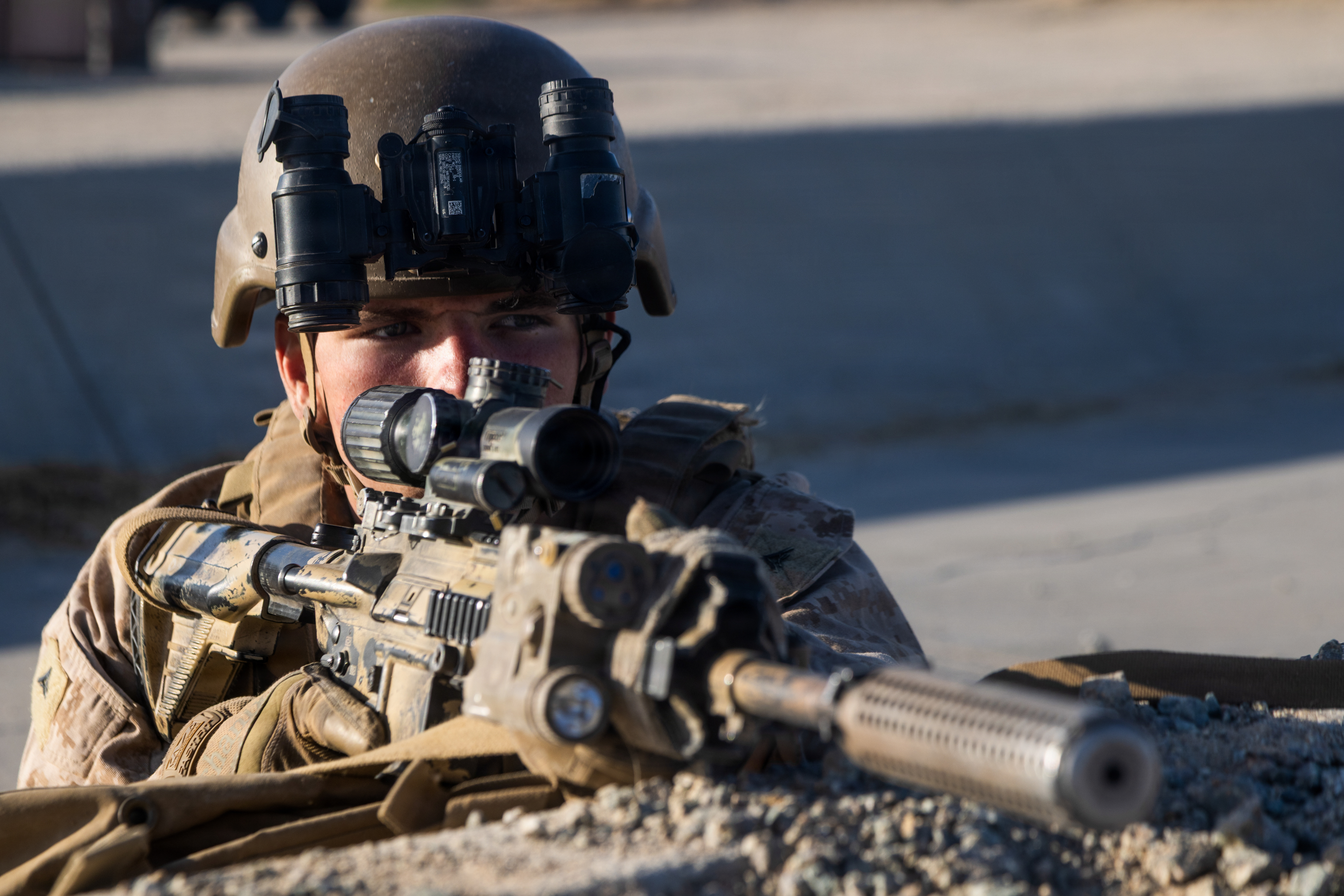
The sniper image is striking in its composition, a precision rifleman framed through a circular concrete aperture, looking out across the Mojave scrubland toward distant mountains. The suppressor on the weapon and the high-magnification optic are appropriate to the overwatch role: the sniper extends the security perimeter beyond what a rifle squad can hold, provides early warning, and can engage threats before they reach the landing zone. In a NEO scenario, where rules of engagement are constrained and the situation is ambiguous, the sniper’s discriminating precision is exactly the kind of capability that allows a commander to act without escalating unnecessarily.
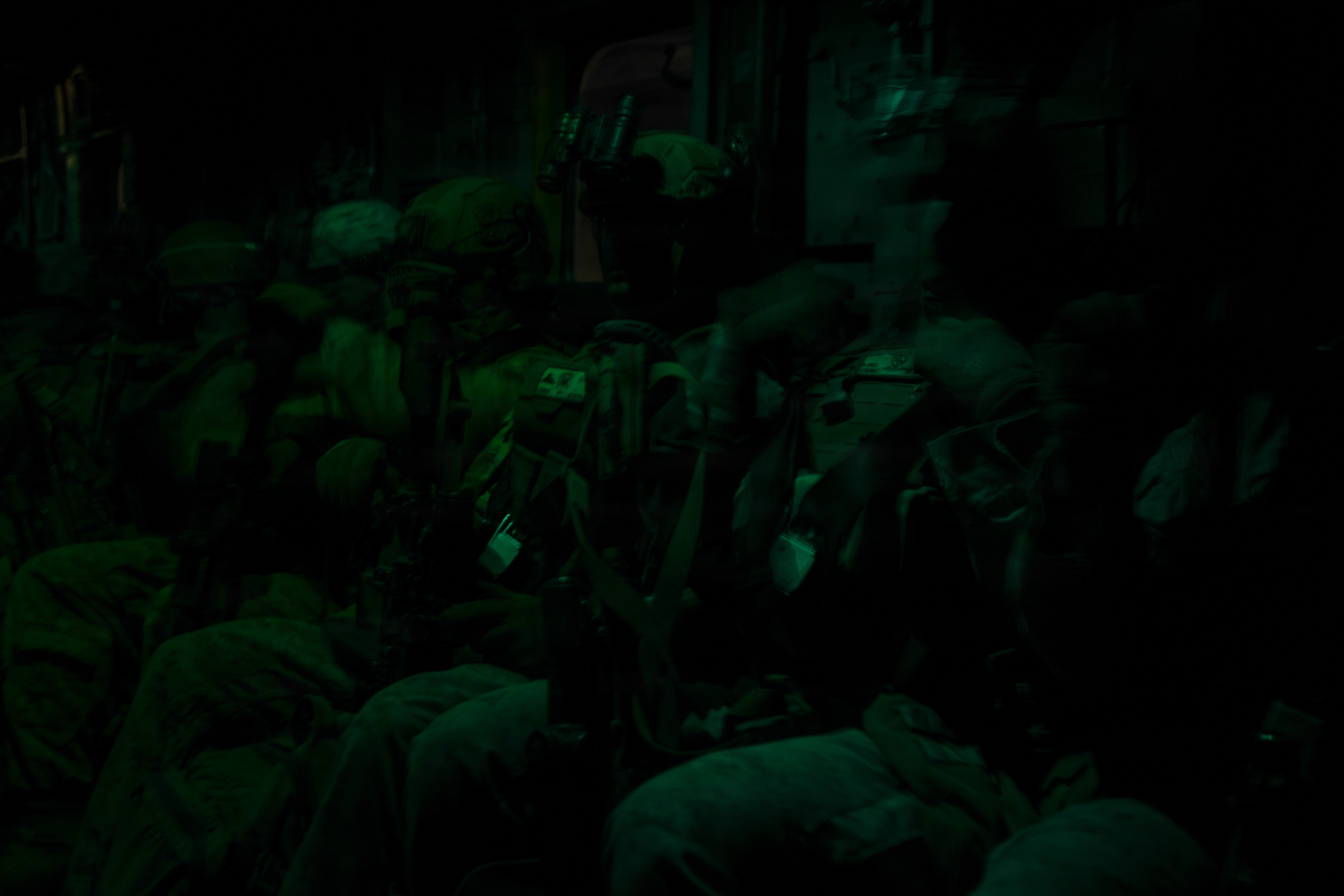
The night photograp, Marines packed into an aircraft cabin under infrared light, night vision devices active, closes the operational arc. AST-3 does not end at last light. The NEO and FHA mission sets are designed to be executed across the full twenty-four-hour cycle, and the darkness that complicates threat identification also provides cover for the extraction of noncombatants. The photograph conveys the compression and focus of the pre-insertion moment: Marines ready, aircraft moving, everything that happens next driven by the plan they built hours earlier.
What AST-3 Reveals About Marine Aviation Transformation
The standard description of WTI focuses on the certification function. It produces WTI-qualified officers and senior NCOs who return to their squadrons as the resident experts in integrated tactics. That is accurate as far as it goes.
But the AST-3 evolution at Twentynine Palms illustrates something broader.
The NEO and FHA mission sets are not legacy Cold War scenarios. They are the operational reality of the current strategic environment: contested environments where the adversary may be non-state, where noncombatants are present and must be protected, where the rules of engagement impose constraints that require judgment rather than simply firepower, and where the aviation-ground interface must function across multiple platform types under time pressure.
The MV-22B’s range and speed matter enormously in this context.
In a NEO, the ability to stand off at distance and come in fast reduces the exposure window. In a FHA operation, the range allows access to austere locations that rotary-wing platforms cannot reach efficiently.
These are not abstract performance specifications.
They are the operational reasons the Osprey is the right aircraft at the center of AST-3.
What the photographs from April 17–18 at Twentynine Palms document is a MAGTF in training, aviation and ground elements working through the friction of a realistic scenario, from first light to darkness, across multiple platform types, under the certification standards that MAWTS-1 was built to enforce. The Osprey overhead, the Marines in the dirt, the sniper in the hide, the crew chief scanning from the cabin door: these are not separate stories.
They are the same story, told from different vantage points.