

By George Galdorisi
The conflict in the Middle East has reminded nations and navies of the importance of naval forces in ensuring that the global commons is relatively free of strife and that nations can trade freely and energize the global economy. The role of navies in ensuring the security and prosperity of all nations has never been greater—nor under more stress. More so than perhaps any other navy, the U.S. Navy is feeling this most acutely.
This conflict has also brought to the fore the deadly effectiveness of sea mines. Reliable estimates from multiple sources assess that Iran has in the neighborhood of 6,000 sea mines. These include moored mines, bottom mines, limpet mines, and drifting mines, all purpose-designed to damage or sink ships attempting to transit the Strait of Hormuz or other restricted waterways.
This is not a new threat, and Iran has learned from previous uses of mines to intimidate adversaries. In the past several decades rogue states have indiscriminately employed sea mines. Libya used mines to disrupt commerce in the Gulf of Suez and the Strait of Bab el Mandeb. Iran laid mines to hazard military and commercial traffic in the Arabian Gulf and Gulf of Oman. During Operation Desert Storm in 1990-1991, the threat of mines precluded the effective use of the Navy and Marine Corps expeditionary task force off the shores of Kuwait and hazarded all U.S. and coalition forces operating in the Arabian Gulf.
Mines cannot be cleared swiftly. The threat posed by mines was so extensive that clearance operations in this confined body of water were not completed until 1997. Indeed, Operation Desert Storm highlighted the importance of mine warfare with the near catastrophic damage to USS Samuel B. Roberts (FFG 58), USS Princeton (CG 59) and USS Tripoli (LPH 10). Indeed, fourteen U.S. Navy ships have been sunk or damaged by mines since World War II, over three times the number damaged by air and missile attack.
The Hybrid Fleet
The U. S. Navy stands at the precipice of a new era of technology advancement. In an address at a military-industry conference, the U.S. Chief of Naval Operations, Admiral Michael Gilday, revealed the Navy’s goal to grow to 500 ships, to include 350 crewed ships and 150 uncrewed maritime vessels. This plan has been dubbed the “Hybrid Fleet.” In an address at the Reagan National Defense Forum, CNO Lisa Franchetti cited the work of the Navy’s Unmanned Task Force, as well numerous exercises, experiments and demonstrations where uncrewed surface vessels were put in the hands of Sailors and Marines, all designed to advance the journey to achieve the Navy’s Hybrid Fleet.
The reason for this commitment to uncrewed maritime vehicles is clear. During the height of the Reagan Defense Buildup in the mid-1980s, the U.S. Navy evolved a strategy to build a “600-ship Navy.” That effort resulted in a total number of Navy ships that reached 594 in 1987. That number has declined steadily during the past three-and-one-half decades, and today the Navy has less than half the number of commissioned ships than it had then. However, the rapid growth of the technologies that make uncrewed surface vessels increasingly capable and affordable has provided the Navy with a potential way to put more hulls in the water.
More recently, the U.S. Navy’s commitment to uncrewed surface vessels has culminated in the issuance of the Chief of Naval Operations Force Design 2045, and subsequently the Chief of Naval Operations Navigation Plan for America’s Warfighting Navy, both of which call for 350 crewed ships and 150 large uncrewed surface vessels. These documents provide the clearest indication yet of the Navy’s plans for a future fleet populated by large numbers of uncrewed surface vessels (USVs). Indeed, the recent DoD reconciliation bill made a $3.6 billion commitment to Navy uncrewed surface vessels, adding $2.1 billion for medium USVs and $1.53 billion for small USVs.
Juxtaposed against this aspiration is the fact that the U.S. Congress has, until recently, been reluctant to authorize the Navy’s planned investment of billions of dollars in USVs until the Service can come up with a concept of operations (CONOPS) for using them. Congress has a point. The Navy has announced plans to procure large numbers of uncrewed systems—especially large and medium uncrewed surface vessels—but a CONOPS, one in even the most basic form, has not yet emerged.
The concept of operations proposed is to marry various size surface, subsurface and aerial uncrewed vehicles to perform missions that the U.S. Navy has—and will continue to have—as the Hybrid Fleet evolves. The Navy can use evolving large uncrewed surface vessels as a “truck” to move smaller USVs, UUVs and UAVs into the battle space in the increasingly contested littoral environment. The Navy has several alternatives for this platform:
The Navy’s program of record LUSV. The Navy envisions these LUSVs as being 200 feet to 300 feet in length and having full load displacements of 1,000 tons to 2,000 tons, which would make them the size of a corvette.
Unmanned Surface Vessel Division One (USVDIV-1) has stewardship for two surrogates for LUSVs, the Ranger and Mariner, as well as two MUSV prototypes, Sea Hunter and Seahawk. The Navy was sufficiently confident in the operation of its LUSV and MUSV prototypes to deploy them to the 2022 international Rim of the Pacific (RIMPAC) exercise.
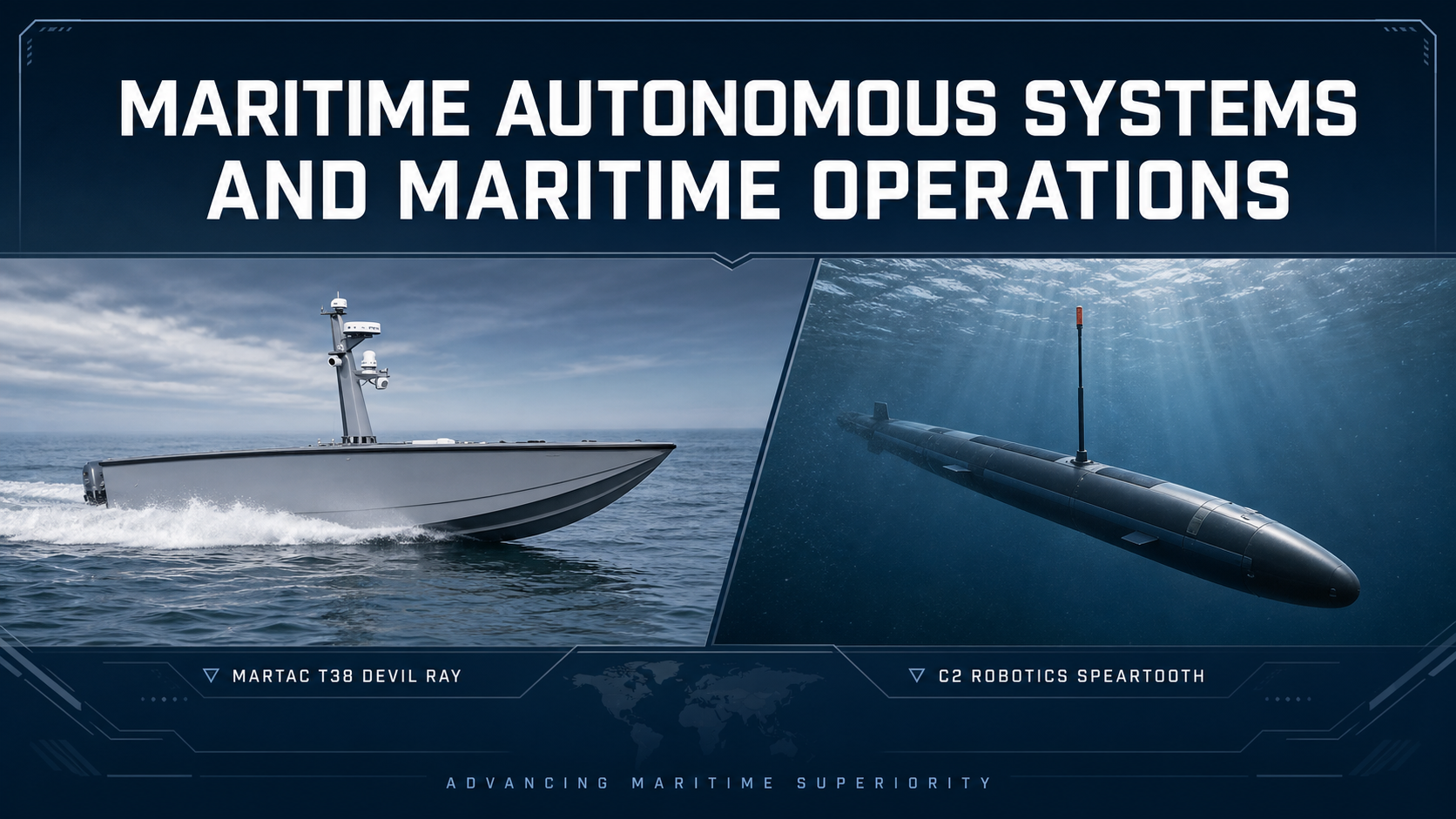
The MARTAC T82 Leviathan, a scaled-up version of the T38 Devil Ray, is an MUSV capable of either carrying an approximately 40,000-pound payload or, alternatively, carrying smaller craft and launching them toward the objective area.
While there are a plethora of important Navy missions this integrated combination of uncrewed platforms can accomplish, this article will focus on two: intelligence surveillance and reconnaissance (ISR) and especially mine countermeasures (MCM). There are many large, medium, small and ultra-small uncrewed systems that can be adopted for these missions. The technical challenge remains that they must be designed to ensure that the “multiple sized” UxSs associated with these missions can be adapted to work together in a common mission goal.
Rather than speaking in hypotheticals as to how uncrewed vehicles might be employed for these missions, this article will offer concrete examples using commercial-off-the shelf (COTS) uncrewed systems that have been employed in recent Navy and Marine Corps events.
While there are a wide range of medium uncrewed surface vessels (MUSVs) that can potentially meet the U.S. Navy’s needs, there are three uncrewed surface vessels that are furthest along in the development cycle. All are currently in production and fully operational. They are:
- The Leidos Sea Hunter is the largest of the three. The craft was launched in 2016 and was built at a cost of twenty million dollars.
- The Textron monohull Common Uncrewed Surface Vessel (CUSV), now referred to as the MCM-USV, features a modular, open architecture design.
- The Maritime Tactical Systems Inc. (MARTAC), catamaran hull, uncrewed surface vessels (USV) include the Devil Ray T24 (24-foot), and T38 (38-foot) craft.
All three of these MUSVs are viable candidates to be part of an integrated uncrewed solution CONOPS. I will use the Devil Ray craft for a number of reasons. First, they come in different sizes with the same hull, mechanical and electrical (HME) attributes. Second, Sea Hunter is simply too large to fit into and of the LUSVs the Navy is considering. Third, the CUSV is the MUSV of choice for the Littoral Combat Ship (LCS) Mine-Countermeasures Mission Package, and all CUSVs scheduled to be procured are committed to this program.
This scenario and CONOPS is built around an Expeditionary Strike Group underway in the Western Pacific. This Strike Group includes three LUSVs under supervisory control from a large amphibious ship. Chief of Naval Operations, Admiral Michael Gilday, suggested this CONOPS in early 2022 when he noted that he: “Wants to begin to deploy large and medium-sized uncrewed vessels as part of carrier strike groups and amphibious ready groups in 2027 or 2028, and earlier if I can.” More recently, Navy officials have suggested that these deployments may begin as early as this year.
Depending on the size that is ultimately procured, the LUSV can carry a number of T38 Devil Ray uncrewed surface vehicles and deliver them to a point near the intended area of operations. The T38 can then be sent independently to perform the ISR mission, or alternatively, can launch and recover one or more T12 MANTAS small USVs to perform this mission.
For the MCM mission, the LUSV can deliver several T38s equipped with mine-hunting and mine-clearing systems (all of which are COTS platforms tested extensively in Navy exercises). These vessels can then undertake the “dull, dirty and dangerous” work previously conducted by Sailors who had to operate in the minefield. Given the large mine inventory of peer and near-peer adversaries, this methodology may well be the only way to clear mines safely.
Implications for the Mine Countermeasures Mission
Few understand just how brittle the ability of the U.S. Navy to combat deadly sea mines is in 2026. The platforms that embody the U.S. Navy’s primary mine countermeasures (MCM) capability—the MH-53E AMCM aircraft and the Avenger-class minesweeper are all-but history. The MH-53E AMCM aircraft is scheduled to sunset in the next few years.
The last Avenger-class minesweepers were recently decommissioned. This leaves the totality of the Navy’s MCM capability in the discrete number of Littoral Combat Ships (LCS) outfitted with the Mine-Countermeasures Mission Module. Indeed, during the war with Iran with the crisis of Iran closing the Strait of Hormuz, the U.S. Navy could only muster three LCS equipped with the Mine Countermeasures Module.
The emerging Hybrid Fleet presents a cutting-edge solution to deploy a viable MCM capability with all U.S. Navy carrier strike groups and expeditionary strike groups, making autonomous mine-countermeasures assets readily available to deal with adversaries who deploy “weapons that wait.”
From Concept to Capability
This innovative approach accomplishes an important goal. If the U.S. Navy wants to keep its multi-billion-dollar capital ships out of harm’s way, it will need to surge MCM-capable uncrewed maritime vessels into the contested battlespace while its manned ships stay out of range of adversary A2/AD systems, sensors and weapons.
To be clear, this is not a platform-specific solution, but rather a concept. When fleet operators see a capability with different size uncrewed COTS platforms in the water working together and successfully performing the MCM mission, they will likely press industry to produce even more-capable platforms to perform these missions.
While evolutionary in nature, this disruptive capability delivered using emerging technologies can provide the U.S. Navy with near-term solutions to the vexing MCM challenge, while demonstrating to a skeptical Congress that the Navy does have a concept-of-operations to employ the uncrewed systems it wants to procure.
Note: The article was originally published in Oceans Robotics Planet and is republished wit the author’s permission.
See also, the following:
Lewis B. Puller and the Mine Warfare Mission at the Strait of Hormuz