Talisman Sabre 21: Port Ops

09/10/2021

Soldiers from 38th Air Defense Artillery Brigade, Marines from the 3rd Marine Division and civilians conducted port operations for Exercise Talisman Sabre 21 on July 9-10, 2021, at the Port of Gladstone located in Queensland, Australia.

This is the ninth iteration of Talisman Sabre, a large-scale, bilateral military exercise between Australia and the U.S. involving more than 17,000 participants from seven nations.

AUSTRALIA

07.09.2021

Video by Staff Sgt. Malcom Cohens-Ashley U.S. Army Pacific Public Affairs Office

Island Marauder 21

09/09/2021

By Matt Gonzales

MARINE CORPS BASE HAWAII

In August, Marine Corps Systems Command led one of the largest command and control user evaluations since the start of the COVID-19 pandemic.

MCSC collaborated with the Marine Corps Warfighting Lab, Marine Corps Forces, Pacific, Navy and Coast Guard to execute Island Marauder 21. The exercise, spread across multiple training sites on Oahu, enabled nearly 500 Marines to assess communication equipment in a maritime environment and provide direct feedback to system developers.

“Island Marauder allows Marines to employ, ask questions about and develop a greater understanding of their command and control equipment to better prepare them for the future fight,” said Maj. Ben Gardner, MCSC’s lead for Island Marauder 21.

The purpose of Island Marauder 21 was to employ a representative Littoral Combat Team to execute objectives using existing and emerging technologies under conditions anticipated for expeditionary advanced base operations, a core concept found in the Marine Corps’ Force Design 2030.

The event was a component of Large Scale Exercise 21—a live, scenario-driven exercise designed to better prepare the armed forces for combat in the Indo-Pacific region. LSE 21 is the largest exercise of this scale conducted by the U.S. in more than 50 years.

LSE 21 is also the first naval and amphibious large-scale exercise conducted since the Ocean Venture NATO exercises held during the Cold War. More than 25,000 Marines, Sailors and civilians took part in this multifaceted event.

Island Marauder serves as a critical LSE 21 exercise for the Marine Corps. The lessons learned through the event will inform future Marine Corps operating requirements and system development and acquisition tasks.

The Marine Corps is undergoing modernization efforts to support the future Marine. Gardner said supporting the Naval Expeditionary Force serves as a critical pillar in the Corps’ ongoing mission to prepare for the future fight against evolving threats.

“Island Marauder represents an integral step toward realizing this vision,” said Gardner.

Testing interoperability

This year’s Island Marauder was unlike previous iterations. In the past, MCSC provided experimental systems for participating Marines to use during training exercises. This year, MCSC instead integrated established programs of record in order to operate on live networks and fully integrate with the Navy.

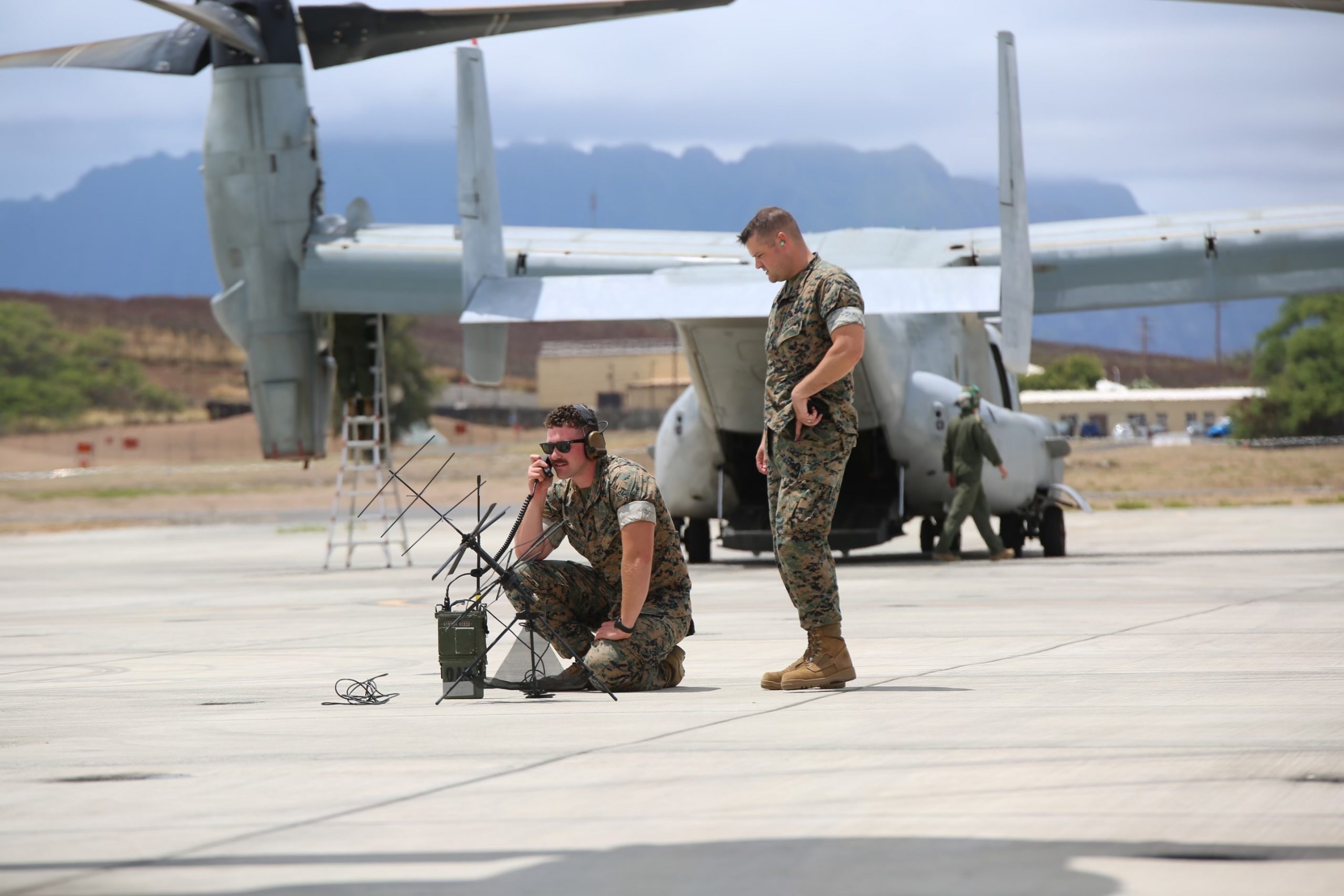
The command provided systems to 3rd Marine Regiment; 1st Battalion, 12th Marines; 1st Battalion, 3rd Marines; and Marine Medium Tiltrotor Squadron 268. These capabilities included tactical tablets such as Marine Air-Ground Common Handheld and Target Handoff System version 2, a Very Small Aperture Terminal satellite capability and more.

“The intent was for Marines to use the equipment in a manner that best supports their operations,” said Gardner.

Third Marine Regiment is an infantry unit, based out of Marine Corps Base Hawaii, who will soon transition to the newly formed Marine Littoral Regiment—a stand-alone, naval force capable of enabling maneuver and operations in a maritime environment.

Once established, 3rd MLR will be the first of its kind in the Marine Corps.

“An objective of Island Marauder is to give [III Marine Regiment] a chance to use this equipment to better inform their process and shape how they’re going to structure themselves to become Marine Littoral Regiment,” said Maj. David Parker, communication officer at III Marine Regiment.

During Island Marauder, Marines were instructed to use gear as they would in a live, operational environment. MCSC devised scenarios incorporating various training objectives that mirrored the future Indo-Pacific battlefield, allowing participants to grow more comfortable with the systems and situations.

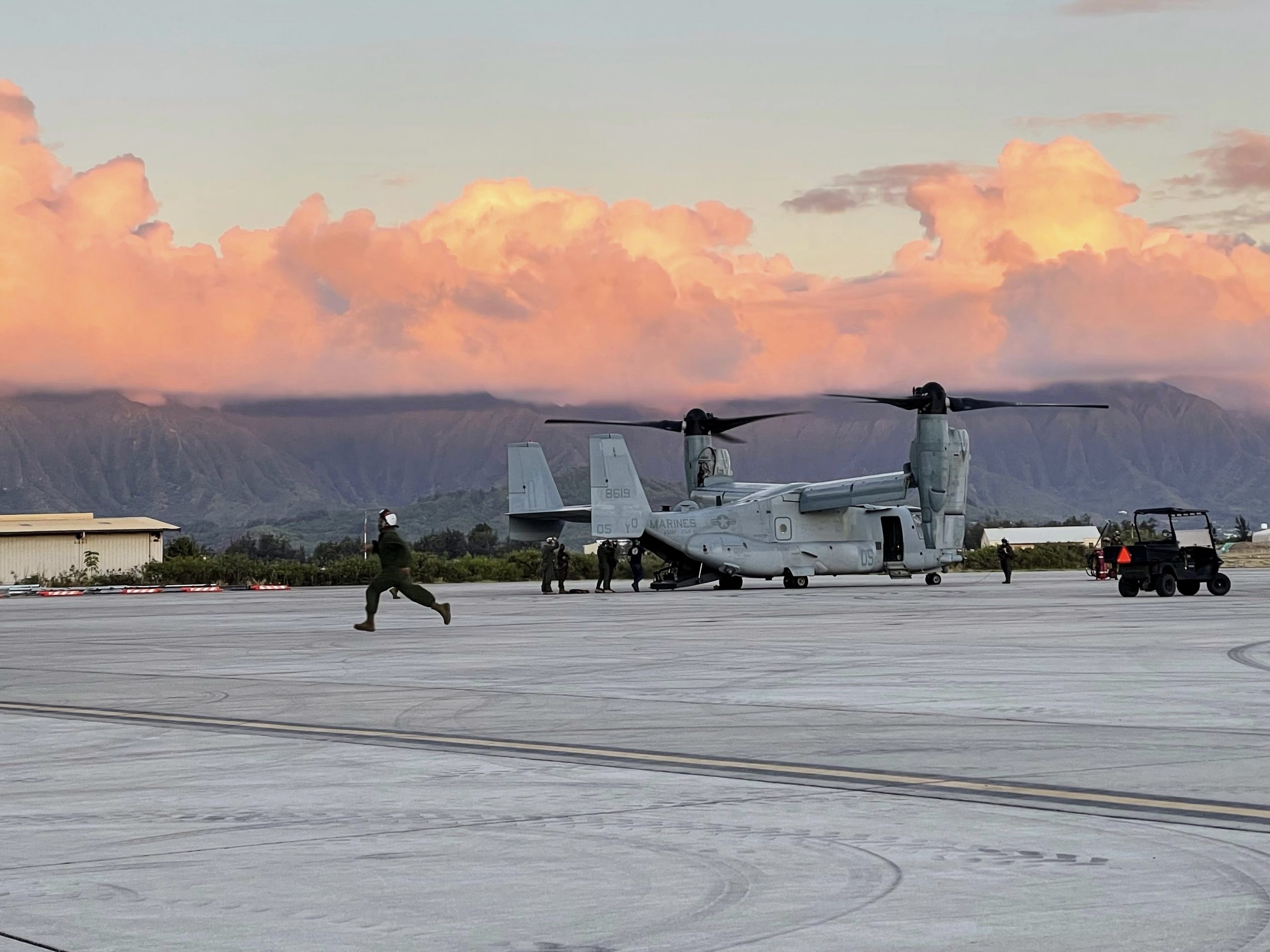
For example, one exercise saw participants seize terrain to enable artillery units to gain fire superiority on a distant island chain. The Marines of VMM-268 transported 3rd Marines and their equipment in an MV-22 Osprey from a pickup zone to a nearby island. Marines traveled in an Osprey equipped with a Networking On-the-Move system for an airborne command and control exercise.

Networking On-the-Move, a critical Force Design capability, was also integrated into a prototype Utility Task Vehicle and wheeled onto another MV-22 aircraft, showcasing its mobility and transportability. NOTM is a satellite command and control system Marines can leverage to communicate while mobile on the battlefield.

“This was the first time 3rd Marines have used NOTM on an aircraft,” said Gardner. “The task proved successful.”

During Island Marauder, MCSC integrated their communication equipment with LINK-16, a standardized communications system used by the U.S. and allied militaries. These capabilities helped to test interoperability among the joint forces in a denied or degraded environment.

The event also included ship-to-shore movements involving an amphibious transport dock, or landing platform dock, and a Landing Craft Air Cushion provided by the Navy. The LPD moved a group of Marines and Sailors from Oahu to Kauai via the LCACs.

“We integrated our equipment with naval and joint [command, control, communications, computers, combat systems and intelligence] systems in a realistic setting,” said Gardner. “That doesn’t happen often.”

‘An Invaluable Opportunity’

Routine interactions between infantry Marines and MCSC engineers is also uncommon.

Andrew Mitchell, a Naval Information Warfare Center Atlantic employee supporting MCSC as the lead engineer for Island Marauder, said Marines were eager to learn from the providers of their equipment, asking questions and receiving relevant, useful information.

These interactions also enabled MCSC program offices to consider the feedback and improve their equipment as needed.

“Having the diverse technologies we’ve brought to Island Marauder and putting them into a field user environment is valuable input to the development engineers,” said Mitchell. “This helps them further direct their work to give Marines better technology in the future.”

Marines participating in Island Marauder expressed their appreciation for the opportunity to familiarize themselves with critical systems, interact with engineers, and gain additional knowledge and skills needed to support future missions.

“I really appreciate the opportunity to gain firsthand experience and provide feedback to those organizations that have given us this equipment,” said Staff Sgt. Brandon Parker, a transmission chief with 1st Battalion, 3rd Marines. “It’s an invaluable opportunity.”

Maj. Christopher Montgomery, the VMM-268 aircraft maintenance officer, was one of the many VMM-268 Marines who provided support during Island Marauder. He believes strongly in the importance of large-scale testing events, as they foster experimentation and collaboration among the services.

“This exercise has given us the venue to test some of the capabilities, especially these new systems, and put them into practice as we achieve tactical objectives,” said Montgomery. “The support and integration of the industry representatives with the tactical level operators was effective.”

Island Marauder allowed MCSC to refine operational concepts that focus on fully integrating command and control capabilities across multiple domains. Commandant of the Marine Corps Gen. David Berger has emphasized the importance of defending key, contested maritime terrain to enable persistent sea denial and control operations to maintain a competitive advantage over enemy forces.

This article was published by Marine Corps Systems Command on September 1, 2021..

And an earlier article by Ashley Calingo highlighted the role of the exercise within the context of the wider U.S. Navy’s Large Scale Exercise 2021.

Marine Corps Base Hawaii—Marine Corps Systems Command provided support to exercise Island Marauder August 2-16 on Marine Corps Base Hawaii. Unlike previous years, Island Marauder this year was nested under the Navy’s Large Scale Exercise 21, a live, virtual and constructive, scenario-driven, globally-integrated exercise spanning 17 time zones.

During Island Marauder 21, a representative Littoral Combat Team executed objectives using existing and emerging technologies under conditions anticipated for expeditionary advanced base operations, a core concept found in the Marine Corps’ Force Design 2030. MCSC and the Marine Corps Warfighting Lab provided the technologies used and evaluated by Marines on the battlefield during the exercise.

“It’s critical we stay connected to our Marines and the operating forces to ensure the capabilities we’re providing not only meet their current needs, but will keep them ahead of any threat,” said MCSC Commander Brig. Gen. AJ Pasagian. “This is the perfect environment not only for us to solicit feedback on some of our new and emerging systems, but also assess the interoperability of those systems with our Naval partners.”

During the exercise, Marines used innovative communication equipment such as Networking On-the-Move, Marine Air-Ground Task Force Common Handheld, Target Handoff System Version 2 and more.

“We are taking fielded programs of record and providing this command and control equipment to 3rd Marine Regiment and a couple other units with whom they’re working,” said Maj. Ben Gardner, MCSC’s lead for Island Marauder 2021.

MCSC designed a series of scenarios designed to mirror real-life battlefield situations. For example, Marines will be loading a prototype NOTM system via Utility Task Vehicle onto an MV-22 Osprey from an airfield to a beach to test the equipment’s effectiveness while mobile.

The event allows the 3rd Marine Regiment, based in Hawaii, to familiarize themselves with a system they will be using in the future.

“This is the first time [3rd Marines] have used NOTM on an aircraft,” said Gardner.

MCSC collaborated with the Navy and Coast Guard to execute Island Marauder 2021. The Coast Guard provided a commissioned vessel to test interoperability among Marine Corps and Naval capabilities, a unique aspect of the exercise, said Gardner.

Island Marauder 2021 supports Commandant of the Marine Corps Gen. David Berger’s intention of developing a more naval force and better prepare for the expeditionary advanced base operations and the future Marine Littoral Regiment.

The Mission Brief of Island Marauder 2019 can be viewed below:

For an exercise by 2nd MAW last year which featured NOTM operating from an Osprey, see below:

Exercise Deep Water: Working the Integrated Distributed Insertion Force

Shaping a Way Ahead for the Marines in Pacific Defense: The Perspective of Lt. General Rudder, Commander, U.S. Marine Corps Forces, Pacific

09/08/2021

By Robbin Laird

My last visit to Hawaii and meetings with the MARFORPAC commander and his staff was in 2014.

In August 2021, I visited again and spent several days in the Islands, during which I visited both MARFORPAC and PACAF.

Since my last visit, what the Marines refer to as the “pacing threat” has gained enhanced momentum. The People’s Republic of China, both in policies and capabilities, have ramped up the threat and challenge envelope for the United States and its allies. The Russians are a Pacific power as well, and the direct threat posed by North Korea is an evolving one as well.

At the onset of my visit to the Marine Corps in Honolulu, I had a chance to talk with Lt. Gen. Steven Rudder, commander, U.S. Marine Corps Forces, Pacific. I have known “Stick” ever since he served as Deputy to the then-Deputy Commandant of Aviation, Lt. General George Trautman.

We started the conversation by focusing on how he sees the challenge facing the Marines in the Pacific.

This is how Lt. Gen. Rudder put it: “Our first challenge is about having the right force postured with the right capabilities.

“Our starting point is today’s posture, which for the most part is centered in Northeast Asia.

“Because of the vast distances in the Pacific, our additive challenge is being able to maneuver capabilities into places where you may not have a dedicated sustainment structure.

“Regardless, you have to be able to rapidly get there, set up, and operate using organic lift and logistics.”

The current Commandant of the USMC has highlighted the importance of the Marines being able to leverage their position as part of an “inside force” that is able to “stand in” and operate inside the adversary’s weapons engagement zone.

Lt. Gen Rudder underscored that part of the USMC current posture means, that on a daily basis, the Marine Corps must operate inside an adversaries threat ring.

“I think the key advantage for us is the daily posture of Marines in Japan and within ongoing partner operations in South East Asia.

“We are persistently in the first island chain ready to maneuver to seize or defend key maritime terrain.

“Continued integration with the joint force in Japan and in the Republic of Korea is critical within the context of any contingency.

“The question then becomes: what capabilities does the Marine and the Joint Force need to maneuver into the right tactical position to get the desired effects?”

When we published in 2013 our book on rebuilding American military power in the Pacific, we highlighted the strategic triangle of U.S. force generation and the strategic quadrangle for force employment.
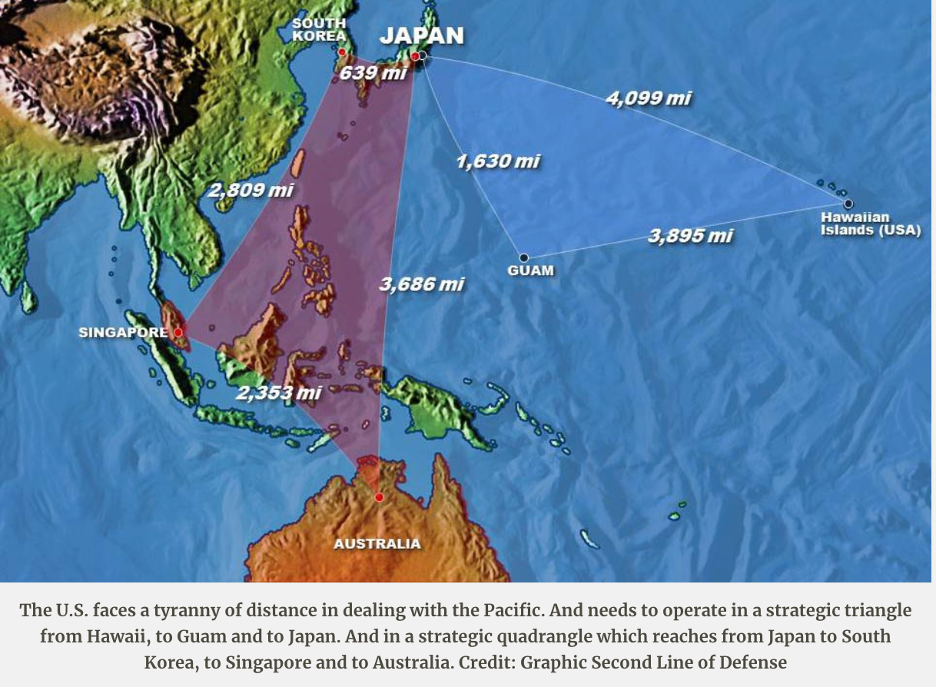
Since we shaped this graphic, and since I last visited MARFORPAC in 2014, the Marines have reworked the force projection trajectories, and are in the process of making these trajectories realities to shape a more effective engagement force in the region.

Since 2014, the initial Marine Rotational Force in Australia (MRF-D) has deepened its cooperation with the Australian Defense Force.

And Australia has itself enhanced its joint force capabilities, including the introduction of the F-35 and an amphibious surface fleet and air/ground capability.  The focus on operations in the direct defense of Australia and wider Indo-Pacific region creates significant and evolving opportunities for U.S./Australia interoperability.

Also, the Marines are building up their presence in Guam at Camp Blaz. This is the first new Marine Corps base since 1952.

As Seth Robson wrote in an October 1, 2020 article in Stars and Stripes about the standup of the base:

“The Marine Corps has activated a new base on Guam for 5,000 members of III Marine Expeditionary Force set to move there over the next five years from Okinawa, Japan. Camp Blaz, near Andersen Air Force Base, is the first new Marine installation since Marine Corps Logistics Base Albany was commissioned in Georgia on March 1, 1952.

“The Japanese government is funding $3 billion worth of projects for the Marines’ relocation, with the U.S. government spending another $5.7 billion, Navy Cmdr. Brian Foster, who is helping oversee construction for the Naval Facilities Engineering Command, told Stars and Stripes during a tour of the new base in February.:

“Only 1,300 Marines will be permanently stationed on Guam, with another 3,700 coming to the island as a rotational force in the same way a Marine Air Ground Task Force deploys to Australia’s Northern Territory to train each summer

“The formal establishment of Camp Blaz secures a Marine Corps posture in the region that is geographically distributed and operationally resilient,” the Marines said in their statement.

“Camp Blaz will play an essential role in strengthening the Department of Defense’s ability to deter and defend, and is also a testament to the strength of the U.S.-Japan alliance,” the Marines said.

This is how Lt. Gen. Rudder highlighted several opportunities for force projection.  

“We are focused on shaping an effective posture that combines forward bases with rotational partnerships with key Allies.

“I have already highlighted how important our posture is in Japan. Employing Infantry and MV-22s from Okinawa and F-35s from Iwakuni (in southwest Honshu) we readily integrate with Japans Amphibious Rapid Deployment Brigade.”

“MRF-D plays a role as well.  Six months out of the year, we rotate 2,000 Marines into Australia with ground forces, MV-22s, fires, and logistics capability.

“Now that the Australians are operating the F-35 and routinely exercising amphibious operations, we can work jointly on expanding high-end bi-lateral and multi-lateral operations.

“As a combined force, we have already increased the complexity of operations as recently demonstrated during Talisman Saber 21.”

“And as we build up and deploy greater numbers of forces to Camp Blaz, Guam, we will use this location as an additional posture location for 5,000 Marines and Sailors.

“All of these posture developments allow us to have various operational touch points from which one could aggregate force capabilities.

“With a combination of air and sea lift, we are designing a force with the ability to rapidly move into positions of advantage.”

We then discussed the evolution of fires which the Marines can bring to the Pacific fight.

With the end of the INF (Intermediate-Range Nuclear Forces) treaty, the United States can now build longer range conventional capabilities.

The Marines are looking to participate in this effort, and employ them from expeditionary forward bases well inside the adversary’s weapons engagement area.

The objective is to contribute to SLOC defense or be additive to offensive naval fires.

According to Lt. Gen. Rudder: “If we look forward in the not-too-distant future, we’ll have the ability to have land-based long-range fires, aviation fires, and persistent high endurance ISR (Intelligence, Surveillance and Reconnaissance) with the MQ-9.

“We’ll be able to move those capabilities with KC-130s, MV-22s, or amphibious lift allowing us to project long-range fires forward anywhere in Asia, much like we do with the HIMARS (High-Mobility Artillery Rocket System) today.”

“HIMARS fits in the back of a KC-130 allowing rapid mobilization and insertion. We will exercise the same operational tactic with anti-ship capability. We want to project sea denial capabilities to cut off a strait of our choosing or maneuver into positions to create our own maritime chokepoint.

“As we saw with hunting mobile missiles in the past, having long-range fires on maneuvering platforms makes them really hard to hit.  As we distribute our long-range fires on mobile platforms, we now become a hard platform to find.”

“Our desire is to create our own anti-access and area denial capability.

“For the last several years, we were thinking about the adversary’s missiles, and how they could be used to deny us access to forward locations.  Now we want to be the sea denial force that is pointed in the other direction.  Land based fires are perfectly suited to support naval maneuver.”

“We want rapidly to move by air or sea, deliver sea denial capabilities onto land, maneuver to position of advantage, deliver fires, maneuver for another shot, or egress by air or sea.  We are training current forces on concepts for sea denial missions supported by maneuver of long-range fires.  This is a key element of the naval integration.”

With a growing capability of joint sensor networks, the potential for more effective joint targeting is a reality.

As the joint force focuses on dynamic targeting, services are closely coordinating fires networks and authorities.

The advantage of land based expeditionary fires is that it provide persistence cover within an established air and surface targeting solution.

This is how Lt. Gen. Rudder characterized how he saw the way ahead. “We are completely integrated with naval maneuver and working hand and hand with the joint force. I MEF and III MEF have been operating seamlessly as three-star naval task forces astride Seventh and Third Fleets.

“During crises, I become the deputy JFMCC (Joint Force Maritime Component Commander) to the Pacific Fleet Commander. 

“The MARFORPAC staff integrates with the PacFleet staff.  Even during day-to-day operations, we have Marines at PacFleet planning and integrating across multiple domains.  Should we ramp up towards crisis or conflict, we will reinforce our JFMCC contribution to ensure we remain fully prepared for all-domain naval force execution.

“This means that our anti-ship missiles will integrate into naval maneuver.

“We also aggressively pursue PACAF integration for bomber, fighter, and 5th Generation support.

“Daily, our F-35s are integrated into the PACAF AOC (Air Operations Center).

“We are focused on better integration to insure we have a common operating picture for an integrated firing solution.”

The USMC F-35s play a key role in all of this. Although there is a clear focus on enhanced integration with the U.S. Navy, the integration with the USAF is crucial for both the U.S. Navy and the USMC.

Lt. Gen. Rudder highlighted the role which USMC F-35s play in Pacific defense and force integration.  

“We count on pulling fifth-gen capability forward in time of crisis.  We are committed to having forward deployed F-35s conducting integrated training on a regular basis with our PACAF counterparts.

“We will also conduct integrated training with our Korean, Japanese, Singaporean and Australian partners.  We are also training with aircraft carriers when they operate in the region. Notably, the USS Carl Vinson, the first U.S. Navy F-35C variant carrier.”

“And the F-35B has caught the operational attention of the rest of the world.  The United Kingdom’s HMS QUEEN ELIZABETH is the largest fifth-generation fighter deployment ever conducted on an aircraft carrier. We are proud to be a part of that UK deployment, with a Marine F-35B squadron, VMFA-211, embarked and operating with our British partners.  They are currently doing combined operations in the Western Pacific.

“We are excited to see the Italians operating F-35s off the ITS CAVOUR, and we hope by the fall of this year that we’ll be landing an F-35B on the Japan Ship IZUMO, as the Japanese look ahead to the purchase of F-35Bs. The South Koreans are considering going down a similar path, with Singapore also adding F-35s to their inventory.”

“Aside from shipboard operations, the F-35B can do distributed operations like no other combat aircraft.

“We can go into a variety of airfields which may not be accessible by other fighter aircraft, reload and refuel, and take back off again, making the both aircraft and the airfields more survivable.”

The Marines are the only combat force that tactically combine fifth generation with tiltrotor capabilities.

This combined capability is crucial for operations in an area characterized by tyranny of distance.

The MV-22 Ospreys can also carry a wide variety of payloads that can encompass the C2 and ISR revolutions underway.

And if you are focused on flexible basing, the combination of the two aircraft provides possibilities which no other force in the world currently possess.

But shortfalls in the numbers of aircraft forward create challenges to unleash their full potential for enabling the Marines as a crisis management force and enhance the Marine Corps contribution to the joint force.

The nature of distributed operations in the Pacific demands long range aircraft like the MV-22 to sustain the force.

The amphibious operating capability of the USMC becomes more significant as flexible basing and the enhanced capabilities which a family of amphibious ships could bring to the force.

This is how Lt. Gen. Rudder put it:  “We can reconfigure our amphibious ships to take on many different assault functions. I think when people talk about amphibious assault, they have singular visions of near-beach operations.  Instead, we need to think of our amphibious capability from the standpoint of our ability to maneuver from range.

“Rather than focusing on the 3,000 or 5,000-meter closure from ship to shore, I think about the  600, 700, 1,000-mile closure, with amphibs able to distribute and put people in place or to conduct resupply once you’re there.

“Amphibious lift, with its ability to bring its own connectors for logistics support, is increasingly significant for the operational force.

“In addition, we have to make sure that we’re able to close the force when lethal and non-lethal shaping has done its course.

At some point, you’re going to need to seize and defend land. We have two ways to tactically accomplish this mission, either by air or by surface assault. There’s no other way to get forces ashore unless you secure a port that has the space to offload and a road network to move ashore. Open port options are highly unlikely during crisis, thus amphibious lift is increasingly becoming more valuable for maneuvering forces in the maritime domain.”

The Marines are launching a new capability in the next couple of years, the Marine Littoral Regiment (MLR).

According to the MARFORPAC commander: “We are working towards initial operating capability (IOC) of the MLR in 2023.  We want to demonstrate the maneuverability of the MLR as well as the capabilities it can bring to naval operations.

“Near term, we will work to exercise new capabilities in the region, such as loading the NMESIS (Navy/Marine Corps Expeditionary Ship Interdiction System) system on the KC-130s or LCAC for integrated operations with F-35s, MQ-9s, and other maritime targeting capabilities.”

In short, the USMC is in transition in the Pacific, and working towards greater interoperability with the joint force, notably, the U.S. Navy and the USAF.

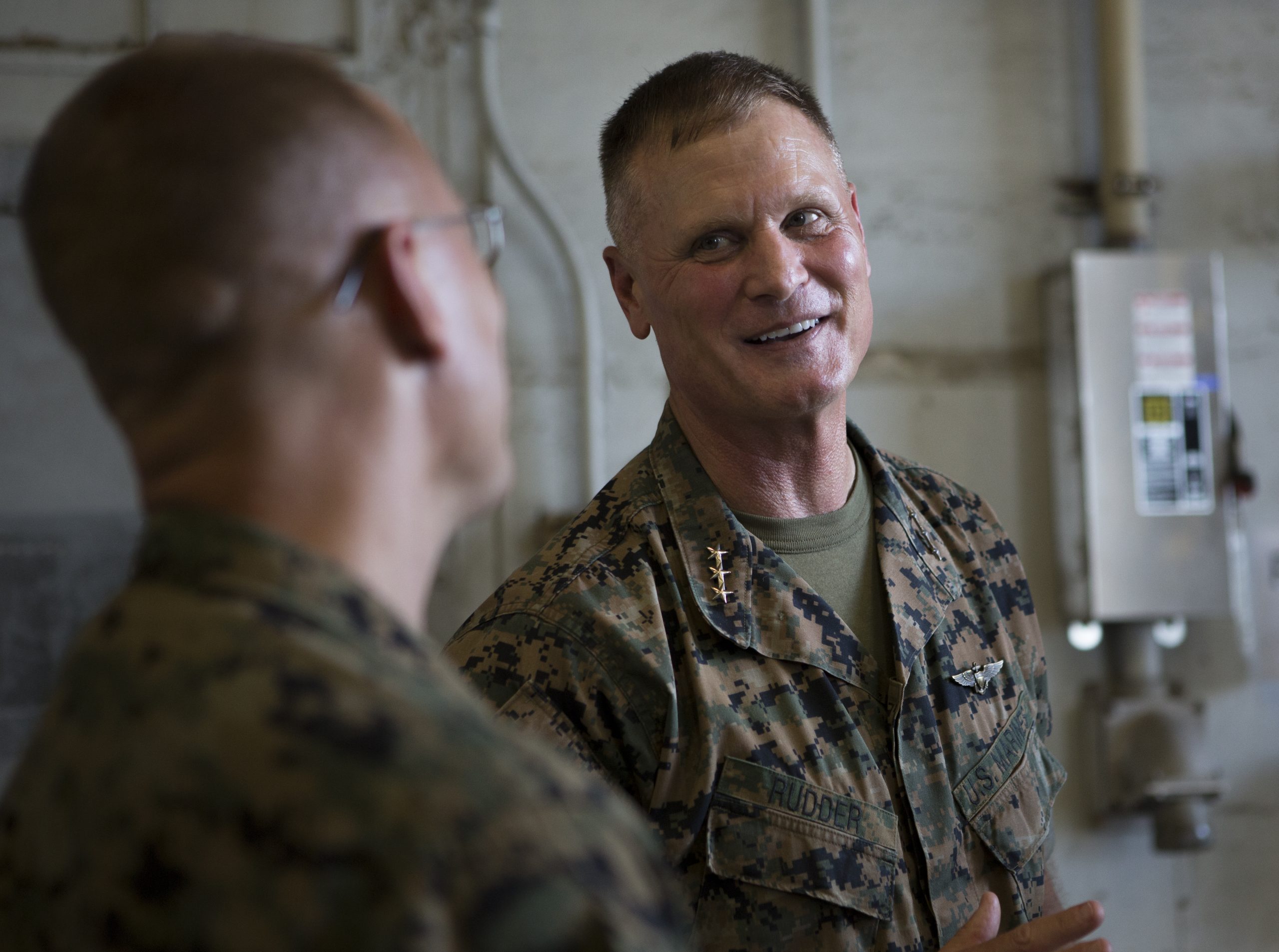
Featured Photo: Lt. Gen. Steven R. Rudder, commanding general of Marine Forces Pacific (center), speaks to the Marines of Marine fighter Attacks Squadron (VMFA) 323 at Marine Corps Base Hawaii, June 21, 2021. VMFA-323 is currently conducting routine operations in U.S. 3rd Fleet. (U.S. Marine Corps photo by Sgt. Dominic Romero)

Global Information Dominance Experiment (2)

U.S. Airmen from the New York, Washington, and Maryland Air National Guard monitor aircraft during the Global Information Dominance Experiment 3 in conjunction with the Architecture Demonstration and Evaluation 5 event at the 601st Air Operation Center on Tyndall Air Force Base, Fla, July 14, 2021.

North American Aerospace Defense Command and U.S. Northern Command, NORAD and USNORTHCOM, in partnership with all 11 Combatant Commands, led the third in a series of Global Information Dominance Experiments designed to rapidly develop the capabilities required to increase deterrence options in competition and crisis through a data-centric software-based approach.

GIDE events combine people and technology to innovate and accelerate system development for domain awareness, information dominance, decisional superiority, and global integration.

The GIDE 3 experiment was executed in conjunction with the Department of the Air Force’s Chief Architect Office (DAF CAO) as part of their fifth Architecture Demonstration and Evaluation event (ADE 5), and the Joint Artificial Intelligence Center.

TYNDALL AFB, FL

07.14.2021

Video by Staff Sgt. Alysia Blake

Global Information Dominance Experiment 3 & Department of the Air Force Architecture Demonstration and Evaluation 5

A Renewed Effort to Shape a European Rapid Reaction Force

09/07/2021

By Pierre Tran

Paris – Europeans have dusted off the concept of a European rapid reaction force in response to a lack of U.S. cooperation with allies in the chaotic withdrawal from Kabul.

The European Union’s pursuit of the concept of strategic autonomy may have won greater political support, but much will depend on what the EU can deliver if there were a call for boots on the ground.

That call for a European combat capability rose as Washington was seen as failing to act as a partner nation, when Taliban forces seized the Afghan capital on August 15.

A revival of a European operational capability, dubbed initial entry force, forms part of the work by the EU to extend its reach to the military world.

Besides the 27-strong European Union, there is also the ex-EU member, the UK, which has military capability and martial culture which make the forces ready to take up arms, if a  political call were made.

Tucked away at the bottom of an August 31 joint statement from France, Germany and Spain on a political agreement on the future combat air system, there was a line on something dubbed “strategic compass.”

“Germany, Spain and France share the common will to achieve an ambitious and operational Strategic Compass, in order to strengthen European defense,” the joint statement said.

That strategic compass refers to EU work to agree the means to guide its actions, strengthen a common European security and defense culture, and define policy objectives.

The EU has conducted for the first time a comprehensive analysis on threats to Europe, including global and regional threats, conflicts near Europe, challenges from state actors, and threats from non-state actors, the EU says on its website, Towards a Strategic Compass.

The strategic compass seeks to address four inter-related areas, namely crisis management missions, capabilities, resilience and instruments.

A “strategic dialog” among member states began in the first half of this year, development in the second half, and adoption of the strategic compass due in March 2022.

Meanwhile, on evacuation from Kabul it was clear the US treated the UK as just another country which happened to speak a common language, albeit with some quaint spelling.

There appeared to be little sign in Afghanistan of the special relationship that London lauds over, which briefly popped up when president Joe Biden met prime minister Boris Johnson ahead of the G7 meeting in June.

Robust and rapid action

In the strategic compass project, some EU member states promote the idea of a first entry force of some 5,000 troops, capable of “robust and rapid action,”  Josep Borrell Fontelles, EU high representative for foreign affairs and security policy, said in a Sept. 1 op ed for the New York Times.

Such an EU force could have been deployed to operations such as securing the Kabul airport, he said.

“A more strategically autonomous and militarily capable E.U. would be better able to address the challenges to come in Europe’s neighborhood and beyond,” he said.

The question is which EU member states would take part in such a high-risk combat operation.

France is at the forefront of such an EU first entry force.

Coincidentally, France takes up the six-month rotating presidency of the EU in January, and Macron is a fierce proponent of European strategic autonomy.

Macron, who will be seeking re-election when the country goes to the polls in April-May next year, sounded a warning of a wave of immigration from Afghanistan in his August 16 address to the nation. That was seen as a play to the far right in his search for votes.

Germany is a political and economic heavyweight in the EU, with a pacifist, anti-war sentiment which the government of the day must deal with.

German voters will decide Sept. 26 whether the conservative Christian Democrats will extend their political leadership beyond the 16 years of Angela Merkel as chancellor of the nation.

The opinion polls show strong support for the center-left Social Democrats and the ecology party, the Greens, while approval ratings for the Christian Democrats’ leader, Armin Laschet, have plummeted.

The voting cards may yield a fresh German coalition government, and it remains to be seen whether that will back a more assertive military presence.

France has long campaigned to build a European capability as an alternative to Nato, which is led by the US.

The shortcomings of Nato as a collective force were apparent in the unseemly retreat from Kabul, adding to the fuel to the fire fed by president Emmanuel Macron, who observed the brain death of the Atlantic alliance.

France is pushing the idea of ad hoc coalition of the “willing and able,” with nations such as the UK and Norway, to avoid delays tied to the search for consensus required by the EU, Jana Puglierin, senior policy fellow at the European Council on Foreign Relations, said.

“In the course of the current reflection process for the Strategic Compass, member states should discuss which types of missions and operations the EU really wants to engage in,” she said in an April 1 research note, Direction of Force: The EU’s Strategic Compass.

There is risk that “rhetoric” will outdo what the EU will deliver in “reality,” she said.

There has also been Brexit, which adds a “driver of ad-hockery in European security,” she said. The UK’s 2021 Integrated Review pointed up that “Global Britain” sought to work as bilateral or multilateral partner rather than through the EU.

Political will

Britain and France are bilateral partners in the combined joint expeditionary force, a 10,000-strong battle group, capable of being deployed for combat.

An operational capability may be there, but political will be needed.

The importance of political support can be seen in the UK parliament voting against intervention in Syria in 2013, with a majority of 13 expressing opposition to prime minister David Cameron.

For France, there is swiftness of a presidential decision to commit in the event of a crisis. For the UK, the prime minister could send armed forces, if need be. Those two nations could deploy a joint combined force with 48 hours.

In Germany, there will be need for parliamentary debate and approval, with much depending on events on the ground.

There have been further steps in Franco-German operational cooperation.

French defense minister Florence Parly and her German counterpart, Annegret Kramp-Karrenbauer, signed Aug. 30 an intergovernmental agreement on cooperation on tactical air transport, the two nations said in a joint statement.

The agreement set up a two-nation squadron and training center at Evreux airbase, to fly a squadron of C-130J transport aircraft, the statement said. The squadron would be stood up on Sept. 1, and French and German personnel will work in mixed teams without distinctions over nationality.

“While retaining the possibility of carrying out missions within a purely national framework, this is the first time an air force squadron is able to carry out operational missions with mixed crews, on French and German aircrafts (sic),” the statement said.

Some building blocks for European cooperation have been laid.

Belgium, France, Germany, and the Netherlands set up in 2010 the European transport air command at Eindhoven airbase, the Netherlands, to serve as a pool of transport aircraft. The seven member nations can draw on more than 170 aircraft.

It looks like a long road ahead for combat cooperation with European forces.

Global Information Dominance Experiment

09/06/2021

U.S. Airmen from the New York, Washington, and Maryland Air National Guard monitor aircraft during the Global Information Dominance Experiment 3 in conjunction with the Architecture Demonstration and Evaluation 5 event at the 601st Air Operation Center on Tyndall Air Force Base, Fla, July 14, 2021.

North American Aerospace Defense Command and U.S. Northern Command, NORAD and USNORTHCOM, in partnership with all 11 Combatant Commands, led the third in a series of Global Information Dominance Experiments designed to rapidly develop the capabilities required to increase deterrence options in competition and crisis through a data-centric software-based approach.

GIDE events combine people and technology to innovate and accelerate system development for domain awareness, information dominance, decisional superiority, and global integration.

The GIDE 3 experiment was executed in conjunction with the Department of the Air Force’s Chief Architect Office (DAF CAO) as part of their fifth Architecture Demonstration and Evaluation event (ADE 5), and the Joint Artificial Intelligence Center.

TYNDALL AFB, FL

07.14.2021

Video by Staff Sgt. Alysia Blake

Global Information Dominance Experiment 3 & Department of the Air Force Architecture Demonstration and Evaluation 5

Taliban Reach Out to India

09/05/2021

By India Strategic

New Delhi. In the first contact with the Taliban after the U.S. ended its two-decade occupation of Afghanistan, India on August 31 raised its “concern” that the country should not be used for anti-India activities and terrorism “in manner” and also discussed the early return of Indian nationals stranded in the country.

The Taliban has assured India that the issues it has raised “would be positively addressed”, the Ministry of External Affairs said in New Delhi.

“Today (August 31), Ambassador of India to Qatar, Deepak Mittal, met Sher Mohammad Abbas Stanekzai, the Head of Taliban’s Political Office in Doha. The meeting took place at the Embassy of India, Doha, on the request of the Taliban side,” the Ministry said in a statement.

“Discussions focused on safety, security and early return of Indian nationals stranded in Afghanistan. The travel of Afghan nationals, especially minorities, who wish to visit to India also came up.

“Ambassador Mittal raised India’s concern that Afghanistan’s soil should not be used for anti-Indian activities and terrorism in any manner.

“The Taliban Representative assured the Ambassador that these issues would be positively addressed,” the statement said.

Stanekzai, known as Sheru, had served as the chief peace negotiator in Doha that had laid the foundation for the US withdrawal that had been planned for August 31 but acquired added urgency after the Taliban seized Kabul on August 15, ahead of which President Ashraf Ghani fled the country.

The 58-year-old Pashtun from the Stanekzai clan had trained at the Indian Military Academy in the 1982. He rose to the ranks of Deputy Health Minister and Deputy Minister of Foreign Affairs in the Taliban regime that was overthrown in the wake of the US invasion following the 9/11 attack on New York’s World Trade Centre and headed the Taliban’s Political Office in Doha from 2015 to 2019.

On August 30, the United Nations Security Council, of which India currently holds the rotating Presidency, adopted a resolution on Afghanistan, aiming to prevent the use of Afghan soil by terrorist organisations against any country. The resolution was adopted with 13 votes in favour with Russia and China abstaining.

India has invested over $3 billion in the country in building dams, roads, electricity transmission lines besides schools and hospitals in the war-torn country. The country’s Parliament building, built by India, was inaugurated by Prime Minister Narendra Modi in 2015.

This article was published by India Strategic in August 2021.

The Australian Army Works the Shadow for Targeting Solutions

By Petty Office Lee-anne Cooper

M777A2 Howitzers were brought into action ready to fire. Tiger helicopters established battle positions ready to engage targets.

But the Shadow 200 unmanned aerial vehicles (UAV) and their targeting lasers were the stars of the show on exercise Dragon Sprint.

The exercise was held at the Townsville Field Training Area from June 21-23, and the UAVs were flown by gunners of the 131st Battery, 20th Regiment, Royal Australian Artillery.

The Shadows designated targets for artillery and close-air support from about 9000 feet above the battlefield.

Laser-designated coordinates fed to the gun line enabled fire missions to be undertaken at maximum range, while Tigers launched Hellfire missiles that the Shadows guided onto their targets using laser.

Huddled around a screen in a viewing tent, eager drone operators watched three dots forming a triangular sight held over a target.

There was silence and a collective breath was drawn as the personnel waited for the Hellfire to strike in the battery’s first laser-guided live-fire task since 2017.

20th Regiment Adjutant Captain Christopher Moroney said using Shadows for target acquisition meant less risk to other assets.

“Shadow can designate a vehicle-size target with as much accuracy as a Tiger. This reduces the risk to the Tiger – or another manned platform – doing it for itself,” he said.

“This, however, does not replace the ground-based observer, as we are a weather-dependant system.”

A forward observer still had to see the target before firing, but using the Shadow meant they didn’t need to get so close to the target, according to gun detachment commander Bombardier Bryson Smith, from the 106th Battery, 4th Regiment, Royal Australian Artillery.

“The target location depends on how close they need to be to that target,” Bombardier Smith said.

“They have to have a good line of sight to call in effective fire, so with UAVs, they do not need to be as close to the target and you can get a better acquisition and we can fire more effective rounds.”

With a range of 125km, the Shadow can fly well past the artillery’s maximum range.

This was further extended during the exercise by dislocating the Shadow operators 50km from the airfield, creating a battery forward position.

Laser designation principles mean the closer the Shadow is to the target, the more accurate it will be, and during the exercise, 12 successful Hellfire designations were achieved.

“Apart from range and target information, we can provide video, stills and have the ability to observe day and night using infrared,” Captain Moroney said.

“Being an aerial observer, it gives us a better perspective of the battlefield and you always want height and good optics to engage the target. This allows adjustments to be made more efficiently.”

Captain Moroney said the development of the capability was driven by the progression of training.

“First, we work in the simulator, and then practise it and execute it for real,” he said.

“It ultimately proves the system works and the soldiers are ready.”

The training value of Exercise Dragon Sprint was also extended to the School of Army Aviation, which brought in their aircraft and crews.

The school’s Commanding Officer, Lieutenant Colonel Scott Doré, said the school brought their entire Tiger training staff along with three trainee pilots to the exercise, and it was the first time they had worked with the 20th Regiment.

“It is a unique opportunity for us to develop our staff and for our trainees to see and be exposed to training they would not normally have the opportunity to at this point,” he said.

“We train our gunnery on a simulator and you do not get all the learning associated with expending live rounds and going through the range safety planning involved with a live-fire activity.”

The forward arming and refuelling point was also abuzz with activity, with significant ground assets required to support the aircraft.

Staff from the School of Army Aviation will look at the feasibility of supporting similar exercises in the future with benefits also identified for ground crew.

“Our aircraft support staff are not just refuelling, they are practising the core skills of loading ordnance onto an aircraft from a deployed location in the field, which is what our tradesmen joined the Army to do,” Lieutenant Colonel Doré said.

Exercise Dragon Sprint was the final in a series leading up to Exercise Talisman Sabre 21.

This was published by the Australian Department of Defence on July 2, 2021.

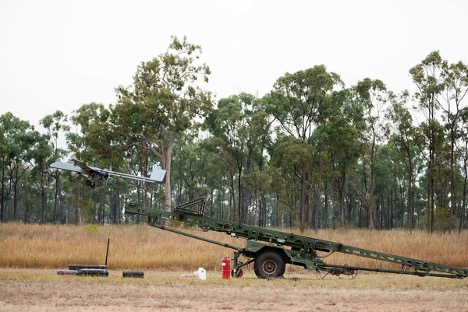
The featured photo: A Shadow 200 UAV is launched during Exercise Dragon Sprint at Townsville Field Training Area. Photo: Petty Officer Lee-Ann Cooper