

By Robbin Laird and Kenneth Maxwell
Brexit was sold, in significant part, as a restoration of sovereign control over Britain’s borders. By leaving the European Union, the United Kingdom would regain the ability to regulate migration flows, end free movement, and reassert national authority over who enters the country. Yet nearly a decade after the referendum, the opposite dynamic has emerged. Illegal migration across the English Channel has surged, not declined, even as EU free movement has been curtailed and net EU migration has turned negative. The result is a strategic and political paradox: Brexit has coincided with a loss of effective border control in precisely the domain it was meant to restore.
This paradox can be understood through a striking historical inversion—what might be called “Dunkirk in reverse.”
From Defensive Moat to Permeable Corridor
In 1940, Britain mobilized extraordinary effort to bring its forces home across the Channel, preserving national survival in the face of continental collapse. Today, the Channel has become a conduit in the opposite direction: not for organized military withdrawal, but for persistent, small-scale, irregular crossings into the United Kingdom. The geography is unchanged, but the strategic meaning has flipped. Where once the Channel served as a defensive moat, it now functions as a permeable boundary exploited by human smuggling networks and shaped by political fragmentation between Britain and its European neighbors.
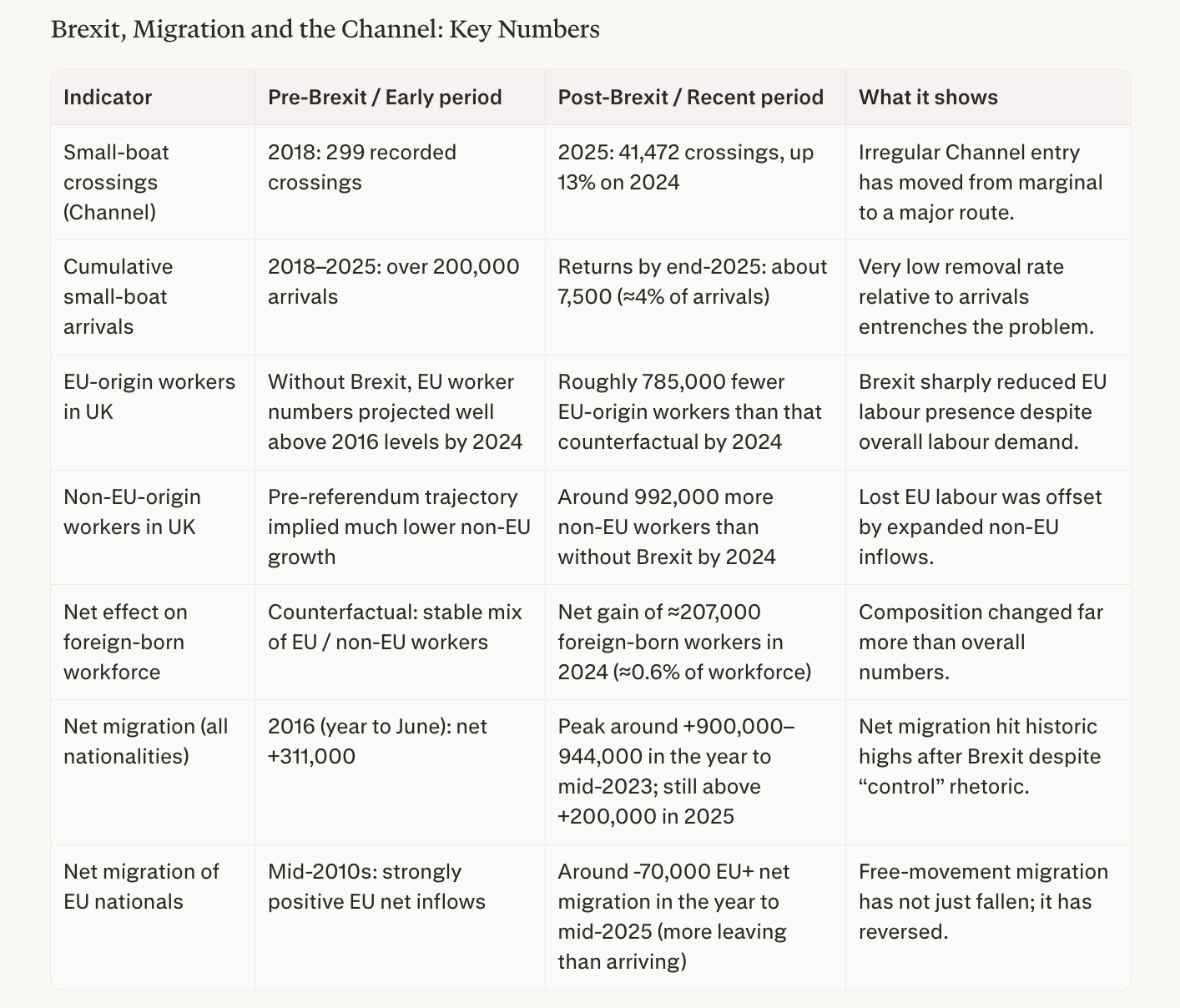
The empirical trend is stark. Since 2018, more than 200,000 people have attempted to enter the United Kingdom by crossing the Channel in small boats. Annual small-boat arrivals rose from a few hundred in 2018 to over 45,000 in 2022, before stabilizing at historically elevated levels—36,566 in 2024 and 41,472 in 2025, the highest total since 2022. By late April 2025, the 10,000-crossing mark had been reached more than a month earlier than the previous year, underscoring the entrenched nature of the traffic.
Post-Brexit Institutional Seams
The increase in illegal crossings since Brexit is not simply a matter of numbers—though those numbers are significant. It reflects a deeper structural shift in how Britain interacts with the European migration system. As an EU member, the UK participated in frameworks—formal and informal—that facilitated cooperation on border enforcement, intelligence sharing, and migrant returns, including the Dublin system for returning asylum seekers to the first EU country they entered. Brexit removed Britain from these arrangements without fully replacing them with equally effective bilateral or multilateral alternatives.
As a result, the UK now operates in a more fragmented enforcement environment. French authorities remain the primary line of defense on the continental side, but their incentives and legal context differ: France remains embedded in Schengen while the UK has positioned itself outside both Schengen and the broader EU legal architecture. Cooperation exists and has been periodically upgraded—the UK government points to joint work with France that it claims has stopped over 42,000 attempted crossings since the 2024 election—but this cooperation is transactional and politically fragile. The absence of integrated legal frameworks on returns and responsibility-sharing has created operational seams of precisely the kind that transnational smuggling networks exploit.
Sovereignty, Expectations, and Unintended Signals
The symbolic politics of Brexit have also produced unintended signaling effects. The emphasis on sovereignty and border control elevated migration to a central political issue, generating public expectations of dramatic reductions in numbers. Yet overall migration into the UK, driven increasingly by non-EU arrivals under the post-Brexit points-based system, climbed to a historic net migration high of around 764,000 in 2022 and remained elevated at approximately 685,000 in 2023. Over the same period, net migration of EU nationals turned negative, with some 162,000 more EU citizens leaving the UK than arriving between mid-2021 and mid-2025, and net EU migration standing at roughly 70,000 in the year to June 2025.
In other words, Brexit succeeded in reducing EU free-movement-based migration—by 2024, EU-born workers in the UK were estimated at around 785,000 fewer than pre-Brexit trends would have projected—but this was more than offset by an increase of roughly 992,000 non-EU-born workers over a comparable period. The net result was a modest increase in the foreign-born workforce of about 207,000, or 0.6 percent of the labor force, but with a sharp compositional shift from EU to non-EU. The political narrative of “taking back control” thus ran headlong into a statistical reality of record-high net migration and highly visible irregular flows by small boat.
Irregular Channel crossings, though a fraction of overall migration, have acquired outsized political salience because they are both visible and symbolically charged. In 2025, 41,472 people were recorded crossing the Channel in small boats—a 13 percent increase on 2024—despite a battery of new deterrence measures including the Illegal Migration Act 2023. Analysts estimate that the “small boats crisis” carries an annual public cost in the region of £3.5 billion, with cumulative costs since 2018 exceeding £24 billion; the National Audit Office has projected that the wider asylum system could cost over £15 billion over ten years. This gap between political promise and operational outcome fuels a feedback loop: heightened salience drives ever-harsher rhetoric and policy experimentation, which in turn raises expectations that go unmet in practice.
Labour Market Pull and Legal Route Closure
There is also a structural demand-side factor that the Dunkirk analogy helps to illuminate. The UK labour market continues to exert a pull, particularly in sectors reliant on flexible or lower-wage labor such as social care, hospitality, and agriculture. The post-Brexit immigration regime restricted most low-skilled EU migration by design but did not eliminate economic demand for such workers. Where legal, low-friction EU routes once existed, they have largely closed, while new legal pathways are concentrated in higher-skilled or specifically sponsored categories dominated by non-EU nationals, who accounted for 91 percent of work-related migration in 2023.
In this context, irregular pathways can become more attractive, particularly when combined with the perception—reinforced by backlogs and limited removal capacity—that successful arrival in the UK leads to a relatively durable presence. The UK government emphasizes that it has removed or deported almost 70,000 people who were in the country illegally since the 2024 election, including over 15,000 illegal migrants and more than 8,700 foreign national offenders, and claims record levels of removals of small-boat migrants. Yet these figures coexist with continued high levels of new small-boat arrivals, suggesting that the overall deterrent signal has been, at best, ambiguous.
Dunkirk in Reverse: Agency and Control
The “Dunkirk in reverse” metaphor captures another dimension: agency. In 1940, Britain controlled the operation, mobilizing state and civilian assets in a coordinated effort to extract national power from the Continent. Today’s Channel crossings are defined by a lack of control—on the part of the UK, France, and to some extent the EU system as a whole. Initiative lies with decentralized actors: migrants making individual or family-based decisions, and smuggling networks organizing routes and timing, often adjusting rapidly to enforcement changes and weather windows. The state largely reacts rather than directs.
From a strategic perspective, this raises a broader question about the meaning of sovereignty in an interconnected environment. Brexit sought to reassert national control by withdrawing from supranational structures. Yet in areas like migration—where flows are inherently transnational—control often depends on embedded cooperation, shared legal frameworks, and predictable burden-sharing rather than unilateral action. The British case suggests that sovereignty exercised outside such frameworks can produce outcomes that are experienced domestically as diminished control, particularly when irregular flows become the most visible manifestation of the system.
This does not mean that Brexit alone “caused” the rise in Channel crossings. Wider forces are at work: instability in source regions, global displacement trends, evolving smuggling tactics, and the partial displacement of other Mediterranean and Balkan routes. But Brexit altered the institutional and signaling context in which these pressures are managed, removing certain tools—notably EU-level return and responsibility-allocation mechanisms—complicating others, and leaving gaps that have yet to be filled by robust alternatives.
The result is the paradox at the heart of the current situation. A political project aimed at tightening borders has coincided with a highly visible and politically destabilizing form of border permeability. The Channel, once a symbol of separation and security, has become a focal point of contested control and policy improvisation. In that sense, “Dunkirk in reverse” is more than a metaphor. It is a lens through which to understand how strategic geography, political choices, and institutional design interact—and how, under certain conditions, they can produce outcomes directly at odds with their stated intent.
The scale and structure of the paradox can be captured in a few headline figures
Sources for the Table:
https://cepr.org/voxeu/columns/impact-brexit-foreign-born-workers-uk
What’s happened to UK migration since the EU referendum – in four graphs