By Robbin Laird
Four photographs from the Anti-Air Warfare exercise during Weapons and Tactics Instructor Course 2-26 near Yuma, Arizona, document something that rarely gets captured together in a single set: not just a radar system deployed, but a radar system deployed survivably.
The AN/TPS-80 Ground/Air Task Oriented Radar standing in the desert scrub, the operations node concealed under camouflage netting blended into the surrounding vegetation, and the security team in a fighting position underneath their own net, these are not separate stories. They are the components of a single survivability concept that the Marine Corps is building into its anti-air warfare architecture.
The AN/TPS-80: The Marine Corps’ Ground/Air Task Oriented Radar
The AN/TPS-80 G/ATOR is the Marine Corps’ primary ground-based multi-mission radar, designed to replace several legacy systems with a single platform capable of performing air surveillance, air traffic control, counter-battery, and short-range air defense cueing functions simultaneously. It is an S-band Active Electronically Scanned Array radar that can detect and track fixed-wing aircraft, rotary-wing aircraft, cruise missiles, unmanned systems, and surface targets across a single integrated architecture.
Its operational significance in the context of WTI’s Anti-Air Warfare exercise is precisely its multi-mission versatility. In the AAW scenario, the G/ATOR is not just providing air surveillance data. It is feeding the common operational picture that the Marine Air Control Squadron uses to manage the airspace, vector interceptors, and coordinate with the broader kill web. The radar’s data outputs connect to the Marine Air Command and Control System architecture, making it a networked node rather than a standalone sensor.
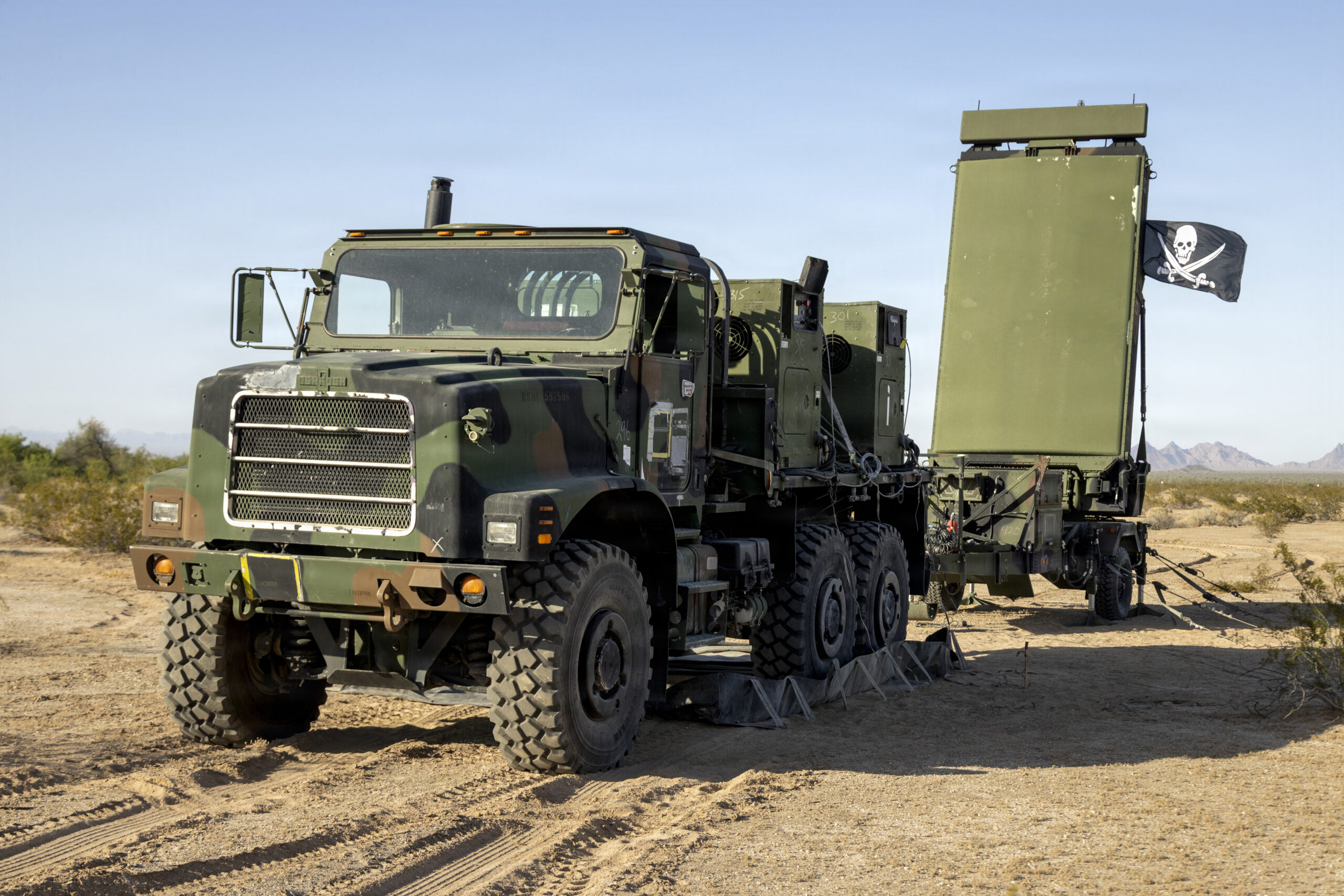
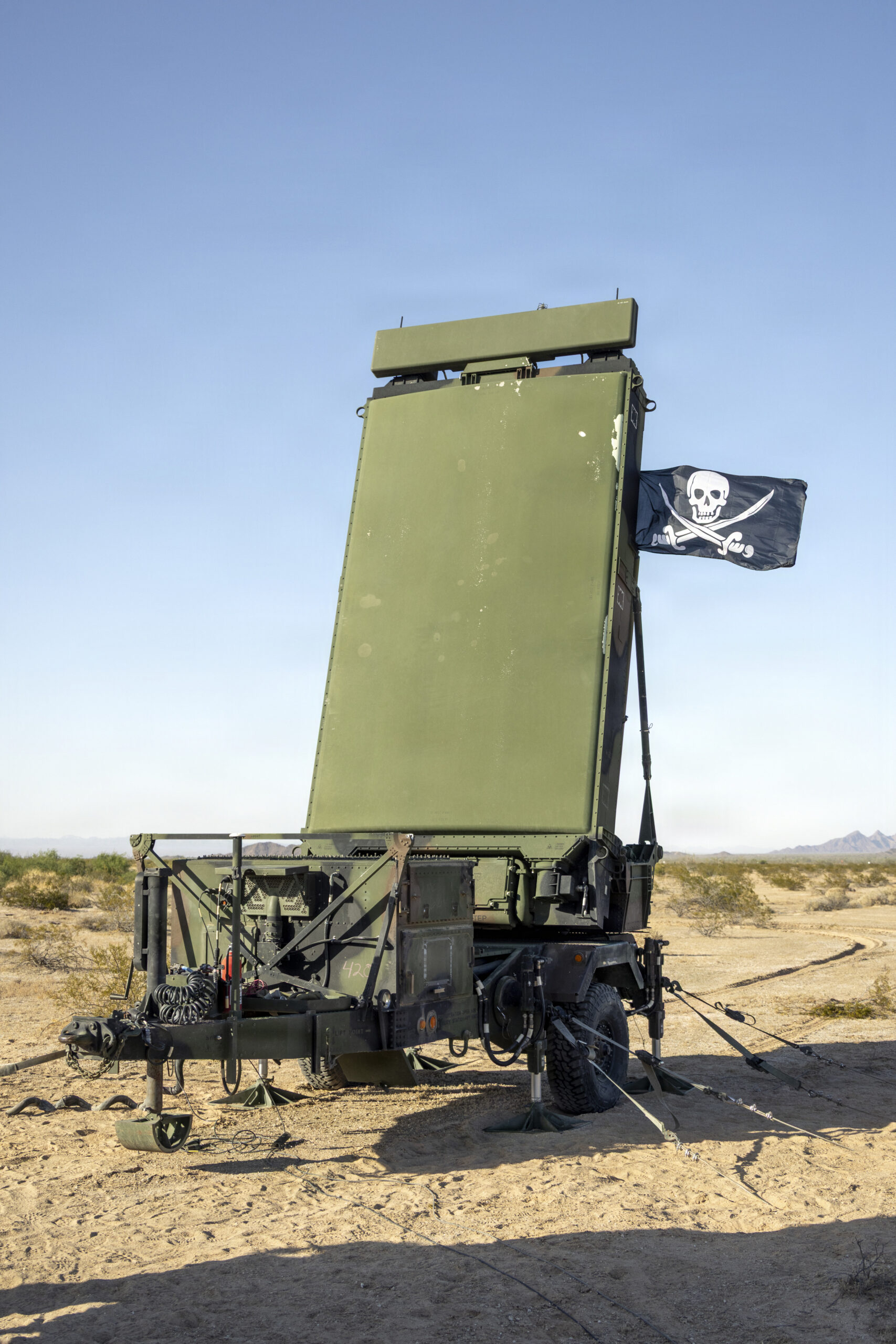
Images 2 and 3 show the radar array erected on its trailer, towed into position behind an MK23 MTVR. The flat-panel array faces outward, its elevation optimized for the detection geometry of the exercise scenario. A Jolly Roger pirate flag flies from the mast beside the array, a unit marking that is common in Marine radar communities and carries a specific connotation: this crew hunts.
The Concealed Operations Node: Signature Management in Practice
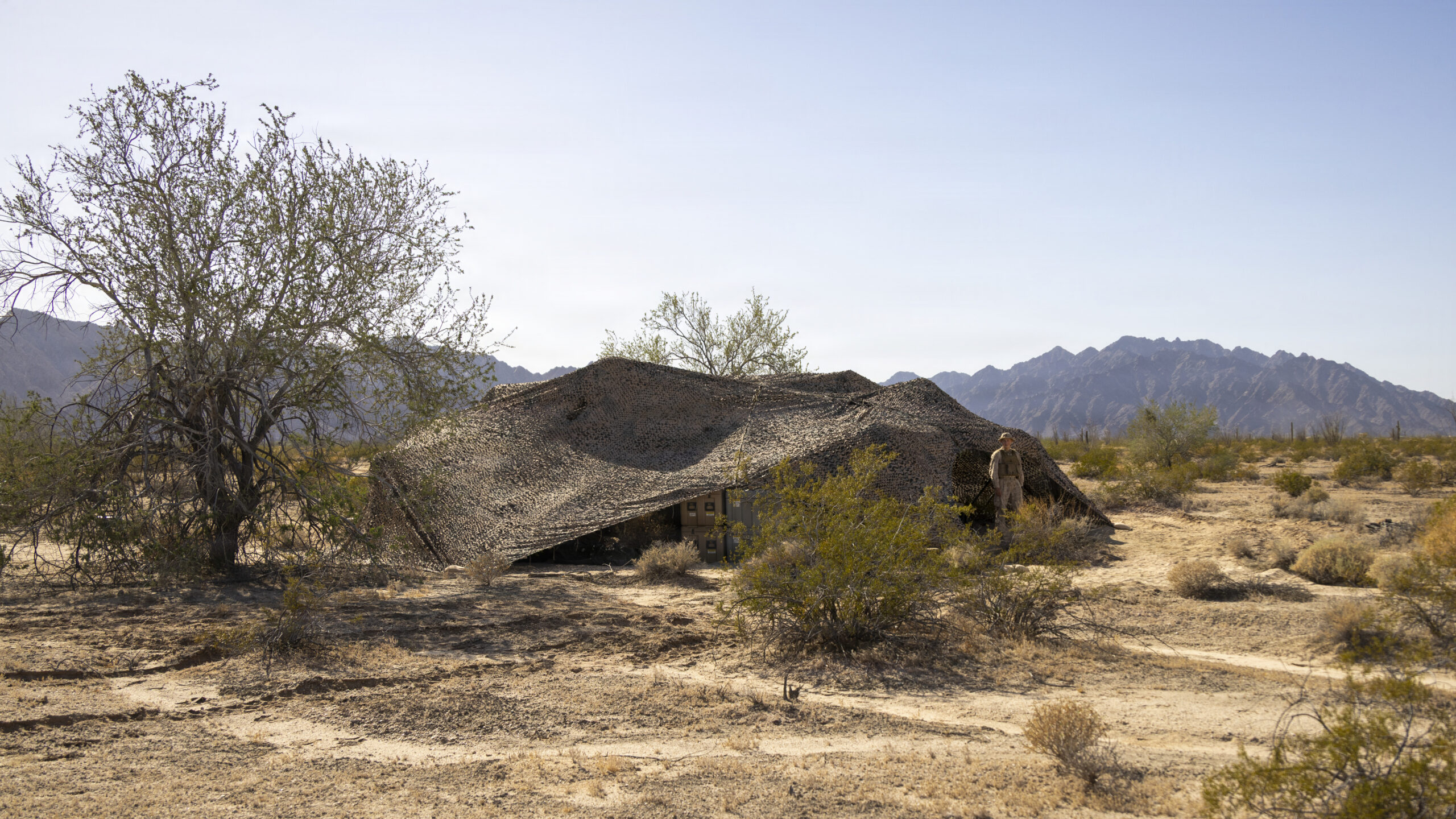
Image 1 is the most operationally significant photograph in the set, and it is the one that requires the most careful reading. At first glance it appears to show a camouflage net draped over low desert scrub. On closer examination, the rectangular outline of equipment housing is visible beneath the netting, and a single Marine stands at the edge. This is the G/ATOR’s operations node, the shelter containing the operator consoles, processing hardware, and communications interfaces that turn radar returns into usable tactical data, concealed under a large-format camouflage net integrated into the surrounding mesquite and desert brush.
The concealment is deliberate and practiced. The net’s edges blend into the vegetation line. The equipment housing is positioned to break up its geometric signature against the natural terrain. A casual aerial observer or a reconnaissance drone passing at altitude would see scrubland. The Marine standing at the net’s edge is the only human indicator visible, and he is partially absorbed by the shadow of the net itself.
This is signature management applied to a high-value sensor node. In a contested environment where adversary ISR is assumed to be persistent — the operational context that WTI is explicitly training for — a radar operations node that can be visually located from the air is a target. The concealment discipline visible in Image 1 is the practical answer to that threat. The radar transmits; the operators work; the node is difficult to find.
There is a productive tension in Images 1 through 3 taken together. The radar array in Images 2 and 3 is necessarily visible. It must have line of sight to the sky to function. It cannot be fully concealed while operating. The operations node in Image 1 can be. The deployment discipline being practiced at WTI 2-26 separates these two elements: the array is positioned to minimize its ground signature while maximizing its radar coverage geometry; the operations node is positioned at distance, concealed, and connected to the array by cable. The adversary who finds the array antenna has not necessarily found the operators or the communications links.
The Security Position: Defending the Sensor
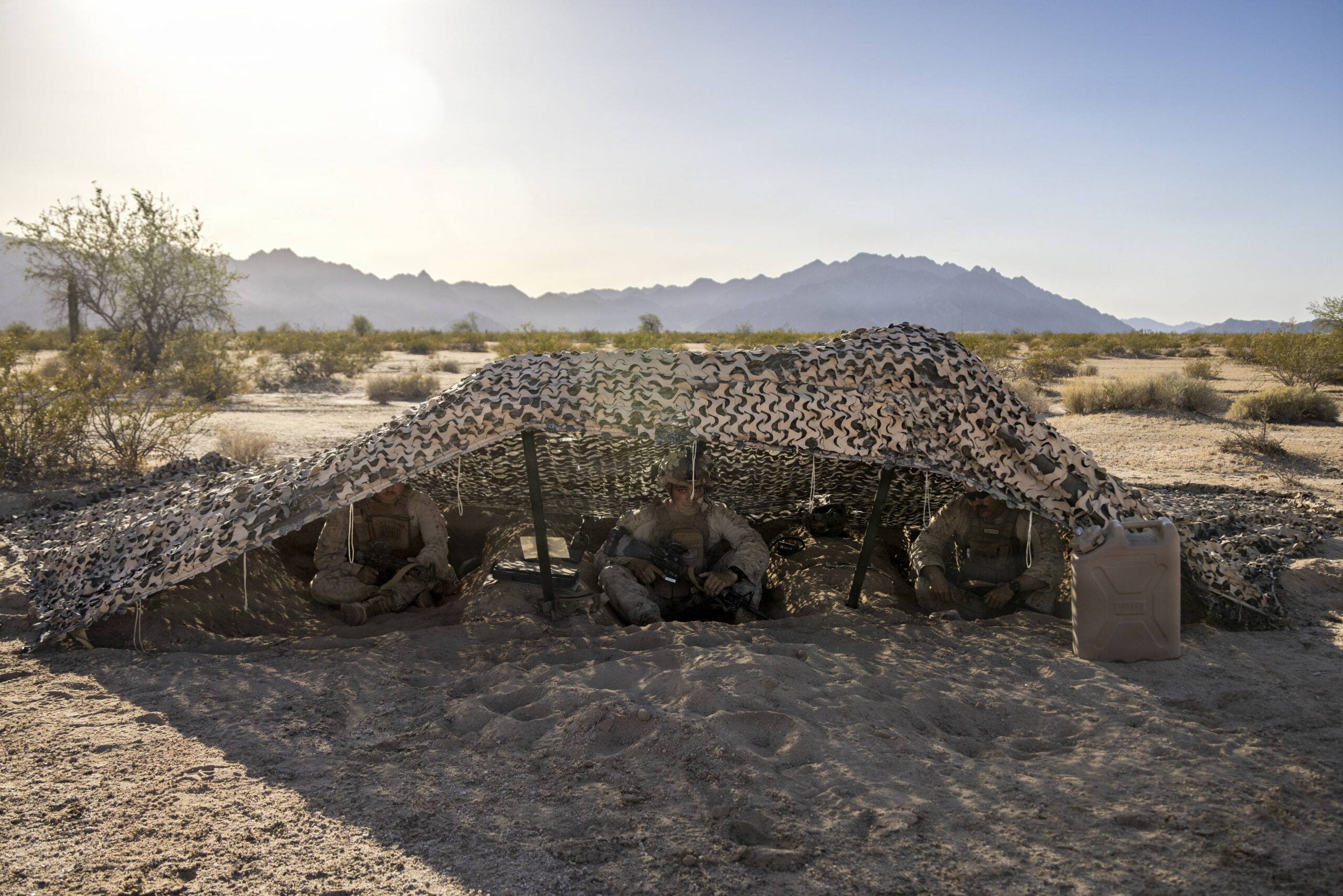
Image 4 completes the operational picture. Three Marines are seated in a prepared fighting position, a scraped depression in the desert sand, under a smaller camouflage net supported by collapsible poles. Weapons are present. The position faces outward from the radar site. The mountains in the background frame the position against the terrain, and the low profile of the net keeps the Marines below the natural vegetation line when viewed from a distance.
A radar site without a security element is a sensor that can be overrun. In the distributed operations environment the Marine Corps is designing for, forward radar positions will be small, lightly manned, and operating at significant distance from any large supporting force. The security team in Image 4 is not a token presence. It is the defensive layer that allows the radar operators in Image 1’s concealed node to continue functioning under the assumption that a ground threat could materialize from any direction.
The fighting position itself reflects the same signature discipline as the operations node concealment. The Marines are below ground level, under netting that breaks their visual signature, in a position that provides observation of the approaches to the site without presenting a standing target. This is not defensive posturing for its own sake. It is the security layer that makes the sensor survivable.
AAW-4 in the WTI Architecture
The Anti-Air Warfare exercise at WTI is one of the most complex evolutions in the course. It requires the prospective WTI to integrate the radar sensor picture, the intercept geometry of available air assets, the airspace deconfliction requirements for friendly aviation, and the engagement authority framework, all simultaneously, in a compressed timeline, against a threat that does not wait for the defender to finish coordinating.
The G/ATOR’s role in that architecture is foundational. Without accurate, timely radar data, the intercept geometry cannot be calculated, the airspace picture cannot be built, and the engagement decision cannot be made with confidence. The radar is the sensor that makes the rest of the kill web’s AAW function possible. This is why MAWTS-1 treats the G/ATOR’s employment, not just its operation, but its survivable employment including site selection, concealment, security, and emissions management, as a core WTI competency.
The prospective WTI who supervised the camouflage net layout over the operations node, walked the security team into its fighting position, and then watched the G/ATOR track simulated threats across the desert airspace has learned something that no classroom slide can convey: the sensor only works if it survives long enough to do its job. Survivability is not a separate subject from radar employment. It is a precondition of it.
The Jolly Roger and What It Signals
The Jolly Roger flying from the G/ATOR mast in Images 2 and 3 deserves a brief note. The pirate flag is a longstanding informal marker in Marine radar and air defense communities, a signal that this crew operates aggressively, hunts its targets, and does not wait passively for the threat to present itself. It is also a subtle reminder of the AAW mindset that WTI is instilling: in the anti-air fight, the defender who waits to be found loses. The crew that goes hunting that positions its sensor to maximize detection geometry, conceals its operations node, defends its position, and pushes its data into the kill web before the threat has completed its attack profile has a chance.
The four photographs from AAW-4 at WTI 2-26 document that mindset made physical: a radar that sees, a node that hides, and a security team that defends. Together, they constitute a survivable sensor position in a contested desert environment.
That is what the Marine Corps is training its future aviation instructors to build, sustain, and fight from.
Note: According to Northrop Grumman and other sourcing on the program, the G/ATOR was designed to consolidate five legacy Marine Corps radar systems into a single platform:
- AN/TPS-63 – air defense/air surveillance radar
- AN/TPS-73 – air traffic control radar
- AN/MPQ-62 – short-range air defense (Hawk system) radar
- AN/TPQ-46 – counter-fire (artillery/mortar) target acquisition radar
- AN/UPS-3 – target tracking radar
Each of those required its own generator, shelter, antenna, crew, and logistics tail. G/ATOR does air surveillance, air traffic control, counter-battery target acquisition, and short-range air defense cueing in one AESA system which is the “single platform instead of five: fewer systems to camouflage, secure, and truck around means a smaller signature for the same mission coverage.