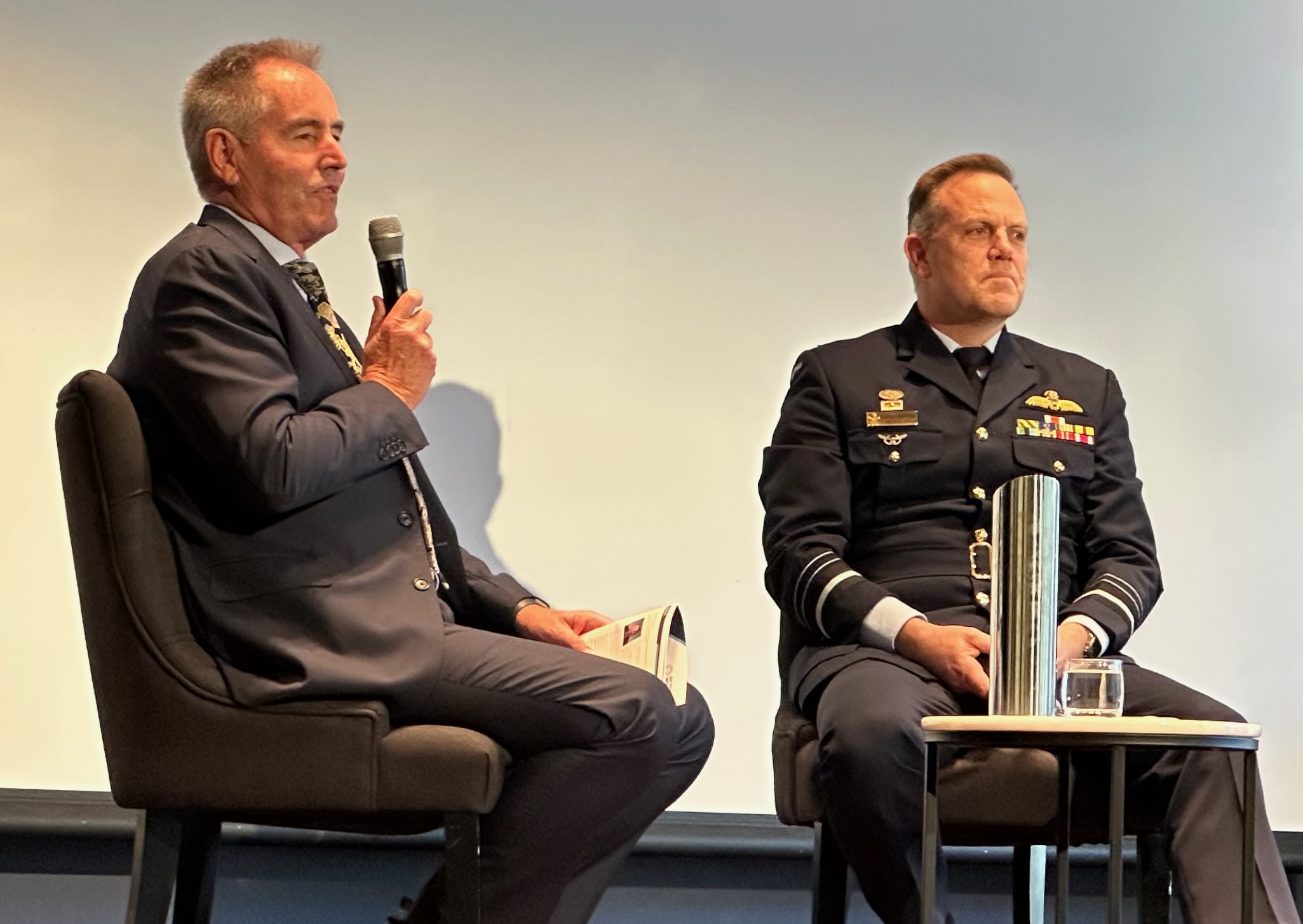
Visiting Italy’s International Flight Training School: Initial Thoughts

10/19/2025

By Robbin Laird

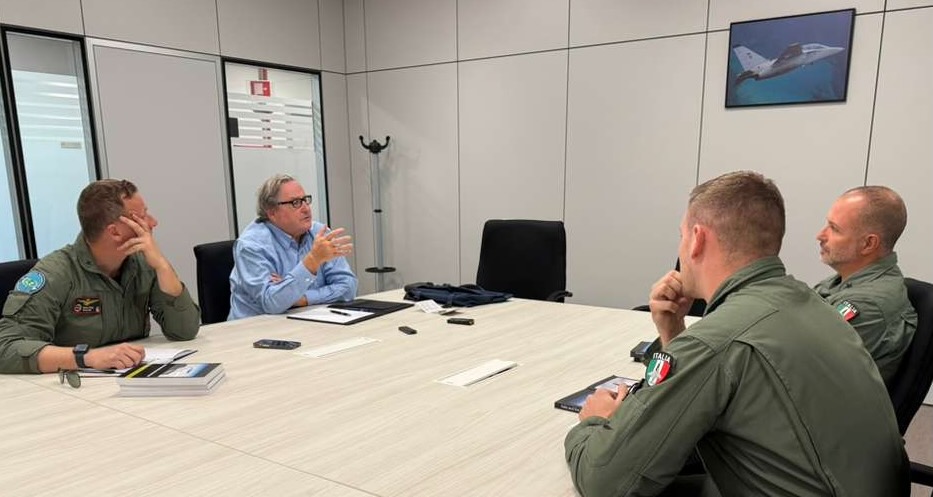
After learning about the International Flight Training School during my visit to Rome in November 2024, I was eager to understand more about Italy’s innovative approach to shaping air power training. The opportunity came in October 2025, when I returned to Italy to meet with Italian Air Force officers in Rome before visiting the IFTS facility at Decimomannu airbase in Sardinia. What I discovered was far more sophisticated than I had anticipated. It provides a comprehensive training ecosystem that represents the future of military aviation education.

A Vision Realized

The progressive collaboration between the Italian Air Force (Aeronautica Militare) and Leonardo to establish IFTS began with an ambitious goal: creating a world-leading military pilot training center. The journey from concept to reality unfolded systematically over six years, demonstrating the commitment required to build something truly exceptional.

The partnership launched in July 2018 with an Italian Air Force-Leonardo Letter of Intent, signaling the initial commitment to this transformative project. By March 2020, the collaboration expanded with the Leonardo-CAE Final Industrial Collaboration Agreement, bringing CAE’s simulation expertise into the consortium. Four months later, in July 2020, the formal Italian Air Force-Leonardo Decimomannu Collaboration Agreement solidified the operational framework that would guide the school’s development.

December 2020 marked a ceremonial milestone with the Decimomannu Groundbreaking Ceremony, officially launching construction of what would become a state-of-the-art training facility. In March 2021, Leonardo CAE Advanced Jet Training was incorporated as the operating entity responsible for running the school. The first students began training with IFTS courses at Galatina in June 2021, followed by courses at Decimomannu in July 2022. The final milestone arrived in the first quarter of 2024 when the school achieved full operational capability after completing the relocation from Galatina, consolidating all operations at Decimomannu.

This six-year transformation turned a strategic vision into a fully operational training center designed to set new global standards for military pilot excellence.

Military Led, Industry Powered

The partnership structure embodies a philosophy of “Military Led, Industry Powered,” creating a unique balance between operational expertise and technological innovation.

The Italian Air Force provides military leadership, drawing on over 70 years of aviation experience to guide the school’s direction. The Aeronautica Militare leads syllabus development, standardization, tests and exams, while overseeing both flight and ground training programs. Critically, the Air Force handles instructor pilot selection for both military and civilian roles, ensuring that training standards remain uncompromised.

Industry support comes from two key partners. Leonardo contributes as the leading integrated training systems and services provider, supplying the T-346 aircraft and logistics support, ground-based simulation systems and support, plus campus construction and services. CAE brings its specialized expertise in simulation systems and services to complement Leonardo’s capabilities.

This joint vision aims to create a worldwide training excellence center that combines military operational knowledge with cutting-edge industry technology and infrastructure. The Italian Air Force sets the training standards and requirements, while Leonardo and CAE provide the technological platforms, facilities, and support services to execute the training mission.

My visit underscored how comprehensive IFTS’s effort is in terms of Level IV training or the training of pilots who already have their wings and are being prepared for their final training step in the operational squadron they would join. This advanced phase represents a critical transition point where pilots move from basic flying skills to combat-ready operational capabilities.

The Ready Room Effect

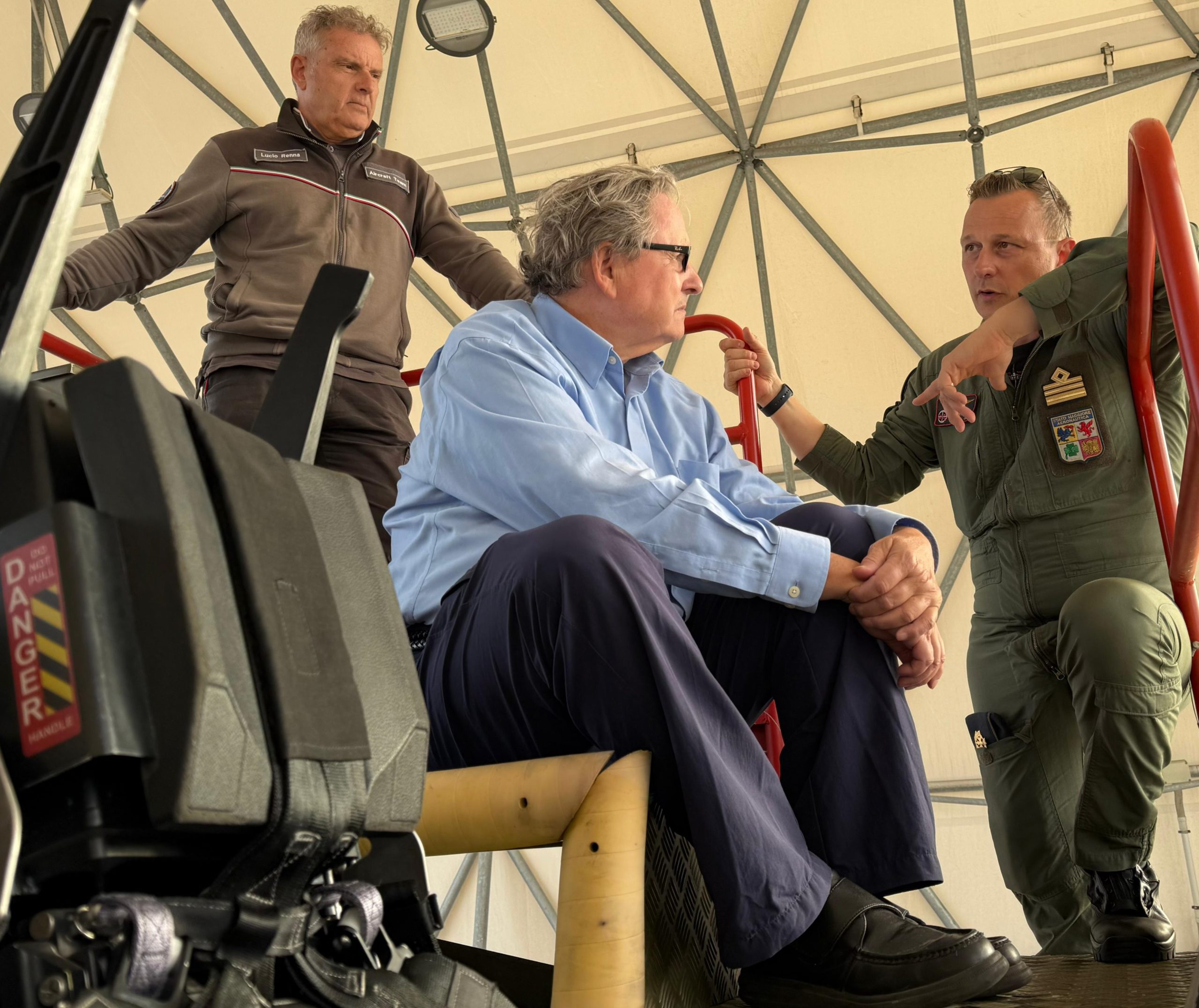
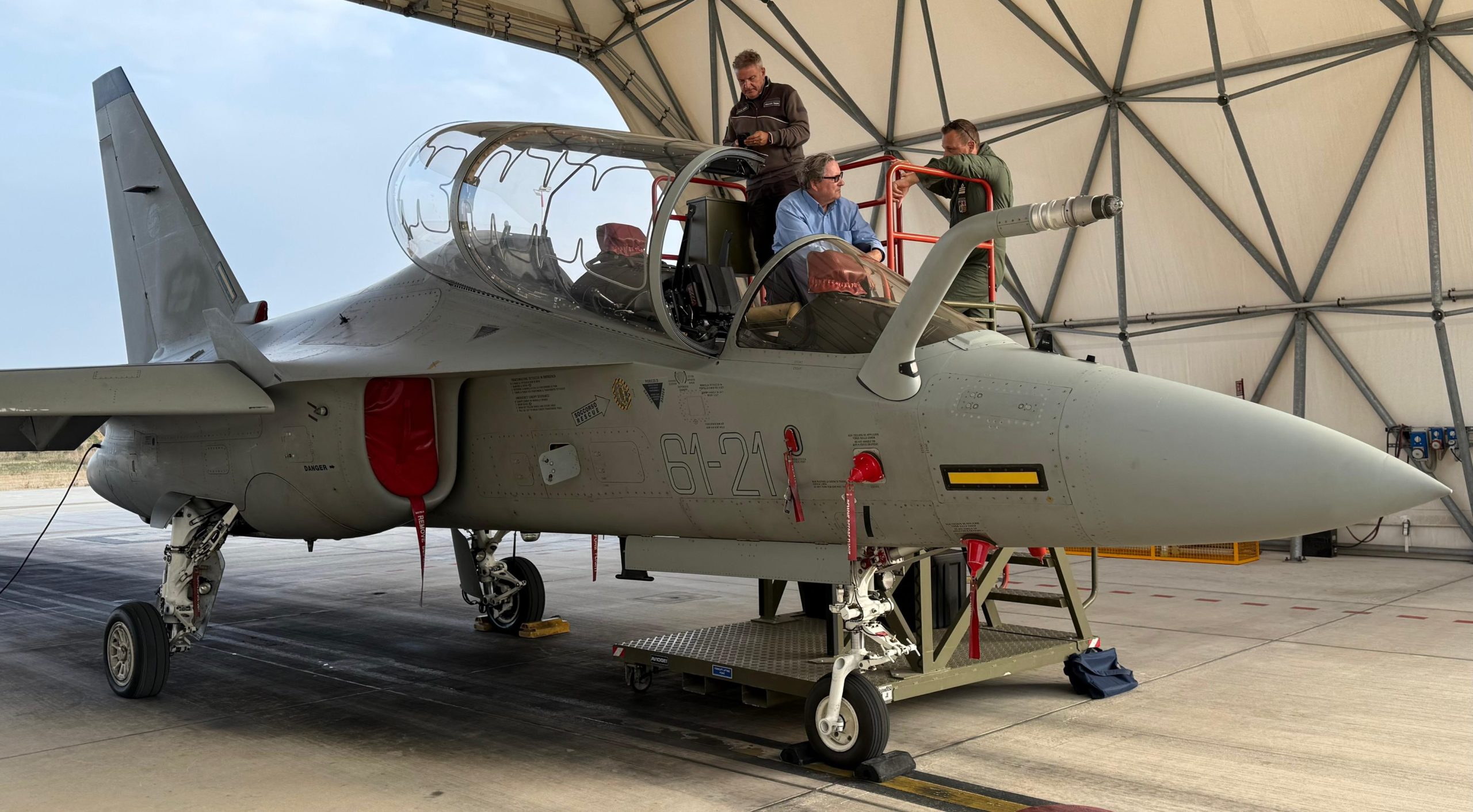
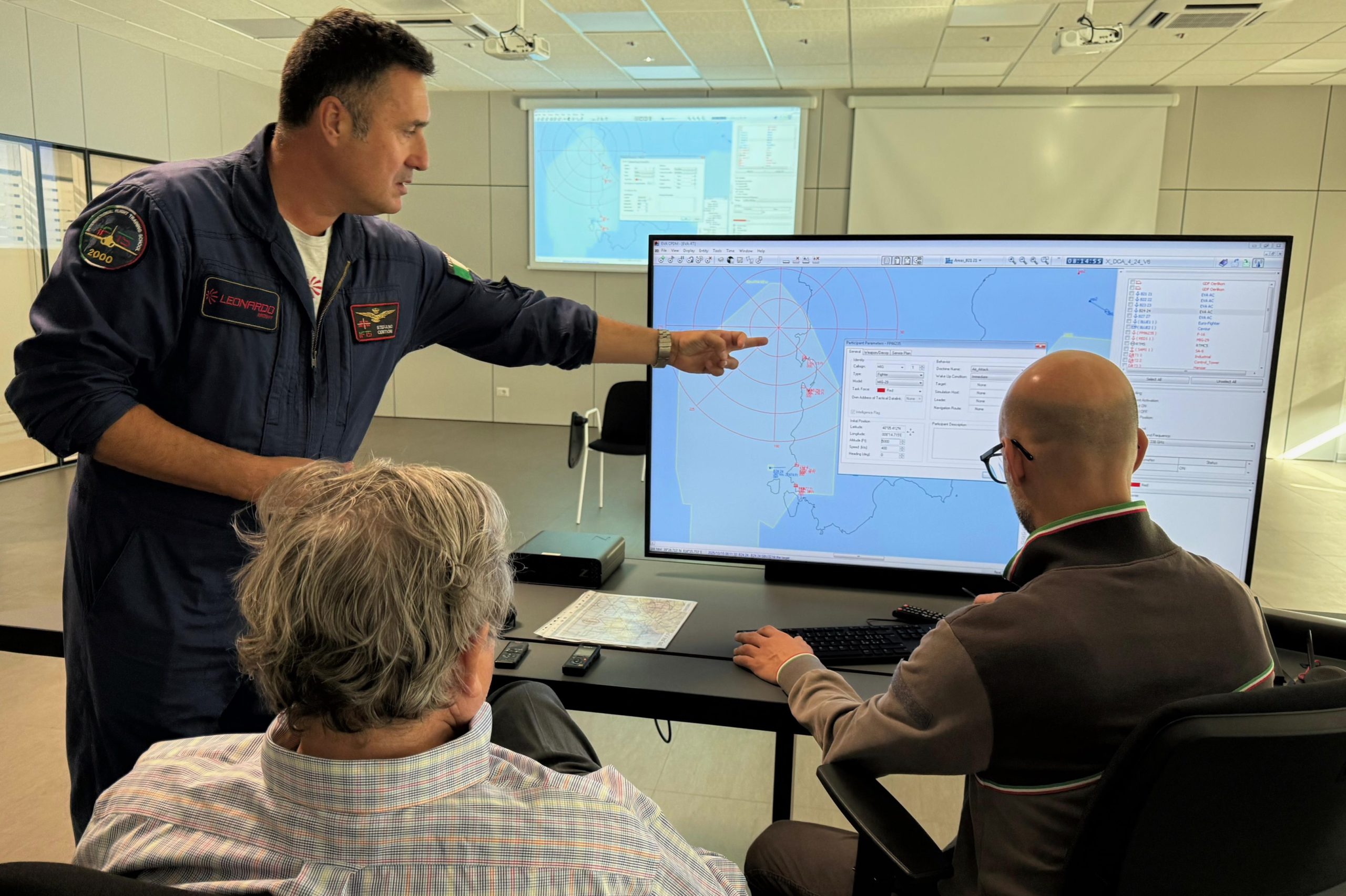
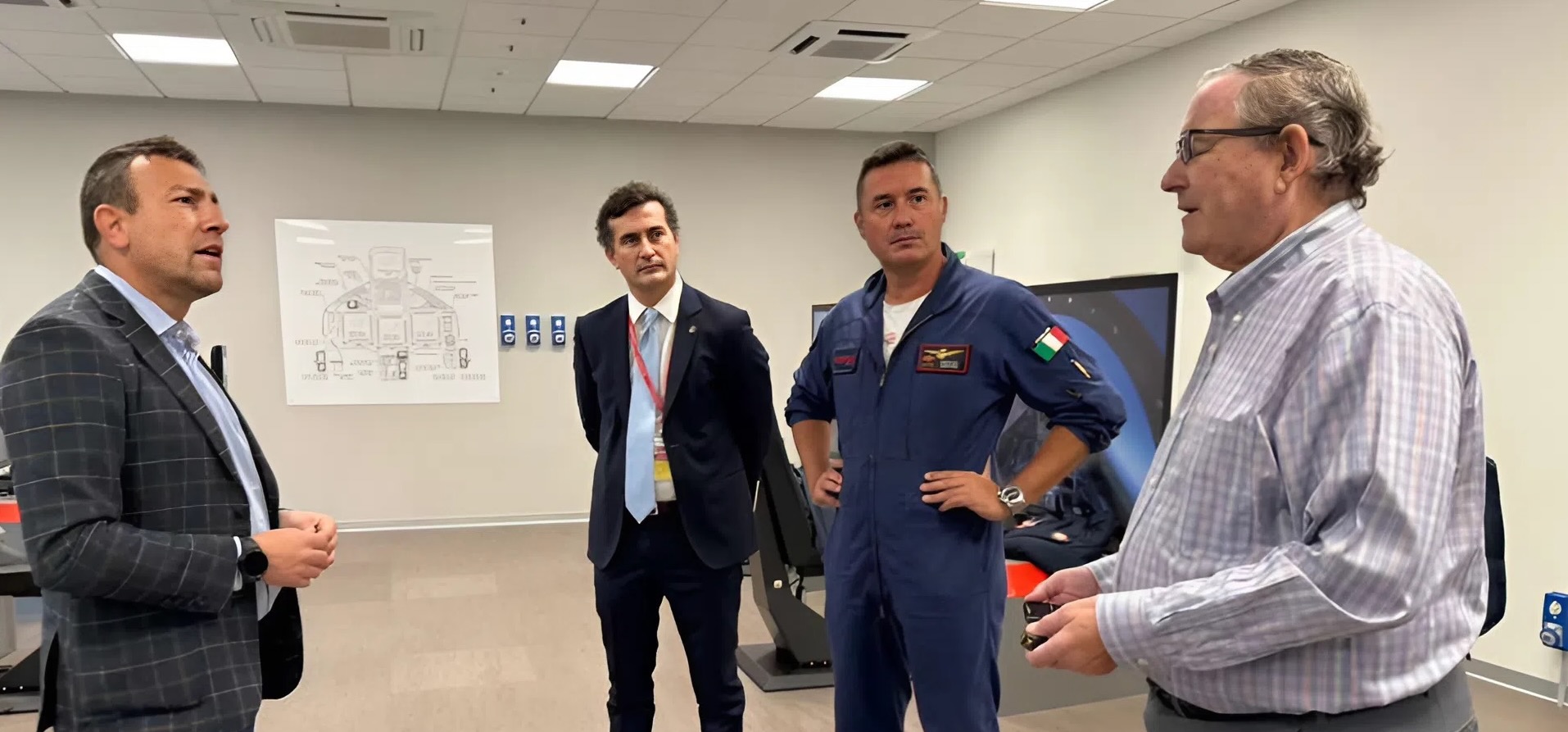
During my time at IFTS, I visited the flight line, lived on campus, and talked in detail with instructors, officers, and contractors regarding their activities. I noted the appearance on campus of many student pilots from the 12 nations currently training at the facility, creating a truly international learning environment.

It was an immersive experience that underscored a key point my colleague, former USMC squadron commander Ed Timperlake, has often made about pilot knowledge gained in the ready room. According to Timperlake, the ready room serves as a crucial informal learning center for air combat pilots in several essential ways.

First, it enables peer learning and knowledge transfer. The ready room is where pilots at different experience levels discuss flying, share experiences, and learn from squadron mates who have been exposed to different career paths and operational situations. This cross-pollination of experience accelerates learning in ways that formal instruction cannot replicate.

Second, it facilitates cultural and professional development. Beyond technical skills, the ready room is where pilots develop camaraderie and understand what it means to be part of the aviation community. It’s where they “talk airplane stuff” and build the team cohesion essential for combat operations.

Third, it serves as a venue for tactical innovation and standardization. The ready room hosts interesting and often heated discussions about training methods and operational procedures that aren’t yet defined in manuals. These debates drive innovation and help establish best practices that eventually become standardized.

Finally, it enables evolution beyond individual skills. The ready room is where pilots transition from focusing solely on their own performance to understanding the bigger picture and how they fit within the larger combat force. It’s where the realization occurs that success isn’t just about individual capability, but about functioning as part of a coordinated team.

These informal ready room exchanges are foundational to shaping combat training approaches and capabilities for the entire air combat force.

Creating a Living Training Ecosystem

IFTS enables such discussions among students from various nations and between students and instructors. But the innovation goes deeper. Twice a year, instructors from the M-346 program, the various operational conversion units for Eurofighter, Tornado, and F-35, and operational squadron pilots come together at Decimomannu. They fly together, review procedures, and adjust curricula based on real-world operational experience.

This creates a continuous feedback loop where operational lessons flow backward through the training system. Squadrons deployed on NATO missions identify tactical or procedural changes based on evolving threats and operational realities. These insights are brought back to IFTS, where they inform curriculum adjustments and training emphasis. The result is a dynamic system that remains constantly aligned with operational requirements rather than becoming static or obsolete.

The Digital Foundation

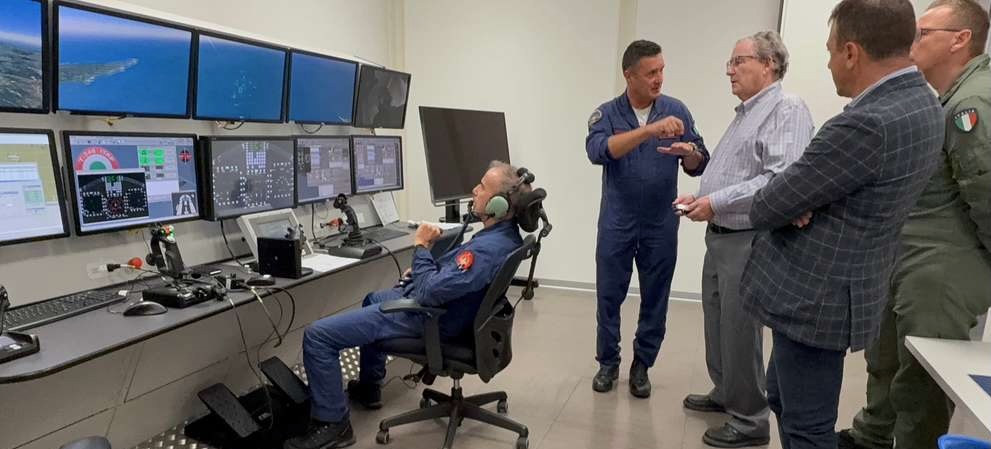
Most tellingly, I had the opportunity to visit and be briefed on the four simulation rooms in the ground-based training center. I was able to see what each accomplished and how they were built to interact, creating an entire interactive digital enterprise that informs the live flying operations within IFTS.

It was an eye-opening experience, much more profound than simply reading about the operation. The simulation systems don’t exist in isolation for they’re networked to create scenarios that can involve multiple aircraft, different threat environments, and complex tactical situations. Students can train on missions that would be too dangerous, expensive, or logistically challenging to execute in actual flight, yet gain realistic experience that transfers directly to the cockpit.

The integration between the ground-based training systems and live flight operations creates a seamless learning progression. Skills developed in simulation are refined in the air, while lessons learned from flight are captured and fed back into simulation scenarios. This bidirectional flow of training data and operational experience ensures maximum efficiency and effectiveness.

A System, Not Just a School

It was during this visit that I learned something fundamental: the “S” in IFTS actually stands for dynamic system, not simply “school.” This distinction is more than semantic for it reflects a philosophical understanding that effective combat aviation training requires more than just instruction. It requires a comprehensive, adaptive ecosystem that integrates technology, human expertise, international collaboration, and continuous operational feedback.

IFTS represents a new model for military aviation training, one that recognizes the complexity of modern air combat and the need for training systems that can evolve as rapidly as the operational environment they prepare pilots to enter. By combining Italian Air Force operational expertise, industry technological capability, international student participation, and integrated digital and live training, IFTS has created something genuinely innovative.

The facility at Decimomannu isn’t just training pilots; it’s advancing the science of how pilots are trained, creating a model that other nations are studying carefully. In an era where air superiority remains crucial to military success and where the technology and tactics of air combat continue to evolve rapidly, IFTS demonstrates that the most effective approach to pilot training is one that views it as a dynamic, integrated system rather than a static program.

As I departed Sardinia, I carried with me a deeper appreciation for what Italy has accomplished. IFTS stands as a testament to what’s possible when military vision, industry capability, and international cooperation align around a common goal: preparing the next generation of combat pilots for the challenges they will face.

The War in Ukraine: Situation Report, October 2025

10/18/2025

The maneuvers in the war in Ukraine in the Fall of 2025 show several dynamics at once. The Russians are using attacks on civilian targets to undercut the will of the Ukrainian people to fight. But Putin has a significantly constricting economy and the threat of the Russian people becoming tired of the war as they did in Afghanistan. The Ukrainians are ramping up their attacks on Russian military and civilian infrastructure to erode the support for the war in Russia by bringing it home to the Russian people.

Meanwhile, Europe is stepping up its support for Ukraine and Russian drone attacks on NATO territory may well led to NATO air patrols over Western Ukraine. President Trump has expressed his frustration with Putin after having given him an off ramp to end the conflict but now may well support extended activities by the Ukrainians to recover more of their territory.

It is clearly a war entering a key phase. As the war in Ukraine enters its fourth autumn, the conflict has reached a critical inflection point. The fighting that began with Russia’s full-scale invasion in February 2022 has evolved into a complex, multi-dimensional struggle that now directly threatens to draw NATO into its first military confrontation with Russia since the alliance’s founding. The dynamics unfolding in Fall 2025 reveal a war that is simultaneously grinding forward on the battlefield while escalating dangerously in the diplomatic and strategic spheres.

Despite more than three and a half years of fighting, Russia continues to make territorial gains in eastern Ukraine, though at a pace that belies the enormous costs Moscow has incurred. According to data compiled by the Institute for the Study of War, Russian forces gained approximately 226 square miles of Ukrainian territory in the four-week period from August 19 to September 16, 2025. While this represents a slight decrease from the previous four-week period, the trend since the beginning of 2025 shows an average monthly Russian gain of 169 square miles.1

These territorial advances, concentrated primarily in the Donetsk region, tell only part of the story. Russian forces have captured numerous villages and towns, including areas near strategically important cities like Pokrovsk, Kostiantynivka, and Kupiansk. The advance has been characterized by intense artillery bombardment, massive use of drones, and grinding infantry assaults that consume enormous amounts of military equipment and personnel.

The human cost of these gains has been staggering. According to an April 2025 estimate by then-Supreme Allied Commander Europe General Cavoli, Russia has suffered more than 790,000 killed or injured, with an additional 50,000 missing.2 Ukrainian casualties, while lower, are also severe, with President Volodymyr Zelenskyy estimating 400,000 killed or injured and 35,000 missing as of January 2025.3 These figures represent a catastrophic loss of life that continues to mount with each passing month.

The material losses are equally devastating. Russia has lost over 22,000 tanks and armored vehicles according to open-source intelligence tracking, while Ukraine has lost nearly 10,000. The Defense Intelligence Agency estimated in May 2025 that Russia has lost at least 10,000 ground combat vehicles since the war’s start, including more than 3,000 tanks, as well as nearly 250 aircraft and helicopters and more than 10 naval vessels.4

Both Russia and Ukraine have intensified attacks on civilian and military infrastructure throughout 2025, each attempting to erode the other side’s capacity and will to continue fighting. This mutual targeting of infrastructure represents a deliberate strategy by both sides to bring the consequences of war home to their opponent’s population.

Russia has maintained its intense campaign against Ukraine’s energy infrastructure since late 2022, inflicting severe damage on the sector. By the end of 2024, Ukraine’s available electricity generating capacity had reportedly shrunk from a prewar total of 56 gigawatts to about 9 gigawatts, with 64 percent of its 25 gigawatts of generation capacity either destroyed or located in territories under Russian occupation. As of September 2024, Russia’s strikes had eliminated 80 percent of Ukraine’s thermal capacity, making the country dependent on the three remaining Soviet-era nuclear power plants for roughly two-thirds of its power supply.5

The danger extends to nuclear facilities themselves. In October 2025, the International Atomic Energy Agency reported that the Russian-controlled Zaporizhzhia Nuclear Power Plant had been without offsite power for six days after recent attacks near the site.

IAEA Director General Rafael Grossi expressed grave concerns about the situation, as the lack of power is needed to cool nuclear reactors and prevent a potential meltdown. Ukrainian President Zelenskyy warned that Russia’s actions around the Zaporizhzhia plant represent “a threat to everyone,” noting that “no terrorist in the world has ever dared to do with a nuclear power plant what Russia is doing now.”6

Ukrainian drone strikes have targeted Russian oil refining capacity and military infrastructure deep inside Russian territory, particularly intensifying in August and September 2025. Analysis from The Moscow Times, BBC, Kyivindependent, and Reuters confirm that these attacks have temporarily shut down substantial portions of Russia’s refining capacity.

Specifically, Reuters and the Kommersant business daily, as cited by The Moscow Times, confirm that drone strikes reduced Russia’s oil refining capacity by about 16–17 percent—equivalent to shutting down approximately 1.1 million barrels per day—during this period. The BBC and the analytics group Ciala provide additional context, noting that up to 38% of refining capacity was offline at peak interruption, but the figure directly attributable to drone strikes for late August and September is about one-quarter (roughly 16–17%) of the country’s total capacity. This has caused gasoline shortages, rationing, and even temporary closures at hundreds of filling stations across Russia.7

These attacks have had tangible effects on Russian-occupied territories. In Crimea, which Russia annexed from Ukraine in 2014, fuel shortages resulting from Ukrainian drone strikes on oil refineries forced authorities to freeze fuel prices and impose petrol rationing, limiting motorists to purchasing 30 liters of fuel at a time.8

The attacks on civilian areas continue as well. A massive Russian attack on September 28, 2025, lasting more than 12 hours, unleashed close to 600 drones and dozens of missiles across seven Ukrainian regions, killing at least four people and injuring more than 70 others. In the Sumy region, a Russian drone attack killed a family of four, including two young children.9

While Russia continues its military operations, it faces mounting economic difficulties that threaten the sustainability of its war effort. Russia’s economy is experiencing what one analysis described as “a slow train wreck,” suffering from high inflation, prohibitive interest rates, a growing budget deficit, labor shortages, and unsustainable military spending.10

President Vladimir Putin signed a decree in October 2025 ordering the conscription of 135,000 men for military service, with Russian men aged 18 to 30 to be drafted between October 1 and December 31. This ongoing need for conscription highlights both the enormous personnel losses Russia has sustained and the difficulty of maintaining force levels necessary to sustain offensive operations.

The economic strain extends beyond military expenditures. Russia has had to develop increasingly complex sanctions evasion networks, partnering with countries like India, the United Arab Emirates, Turkey, and using shell companies in unexpected locations.

Despite these economic pressures, it remains unclear whether domestic discontent in Russia has reached levels that would threaten Putin’s grip on power. The Kremlin has maintained strict control over information and dissent, making it difficult to assess the true state of public opinion regarding the war.

Perhaps the most significant development in Fall 2025 has been President Donald Trump’s dramatic rhetorical shift on Ukraine policy. After months of pressuring Ukraine to accept territorial concessions and suggesting that Kyiv would need to cede land to Russia to achieve peace, Trump reversed course in late September 2025.

On September 23, following a meeting with President Zelenskyy on the sidelines of the United Nations General Assembly in New York, Trump posted on Truth Social that he believed “Ukraine, with the support of the European Union, is in a position to fight and WIN all of Ukraine back in its original form.” He added that with “time, patience, and the financial support of Europe and, in particular, NATO, the original Borders from where this War started, is very much an option.”11

The policy shift came after what Trump described as getting to “know and fully understand the Ukraine/Russia Military and Economic situation” and seeing the “Economic trouble it is causing Russia.”  Trump also expressed support for NATO countries shooting down Russian aircraft that violate their airspace, though he said U.S. support would “depend” on the circumstances.

The most dangerous development in Fall 2025 has been a dramatic escalation in Russian violations of NATO airspace, creating the potential for direct military confrontation between the alliance and Russia. These incidents have reached an unprecedented scale and put NATO members on edge about Russian intentions.

The most significant incident occurred on September 10, 2025, when approximately 20 Russian drones violated Polish airspace during a Russian attack on Ukraine. Some drones were shot down by NATO jets, while others crashed on their own. This marked the first direct military engagement between NATO and Russia since the start of the full-scale invasion of Ukraine. The operation involved Polish F-16s, Dutch F-35s, Italian AWACS aircraft, NATO Multi Role Tanker Transport, and German Patriot systems.12

Less than two weeks later, on September 19, three armed Russian MiG-31 fighter jets violated Estonian airspace, remaining there for over 10 minutes. This prompted Estonia to invoke Article 4 of the NATO Treaty, which allows members to request consultations when they believe their territorial integrity or security is threatened. NATO’s response was swift, with Allied aircraft scrambled to intercept and escort the Russian jets from Estonian airspace.13

Additional violations have been reported across NATO’s eastern flank. Norway announced that Russia had violated its airspace three times in 2025 alone—twice over the sea near Vardø in Norway’s far northeast, and once over an uninhabited area in the northeastern county of Finnmark. Romania and Latvia also reported single Russian drone violations of their airspace during September.14

The NATO response has been firm in rhetoric but reveals significant internal divisions about how to handle future incidents. Following the Estonian incident, NATO issued a strong statement condemning Russia’s “dangerous violation” and warning that “Russia should be in no doubt: NATO and Allies will employ, in accordance with international law, all necessary military and non-military tools to defend ourselves and deter all threats from all directions.”

NATO Secretary General Mark Rutte backed Trump’s comments about shooting down Russian aircraft that violate NATO airspace, stating that suspect aircraft would be shot down depending on threat assessments. Poland’s Prime Minister Donald Tusk took an even harder line, vowing to strike any intruders “without discussion,” while Czech President Petr Pavel stated that “we must respond appropriately, including possibly shooting down Russian aircraft.”

However, significant divisions exist within the alliance. During an emergency North Atlantic Council meeting called by Estonia, representatives from Poland, the Baltic states, and other eastern European countries wanted the joint statement to make clear that additional violations, including by manned aircraft, would be met with force. Germany and some other members urged more restraint, concerned about escalation risks.15

NATO Supreme Allied Commander Europe General Alexus Grynkewich acknowledged the complexity of the situation, noting that shooting down unmanned drones carries different risks than engaging manned aircraft. “Shooting down manned aircraft like fighter jets clearly carries a higher risk of escalation if there’s an engagement that kills someone on either side,” Grynkewich explained. He acknowledged that different NATO nations have varying expectations about when and how NATO assets should intervene, with some countries like Poland wanting “a very broad application” while “other nations make different judgments.”16

The incidents have raised fundamental questions about Russian motives. Some experts believe Russia is probing NATO’s defenses to identify weak points and exploit fissures in the alliance’s response. Estonian Defense Minister Hanno Pevkur suggested that Russia may be trying to force NATO to divert air defense resources from Ukraine to defending its own territory: “Maybe their calculation was that now the European countries have to send something additionally to Estonia regarding the air defense assets, and that means they cannot send it to Ukraine.”17

The NATO airspace violations have revived discussions about “closing the skies” over Ukraine, a proposal that was rejected early in the war due to fears of direct NATO-Russia confrontation. While NATO air patrols over Ukrainian territory have not been implemented, the concept is receiving renewed attention as Russian airspace provocations continue.

Some proposals involve creating what has been termed an “Integrated Air and Missile Protection Zone” over western and central Ukraine. Defense analyst Margaryta Vdovychenko has argued that such a zone would not only restore stability and enable economic recovery, but also allow Ukraine’s Air Force to focus on defending the eastern front. She estimates that implementing this would require around 120 modern fighter jets, backed by early warning aircraft, tankers, and robust intelligence, surveillance, and reconnaissance capabilities.18

Poland is moving to amend its law on overseas military deployments to allow Polish forces to shoot down Russian drones over Ukraine without prior approval from NATO or the EU. The Polish Ministry of Defense introduced the draft legislation in June 2025, aiming to restore rapid and independent response powers that had been restricted by a law passed in 2022. That earlier law required obtaining prior consent from NATO, the EU, and the host country for Polish military operations abroad; this change had been criticized for limiting Poland’s ability to act against airborne threats like Russian drones near its border. The new, expedited bill seeks to remove these restrictions, permitting Poland’s military to engage Russian unmanned aerial vehicles over Ukrainian airspace without international approval.19

European nations have increased their support for Ukraine throughout 2025, though responses remain uneven across the continent. Germany has pursued significant rearmament efforts. German Defense Minister Boris Pistorius described Russia as “the most significant and direct threat to NATO,” pledging that Germany is ready to protect the Baltic region and will respond to Russian threats in a united and responsible manner.20

Lithuania’s Defense Minister Dovile Sakaliene stated that Russia’s recent airspace violations showed that NATO must move from “air policing missions” to “genuine air defence.” The Danish government announced that production of solid rocket fuel for the Ukrainian FP-5 Flamingo missile would start in Denmark from December 1, 2025. British Prime Minister Keir Starmer visited Kyiv in early 2025 and announced £4.5 billion in aid, including 150 artillery barrels made in the UK and 15 additional Gravehawk air defense systems.21

European leaders are actively advancing plans to use frozen Russian assets held in European banks to support Ukraine, including at a recent summit in Copenhagen where both the proposal for a €140 billion loan (approximately $165 billion) backed by these assets and the concept of a “drone wall” were debated.

At the summit, European Commission President Ursula von der Leyen and leaders from Finland, Sweden, Denmark, and other nations voiced support for employing immobilized Russian central bank assets as collateral for the loan, which Ukraine would only repay if Russia fulfills its reparation obligations. The idea was first floated by von der Leyen and quickly gained traction as U.S. aid for Ukraine waned, putting increased financial responsibility on European states. Several leaders, including the Belgian Prime Minister, noted the need for legal clarity and risk-sharing among EU states, given many of these assets are held in Belgium.

The summit, dubbed the “drone wall” meeting, provided the first opportunity for EU leaders to formally debate the plan to use frozen Russian assets to fund the €140 billion ($165 billion) loan for military and economic support to Ukraine, alongside new defense initiatives like the drone wall and Eastern Flank Watch to counter Russia. The proposal received broad support, with leaders agreeing to further develop legal and financial frameworks before a final decision at a follow-up summit in three weeks.22

Nonetheless, Hungary and Slovakia refused to endorse European Union plans to phase out Russian gas deliveries by 2027-2028, particularly concerning the Turkish supply route, citing risks to their national energy security and economic interests. Both governments publicly criticized Brussels’ push, arguing such measures would increase energy costs and undermine their ability to guarantee stable supplies.

Hungarian Prime Minister Viktor Orban held a phone call with President Donald Trump in September 2025 specifically addressing Central European energy security. Orbán explained to Trump that Hungary’s energy supply cannot be guaranteed without Russian gas and oil. Trump acknowledged this concern during or after the call, even as he pressed Hungary and other NATO allies to stop purchasing Russian energy to weaken Russia’s war economy.

Hungary’s Foreign Minister Péter Szijjártó and cabinet minister Gergely Gulyás confirmed the content of the call and Hungary’s position publicly, making energy security and Russian supplies central to the discussion. These events followed EU legislative proposals that could allow phasing out Russian pipeline gas through Turkey by 2028, which Hungary and Slovakia oppose.23

The dynamics unfolding in Fall 2025 reveal a war that has entered what can best be described as an “escalatory stalemate with heightened NATO-Russia tensions.” This phase is characterized by several simultaneous and potentially contradictory trends:

• Continued Russian territorial advances: Despite enormous costs, Russia maintains the operational initiative on the ground in eastern Ukraine, making slow but steady gains that gradually erode Ukraine’s defensive positions.

• Intensifying infrastructure warfare: Both sides are escalating attacks on civilian and military infrastructure, attempting to break the other’s will to continue fighting by bringing the war home to their opponent’s population.

• Economic pressure mounting: Russia faces significant economic difficulties that threaten the long-term sustainability of its war effort, though whether these pressures will translate into meaningful constraints on Russian military operations remains unclear.

• Shifting U.S. policy rhetoric: Trump’s dramatic change in tone regarding Ukraine’s ability to win represents a potential inflection point, though whether this rhetorical shift will translate into substantive policy changes and sustained support remains highly uncertain.

• Unprecedented NATO-Russia tensions: Russian airspace violations have created the most dangerous direct confrontation between NATO and Russia since the Cold War, with significant potential for miscalculation or escalation.

• European commitment deepening but divided: While European support for Ukraine has increased, significant divisions remain within Europe about how far to go in supporting Ukraine and how to respond to Russian provocations.

• Nuclear risks persisting: The situation at the Zaporizhzhia nuclear plant and Russia’s general approach to targeting infrastructure create ongoing risks of nuclear accident, even absent intentional use of nuclear weapons.

This combination of factors creates a critical inflection point. a moment when the conflict could move in dramatically different directions depending on decisions made by key actors. The war is neither frozen into a stable stalemate nor rapidly moving toward resolution. Instead, it exists in a dangerous state where both breakthrough and catastrophic escalation remain possible, sometimes simultaneously.

As Fall 2025 progresses into winter, the trajectory of the war remains highly uncertain. Several key questions will likely determine how the conflict evolves:

• Will Trump’s rhetorical shift translate into sustained policy? If the United States increases support for Ukraine beyond rhetoric, it could significantly alter the battlefield dynamics. Conversely, if Trump’s position proves fleeting or European allies are left to shoulder most of the burden, the effect may be limited.

• Can Ukraine sustain its defense?  Ukraine’s ability to maintain sufficient force levels is increasingly debated among analysts, driven by high casualties, declining morale, desertion trends, and recruitment difficulties. These factors have contributed to urgent discussions about the future sustainability of the country’s defense,

• Will Russian economic pressures force strategic recalculation? If Russia’s economic difficulties become severe enough to threaten domestic stability or military sustainment, Moscow might be forced to seek a negotiated settlement. However, Putin has shown little indication of such willingness thus far.

• How will NATO navigate the airspace violation challenge? The alliance’s response to continued Russian provocations will test its cohesion and could either deter further Russian aggression or lead to dangerous escalation if miscalculation occurs.

• Can Europe sustain and increase its support? With the United States potentially reducing its role, Europe’s willingness and ability to fill the gap will be crucial. This includes not just military aid but also potential security guarantees for Ukraine and possible deployment of European forces.

The Kremlin has stated it is ready for peace negotiations, but Russia’s position has not changed: Ukraine must withdraw from the four regions Russia annexed in 2022, end its desire to join NATO, and accept strict limits on its armed forces. This remains unacceptable to Ukraine and its Western supporters, leaving the diplomatic path as blocked as ever.

The war in Ukraine as it stands in Fall 2025 represents perhaps the most dangerous moment since the initial invasion. The combination of ongoing military pressure, escalating infrastructure attacks, heightened NATO-Russia tensions, shifting U.S. policy, and mounting but uncertain economic pressures creates a highly volatile situation.

The international community faces difficult choices. Too little support for Ukraine risks emboldening Russian aggression and potentially inviting further attacks on European security. Too much support, particularly if it involves direct NATO military involvement in Ukrainian airspace, risks triggering a broader conflict between nuclear-armed powers.

What is clear is that the war has reached a critical juncture. The decisions made in the coming months by leaders in Washington, European capitals, Kyiv, and Moscow will likely determine not just the outcome of this conflict, but the broader security architecture of Europe.

1. https://www.russiamatters.org/news/russia-ukraine-war-report-card/russia-ukraine-war-report-card-sept-17-2025

2. https://www.armed-services.senate.gov/imo/media/doc/general_cavoli_opening_statements.pdf

3. https://www.russiamatters.org/news/russia-ukraine-war-report-card/russia-ukraine-war-report-card-feb-26-2025

4. https://www.oryxspioenkop.com/2022/02/attack-on-europe-documenting-equipment.html; https://www.pravda.com.ua/eng/news/2025/05/18/7512753/

5. https://euideas.eui.eu/the-evolving-rationale-behind-russian-attacks-on-ukraines-energy-infrastructure; https://warontherocks.com/2025/02/the-electricity-front-of-russias-war-against-ukraine/; https://kyivindependent.com/russia-destroys-all-thermal-power-plants-nearly-all-hydroelectric-capacity-in-ukraine-ahead-of-winter-zelensky-says/

6. https://news.un.org/en/story/2025/10/1166016; https://www.reuters.com/business/energy/ukraines-zaporizhzhia-nuclear-plant-now-without-offsite-power-six-days-grossi-2025-09-29/

7. https://www.bbc.com/news/articles/czx020k4056o; https://www.themoscowtimes.com/2025/09/26/ukrainian-drones-hit-major-oil-refinery-in-southern-russia-for-second-time-in-a-month-a90634; https://www.kyivpost.com/post/61252

8. https://www.aljazeera.com/news/2025/9/30/russia-ukraine-war-list-of-key-events-day-1314

9. https://www.newsweek.com/nato-scrambles-fighter-jets-russia-12-hour-barrage-ukraine-10793973

10. https://www.themoscowtimes.com/2025/09/26/the-real-losers-of-russias-war-ukraine-europe-and-russia-itself-a90642

11. https://www.nbcnews.com/politics/white-house/major-shift-trump-says-ukraine-can-win-back-land-from-russia-rcna233287

12. https://www.nato.int/cps/en/natohq/opinions_237559.htm

13. https://www.nato.int/cps/en/natohq/official_texts_237721.htm

14. https://abcnews.go.com/International/wireStory/russian-forays-nato-airspace-causing-alarm-happening-125954596; https://www.cnn.com/2025/09/25/politics/nato-divided-repeated-russian-incursions-response

15. https://www.cnn.com/2025/09/25/politics/nato-divided-repeated-russian-incursions-response

16. https://www.lemonde.fr/en/international/article/2025/09/24/alexus-grynkewich-top-nato-commander-in-europe-russia-has-always-tried-to-maneuver-for-advantage-over-the-alliance_6745696_4.html; https://www.koha.net/en/bote/nato-ja-e-ndare-per-reagimin-ndaj-rusise

17. https://news.err.ee/1609807077/defense-minister-nato-was-ready-to-use-force-if-needed-after-russian-airspace-violation; https://kyivindependent.com/nato-was-ready-to-use-of-force-if-needed-tallinn-says/

18. https://kyivindependent.com/calls-to-close-ukraines-skies-return-as-russia-tests-nato-borders/

19. https://reopen.media/en-gb/articles/poland-to-let-forces-target-russian-drones-over-ukraine; https://euromaidanpress.com/2025/09/25/poland-wants-to-shoot-down-targets-over-ukraine-without-nato-and-eu-approval/

20. https://www.euronews.com/2025/09/29/german-def-min-pistorius-russian-federation-is-the-greatest-and-most-immediate-threat-to-n

21. https://www.baltictimes.com/air_defense_should_be_a_nato_priority_this_fall_-_lithuanian_minister/; https://caliber.az/en/post/ukrainian-company-to-launch-solid-rocket-fuel-production-in-denmark; https://www.ukrinform.net/rubric-defense/3949352-britain-to-send-150-artillery-barrels-new-mobile-air-defense-system-to-ukraine.html

22. https://apnews.com/article/europe-ukraine-russia-assets-frozen-loans-plan-91929d8b2263ace7ea452157f19a6222; https://www.nytimes.com/2025/10/01/world/europe/russia-frozen-assets-ukraine-loan.html; https://www.reuters.com/sustainability/boards-policy-regulation/belgium-says-eu-leaders-must-share-risk-use-frozen-russian-assets-ukraine-2025-10-02/

23. https://www.reuters.com/business/energy/slovakia-rejects-eu-plan-phase-out-russian-gas-by-end-2027-2025-05-07/; https://www.euinsider.eu/news/hungary-and-slovakia-withhold-support-as-eu-proposes-ban-on-russian-gas-and-oil-by-2027

Ukraine’s Robot Army: The Rise of Unmanned Ground Vehicles in Modern Warfare

10/10/2025

The battlefields of Ukraine are witnessing a technological revolution that is reshaping the nature of ground combat.

While aerial drones have dominated headlines throughout the conflict, a new category of unmanned systems is quietly transforming military operations: unmanned ground vehicles (UGVs).

From experimental prototypes to mass deployment, Ukraine’s ambitious push to field 15,000 ground robots by the end of 2025 represents one of the most rapid military technology adoptions in modern warfare history.

This transformation reflects more than mere technological advancement. It represents a fundamental shift in how modern armies conceptualize and conduct ground operations.

The integration of artificial intelligence, autonomous navigation systems, and advanced weapons platforms on ground-based robots are emerging as part of an overall ground-based 360 degree operating ground force.

The Evolution from Experiment to Mass Deployment

The journey of Ukrainian UGVs from concept to battlefield reality has been remarkably swift, compressed into a timeline that would have been inconceivable under peacetime development conditions.

Ukraine’s first confirmed UGV combat mission took place in December 2024, when the Charter Brigade successfully deployed one in Kharkiv Oblast. This marked a pivotal moment for it was the first time a domestically produced unmanned ground vehicle participated in a full battlefield operation, transitioning these systems from experimental curiosities to operational military assets.

The progression since then has been extraordinary, defying conventional timelines for military technology adoption.

For example, Ukrainian forces recently captured Russian troops without deploying any infantry, relying entirely on drones and ground-based robotic systems². This achievement demonstrates not just technological advancement, but a fundamental shift in how ground operations can be conducted, potentially redefining the role of human soldiers in direct combat scenarios.

Major General Borys Kremenskyi, Ukraine’s defense attaché in Washington, emphasized the critical importance of these systems at the GVSETS 2025 conference. “We are ready to take any system to test,” he declared, highlighting Ukraine’s openness to rapid innovation and battlefield experimentation.

This willingness to embrace new technology has been a defining characteristic of Ukraine’s approach throughout the conflict, driven by both operational necessity and the recognition that technological superiority can offset numerical disadvantages.

The rapid deployment timeline reflects unique wartime conditions that have accelerated normal development cycles. Traditional military procurement processes, which typically span years or even decades, have been compressed into months. This acceleration has been enabled by a combination of urgent operational requirements, streamlined bureaucratic processes, and the direct involvement of end-users in the development process.

Scale and Industrial Transformation

The numbers behind Ukraine’s UGV program are staggering and represent a complete transformation of the country’s defense industrial landscape. Hlib Kanevskyi, Director of Procurement at Ukraine’s Ministry of Defense, announced plans to deliver 15,000 ground robots for combat use by the end of 2025. To put this in perspective, this represents a massive scaling from the handful of experimental units deployed just months earlier, and exceeds the total number of UGVs deployed by most major military powers over decades of development.

Supporting this ambitious goal is a rapidly expanding industrial base that has emerged almost entirely during the conflict period. Over 200 Ukrainian companies are now working on UGV development, representing a fundamental transformation of the country’s defense industrial capacity. This ecosystem includes everything from large established defense contractors to small startups founded specifically to address battlefield requirements identified by frontline units.

The Ukrainian government has backed this expansion with substantial financial commitments that demonstrate the strategic priority placed on unmanned systems. After contracting around 100 million UAH ($150M USD) in the first quarter of 2025 alone. This sixty-fold increase in procurement spending illustrates both the growing confidence in UGV capabilities and the urgent operational demand for these systems.

The development process has been uniquely shaped by the exigencies of war, creating an innovation ecosystem unlike anything seen in peacetime military development. Rather than following traditional lengthy development cycles, Ukrainian UGV manufacturers operate through  “frontline workshops”. Here, military engineers and operators directly modify, test, and improve UGVs received from manufacturers, creating an incredibly tight feedback loop between combat experience and technological refinement.

This approach has proven remarkably effective at identifying and solving practical problems that might not emerge in laboratory testing. Companies like Tencore, with its popular “TerMIT” UGV, have undergone hundreds of modifications based on field input, demonstrating the value of this collaborative development model. The result is systems that are optimized for actual battlefield conditions rather than theoretical requirements.

The industrial transformation extends beyond manufacturing to encompass the entire supply chain. Ukrainian companies have developed domestic capabilities for producing everything from basic components to sophisticated sensor systems, reducing dependence on foreign suppliers and enabling rapid iteration cycles.

Technological Breakthroughs and Innovation

One of the most significant recent developments has been the introduction of fiber optic control systems, representing a quantum leap in UGV capability and survivability. Inspired by the success of fiber optic cables on first-person view (FPV) aerial drones, Ukraine has begun testing these systems on ground vehicles. This innovation addresses one of the most critical challenges facing UGV operations: electronic warfare jamming, which has proven devastatingly effective against radio frequency-controlled systems.

Unlike radio frequency systems, fiber optic links cannot be jammed by electronic warfare equipment and maintain connectivity even in electromagnetically contested environments. This capability is particularly crucial given the saturated electronic warfare environment that characterizes the Ukrainian battlefield. As Major General Kremenskyi noted, “When we are talking about EW, we are changing, and the enemies are changing. We are developing this approach, but it creates a kind of electronic warfare dome”.

The introduction of fiber optic systems also enables operations at greater distances and provides more reliable data transmission for sophisticated sensor packages. Early tests have shown promising results, though the technology remains in development stages. The goal is to achieve the same revolutionary impact that fiber optic controls had on aerial drone operations, potentially making UGVs significantly more effective in contested environments.

The sophistication of Ukrainian UGV systems continues to advance rapidly across multiple technological dimensions. The domestically developed Droid TW tracked platform, operational since December 2024, features artificial intelligence algorithms capable of recognizing enemy personnel. This represents a significant leap toward autonomous target identification and engagement capabilities, moving beyond simple remote-controlled vehicles toward semi-autonomous systems capable of independent decision-making.

Ukraine’s largest UGV trial to date took place in April 2025, involving over 70 ground drones from 50 domestic manufacturers. The test covered a 10-kilometer course under challenging conditions designed to replicate actual battlefield environments, including unknown routes and electronic warfare with constantly shifting frequencies. The majority of participating vehicles successfully completed the trial, confirming their payload capacity and demonstrating sustained high performance over long distances.

The trial also tested advanced communication systems and evaluated mobility for long-range operations, providing valuable data for future development efforts. The next phase of testing will focus on developing operational tactics for logistics and casualty evacuation, as well as designing combat systems with an optimized balance between firepower and mobility.

Recent developments have also focused on modular design concepts that allow rapid reconfiguration for different mission requirements. Most Ukrainian UGVs are designed with modular architectures that enable quick swapping of mission packages, sensors, weapons, or specialized equipment. This flexibility has proven crucial in responding to rapidly evolving battlefield requirements and maximizing the utility of each platform.

Combat Applications and Tactical Evolution

The tactical applications of Ukrainian UGVs have expanded far beyond initial concepts, evolving through direct battlefield experience rather than theoretical planning. As Major General Kremenskyi explained, these systems have proven “really crucial” across multiple mission areas, with new applications being discovered and refined through operational use.

Electronic warfare has emerged as a particularly important application, with UGVs serving as mobile platforms for EW equipment in areas too dangerous for manned vehicles. The ability to deploy electronic warfare systems closer to enemy positions without risking personnel has proven strategically valuable, enabling more effective jamming and signals intelligence operations. These platforms can operate in forward positions where traditional manned EW vehicles would be immediately targeted and destroyed.

Medical evacuation represents another critical capability that has saved numerous lives since implementation. Kremenskyi noted that Russian forces often target medical vehicles despite red cross markings, making unmanned evacuation systems essential for casualty recovery operations. “Since you cannot fly a helicopter to the trenches, we had to invent other ways of medevac, and ground unmanned systems are quite good,” he observed. The ability to evacuate wounded personnel without exposing medical teams to direct fire has transformed casualty recovery operations in high-threat environments.

The scale of the mine clearance challenge in Ukraine has made UGVs indispensable for this mission, addressing what may be the largest mine contamination problem in modern history. The United Nations Mine Action Service estimated in June that over 20 percent of Ukraine’s land representing nearly 55,000 square miles is contaminated by mines or unexploded ordnance¹⁶. Traditional manual clearance methods are simply inadequate for this scope of contamination, making robotic solutions essential for post-conflict recovery efforts.

Current Ukrainian UGV platforms demonstrate the diversity of capabilities being fielded across different mission requirements:

  • Liut (Fury): Equipped with a 7.62mm machine gun, this system has passed comprehensive combat testing and can identify and engage targets day and night using advanced sensor packages. Its quiet electric motor and rugged construction allow operation across challenging terrain and in harsh weather conditions, making it suitable for extended autonomous operations.
  • Termit: A next-generation tracked UGV capable of carrying up to 300 kilograms across various terrain types. Its modular design allows configuration for combat roles, medical evacuation, or specialized equipment transport, providing tactical commanders with flexible capabilities that can be adapted to mission requirements.
  • D-21-12R: Armed with a large-caliber machine gun, specifically designed for surveillance, patrolling, fire support, and engaging lightly armored vehicles. This platform represents the evolution toward dedicated combat roles, moving beyond support functions to direct engagement capabilities.
  • Murakha: A versatile platform priced at approximately $29,000, designed for multiple mission configurations including reconnaissance, logistics support, and limited combat operations. Its relatively low cost makes it suitable for mass deployment and acceptable loss rates in high-threat environments.

Intelligence, surveillance, and reconnaissance (ISR) operations have also been transformed by UGV deployment. Ground-based platforms can establish persistent observation posts in areas too dangerous for human operators, providing continuous intelligence gathering capabilities. The ability to pre-position sensor platforms and maintain surveillance without human presence has proven particularly valuable for monitoring enemy movements and providing early warning of attacks.

Logistics operations represent perhaps the most immediately practical application of UGV technology. The ability to transport supplies, ammunition, and equipment without exposing personnel to enemy fire has proven invaluable in maintaining frontline operations. Some units report transporting tonnes of supplies per month over distances of up to 10 kilometers using robotic systems, significantly reducing the risk to human logistics personnel.

Strategic Response to Manpower Challenges

Ukraine’s accelerated UGV deployment directly addresses acute manpower shortages that have become increasingly critical as the conflict has prolonged. Despite expanded draft measures and new incentives, recruitment challenges persist, putting extraordinary pressure on infantry units that bear the primary burden of ground combat operations. UGVs offer a force multiplier effect, allowing fewer human soldiers to control larger operational areas while reducing exposure to direct combat risks.

The manpower crisis has created urgent operational requirements that drive rapid technological adoption at unprecedented speed. As one Ukrainian official noted, “It is about innovation. If you don’t innovate during two months, you are dead”. This pressure has accelerated development cycles and forced creative solutions to emerge at speeds that would be impossible under peacetime conditions.

The demographic realities facing Ukraine make technological solutions increasingly attractive. With a population approximately one-quarter the size of Russia’s, Ukraine cannot afford to engage in attritional warfare using traditional methods. The ability to substitute machines for human soldiers in the most dangerous roles provides a sustainable approach to maintaining defensive capabilities while preserving human resources for roles that cannot be automated.

UGVs are particularly valuable for defensive operations, where they can be used to create automated defensive positions that require minimal human oversight. Theoretical applications include unmanned sentry systems that could allow the same stretch of frontline to be manned by fewer troops continuously exposed to artillery, drone attacks, and direct fire²⁵. This capability could be transformative for force structure planning and operational sustainability.

The psychological impact of UGV deployment also provides strategic benefits beyond their immediate tactical utility. The knowledge that robotic systems are monitoring and defending positions can provide psychological reassurance to human defenders while potentially deterring enemy attacks. The uncertainty created by not knowing whether a position is manned by humans or machines can complicate enemy planning and force more cautious approaches.

Training and doctrine development have evolved to accommodate UGV integration, with dedicated training centers established to develop operator expertise and tactical employment concepts. The first dedicated UGV operator training centers emerged in late 2024, reflecting the institutionalization of these capabilities within Ukrainian military structure. These centers are developing standardized training programs and operational procedures that will enable broader deployment and more effective employment of robotic systems.

Russian Responses and Technological Competition

Russia has not remained passive in the face of Ukrainian UGV advances, but its response has been hampered by systemic issues that reflect broader problems with Russian military adaptation. The Battle of Avdiivka (October 2023-February 2024) saw both sides deploy UGVs in significant numbers for the first time, providing crucial lessons about the operational employment of these systems in high-intensity combat²⁷.

However, Russian systems have generally proven less effective than their Ukrainian counterparts, reflecting differences in development philosophy and battlefield adaptation capabilities. A notable example occurred in March 2025, when six Russian Courier UGVs armed with automatic grenade launchers attempted a coordinated assault near Avdiivka’s fallback defenses. Despite allegedly firing hundreds of grenades, all six vehicles were quickly destroyed, with two being eliminated on camera by Ukrainian FPV drones. This engagement highlighted both the potential and limitations of current UGV technology while demonstrating the vulnerability of these systems to existing countermeasures.

The failure of this assault illustrates several key challenges facing UGV deployment in contested environments. The vehicles were apparently unable to coordinate effectively, lacked adequate protection against drone attacks, and failed to achieve tactical surprise despite their technological sophistication. The rapid destruction of these expensive systems also raises questions about cost-effectiveness and acceptable loss rates for robotic platforms.

Russian UGV development has been hampered by several structural factors that reflect broader issues with Russian military-industrial complex adaptation. The dangerous tactical environment created by widespread drone surveillance makes larger, more expensive systems highly vulnerable to detection and destruction. Additionally, Russia’s pre-war UGV programs focused on complex, autonomous systems that proved unsuitable for the realities of combat operations.

Pre-war Russian development efforts concentrated on sophisticated platforms like the Uran-9 combat vehicle and the Marker autonomous system, both of which required controlled environments and extensive support infrastructure. These systems were designed for scenarios that assumed technological superiority and permissive operating environments, assumptions that proved invalid in the Ukrainian conflict. The absence of larger Russian UGV systems from the battlefield reflects the mismatch between pre-war development priorities and actual operational requirements.

Russia has deployed some specialized systems, including Uran-6 demining vehicles, but these have been used only in carefully controlled environments after operational areas were cleared of threats. This cautious approach reflects the high value and limited availability of these systems, as well as recognition of their vulnerability in contested environments.

The technological competition between Ukrainian and Russian UGV programs reflects broader themes in the conflict, including the importance of rapid adaptation, the value of battlefield feedback, and the advantages of distributed development models. Ukrainian success appears to stem from shorter development cycles, closer integration with end-users, and willingness to accept higher loss rates in exchange for operational learning.

Industrial Organization and Government Support

Ukraine’s approach to UGV development reflects lessons learned from its successful FPV drone programs, applying proven organizational models to ground-based systems. The Brave1 defense technology cluster serves as the primary coordination mechanism, connecting manufacturers with military requirements and facilitating rapid prototyping. This centralized coordination function has proven essential for managing the complexity of multiple parallel development efforts while ensuring compatibility and standardization.

Currently, over 140 robotic systems are registered on the Brave1 platform, with 96 having undergone defense scrutiny and 14 meeting NATO standards. This progression from registration through testing to certification demonstrates the maturation of the Ukrainian UGV development ecosystem and its increasing integration with international standards and requirements.

The government has implemented comprehensive regulatory reforms to accelerate deployment while maintaining quality standards. Codification procedures that previously took several months have been reduced to just 10 days, eliminating a major bureaucratic bottleneck that traditionally slowed military technology adoption. This regulatory efficiency has been crucial in maintaining the rapid pace of technological development and field deployment.

The Brave1 platform has also launched an innovative procurement system dubbed “Amazon for war,” where military units can order drones and equipment using either money or points earned in combat. This system provides direct feedback mechanisms between users and manufacturers while streamlining the procurement process for frontline units with urgent operational requirements.

Government procurement strategies have evolved to emphasize domestic production capabilities and rapid scalability. Procurement officials prioritize manufacturers who can demonstrate ability to scale production quickly and adapt designs based on battlefield feedback. This approach has created competitive pressures that reward innovation and responsiveness over traditional factors like established relationships or lowest initial cost.

The industrial organization model emphasizes distributed production capabilities rather than centralized manufacturing, reducing vulnerability to targeted attacks while enabling rapid scaling. Multiple companies produce similar systems using different approaches, creating redundancy and enabling comparative testing of alternative solutions. This approach has proven more resilient than traditional defense industrial models that rely on single-source suppliers for critical capabilities.

International cooperation has become increasingly important as the program matures. Ukrainian companies are exploring various forms of partnership with foreign entities, including investment opportunities, joint testing programs, and technology transfer arrangements. These partnerships provide access to advanced technologies and manufacturing capabilities while potentially opening export markets for Ukrainian-developed systems.

Technological Challenges and Limitations

Despite remarkable progress, significant technological challenges continue to limit UGV effectiveness and deployment. Reliable communication links remain problematic, as terrain contours, vegetation, and urban environments can easily disrupt connectivity between operators and robotic platforms. The fiber optic solutions being tested address some of these issues but introduce new challenges related to cable management and vulnerability to physical damage.

All-terrain capability represents another persistent limitation that affects operational utility. Many current systems remain vulnerable to becoming stuck in mud, snow, sand, or rough terrain that human soldiers could easily navigate. This limitation restricts deployment to suitable terrain and weather conditions, reducing the operational flexibility that makes UGVs attractive for military applications.

Power and endurance constraints also limit operational effectiveness, particularly for systems carrying heavy payloads or operating sophisticated sensor packages. Battery technology limitations restrict operational duration and payload capacity, forcing trade-offs between mission capability and operational endurance. These constraints are particularly problematic for extended autonomous operations or missions requiring long-duration surveillance.

The integration of artificial intelligence and autonomous capabilities raises additional technical and operational challenges. Current AI systems require extensive training on specific operational environments and may perform poorly when confronted with novel situations or adversarial countermeasures. The development of robust AI systems capable of operating effectively in dynamic, contested environments remains an ongoing challenge.

Cybersecurity represents an emerging concern as UGV systems become more sophisticated and networked. The potential for enemy hacking, spoofing, or taking control of robotic systems creates new vulnerabilities that must be addressed through secure communication protocols and robust authentication systems. The consequences of compromised UGV systems could include loss of valuable equipment, intelligence breaches, or even systems being turned against their operators.

Maintenance and logistics support for UGV systems require specialized capabilities that are still being developed. Unlike traditional military equipment, robotic systems require technical expertise for software updates, sensor calibration, and electronic component replacement. The development of field-maintainable systems and training of technical personnel represents an ongoing challenge for large-scale deployment.

Future Developments and Autonomous Capabilities

Looking ahead, Ukrainian UGV development is focusing on increased autonomy and multi-robot control systems that could fundamentally transform ground combat operations. The goal is to reduce operator burden while enabling single operators to control multiple platforms simultaneously, potentially achieving force multiplication effects that could offset numerical disadvantages against larger adversaries.

Artificial intelligence integration for navigation and targeting represents another key development area with potentially revolutionary implications. Future systems may be capable of independent route planning, obstacle avoidance, and target identification, reducing the skill requirements for operators while enabling more sophisticated mission execution. The integration of machine learning algorithms could enable systems to adapt to new environments and threats autonomously.

Swarm capabilities represent an particularly promising area of development, potentially enabling coordinated operations by multiple UGV platforms under distributed control. Swarm systems could provide redundancy against individual system losses while enabling complex coordinated maneuvers that would be difficult or impossible for individual platforms. The development of swarm algorithms and communication protocols represents a significant technical challenge with transformative potential.

Advanced sensor integration continues to expand UGV capabilities, with developments in thermal imaging, radar systems, and multi-spectral sensors enabling operation in diverse environmental conditions. The miniaturization of sophisticated sensor packages makes it possible to equip smaller, cheaper platforms with capabilities previously available only on much larger systems.

The development of automated turrets and weapons systems represents another frontier with significant implications for ground combat. Future UGV platforms may incorporate stabilized weapons systems capable of engaging targets while moving, potentially matching or exceeding the capabilities of traditional armored vehicles. The integration of advanced fire control systems and targeting algorithms could enable precision engagement at extended ranges.

Defensive capabilities are also advancing, with research into active protection systems, electronic countermeasures, and stealth technologies specifically designed for unmanned platforms. These developments could significantly improve UGV survivability in contested environments, making them more suitable for direct combat roles rather than just support functions.

Ukraine’s UGV program has implications extending far beyond the current conflict, providing insights into how future military forces might be organized and employed. The rapid evolution from experimental systems to mass deployment demonstrates how urgent operational requirements can accelerate technological adoption in ways that would be impossible under peacetime conditions.

The cost-effectiveness of UGV systems compared to traditional manned platforms offers compelling strategic advantages that military planners worldwide are studying intensively. When six Russian UGVs were destroyed near Avdiivka, the financial cost was approximately $66,000—far less than the typical cost of losing squads of infantry or platoons of armored vehicles³⁸. This cost differential suggests that robotic systems could provide sustainable alternatives to traditional force structures, particularly for smaller military forces facing larger adversaries.

The battlefield testing occurring in Ukraine provides invaluable data for future military planning worldwide, creating what amounts to the largest real-world testing program for unmanned ground systems in history. Military organizations across the globe are studying Ukrainian experiences to understand how unmanned systems might be integrated into their own forces and what organizational changes would be required to maximize their effectiveness.

The majority of current applications focus on logistics, medical evacuation, and force protection rather than direct combat roles, suggesting that the primary value of UGV systems may lie in reducing human exposure to danger rather than replacing human decision-making in combat situations.

The implications for military doctrine and training are profound, requiring fundamental reconsideration of how ground forces are organized, equipped, and employed. Traditional concepts of unit organization, command and control, and tactical employment may require revision to accommodate the capabilities and limitations of unmanned systems.

International security implications include questions about arms control, technology transfer, and the potential for UGV technology to proliferate to non-state actors. The relatively low cost and technological accessibility of basic UGV systems raises concerns about their potential use by terrorist organizations or other non-state groups, creating new security challenges for governments worldwide.

Economic and Industrial Implications

The rapid development of Ukraine’s UGV industry represents a significant economic transformation with implications extending beyond defense applications. The technological capabilities being developed for military UGVs have potential civilian applications in agriculture, mining, construction, and other industries, creating opportunities for post-conflict economic development.

The industrial base being created to support UGV production includes capabilities in advanced manufacturing, software development, artificial intelligence, and systems integration that could form the foundation for broader technological development. These capabilities represent valuable intellectual property and industrial capacity that could attract international investment and partnership opportunities.

The success of the distributed development model pioneered in Ukraine’s UGV program could influence how other countries approach defense industrial organization. The emphasis on rapid iteration, user feedback, and competitive innovation has proven more effective than traditional centralized development approaches, potentially providing a model for other military technology development efforts.

Export potential for Ukrainian-developed UGV systems could provide significant economic benefits while strengthening international security partnerships. Several countries have expressed interest in Ukrainian unmanned systems technology, creating opportunities for technology transfer and joint development programs that could provide long-term economic benefits.

Conclusion

Ukraine’s transformation from UGV experimenter to mass deployer of 15,000 robotic systems represents a watershed moment in military technology adoption that will influence warfare for decades to come. Driven by operational necessity and enabled by innovative industrial organization, this program demonstrates how rapidly military technology can evolve under combat pressure when traditional bureaucratic constraints are removed.

The success of Ukrainian UGVs reflects broader themes in modern warfare: the importance of rapid innovation cycles, the value of operator feedback, and the potential for unmanned systems to address fundamental military challenges. As Major General Kremenskyi emphasized, the constant need for innovation has become a matter of survival, creating pressures that accelerate technological development in ways that would be impossible under peacetime conditions.

The implications extend far beyond Ukraine’s borders, providing lessons that military organizations worldwide are studying to understand how unmanned ground systems might be integrated into their own forces. The rapid progression from experimental systems to mass deployment demonstrates that the era of robotic warfare is no longer a distant possibility—it is unfolding in real-time on the battlefields of Eastern Europe.

The technological achievements documented in Ukraine represent more than military innovation; they demonstrate the potential for human ingenuity to overcome resource constraints through creative application of emerging technologies. The ability to develop, test, and deploy sophisticated robotic systems under extreme pressure illustrates the accelerating pace of technological change and its potential to transform not just military affairs but broader aspects of human society.

As the conflict continues to evolve, Ukraine’s robot army represents not just a tactical adaptation but a glimpse into the future of ground warfare. The lessons being learned through this massive real-world testing program will influence military planning, industrial organization, and technological development for generations, marking Ukraine’s UGV program as one of the most significant military innovations of the modern era.

The transformation of Ukraine’s military from a conventional force to one increasingly reliant on unmanned or uncrewed systems demonstrates the potential for technological adaptation to overcome traditional military disadvantages. This evolution provides hope that smaller nations can maintain effective defense capabilities against larger adversaries through superior technology and innovation, potentially contributing to global stability by reducing the advantages of numerical superiority in military conflicts.

Renewable Energy Economics: The Challenges that Need to Be Met

On April 28, 2025, at precisely 12:33 CEST, the lights went out across the Iberian Peninsula. What began as a voltage surge at a solar installation in Spain cascaded into a massive blackout affecting nearly 60 million people across Spain and Portugal, lasting approximately 10 hours in most areas. The event would prove to be more than just a technical failure. It became a watershed moment that exposed fundamental economic realities about renewable energy that policymakers and advocates have long sought to obscure.

The blackout occurred during peak solar generation, with photovoltaic sources providing approximately 59% of Spain’s electricity supply at the time of failure, complemented by 12% from wind power. This wasn’t a case of renewables failing to produce power; quite the opposite. The grid was actually oversupplied, exporting electricity to Portugal, France, and Morocco while using excess generation for pumped hydro storage. Yet within seconds, this abundance transformed into catastrophic failure, raising uncomfortable questions about the true costs of our renewable energy transition.

Spanish authorities initially reacted with predictable defensiveness. Prime Minister Pedro Sánchez dismissed allegations that renewable energy caused the blackout, calling such claims “lies” and criticizing those who blamed Spain’s reliance on wind and solar power. This reflexive denial reflected the political stakes involved. Spain has positioned itself as a European leader in renewable energy, with ambitious plans to generate 81% of its power from renewables by 2030.

However, as investigations progressed, a more nuanced picture emerged.

Preliminary findings from Spain’s Council of Ministers revealed unusual voltage oscillations across the grid in the days preceding the blackout. Some power plants contracted to provide reactive power control which is a critical grid stability service failed to perform their function. In at least one case, these plants actually added reactive power instead of absorbing it, exacerbating voltage problems rather than solving them. The cascade began with two consecutive generation loss events involving large solar installations in southwestern Spain, creating what the Baker Institute described as a “perfect storm” when combined with limited conventional generation backup.

The technical details matter because they illuminate a broader economic reality: managing high penetrations of renewable energy requires expensive, specialized infrastructure that isn’t captured in simple cost-per-megawatt comparisons that advocates typically use to promote solar and wind power.

Perhaps the most significant revelation to emerge from the Spain blackout wasn’t technical but economic. UN Secretary-General António Guterres, speaking at a July conference about the event, inadvertently revealed what may be the most damaging fact about renewable energy economics: “Here’s the problem: Investments in the right infrastructure are not keeping up. That ratio should be one to one.”

This admission that grid infrastructure investments should match renewable energy investments dollar-for-dollar fundamentally undermines one of the most persistent myths in energy policy: that solar power is inherently cheap because sunlight is free. The data backing up Guterres’ statement is stark. According to Bloomberg New Energy Finance, the 27 members of the European Union and the UK invest on average only $0.7 in grids for every dollar spent on renewables. Spain ranks the lowest among these nations, with only $0.3 spent on grid infrastructure for every dollar invested in renewable generation.

This 1:1 investment requirement means the capital needed to actually use solar electricity reliably is at least double what renewable energy proponents typically claim. When advocates cite the declining costs of solar panels, they’re presenting only half the economic equation. The other half, the grid infrastructure needed to integrate intermittent power sources safely, remains largely hidden from public discourse but shows up in electricity bills nonetheless.

The Breakthrough Energy foundation confirms this reality, stating that “for every euro spent on renewable power generation, the same should be invested into upgrading power grids.” The foundation estimates that Europe alone needs over €584 billion in grid investment this decade to achieve its target of 42.5% renewable power by 2030.

Understanding why renewable energy requires such massive parallel investments requires a brief technical detour. Traditional power plants, whether coal, natural gas, or nuclear, generate electricity using large spinning turbines connected to synchronous generators. These rotating masses, which can weigh over 100 tonnes, provide natural grid stability through physical inertia. When demand fluctuates or a generator fails, these spinning masses can’t stop immediately, giving grid operators crucial seconds to balance supply and demand.

Solar panels and wind turbines connected through power electronics lack this physical inertia. Instead, they rely on complex control systems to maintain grid stability, and most currently deployed renewable installations use “grid-following” inverters that can only operate when they can synchronize to an existing stable grid signal provided by conventional generators.

As renewable penetration increases beyond 60-70% of total generation, these grid-following systems become inadequate. The solution involves two expensive technologies: synchronous compensators and grid-forming inverters. Synchronous compensators are essentially large spinning machines without prime movers which provide the inertia that renewable sources lack. Grid-forming inverters use advanced power electronics to mimic the behavior of conventional generators, but they’re significantly more complex and expensive than standard grid-following inverters.

The costs are substantial. In Great Britain, estimates suggest that 10 GVA of synchronous compensators would be needed to support occasional 100% renewable penetration, representing what experts describe as “substantial cost.” Some transmission system operators have already seen ancillary services costs, the fees paid for grid stability services, increase by up to five times as renewable penetration has grown. These costs don’t appear in renewable energy promotional materials, but they inevitably show up in consumer electricity bills.

The theoretical concerns about renewable energy costs are borne out by real-world evidence from regions with high renewable penetration. California, despite or perhaps because of its 57% renewable generation, provides a cautionary tale. Residential electricity bills in the Golden State increased by 72% from 2010 to 2023, with rates now among the highest in the United States.

Multiple factors contribute to California’s high electricity costs, but renewable energy mandates play a significant role. The state’s initial renewable energy requirements forced utilities to purchase green power at above-market rates. Additionally, subsidies for rooftop solar have created cross-subsidies where non-solar customers effectively pay for the grid infrastructure that solar customers use while contributing less to grid maintenance costs.

The Heritage Foundation’s analysis of national electricity costs reveals a broader pattern. The gap between electricity rates in high-renewable states and those relying on traditional energy sources has widened significantly over the past two decades. In 2004, the five most expensive states charged only twice as much as the five most affordable states. By 2024, that ratio had grown to 2.6 times, reflecting the cumulative impact of renewable energy mandates and associated grid infrastructure costs.

Even Texas, blessed with abundant wind resources and generally low energy costs, has experienced grid reliability challenges as renewable penetration has increased. The state’s electricity market structure, designed for conventional generators, struggles to properly value reliability when renewables can exhibit 50% or greater variability during peak demand periods. This mismatch contributed to the devastating February 2021 blackouts during Winter Storm Uri, which left over 4 million Texans without power and resulted in at least 80 deaths.

Europe’s experience with renewable energy integration provides additional evidence of the substantial hidden costs involved. European grid development plans reveal that transmission system operators expect to spend an average of €30 billion per year just on transmission infrastructure to support renewable energy integration. Yet even these record investment levels may prove insufficient.

Dutch utility Alliander, despite implementing record investment programs, acknowledges that “bottlenecks will be recurring on the power grid for at least the next decade.” The Netherlands faces a particularly acute version of this problem, with grid congestion hampering both renewable energy development and industrial expansion. The situation has become so severe that the Dutch government is considering selling TenneT’s German operations to Germany’s federal government, in part because of concerns about the billions of euros in grid investments that will be needed over the coming decade.

The European Union has responded with increasingly ambitious funding programs, including a €584 billion grid investment target for this decade. However, the scale of required investment continues to grow as renewable energy targets become more aggressive and the technical challenges of grid integration become clearer.

Beyond the direct costs of grid infrastructure, renewable energy imposes additional economic burdens through intermittency. This seasonal variability creates what economists call “capacity value” problems. While solar panels might generate substantial electricity during summer afternoons, their contribution during winter evenings, when electricity demand peaks in many regions, approaches zero. Meeting total electricity needs therefore requires either massive over-building of renewable capacity or expensive backup systems that can operate reliably when solar and wind output is minimal.

The northeastern United States faces an even more challenging version of this problem, with solar capacity factors regularly dropping below 5% for weeks at a time between November and January. Yet these same regions continue shutting down reliable nuclear and natural gas plants in favor of renewables, creating increasingly precarious supply situations during peak winter demand periods.

Renewable energy advocates often point to battery storage as the solution to intermittency problems, but the economics remain daunting. Storing electricity for seasonal variations or the need to bridge weeks or months of low renewable output would require battery installations far beyond anything currently contemplated. Even shorter-term storage for daily cycling faces significant cost challenges.

The experience with grid-scale battery installations in regions like California suggests that while batteries can provide valuable services for managing hour-to-hour variations, they remain expensive for longer-duration storage needs. Moreover, batteries themselves require rare earth materials and manufacturing processes that have their own environmental and economic costs, further complicating the renewable energy value proposition.

The hidden costs of renewable energy integration create significant policy challenges. Current subsidy structures, including federal tax credits that can represent 50% or more of wholesale electricity prices, give renewables artificial economic advantages while socializing their integration costs across all electricity consumers.

This creates a classic market failure. Renewable generators receive the benefits of subsidies and preferential market treatment, while the costs of managing their intermittency and grid integration challenges are borne by grid operators and, ultimately, all electricity consumers. The result is systematic over-investment in intermittent generation and under-investment in the reliability services most needed to maintain grid stability.

Some jurisdictions are beginning to recognize these problems. Texas legislators are considering “capacity market” mechanisms that would require all generators to guarantee their availability, effectively forcing renewable generators to internalize some of their reliability costs. However, such reforms face substantial political resistance from renewable energy interests and environmental advocates.

Conclusion

The Spain blackout serves as a wake-up call about the true economics of renewable energy transition. While solar and wind power can contribute to electricity generation, their integration requires massive parallel investments in grid infrastructure, storage, and reliability services that are rarely included in cost comparisons with conventional generation.

The path forward requires acknowledging these economic realities rather than hiding them behind misleading cost comparisons and political rhetoric.

Only by honestly confronting the full costs of renewable energy integration can we make informed decisions about energy policy and ensure that the transition to cleaner electricity sources doesn’t come at the expense of grid reliability or economic prosperity.

Fight Tonight: The Major Answers to Readiness at the Speed of Relevance

10/09/2025

By Robbin Laird

The Sir Richard Williams Foundation’s September 18, 2025 seminar posed a fundamental question that cuts to the heart of modern defense planning: How does a nation achieve “readiness at the speed of relevance” when the luxury of time may no longer exist?

The presentations provided sobering but actionable answers that collectively paint a picture of how 21st-century militaries must fundamentally restructure their approach to combat readiness.

The answers that emerged reveal a paradigm shift away from the comfortable assumptions of the post-Cold War era toward a new reality where conflicts may be decided before the first shot is fired, where industrial mobilization cannot wait for crisis to justify investment, and where readiness is no longer a destination but a continuous, dynamic condition requiring constant maintenance across multiple domains.

Answer One: Deterrence Through Demonstrated Capability, Not Future Promises

Air Marshal Stephen Chappell, Chief of Air Force, provided perhaps the most fundamental reframe of how military forces contribute to deterrence in the modern era. His insight challenges decades of defense planning focused on future capability acquisition, arguing instead that deterrence emerges from the continuous demonstration of existing capabilities.

“We contribute to deterrence directly through force generation, through raise, train, sustain, sustaining a tier one force and demonstrating that every day,” Chappell explained. This philosophy centers on what he calls the “D words” or the ability to “degrade, disrupt, destroy, defeat” showcased through regular, visible exercises that communicate credible hard power to potential adversaries.

This approach recognizes that potential adversaries make cost-benefit calculations based on demonstrated capabilities rather than promised future systems. The repeated demonstration of complex, integrated operations or what Chappell describes as having “capability and credibility that aligned minds will comprehend, communicated collectively with innovative force structures including allies and partners, delivered cumulatively over time” creates deterrent effects that pure acquisition programs cannot match.

The strategic implications are significant: military forces must be structured not just to fight when called upon, but to continuously demonstrate their readiness to fight. This requires maintaining higher peacetime operational tempos, conducting more complex training exercises, and accepting the costs of regular capability demonstrations as essential investments in deterrence.

Answer Two: Industrial Mobilization as Immediate Capability, Not Crisis Response

The seminar’s most uncomfortable truth emerged from industry leaders who shattered traditional assumptions about wartime mobilization. Air Vice Marshal (Retired) Robert Denney of Northrop Grumman delivered the starkest assessment: “Mobilization is not a switch you can flip when conflict begins. It’s a capability you build in advance.”

This insight fundamentally challenges defense planning that assumes industrial surge capacity can be activated when needed. The reality, as demonstrated by Ukraine’s experience and historical analysis, is that effective mobilization requires years of preparation, established supply chains, and experienced workforces that cannot be created during crisis.

Matt Jones from BAE Systems Australia reinforced this reality through historical comparison, contrasting Bill Knudsen’s successful coordination of America’s “Arsenal of Democracy” with Essington Lewis’s frustrated attempts to mobilize Australia’s industrial base before World War II. The key difference was timing: Knudsen had government backing and urgency before conflict began, while Lewis faced bureaucratic obstacles that prevented adequate preparation.

Ukraine’s transformation following Russia’s 2014 annexation of Crimea provides the most relevant contemporary example. By beginning industrial modernization eight years before Russia’s 2022 invasion, Ukraine had developed the capacity to sustain artillery fire, manufacture unmanned systems, and innovate at wartime speed. Crucially, Ukrainian industry had cultivated “a culture of innovating at wartime speed” where battlefield problems were prototyped in days and fielded in weeks.

The implications for Australia are stark: waiting for crisis to justify industrial investment leaves money but no time. Defense industry leaders emphasized that successful mobilization requires early government investment in industrial capabilities, acceptance of higher peacetime costs to maintain surge capacity, and systematic development of the skills and infrastructure necessary for rapid scaling.

Mike Prior from Boeing Defence Australia highlighted the practical challenges through the “reservist dilemma”. Boeing Australia employs approximately 900 active reservists representing over 30% of their workforce, concentrated in critical maintenance, modifications, and training roles. Activating these personnel for military service would immediately collapse Australia’s Wedgetail training system, creating impossible choices between civilian defense support and military mobilization.

Answer Three: The Tyranny of Compressed Timelines

Professor Justin Bronk of the Royal United Service Institute delivered perhaps the seminar’s most urgent warning: Australia faces a 2-5 year window for preparation, not the 5-10 year timeline commonly assumed in defense planning. This compressed timeline stems from converging factors that create windows of opportunity for potential adversaries.

American military capabilities will improve significantly by 2030 with new platforms like the B-21 bomber and advanced missiles coming online. Chinese leaders likely recognize this window of temporary advantage and may feel pressure to act before American capabilities mature. Similarly, current American political dysfunction hampers intelligence synthesis and decision-making, providing additional incentive for adversaries to act sooner rather than later.

The implications cascade through every aspect of defense planning. Traditional acquisition timelines measured in decades become irrelevant when potential conflicts may emerge within years. The comfortable assumption that warning time will allow for mobilization and preparation dissolves when adversaries can achieve fait accompli before effective responses can be mounted.

This reality demands fundamental changes in how military forces approach readiness. Air Commodore Peter Robinson, Commander Air Combat Group, emphasized that rather than planning for future capabilities or waiting for ideal conditions, forces must achieve readiness “with current assets against existing threats.” The “fight tonight” philosophy acknowledges that adversaries operate on their own timelines, not those preferred by defense planners.

The compressed timeline also affects international cooperation and alliance coordination. Traditional consultation processes that unfold over weeks or months become irrelevant when adversaries can achieve decisive results in days. This doesn’t mean abandoning democratic principles, but rather pre-positioning decision-making frameworks that can respond rapidly while maintaining legitimacy and coordination.

Answer Four: Beyond Platform Acquisition to Whole-of-Nation Capability

The seminar’s presentations consistently emphasized that combat readiness extends far beyond military platforms to encompass what officials termed “whole-of-nation capability.” This recognition challenges traditional boundaries between military and civilian sectors, demanding integration across government, industry, and civil society.

Lieutenant General Susan Coyle, Chief of Joint Capabilities, put this in stark terms: “the use of non-kinetic effects and our ability to defend against those effects prior to and during conflict will likely be the deciding factor in who prevails.” This reality requires capabilities that span space, cyber, and electromagnetic domains – areas where civilian infrastructure and expertise prove as critical as military systems.

Air Marshal Chappell outlined preliminary concepts for a National Aerospace Enterprise that recognizes Australia as “an aviation nation” with “an incredible amount of capacity and capability out there, but we are no way stitched up.” Even within the defense establishment, integration remains incomplete, making broader civilian integration even more challenging.

The challenge involves practical questions that become critical during crisis:

• Which civilian reserve personnel should be recalled to active duty versus remaining in industry roles where they contribute more effectively?

• Where should civilian aircraft land during emergencies, and which airfields should remain clear for military operations?

These decisions require coordination mechanisms that don’t currently exist.

Colonel Dave Beaumont from Defence’s National Support Division identified four pillars of Australia’s national support base: industry, workforce, social cohesion, and institutional decision-making capacity. Each pillar faces distinct challenges, but success requires integration across all four. The vast majority of Australia’s economy operates without daily consideration of defense requirements, yet these civilian industries would prove critical during extended conflict.

This whole-of-nation approach requires fundamental changes in how Australia thinks about national security. It demands civilian industries understand potential defense requirements, government agencies coordinate across traditional boundaries, and society as a whole maintains commitment to sustained defense efforts.

Answer Five: Geographic Realities Demand Forward Defense

Australia’s unique geography emerged as both advantage and constraint throughout the seminar discussions. Air Commodore Robinson’s presentation included a striking comparison: the 2,000-mile span from Perth to Cairns equals the distance from northern Finland to Greece or essentially the entire NATO front line. Yet where Europe offers dense populations, extensive infrastructure, and multiple allied nations, Australia faces vast oceanic distances with scattered island chains and limited friendly bases.

This “tyranny of distance” creates what Robinson termed the imperative for forward defense: it’s preferable to “kill the ship before it launches missiles” than to intercept those missiles after launch. This forward defense concept demands not only advanced capabilities but extensive regional partnerships and basing arrangements.

The RAAF maintains an extensive exercise program across the Indo-Pacific, from Thailand and Indonesia to Japan and the Philippines. These engagements serve multiple purposes beyond simple training: building operational familiarity with regional air forces, demonstrating Australian commitment to regional security while providing deterrent effects, and offering practical experience in operating from austere or unfamiliar bases.

Recent developments, such as taking weapons into Southeast Asia for the first time in decades during Exercise Cope West in the Philippines, represent significant policy and operational milestones. Such exercises test not only tactical procedures but also the diplomatic and logistical frameworks necessary for forward operations.

The geographic imperative also shapes capability requirements. Unlike European theaters where reinforcements might arrive within hours, the Indo-Pacific demands self-reliance and forward positioning. Australian forces must be capable of sustained operations at extended ranges with limited support infrastructure.

Answer Six: The Human Dimension as the Ultimate Constraint

Across multiple presentations, the human dimension emerged as both the greatest strength and most critical constraint in achieving combat readiness. Air Marshal Chappell noted a concerning disconnect: “Too many folks in the Air Force and too many folks in the air domain team don’t see that. They just think they’re doing their job, their bit, and aircrew and a few others are doing the air power thing.”

This observation led to his focus on building shared purpose or transforming individual jobs into a collective calling. The framework extends beyond immediate tactical readiness to encompass what Chappell describes as “healthy tension” between maintaining readiness for immediate threats while avoiding unnecessary attrition that could compromise long-term capability.

The human challenge manifests across multiple dimensions. Lieutenant General Coyle acknowledged the education gap: “There are still people out there that say to me, ‘What do you do in space and cyber? I’ve got no idea,’ and they’ve been in the defense force for decades.” This knowledge gap isn’t merely about technical details: it’s about fundamental operational concepts necessary for integrated operations across domains.

Industry faces parallel challenges. Mike Prior from Boeing noted that 30-35% of most defense industry workers have less than 18 months of experience, with over 50% of sustainment program personnel expected to have less than three years of experience by next year. This inexperience creates dangerous knowledge gaps during normal operations and could prove catastrophic during crisis mobilization.

The retention challenge proves equally critical. Lieutenant General Coyle noted that the Australian Defence Force has implemented specialized pay scales for cyber warfare officers using aviation officer pay scales to compete with civilian opportunities. However, compensation alone isn’t sufficient because these fields require development times of three to five years before personnel become fully proficient.

Air Commodore Robinson concluded by emphasizing the exceptional quality and dedication of current service members, noting “a really clear sense of purpose for the environment that we’re in, more so than I think I’ve ever seen in my career.” However, preserving this human capital through appropriate pacing of operations and training remains essential for maintaining readiness.

Answer Seven: Technology Integration at Operational Speed

The seminar revealed that technological advancement alone cannot deliver combat readiness. The critical factor is integrating technology at the speed of operational relevance. This emerged most clearly in discussions of non-kinetic effects across space, cyber, and electromagnetic domains.

Wing Commander (Retired) Steven Thornton, commanding No. 6 Squadron RAAF, described the electromagnetic spectrum as fundamental to ensuring “survivability and lethality of the joint coalition force.” However, Professor Bronk noted that cyber operations represent “one of the slowest forms of warfare” for counter-military network cyber payloads require “between 18 months and three years, often to develop and embed a capability in an adversary Air Defense Network.”

This temporal disconnect between cyber capabilities and operational needs creates significant planning challenges. Unlike kinetic weapons that can be employed rapidly once available, cyber effects require extensive preparation, reconnaissance, and often pre-positioning of capabilities years in advance.

The classification requirements surrounding cyber operations further complicate integration. As Professor Bronk observed, “Does the person who’s putting together the campaign plan have the clearances to know that and the compartments to know that that capability exists, let alone the authorities to release it?” Even when cyber capabilities exist, they may not be usable due to legal, operational, or security constraints.

Electronic warfare offers more immediate effects but faces its own challenges. The effectiveness of jamming depends on signal processing capabilities improving rapidly on both sides. This evolution is driving military forces toward “stand-in” electronic warfare platforms – systems that can penetrate closer to enemy territory to deliver jamming effects at shorter ranges where they remain effective.

Air Marshal Chappell’s enthusiasm for the MQ-28 Ghost Bat program exemplifies what is the goal of technology integration. Having observed live demonstrations where two aircraft operated “just like a fighter formation” with control systems simple enough to operate while inverted in an aircraft, he described the potential for transforming Australia from “a tier one small air force into a tier one medium-sized air force” without burning out human capability and capacity.

Answer Eight: Cost-Effective Solutions to Mass Threats

The emergence of low-cost drone threats has prompted significant rethinking of defense economics throughout the allied community. Professor Bronk highlighted the unsustainable mathematics: NATO forces intercepting $20,000 drones with $1.2-1.8 million missiles creates cost-exchange ratios that favor adversaries employing mass drone tactics.

Russia’s mass production of Shahed-136 drones illustrates how adversaries exploit these economic vulnerabilities. Initially costing $150,000-200,000 per unit, Russian manufacturers have driven costs down to approximately $7,000 through simplified production methods. While crude, these systems work effectively as saturation weapons designed to overwhelm defensive systems.

Ukraine’s experience provides crucial insights into cost-effective responses. Ukrainian forces have found helicopters equipped with machine guns and forward-looking infrared sensors represent one of their most cost-effective counter-drone platforms. Crews in light aircraft like Yak-52s armed with assault rifles shoot down hundreds of drones monthly, a decidedly low-tech solution to a high-tech problem.

The Advanced Precision Kill Weapon System (APKWS) emerged as perhaps the most promising development in cost-effective air defense. At $20,000-35,000 per interceptor, APKWS breaks the unsustainable cost curve while providing genuine tactical capability. A single fighter aircraft can carry 28-49 APKWS rounds in standard rocket pods, providing sustained engagement capability against drone swarms.

For Australia, APKWS represents an opportunity to leverage existing platforms effectively. Super Hornets could serve as interceptor aircraft while F-35s provide sensor coverage, creating a layered defense network capable of engaging threats far from Australian shores. The system’s relative simplicity also makes it a candidate for domestic production.

Answer Nine: Resilience Through Distributed Operations

The concept of resilience emerged as fundamental to combat readiness, but not in traditional terms of hardening individual assets. Instead, presentations emphasized resilience through distribution, adaptability, and multiple redundant capabilities across all operational domains.

Air Marshal Chappell highlighted lessons from Ukraine and Israel, both of which have demonstrated continued air power generation despite sustained attacks on their infrastructure. Australia has been developing these capabilities through exercises like Coral Sea, where forces practiced rapid relocation, refueling, rearming, and replanning using agile basing concepts with C-17 transport aircraft supporting fast jet operations.

Lieutenant General Coyle emphasized building resilience through PACE planning or Primary, Alternate, Contingency, and Emergency options for every critical capability. “We expect to lose everything at that point in time. The reality of that is unlikely, because it’s not like you can barrage jam the entire Australian Defense Force and expect it to sustain, but we are prepared to have alternates to everything.”

This resilience requires more than technical redundancy: it demands operational flexibility. Military personnel must be trained not just on primary systems but on backup methods, including potentially reverting to older technologies that may be less vulnerable to sophisticated attacks. This might mean training on celestial navigation as backup to GPS, or understanding how to operate with paper maps when digital systems are compromised.

The distributed approach extends to force structure decisions. Rather than concentrating capabilities in large, vulnerable platforms, military forces are moving toward networks of smaller, more survivable systems. This trend has implications across all domains, suggesting that future conflicts will require capabilities that can operate effectively against distributed, adaptive adversaries.

Answer Ten: The Strategic Depth of Time

Air Marshal (Retired) Mark Binskin focused on  “strategic depth” as a key challenge which he characterized as not just in geography or resources, but in time itself. By accelerating the development of critical capabilities now, strengthening industrial partnerships today, and synchronizing efforts across all domains, democracies can compress the decision-making cycle that adversaries seek to exploit.

This temporal strategic depth requires departure from traditional procurement timelines and bureaucratic processes designed for a more stable world. Consider the implications for defense industrial capacity: in previous conflicts, nations could rely on their ability to mobilize and scale production during wartime. Modern warfare may not provide that luxury for the industrial base must be prepared to surge immediately.

The human dimension proves equally critical to temporal strategic depth. Military personnel cannot simply be trained for yesterday’s conflicts; they must be prepared for scenarios that may unfold with unprecedented speed and complexity. This demands not just technical proficiency, but cognitive agility – the ability to adapt rapidly to changing circumstances and make effective decisions under extreme time pressure.

Alliance structures, too, must evolve to match the speed of modern threats. Traditional consultation processes that unfold over weeks or months become irrelevant when adversaries can achieve fait accompli in days. This doesn’t mean abandoning democratic principles or alliance consultation, but rather pre-positioning decision-making frameworks that can respond rapidly to emerging crises while maintaining legitimacy and coordination.

Conclusion: A New Paradigm for an Uncertain Era

The Sir Richard Williams Foundation seminar underscored that “readiness at the speed of relevance” demands nothing less than a fundamental transformation in how democratic societies approach defense. The comfortable certainties of the post-Cold War era, extended warning times, predictable adversaries, and the luxury of perfect preparation, have dissolved in the face of new strategic realities.

The major answers that emerged from the seminar point toward a new paradigm: deterrence through demonstrated capability rather than future promises; industrial mobilization as immediate capability rather than crisis response; compressed timelines that demand immediate action rather than gradual preparation; whole-of-nation approaches that transcend traditional military boundaries; geographic realities that require forward defense; human dimensions that represent both greatest strength and critical constraint; technology integration at operational speed; cost-effective solutions to mass threats; resilience through distributed operations; and strategic depth measured in time rather than just geography.

These answers collectively paint a picture of military forces that must be continuously ready, constantly adapting, and perpetually demonstrating their capabilities. The alternative, waiting for perfect conditions or crisis justification, risks ceding the initiative to adversaries who have already embraced the speed of modern conflict.

The transformation is not optional. As the seminar made clear, in an era where the luxury of time may no longer exist, nations must choose between preparation now or improvisation later. The consequences of choosing poorly could prove as tragic as those witnessed in previous conflicts where inadequate preparation led to avoidable losses.

The question is not whether this transformation is necessary for the strategic environment has already made that choice. The question is whether Australia can implement these changes quickly enough to remain secure in an increasingly dangerous world.

The Hidden Cost of Flying Yesterday’s Trainers

10/08/2025

By Robbin Laird

When the first T-7A Red Hawk trainer arrives at Joint Base San Antonio-Randolph this December, it will mark more than just the introduction of a new aircraft. It represents the U.S. Air Force’s acknowledgment of a decades-long training crisis that has quietly undermined pilot development: the service has been teaching aviators habits they’ll later need to unlearn, building muscle memory for aircraft that retired before many current pilots were born, and fundamentally misaligning the earliest stages of flight training with the demands of modern air combat.

The numbers tell part of the story. The T-38 Talon, which the T-7 will replace, is roughly sixty years old. It was designed to prepare pilots for Vietnam-era jets like the F-100 Super Sabre, F-105 Thunderchief, and F-4 Phantom, aircraft that retired more than three decades ago.

But the deeper problem isn’t age.

It’s that every hour a student pilot spends in a T-38 is an hour spent learning responses, developing instincts, and ingraining motor patterns that may actively work against them when they transition to fifth-generation fighters.

Maj. Gen. Clark Quinn, deputy commander of Air Education and Training Command, underscored a striking detail in a recent interview: during his time as a T-38 instructor pilot, he spent approximately a quarter of the entire training syllabus just teaching students how to land the jet without crashing. A quarter. Not teaching advanced tactics, not building situational awareness, not learning weapons employment, simply preventing the aircraft from stalling and killing them during approach.

This isn’t a trivial detail.

It represents hundreds of hours across thousands of pilots, all developing deeply ingrained compensatory behaviors for an aircraft design problem that doesn’t exist in modern fighters. The T-38 lacks leading edge flaps, making it prone to stalling during landing. As Maj. Gen. Gregory Kreuder, commander of 19th Air Force, noted: “You’ve got to know what to do quickly, or you can be in big trouble.”

But here’s the problem that the Air Force hasn’t fully articulated: motor learning research shows that deeply practiced physical skills create neural pathways that are extraordinarily resistant to change.

When a pilot spends months learning specific control inputs, developing particular scan patterns, and building automatic responses to certain flight characteristics, those patterns don’t simply disappear when they transition to a different aircraft. They persist, creating what learning theorists call “negative transfer” or where prior learning actively interferes with new skill acquisition.

Every T-38 graduate who moves to an F-35 doesn’t arrive as a blank slate ready to learn fifth-generation flying. They arrive with hundreds of hours of ingrained responses built for an aircraft that behaves fundamentally differently. They’ve learned to anticipate stalls that won’t happen, to compensate for control characteristics that don’t exist, and to employ tactics that operational commanders abandoned years ago.

The implications extend far beyond individual pilot development. Consider the formation takeoffs and landings that were once central to the T-38 syllabus. These skills were essential when the Air Force routinely sent large formations of fighters into battle together, a tactical approach that reflected Cold War-era air combat doctrine. But as Quinn acknowledged, “operational commanders don’t use those tactics anymore.”

So why were student pilots still learning them?

The answer reveals a troubling inertia in training systems: because the aircraft could do them, because the syllabus had always included them, because changing curriculum is hard. Meanwhile, every hour spent practicing obsolete formation procedures was an hour not spent on skills that modern combat actually demands.

The Air Force has now dropped formation takeoffs and landings from the syllabus, but this raises an urgent question: what else remains in pilot training simply because it’s always been there?

How many other skills are being taught not because they’re relevant to modern air combat, but because they’re necessary to safely operate a sixty-year-old trainer?

Kreuder offered a fascinating observation about the evolution of fighter aircraft: “Over time, I have seen our aircraft get easier to fly and harder to employ. The F-35 is the easiest aircraft to fly that I have ever flown. We want pilots focused on employing the mission weapon systems and not focused on whether or not they’re going to stall and fall out of the sky.”

This represents a fundamental shift in what it means to be a fighter pilot.

The romantic image of aviation, the skilled aviator wrestling a difficult machine through challenging flight regimes, is giving way to something closer to a systems operator managing complex sensor fusion, weapons employment, and kill web warfare while the aircraft handles much of the actual flying.

But if that’s the future, then training pilots on an aircraft that demands constant attention to basic flight characteristics isn’t just inefficient: it’s teaching the wrong mental model entirely.

The cognitive load required to safely fly a T-38 leaves less bandwidth for learning the systems management and tactical decision-making that define modern air combat. Students are learning to focus on stick-and-rudder skills at exactly the moment when the Air Force needs them focused elsewhere.

The current training pipeline forces an awkward transition: pilots spend their formative training hours learning to manage a demanding, quirky aircraft, then must essentially relearn their job when they encounter fighters that fly more smoothly but require vastly more sophisticated tactical employment. It’s building foundational skills for one type of flying, then asking pilots to operate in a completely different paradigm.

Here’s a question the Air Force hasn’t adequately addressed: what about the pilots currently in training or entering the pipeline in the next two years?

The first non-test T-7 arrives in December 2025, but student pilots won’t begin training on it until early 2028. That means at least two more years of aviators learning on the T-38, building the same outdated habits, developing the same misaligned instincts, and requiring the same remediation when they reach operational units.

The service is essentially acknowledging that its current training system is fundamentally flawed while simultaneously continuing to run pilots through it. Every pilot who graduates between now and 2028 will face the full burden of learning on an aircraft that teaches the wrong lessons. They’ll be the last generation of aviators to carry this particular developmental handicap into their operational careers.

The Air Force could argue that there’s no alternative but this gap period deserves more attention and mitigation than it’s receiving. Are there simulator-based programs that could help offset some of the negative transfer?

Are there specific debriefing or remediation protocols that could help pilots recognize and overcome T-38-specific habits more quickly?

The fact that the Air Force needs a completely new aircraft that incremental improvements to the T-38 couldn’t bridge the gap shows how far the training system had drifted from operational reality. This isn’t a minor upgrade. It’s a fundamental reimagining of what primary flight training should accomplish.

There’s also the question of collaborative combat aircraft, the semi-autonomous drone wingmen that will fly alongside manned fighters. Should pilots learn to employ CCAs during training, or wait until they reach operational units?

The Air Force hasn’t decided, but the question reveals a broader uncertainty: as warfare becomes more kill web focused and autonomous systems more prevalent, what core skills do human pilots actually need to develop?

But if the goal is operators who can manage complex systems, make rapid tactical decisions, and employ sophisticated weapons in a kill web approach, then every hour spent wrestling with unnecessary flight control challenges is wasted.

Kreuder’s comment that pilots should focus on “employing the mission weapon systems, and not focus on whether or not they’re going to stall and fall out of the sky” sounds obviously correct.

But it also marks the end of an era where stick-and-rudder skills defined pilot excellence. The future fighter pilot is more tactician than aviator, more systems operator than aircraft commander. That’s not necessarily wrong, but it is different..

But the deeper question remains: what are we still teaching, across all domains of military training, simply because we’ve always taught it?

What other mismatches are quietly accumulating while institutions move slowly toward solutions?

The cost of outdated training systems isn’t always obvious, but it shows up in pilots who have to unlearn before they can truly learn, in wasted hours building the wrong skills, in the invisible gap between what training develops and what operations demand.

Australia’s Air Power Strategy: Chief of Air Force Outlines Vision for Deterrence and Defence

10/07/2025

By Robbin Laird

In a discussion at the Sir Richard Williams Foundation seminar on September 18, 2025, Air Marshal Stephen Chappell, Chief of Air Force, provided comprehensive insights into the Royal Australian Air Force’s strategic direction and operational philosophy.

Speaking to Air Marshal (Retired) Brown and an audience of defence professionals, Chappell outlined a vision that balances immediate readiness with long-term capability development, drawing critical lessons from contemporary conflicts while positioning the RAAF for future challenges.

The Strategic Framework: People, Purpose, and Preparedness

Fourteen months into his tenure as Chief of Air Force, Chappell has crystallized his leadership approach around three fundamental pillars. His first 100 days involved extensive consultations across all Australian air bases, including remote locations like Curtin and Scherger, engaging with what he terms the “air domain team” or aviators, soldiers, sailors, public servants, and industry colleagues who collectively generate and deliver air power.

“Every member of the Royal Australian Air Force and every member of the broader air domain team directly contributes every day to the generation of delivery of air power,” Chappell emphasized. However, he noted a concerning disconnect: “Too many folks in the Air Force and too many folks in the air domain team don’t see that. They just think they’re doing their job, their bit, and aircrew and a few others are doing the air power thing.”

This observation led to his focus on building shared purpose which is transforming individual jobs into a collective calling. The framework extends to medium-term objectives, including influencing the 2026 National Defence Strategy update, and long-term vision development for air power in the 2040s and beyond.

Central to this approach is a single key directive: “preserve the force.” This concept creates what Chappell describes as “healthy tension” between maintaining readiness for immediate threats while avoiding unnecessary attrition that could compromise long-term capability.

Redefining Deterrence Through Demonstrated Capability

Chappell’s approach to deterrence represents a departure from traditional acquisition-focused strategies. While acknowledging that acquiring future capabilities with future funding contributes to deterrence, he argues it’s insufficient on its own. Similarly, being “really, really good at current operations” which Australia demonstrably is remains important but incomplete.

The key, according to Chappell, lies in how air forces contribute to deterrence through continuous force generation and demonstration. “We contribute to deterrence directly through force generation, through raise, train, sustain, sustaining a tier one force and demonstrating that every day,” he explained. This involves showcasing the ability to “degrade, disrupt, destroy, defeat” or the “D words” that demonstrate hard power capabilities.

This philosophy extends to what he calls the “six Cs” or having capability and credibility that aligned minds will comprehend, communicated collectively with innovative force structures including allies and partners, delivered cumulatively over time. The repetition of these demonstrations, Chappell argues, is what truly deters malign actors by showcasing consistent, credible hard power.

Operational Excellence in Practice

The RAAF’s current operational tempo provides compelling evidence of this deterrence-through-demonstration approach. Chappell detailed several recent examples that showcase the force’s ability to respond rapidly and effectively to emerging challenges.

In June 2025, a C-130J crew deployed at extremely short notice to assist in evacuating Australians and other approved nationals from Tel Aviv. The mission exemplified operational excellence under pressure: called on a Saturday, the crew launched by Monday with minimal preparation, conducting a 19-hour mission with multiple takeoffs and landings while receiving real-time intelligence from the Air Operations Center. The captain timed landings between ballistic missile barrages, loading 119 people in just 10 minutes before departing ahead of the next attack wave.

During Tropical Cyclone Alfred’s impact on Southeast Queensland, the RAAF demonstrated its ability to rapidly relocate and regenerate air power. After flushing assets from affected bases, the force quickly reorganized to conduct a marathon strike mission covering over 2,400 nautical miles into the northern South China Sea – all without preparation or rehearsal.

The deployment of EA-18G Growlers and F/A-18F Super Hornets to Clark Air Base in the Philippines provided another validation point. Operating in the West Philippine Sea/South China Sea, these assets verified their capabilities against real-world competitor systems , something impossible to replicate on any training range globally.

Lessons from Contemporary Conflicts

Chappell’s analysis of current conflicts provides sobering insights for air power practitioners. Regarding the Russia-Ukraine conflict, he argues that Russia “took the wrong lessons from the Spanish Civil War,” maintaining air power as a subservient component of continental land forces rather than developing genuine air domain mastery.

“They never developed the culture, doctrine, capabilities, the capacity to actually genuinely fight in the air domain and try to master that domain,” Chappell observed. Had they achieved air superiority early in 2022, the conflict might have proceeded very differently.

Conversely, Ukraine has demonstrated remarkable resilience in air base operations, continuing to generate air power despite sustained attacks. This resilience, Chappell noted, exceeds what most analysts predicted and suggests that air bases possess more inherent survivability than commonly credited.

The proliferation of drones in the Ukraine conflict, while significant, represents what Chappell sees as a second-order effect of Russia’s failure to achieve air superiority. “Drones are just adding additional lethality in an attempt to get lethality and mobility and maneuver into the conflict,” he explained, while the fundamental nature remains an attritional ground fight.

The contrast with Israeli operations in the Middle East is stark. Over 12 days in June, Israeli air operations demonstrated “what a tier one Air Force can do utilizing multi-domain effects.” While acknowledging that tier one air forces represent significant investment, Chappell emphasized they’re “vastly less expensive than the alternative, which is a tier two air force.”

The rapid degradation of Iranian air defence systems surprised many observers, but Chappell attributes this to the layered, multi-domain approach characteristic of tier one air operations. Fifth-generation capabilities, electromagnetic warfare assets, and multi-domain integration created synergistic effects that quickly overwhelmed defensive systems.

Integrated Air and Missile Defence: The Priority Program

When discussing Integrated Air and Missile Defence (IAMD), Chappell’s urgency was evident. “It is the thing that I would look to pull forward as quickly as possible,” he stated, emphasizing the program’s strategic importance for Australian defence.

His conceptual framework for IAMD encompasses multiple layers: passive defence, active defence, counter-force operations, and counter-proliferation measures. While acknowledging that counter-proliferation may be less relevant given Australia’s primary strategic competitor, he noted its continued importance as regional proliferation dynamics evolve over decades.

The passive defence layer draws heavily on lessons from Ukraine and Israel, both of which have demonstrated continued air power generation despite significant attacks on their infrastructure. Australia has been developing these capabilities through exercises like Coral Sea, where forces practiced rapid relocation, refueling, rearming, and replanning using agile basing concepts with C-17 transport aircraft supporting fast jet operations.

Counter-force capabilities received significant attention, with Chappell highlighting recent maritime strike demonstrations that effectively reached “the primary area of military interest for Australia.” These exercises validated the ability to engage tier-one targets at maximum range, providing crucial deterrent signaling while building operational confidence.

The active defence component will see prototype testing next year in collaboration with U.S. forces to demonstrate integrated air and missile defence concepts. Integration with broader ADF sensor networks and countermeasures will be crucial to the system’s effectiveness.

Addressing the Drone Threat: Cost-Effective Solutions

The emergence of low-cost drone threats has prompted significant rethinking of air defence economics. The unfavorable cost-to-kill ratios of using expensive interceptors against cheap drones has led to renewed interest in kinetic solutions, including the return of cannon-based systems for point defence.

“There’s lots of ways of countering UAS,” Chappell noted, emphasizing that threats won’t necessarily originate from overseas but could include internal threats. The RAAF has established a panel of providers to advise on counter-UAS capabilities and is implementing both active and passive defence measures.

Current efforts focus on protecting air bases and key infrastructure during the latter half of 2025, though Chappell acknowledged that “we are not ahead of the track” in this area. Learning from Israeli, European, and US experiences, the RAAF is exploring lower-cost effectors that can be deployed even on high-end platforms like fast jets.

The Ghost Bat Revolution: Collaborative Combat Aircraft

Chappell’s enthusiasm for the MQ-28 Ghost Bat program was unmistakable. Having recently observed live demonstrations, he described watching two aircraft launch and operate in trail formation “just like a fighter formation,” with control systems simple enough to operate while inverted in an aircraft.

The program’s collaboration with the United States has yielded impressive results, including demonstrations where a single operator controlled multiple Ghost Bats simultaneously while performing “find, fix, track, and transmit” missions with operationally relevant data. The system has been deployed to operational bases and tested in realistic environments.

“I’m really confident when I talk to my fellow air chiefs that we have a world-leading collaborative combat aircraft in the MQ-28,” Chappell stated. The strategic implications are significant: the ability to position uncrewed assets across Australian air bases during crisis periods could transform Australia from a “tier one small air force into a tier one medium-sized air force” without burning out human capability and capacity.

The Ghost Bat’s potential for defensive counter-air operations is particularly compelling. Positioned to intercept threats before they reach Australia, these systems could engage hostile aircraft over key terrain while preserving human crews. Even if subjected to preemptive strikes, losses wouldn’t include irreplaceable aircrew.

National Aerospace Enterprise: Integrating Civilian Capabilities

Looking beyond pure military capabilities, Chappell outlined preliminary concepts for a National Aerospace Enterprise through an aerospace council. This initiative recognizes Australia’s vibrant aviation sector and seeks to integrate civilian capabilities more effectively with defence needs.

“We are an aviation nation,” Chappell observed. “We’ve got an incredible amount of capacity and capability out there, but we are no way stitched up.” Even within the defence establishment, integration remains incomplete, making broader civilian integration even more challenging.

The concept addresses practical questions that become critical during crisis:

• Which civilian reserve personnel should be recalled to active duty versus remaining in industry roles where they contribute more effectively?

• Where should civilian aircraft land during emergencies, and which airfields should remain clear for military operations?

These decisions require coordination mechanisms that don’t currently exist.

The aerospace council would provide a framework for addressing cultural and mindset challenges while developing practical solutions with available resources. As the 2026 National Defence Strategy provides opportunities for increased funding, this groundwork will prove essential for maximizing return on investment.

Looking Forward: The 2040s Vision

While maintaining operational focus on current threats, Chappell emphasized the importance of imagining air power’s evolution into the 2040s. His interactions with international counterparts at the Global Aerospace Chiefs Conference reinforced his confidence in the RAAF’s tier-one status, built through a century of investment in human capability and decades of platform acquisition by his predecessors.

This legacy creates an obligation to future air forces. The decisions made today regarding capability development, force structure, and operational concepts will determine whether Australia maintains its tier-one status through the next generation of air power evolution.

Conclusion: Balancing Present Readiness with Future Vision

Air Marshal Chappell’s strategic vision for the RAAF represents a sophisticated balance between immediate operational requirements and long-term capability development. His emphasis on deterrence through demonstrated capability, rather than mere acquisition, provides a framework for maximizing current investments while building toward future needs.

The integration of human capability development, technological advancement, and operational excellence creates a comprehensive approach to air power that extends well beyond traditional service boundaries. By engaging the broader aerospace community and learning from contemporary conflicts, the RAAF is positioning itself to meet the challenges of an increasingly complex strategic environment.

As Australia faces an uncertain security future, the RAAF’s commitment to maintaining tier-one status while innovating for tomorrow’s challenges provides a model for how middle powers can maintain strategic relevance in an era of great power competition.

The success of this approach will depend on sustained commitment to excellence, continued investment in both human and technological capabilities, and the wisdom to learn from current conflicts while preparing for future challenges that may be fundamentally different from today’s threats.

Featured image: Air Marshal (Retired) Geoff Brown and Air Marshal Stephen Chappell, Chief of Air Force addressing the audience at the seminar.

Charting a Course for A Way Ahead for the U.S. Navy: Key Recommendations from the 2025 Notes to the New CNO Series

10/06/2025

In August 2025, Admiral Daryl Caudle assumed the role of the 34th Chief of Naval Operations, inheriting a U.S. Navy facing extraordinary pressures. From shipyard backlogs and workforce challenges to evolving threats in the Indo-Pacific, the service confronts demands that will test every aspect of its institutional capacity.

To mark this transition, the Center for International Maritime Security (CIMSEC) convened its “Notes to the New CNO series which is a collection of recommendations from naval officers, defense analysts, and maritime experts worldwide. The resulting contributions paint a comprehensive picture of the challenges ahead and offer concrete pathways toward solutions.

This article synthesizes the major themes and recommendations from this series, organizing them around five critical areas: institutional culture and reform, force structure and capabilities, warfighting development and readiness, strategic positioning and alliances, and the human dimension of naval power.

The Call for Radical Institutional Change

Perhaps the most urgent theme throughout the series is the need for fundamental cultural and institutional transformation. Lieutenant Chris Rielage’s contribution, “Sir, Be Radical,” sets this tone forcefully. Rielage argues that junior officers, those closest to tactics, closest to sailors, and least enculturated into Navy bureaucracy, overwhelmingly believe the current approach is insufficient for major power competition.

Rielage identifies a broken social contract: junior officers were encouraged to think innovatively about naval warfare, yet their ideas have rarely translated into meaningful institutional change. The result is a generation of officers who know promotion milestones but lack clarity on how the Navy will defeat China. This administrative obsession, Rielage argues, has created battlefield risk by prioritizing bureaucratic compliance over warfighting readiness.

Commander Paul Viscovich reinforces this critique in “The Foundry, Fleet, and Fighting Triad? Warfighting Focus,” comparing the Navy unfavorably to Naval Special Warfare communities. SEALs maintain laser focus on their mission by ruthlessly eliminating anything that doesn’t directly contribute to combat readiness. The conventional Navy, by contrast, has allowed eight decades without peer conflict to erode its warrior ethos, replacing it with an administratively-obsessed culture that conflates inspection performance with warfighting capability.

Viscovich’s prescription is direct: the CNO must cultivate a critical mass of reformers of independent-thinking junior admirals and captains willing to challenge calcified orthodoxy. He recommends establishing a blue-ribbon panel of retired officers, including SEALs expert in eliminating institutional bloat, to systematically cut non-essential programs. This approach recognizes that personnel policy drives organizational culture, and that sustained reform requires champions at multiple levels who can outlast any single CNO’s tenure.

Captain John Cordle’s “We Are At Risk of Forgetting the Lessons of the 2017 Collisions” provides sobering context for why institutional reform matters. The 2017 collisions that killed 17 sailors prompted the Comprehensive Review, which generated 112 corrective actions addressing fatigue, human-centered design, and the “can-do” attitude that had normalized dangerous practices.

Yet recent Class A mishaps suggest these reforms may not have taken root. Human Factors positions in the Surface Force remain vacant due to hiring freezes, essentially “unchecking the block” on key recommendations. Cordle warns that organizational drift toward failure remains constant, and that only sustained critical self-assessment prevents tragedy. His message to the CNO is clear: read complete mishap reports, not just summaries, and conduct holistic examination of whether reforms actually worked.

Reimagining Force Structure and Capabilities

The series features extensive debate about the platforms and capabilities the Navy needs for future conflict. Dmitry Filipoff’s “Fix the Navy’s Flawed System of Warfighting Development” provides essential context by arguing that 30 years of post-Cold War experience created fundamental atrophy in high-end warfighting skills. The Navy’s combat training program trained one warfare area at a time against opposition deliberately made to lose, producing certified forces whose actual readiness for great power war remained distorted by institutional pressure to meet deployment schedules.

This tactical literacy deficit undermines nearly everything else, Filipoff argues, because “almost everything the Navy does boils down to its tactical warfighting implications.” Without understanding the logic of how fleets are destroyed in combat, sound decisions about force structure, operational concepts, or personnel policy become nearly impossible.

Against this backdrop, several contributors address specific capability gaps. Dr. Shelley Gallup and Ben DiDonato make the case for small, lightly-manned warships in “Start Building Small Warships.” They argue that while submarines and naval aviation remain world-class, the surface fleet faces serious challenges.

The solution is not more large, expensive platforms but smaller, well-armed vessels that can provide persistent presence, reduce logistics burdens through greater endurance, and bring smaller shipyards into the industrial base. Their Lightly Manned Automated Combat Capability (LMACC) design envisions a crew of approximately 25 operating alongside unmanned systems, with commanding opportunities for O-3s that develop leadership earlier in officers’ careers. At under $200 million per platform, such vessels could be built in meaningful numbers to address China’s maritime militia while freeing destroyers for higher-end missions.

Dr. Craig Koerner takes a different approach in “A Navy for War in the Age of Intelligent Missiles,” arguing that the era of smart platforms delivering short-range weapons is ending. Modern missiles with capable seekers can penetrate defenses more effectively than aircraft, and at lower cost.

This shift demands moving from platform-centric to missile-centric operations, with long-range weapons launched from low-signature vehicles that never see their targets. Koerner emphasizes that survivable reconnaissance becomes paramount, satellites with improved resilience through large constellations, expendable drones, and specialized reconnaissance forces hidden in clutter. Unable to hide, conventional air and sea-surface platforms face grim prospects against competent opponents equipped with modern ISR and long-range fires.

Nicholas Weising’s “Anchor Acquisition and Force Development on Targeting China’s C4ISR” bridges platform debates by arguing that neutralizing Chinese command, control, communications, computers, intelligence, surveillance, and reconnaissance should serve as the organizing principle for Navy development. China’s anti-access/area denial strategy depends fundamentally on its C4ISR architecture or its ability to find and target U.S. forces.

The CNO should therefore prioritize layered approaches that target hostile sensing while reinforcing friendly networks, scaling up electronic warfare and cyber teams, investing in resilient communication architectures, and developing deception methods to complicate enemy targeting. This focus ensures that force structure debates remain grounded in the operational problem: defeating China’s kill chains before they can be executed.

Warfighting Development and Readiness

The series dedicates substantial attention to how the Navy trains, educates, and prepares its forces. Captain Paul Nickell’s “To Win the Fight, We Must First Win the Mind: Create NDP-1.1 Naval Warfighting” identifies a critical gap. The Navy possesses abundant technical manuals but lacks unifying warfighting philosophy that helps sailors think through friction, fluidity, and ambiguity inherent in combat.

Modeled on the Marine Corps’ transformative MCDP-1 Warfighting, Nickell proposes NDP-1.1 as a companion to existing doctrine. This publication should articulate clear philosophy valuing initiative and adaptation, provide strong conceptual foundations about the nature of naval warfare, and elevate leadership and decision-making as core competencies. Critically, publication alone is insufficient for the document must be integrated into curriculum, training, and fleet culture from accession to flag rank.

Commander Michael Posey’s “Accelerate Human-Machine Teaming in the Maritime Operations Center” addresses the technological dimension of readiness. Maritime Operations Centers serve as decision hubs for numbered fleets, integrating intelligence, operations, and logistics at scale. With the Navy fighting from seabed to space and through the electromagnetic spectrum, the volume of data demands AI-enhanced tools that augment rather than replace human judgment.

Posey emphasizes that AI literacy must be built in the Foundry, through education at Naval Postgraduate School, Maritime Warfighting Courses, and Fleet Tactical Training Groups. Watchstanders must arrive prepared to operate in vast, volatile, contested maritime domains that demand machine teaming, understanding both AI’s force-multiplying potential and its limitations in bias, contextual failures, and misinterpretation.

Captain Alan Brechbill takes a more specific focus in “Sink the Kill Chain: A Navy Space Guide to Protecting Ships and Sailors,” arguing that the next war at sea will be decided first in space. Ships operating inside lethal weapons engagement zones cannot survive China’s massed precision fires unless the Navy treats space operations and Counter-C5ISRT as foundational rather than auxiliary.

Brechbill outlines five lines of effort: treating space as a warfighting domain owned by trained sailors rather than outsourced to the Space Force; making Counter-C5ISRT the Navy’s first layer of defense; building platforms designed to operate when space enablers are degraded; training the fleet to disappear through emissions control and deception; and investing in dedicated Navy Space operators with the same rigor given aviators and submariners. His central argument is stark: a fleet that cannot hide cannot fight, and breaking the enemy’s kill chain is the Navy’s main line of defense.

Lieutenant Andrew Pfau and Bridger Smith address training gaps for submarine forces in “The Submarine Force Needs More Flexible Training Tools.” Shore-based attack centers provide high-fidelity training but are limited in number, leaving shipyard crews, often weeks between opportunities, struggling to maintain readiness. Their solution involves “attack center in a box” trainers: lower-fidelity, modular systems running on basic laptops that link tactical watchstanders in shared training environments. These would not replace shore trainers but provide higher training density and frequency. Combined with tabletop wargames for tactical decision-making, such approaches offer cost-effective ways to maintain perishable skills during extended shipyard availabilities while preparing crews to transition quickly to combat-ready status.

Strategic Positioning and Alliance Management

Several contributors address how the Navy should position itself strategically and leverage partnerships.

Dr. Peter Dombrowski’s “Change the Navy’s Narrative: The Future Fight and the Hybrid Fleet” argues that Admiral Caudle has an opportunity to realign strategic narrative with emerging operational reality. After years of distributed maritime operations experimentation and unmanned systems integration, the Navy must overcome headlines about past scandals to restore faith with the President, Congress, and the American people.

This requires emphasizing two pillars: how the Navy has adapted to shifts in maritime warfare based on Black Sea and Red Sea lessons, and how the American industrial base, in collaboration with partners and new entrants, will provide advanced systems enabling new operational concepts. By articulating a powerful vision through testimony, documents, and sustained communication, the CNO can help unify effort and provide insight to other services about naval operations for the next three years and beyond.

Lieutenant Vince Vanterpool focuses on a specific operational challenge in “Train to Win Below the Threshold of War.” The PRC and PLAN operate comfortably under their “Three Warfares” doctrine in gray-zone competition, growing bolder in day-to-day operations. While Integrated Deterrence has increased partnerships and exercises, these initiatives fall short of providing tactical-level personnel with training necessary to win in situations remaining just below hostile acts of war.

Vanterpool argues for robust tactics and techniques development through discussions and wargames guided by JAGs, warfare commanders, and personnel familiar with PRC coercion tactics. The Navy Deterrence Concept needs tactical-level operational guidance for units operating in this ambiguous space where China excels at exploiting policy seams.

Commander Jason Lancaster offers an unconventional approach in “Rugby and Rivalry: Use Sports Diplomacy to Counter China in the South Pacific.” Despite U.S. and allied development aid dwarfing PRC contributions in the South Pacific, China has made significant regional influence gains. The region’s 14 countries may be small, but their economic exclusion zones cover 20 percent of Earth’s surface in strategically vital locations.

Lancaster proposes systematic sports diplomacy through regular rugby matches, building on successful Naval Academy tours and learning from Australia’s $600 million agreement for an NRL expansion team in Papua New Guinea. This provides high-profile opportunities for key leader engagement, allows sailors of Pacific Island descent to connect with their heritage communities, and leverages competitive rugby teams, a capability the PRC cannot match, to demonstrate presence and benefit U.S. regional interests.

Captain Renato Scarfi and Captain Gian Carlo Poddighe address the broader alliance challenge in “The Indian Ocean: An Opportunity to Strengthen Alliances and Deter China.” They argue that Western presence in the Indo-Pacific, particularly the Indian Ocean, is essential for commercial and energy survival, especially for southern European countries vital to Euro-Mediterranean balance.

A permanent European naval presence in the Indian Ocean should interest the U.S. Navy greatly, potentially freeing American forces to focus on the Pacific in conjunction with Japan, South Korea, and Australia. The Italian Navy’s longstanding presence and Virtual Regional Maritime Traffic Centre experience collecting maritime domain awareness data across half the Atlantic, the Persian Gulf, and Indian Ocean positions it well for expanded roles. The U.S. Navy can catalyze this cooperation, manifesting strengthened friendship and representing a key deterrence factor while improving burden-sharing.

The Human Dimension of Naval Power

Throughout the series, contributors emphasize that platforms and concepts mean nothing without properly trained, educated, and cared-for personnel.

Lieutenant Colonel Steven Bancroft and Major Benjamin Van Horrick’s “The Imperative for Integrated Maritime Operations” discusses how the ARG/MEU team, while remaining vital, proves insufficient against modern threats. Twenty-first-century naval integration requires maritime networks accessing various platforms, sensors, and weapons systems enabling distributed forces to operate in concert. The Task Force 76/3 experiment merging Expeditionary Strike Group capabilities with Marine Expeditionary Brigade expertise demonstrates how integrated command structures enhance responsiveness and lethality. This integration, exemplified by formations like TF-76/3, TF-61/2, and TF-51/5, ensures maritime power projection remains ready for modern demands while maintaining the agility and expeditionary mindset that makes naval forces distinctive.

Jacob Wiencek’s “Three Focus Areas for the New CNO” addresses foundational personnel issues often overshadowed by platform debates.

  1. First, physical health: with nearly 70 percent of servicemembers classified as obese or overweight and the Navy exhibiting 20 percent obesity rates, improved food quality and daily physical training must become command priorities at all levels.
  2. Second, unifying naval education and training: despite the Education for Seapower report’s promise six years ago, the vision remains incomplete. Re-establishing the Chief Learning Officer position and creating a Naval University to unify efforts would help develop warfighter readiness among officers and enlisted.
  3. Third, revamping information warfare: Congress has expressed displeasure over cyberspace being subsumed without resident expertise to leverage specialized skillsets. The CNO should work with Congress to re-create Navy Cyber Forces as a Type Command separated from Navy Information Forces, enabling development of specialized talent necessary for maritime cyber operations.

Ryan Walker addresses industrial workforce in “Revisiting a Modest Proposal for Improving Shipyard Production and Repair Capacity.” While new shipyards won’t open until 2029 at earliest, current facilities concentrate too much work into first shift, creating bottlenecks and diminishing returns.

Walker proposes modified Dupont shift schedules (8-4-2-10) dividing labor pools into two ten-hour shifts across eight-day cycles, with crews working four days on, four days off. This could increase productive hours from 60-76 per week to potentially 140 while improving morale through predictable schedules, attracting new talent, and creating built-in training pipelines where experienced workers mentor new hires. Though requiring buy-in from unions, management, and policymakers, this approach offers realistic solutions rooted in World War II-era production tempo adapted for modern labor realities.

Strategic and Legal Frameworks

Several contributions address broader frameworks within which the Navy operates.

Professor James Kraska’s “Conduct Legal Preparation of the Battlespace” argues the Navy must rebuild capacity to shape international maritime law. From the first Code of Naval Warfare in 1900 through Law of the Sea Convention negotiations in the 1970s, the Navy led in establishing global ocean rules. This influence has greatly diminished as expertise dwindled and other nations, officials, and scholars with different priorities shaped rules for peacetime and armed conflict operations.

Kraska recommends three actions: mandating law of the sea and naval warfare be added to Naval War College core curriculum; engaging purposefully in bilateral and multilateral negotiations to ensure new rules don’t restrain naval commanders; and rebuilding maritime law expertise throughout the force. Legal preparation of the battlespace is not optional—it shapes the operational environment within which future conflicts will be fought.

Richard Mosier addresses a specific capability gap in “Expand the Navy’s Over-the-Horizon Targeting Solutions.” Since Harpoon in the 1970s and original Tomahawk Anti-ship Missile in 1982, over-the-horizon targeting has been insufficient. New weapons like Naval Strike Missile, SM-6 in anti-ship mode, LRASM, and Maritime Strike Tomahawk cannot be fully employed without supporting ISR-T. The Space Force’s Long-Range Kill Chains satellite program offers the Navy dramatic opportunities to improve fleet tactical situational awareness through continuous near-real-time moving target indicator tracks.

However, realizing this potential requires three actions: ensuring fleet requirements and wartime constraints are accepted in LRKC constellation requirements; modernizing MOC and major combatant capabilities for building common tactical pictures with LRKC inputs; and incorporating AI applications supporting rapid command understanding at operational and tactical levels. This investment in ISR-T architecture would help the Navy make the most of latest long-range weapons entering the fleet.

Nicholas Kristof’s “Technical Interoperability in Contested Environments is a Must” identifies a critical tension the Navy must resolve. Interoperability enables coalition and joint forces to share information and coordinate actions—essential when no single nation can address threats alone.

However, contested communications environments remain harsh reality, with adversaries employing electronic warfare, cyberattacks, and anti-access/area denial strategies to disrupt links. The challenge is designing systems that maximize interoperability when conditions permit while remaining effective when communications are degraded.

This demands modular open architectures, distributed C2 models, zero-trust cybersecurity, and bandwidth-efficient protocols sending only minimum bits required. Despite “interoperability” being a buzzword for years, the Navy has been slow to improve, with some recent acquisitions focusing on bandwidth-heavy, headquarters-focused systems doomed to fail in contested environments. Admiral Caudle must provide forceful direction that the acquisition enterprise prioritize systems capable of operating “alone and unafraid when necessary.”

Cognitive and Educational Development

Dr. Roshan Kulatunga’s “Navigate the Future Through Maritime Wisdom” takes the longest historical view in the series, arguing that subtle intellect remains the most essential trait for individuals steering maritime power. Maritime wisdom is cultivated through sustained engagement with centuries of thought from Sun Tzu and Thucydides through Kautilya, Machiavelli, Clausewitz, Mahan, Corbett, and others who profoundly influenced strategic evolution. These intellectual traditions encompass not just technical seamanship but political, economic, and military art integrated into comprehensive understanding.

For 21st-century officers and sailors confronting conventional challenges plus piracy, illegal fishing, climate-driven insecurity, cyber threats, and hybrid tactics, understanding this tradition proves vital. Cognitive preparation must be a key CNO consideration for knowledge alone is inadequate without intellect. Prominently embedding these traditions in military education ensures sailors become not just ship operators but custodians of enduring wisdom guiding humanity’s engagement with the sea.

This educational imperative connects to broader themes about how the Navy develops its people. The repeated emphasis on warfighting development, tactical literacy, human-machine teaming, and professional military education reflects recognition that technology and platforms matter far less than the humans employing them. The most advanced systems become liabilities in the hands of poorly trained operators who lack tactical understanding or cannot make sound decisions under pressure. Conversely, well-educated, tactically proficient sailors can maximize the potential of even imperfect platforms.

Synthesis and Path Forward

The “Notes to the New CNO” series reveals remarkable consensus on several key points, despite contributors’ diverse backgrounds and perspectives:

First, the status quo is insufficient. Whether discussing force structure, training, personnel policy, or institutional culture, contributors agree that incremental adjustments will not prepare the Navy for great power competition. The coming decade requires boldness matching the challenges it presents.

Second, tactical literacy matters more than technology. Sophisticated platforms and systems provide advantages only when operators understand the fundamental logic of naval combat. Without this understanding, the Navy cannot make sound decisions about force design, operational concepts, or resource allocation.

Third, resilience trumps exquisiteness. In contested environments against capable adversaries, expensive platforms optimized for permissive conditions become liabilities. The Navy needs forces that can operate when communications are degraded, that present harder targeting problems through dispersion and deception, and that can continue core functions autonomously when disconnected from networks.

Fourth, people remain the decisive factor. Physical health, education, training, command opportunities, career incentives, these human factors determine whether the Navy can execute any operational concept or employ any technology effectively. Platforms are replaceable; institutional knowledge and tactical expertise are not.

Fifth, alliances multiply power but require active cultivation. The Navy cannot meet global demands alone, and coalition operations provide strategic advantages. However, interoperability doesn’t happen automatically—it requires sustained investment in common systems, shared training, sports diplomacy, and persistent engagement.

Sixth, institutional reform is organizational imperative. Administrative overhead that doesn’t directly support warfighting consumes resources and attention that should focus on preparing for combat. Ruthlessly eliminating non-essential requirements isn’t about doing less—it’s about concentrating effort on what matters most.

For Admiral Caudle, these themes suggest several overarching priorities:

  • Establish warfighting as the organizing principle. Every decision about platforms, personnel, training, or administration should be evaluated against the standard: does this help us fight and win? The CNO’s voice and authority must consistently reinforce that passing inspections matters far less than defeating adversaries.
  • Invest in human capital systematically. Physical fitness, tactical education, technical training, leadership development, and career progression that rewards warfighting contribution—these must receive sustained attention and resources. The Foundry determines Fleet capability.
  • Reform warfighting development governance. Creating high-echelon warfighting development command with authority to truly integrate community tactics into fleet-level doctrine would address systematic problems in how the Navy develops forces. This structural change would enable implementing many specific recommendations about training, education, and readiness.
  • Accelerate acquisition and fielding timelines for critical capabilities. Whether long-range precision fires, ISR-T architecture, autonomous systems, or cyber capabilities, the Navy cannot wait for perfect solutions. Rapidly fielding good-enough systems and iterating based on fleet feedback beats prolonged development of exquisite platforms that arrive obsolete.
  • Cultivate reformers and protect institutional memory. Personnel policy should identify and promote independent-thinking officers willing to challenge orthodoxy. Retaining human factors expertise, establishing chief learning officers, and maintaining specialized communities like cyber warfare operators ensures institutional knowledge persists beyond individual tours.
  • Communicate strategic vision persistently. The CNO’s bully pulpit through testimony, documents, speeches, and sustained engagement can shape how the Navy, Congress, and the public understand the service’s role and needs. Articulating powerful vision unifies internal effort while building external support.

The recommendations in this series are not exhaustive, nor do all contributors agree on every point. Some tensions remain unresolved such between building more platforms versus improving existing capabilities, between standardization for interoperability versus specialization for contested environments, between distributing authority and maintaining unified command. These tensions reflect genuine complexity in modern naval warfare, not failures of analysis.

What emerges clearly, however, is that the U.S. Navy stands at an inflection point. Decisions made during Admiral Caudle’s tenure will shape the service significantly, determining whether the fleet can compete effectively with China, maintain global presence, honor commitments to allies, and deter or defeat aggression. The path forward requires courage to make hard choices, wisdom to learn from history and recent operational experience, and commitment to putting warfighting first despite competing demands.