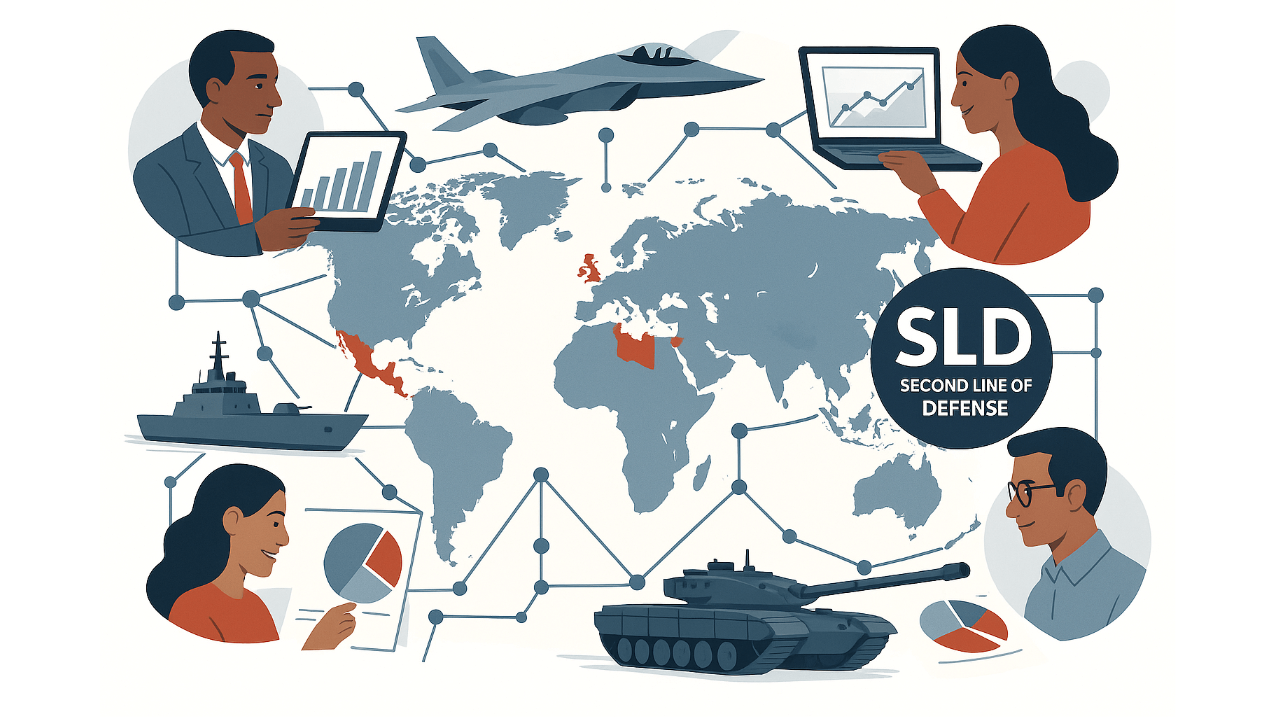
Breaking Through the Echo Chamber: Sixteen Years of Comprehensive Defense Analysis

11/03/2025

By Robbin Laird

Sixteen years ago, we launched Second Line of Defense with General Patton’s warning that “if everyone is thinking alike then no one is thinking” wasn’t philosophical wisdom for it is operational necessity. When defense establishments fall into intellectual lockstep, people die. When military leaders embrace comfortable assumptions rather than uncomfortable realities, they prepare for yesterday’s wars while tomorrow’s conflicts explode around them.

This isn’t academic theorizing. This is life-and-death analysis for decision-makers who cannot afford to get it wrong.

From our inception, we established three non-negotiable analytical pillars: understanding how the global security system actually evolves (not how we wish it would), examining how military force operates within that brutal reality (not within sanitized war games), and tracking emerging capabilities that fundamentally alter warfighter effectiveness (not distant science fiction). These are not research projects; they were survival imperatives for liberal democracies facing adversaries who don’t play by Western rules.

The defense analytical community has developed a pathological addiction to consensus-building that actively undermines strategic thinking. Academic institutions reward scholars who build on established frameworks rather than challenge them. Government agencies promote analysts who validate existing programs rather than question their effectiveness.

The result is an echo chamber that consistently misses the most important developments while obsessing over the least relevant ones.

We made a deliberate decision to reject this intellectual corruption. We focus on what can be done rather than what sounds sophisticated, on real options for decision-makers rather than theoretical constructs that impress peer reviewers, and on the paths actually taken by military organizations under pressure rather than the paths recommended by consultants who have never faced enemy fire.

This approach required building relationships with a different kind of analytical network, practitioners, innovators, and strategists who understand that effective defense analysis demands both ruthless criticism and constructive problem-solving. We sought out multidimensional thinkers because multifaceted problems cannot be solved by narrow specialists who have never ventured outside their academic silos.

The defense establishment too often suffers from chronic platform fetishism, an obsession with individual weapon systems divorced from their operational context. Our analytical approach extends beyond this narrow focus to examine how new technologies enable entirely new concepts of operations. For example, the tiltrotor aircraft revolution didn’t just provide the military with a new platform because it opened tactical and operational possibilities that demanded fresh thinking about mission planning, maintenance logistics, pilot training, and force structure design. Understanding the aircraft meant nothing without understanding the system it enabled.

This systems-thinking approach proved invaluable for understanding the broader implications of military innovation, particularly the second- and third-order effects that defense planners consistently underestimate. New capabilities don’t exist in isolation: rather they interact with existing systems, create new vulnerabilities even as they address old ones, and produce cascading effects that weren’t visible during initial development phases.

The drone revolution exemplifies this dynamic complexity with devastating clarity. What began as simple remotely piloted vehicles for intelligence gathering evolved into a comprehensive ecosystem of unmanned systems spanning air, ground, and maritime domains. But more importantly, it fundamentally altered the strategic balance between state and non-state actors, democratized precision strike capabilities, and collapsed the traditional distinctions between tactical and strategic effects.

One of our most important analytical innovations has been our relentless emphasis on the “fight tonight” force rather than speculative 2040 capabilities. This perspective stems from a hard-learned understanding that military forces must be prepared to operate effectively with the systems they have, not the systems they wish they had or hope to develop over the next two decades.

This isn’t anti-innovation bias — it’s pro-survival realism.

The approach recognizes that effective deterrence and crisis response depend on current capabilities, realistic near-term improvements, and adaptive strategies that can evolve with changing circumstances. We analyze what has been done successfully and how it can be replicated, because focusing too heavily on distant future capabilities creates dangerous gaps between current readiness and immediate threats.

The drone warfare revolution perfectly illustrates why this perspective matters. While defense establishments were planning elaborate future warfare scenarios for 2035, adversaries and proxies were using commercially available drones modified for military purposes to reshape battlefields from Ukraine to Gaza to Yemen. Military forces that adapted existing systems and tactics to counter these immediate threats proved vastly more effective than those waiting for perfect future solutions that might never arrive.

The lesson is clear: adaptation beats anticipation, and flexibility trumps perfection when the shooting starts.

In an era of increasing polarization and institutional groupthink, maintaining analytical independence becomes not just important but existentially necessary. Effective defense analysis requires the ability to question fundamental assumptions, challenge established practices and consider alternative perspectives without losing sight of practical constraints and operational realities.

As we continue this analytical journey, we remain committed to the principles that have guided us from the beginning: rigorous analysis over convenient consensus, practical focus over theoretical elegance, forward-thinking perspective over bureaucratic inertia, and intellectual independence over institutional approval.

The strategic environment will continue evolving in ways that surprise the consensus and vindicate the skeptics. New technologies will emerge that reshape military possibilities faster than procurement systems can adapt. Fresh challenges will arise that demand intellectual agility rather than bureaucratic momentum.

Our mission remains constant: providing insights that help decision-makers navigate complexity and uncertainty in service of effective defense and deterrence. We analyze the world as it is, not as we wish it were. We focus on capabilities that exist, not capabilities that might exist someday. We examine strategies that work, not strategies that sound impressive in briefing rooms.

The next few years promise to be at least as dynamic as the last sixteen, with the added urgency that comes from adversaries who have learned to exploit Western analytical blind spots. We look forward to continuing this analytical journey, tracking the evolution of military capabilities and strategic realities, and contributing to the broader conversation about how liberal democracies can maintain security in an increasingly complex and dangerous world.

The stakes have never been higher. The need for independent, hard-hitting analysis has never been greater. And the cost of getting it wrong has never been more catastrophic.

With this article, I launch a series recognizing the analysts and strategists who have contributed to our journey and made the entire experience not just worthwhile, but essential for national survival.

War in the Modern Age: The Social Media Dimension of the War in Ukraine

10/31/2025

By Robbin Laird

The war in Ukraine is the most documented conflict in human history, and at the center of this digital chronicle sits Telegram, a messaging application that has transformed from a simple communication tool into a multifaceted instrument of warfare.

Since Russia’s full-scale invasion began in February 2022, Telegram has served simultaneously as a lifeline for civilians, a command-and-control platform for military operations, a propaganda megaphone, and a recruitment tool for espionage.

Understanding Telegram’s role in this conflict reveals how modern warfare extends far beyond traditional battlefields into the digital realm where information itself becomes both weapon and shield.

The Rise of Telegram as Ukraine’s Primary Information Source

Before the invasion, Telegram was already popular in Eastern Europe, but the war catapulted it to unprecedented prominence. By 2023, an astonishing 72% of Ukrainians cited Telegram as a primary news source, representing a significant increase from 63% the previous year.1 Its rise occurred as traditional social media platforms faced restrictions and censorship, particularly in Russia, where Facebook, Instagram, and Twitter were either banned or severely limited by authorities.2

The platform’s popularity stems from its unique combination of features: end-to-end encrypted private messaging, public broadcasting channels capable of reaching millions, and minimal content moderation that allows for the rapid, unfiltered dissemination of information. For Ukrainians, Telegram became the most reliable way to receive real-time updates about air raids, safe routes, available bomb shelters, and the general security situation.

For refugees fleeing the violence, Telegram proved essential in coordinating the exodus of more than three million people. The app connected displaced Ukrainians to safe routes, humanitarian aid, and shelter information across Europe. Millions of Ukrainians living abroad used the platform to maintain connections with their homeland, desperately scanning feeds for familiar landmarks or faces that might provide news of loved ones.3

A Tool for Civilian Safety and Government Communication

Ukrainian authorities swiftly recognized Telegram as a vital pillar of wartime communications infrastructure. Throughout the country, official Telegram channels run by local governments and agencies became essential tools for disseminating urgent safety information, including real-time air-raid warnings, bomb shelter locations, security instructions, and alerts on identifying potential Russian saboteurs.4

 Telegram’s two-way design uniquely empowered Ukrainian civil defense. While officials broadcast critical updates to mass audiences, citizens contributed intelligence by reporting details such as enemy troop movements, armored vehicles, and suspicious activities via dedicated Telegram bots and chat platforms. This real-time crowdsourced data proved invaluable, Ukraine’s security services credited information received through these chatbots for enabling a successful strike against Russian vehicles near Kyiv in March 2022, with officials noting that user submissions were responsible for “new trophies every day”5

This crowdsourced intelligence gathering represented a novel approach to civil defense, turning ordinary citizens into the eyes and ears of the military establishment. The democratization of intelligence collection through Telegram fundamentally altered the traditional relationship between civilians and military forces during wartime.

Intelligence Services Enter the Public Sphere

Perhaps one of the most unprecedented aspects of Telegram’s role in the war has been its adoption by Ukrainian intelligence agencies as a public-facing communication platform. Ukraine’s Main Directorate of Intelligence (HUR) developed a structured communication strategy on Telegram that diverges sharply from conventional intelligence practice, which typically emphasizes secrecy and limited public disclosure.

The verified Ukrainian-language Telegram channel operated by the Main Directorate of Intelligence (HUR) accumulated more than 240,000 followers by February 2024. In-depth analysis of 2,606 messages posted from the onset of Russia’s full-scale invasion up to February 2024 identified three core functions: establishing institutional legitimacy, targeting adversaries through carefully calibrated disclosures, and mobilizing domestic citizens for support and participation. The HUR’s channel delivered consistent battlefield updates, released operational footage, publicized intercepted Russian communications, announced special intelligence projects, and broadcast calls to civilians for supportive action.6

This approach transformed intelligence communication from episodic outreach into an ongoing process of public engagement. Rather than maintaining the traditional veil of secrecy, Ukrainian intelligence services used digital platforms to coordinate narrative control, reinforce their legitimacy, and enlist the public as active contributors to the intelligence mission. This represents a fundamental shift in how intelligence agencies operate during high-intensity conflicts, suggesting that transparency and public engagement can complement rather than compromise operational effectiveness.

Military Units and Frontline Documentation

Beyond government agencies, individual Ukrainian military units established their own Telegram channels to share updates, boost morale, and document their operations. Elite units like the Third Separate Assault Brigade, the 36th Separate Marine Brigade, and the 47th Separate Mechanized Brigade maintained active channels showcasing training exercises, battlefield successes, and appeals for equipment donations.7

These military channels served multiple purposes. They provided transparency to Ukrainian citizens about how their armed forces were performing, helped maintain public support for the war effort, and attracted international attention and assistance. The channels also documented the war in unprecedented detail, with soldiers posting footage from helmet cameras, drones, and battlefield positions.

Military bloggers, known as “voenkory” in Russian and Ukrainian, emerged as influential voices on Telegram. These individuals, often with military experience or embedded with combat units, provided detailed tactical analysis and frontline reports that sometimes offered greater technical detail than official media sources.8 The phenomenon of voenkory represented a new category of war correspondents, semi-official voices that blurred the lines between journalism, propaganda, and military communication.

Propaganda and Psychological Warfare

While Telegram served beneficial purposes for Ukraine, it also became a powerful tool for Russian propaganda and psychological warfare. The unregulated nature of the platform made it ideal for disseminating disturbing content designed to demoralize Ukrainian forces and terrorize civilians.

Russian channels regularly posted graphic footage of killed Ukrainian soldiers, often accompanied by mocking captions and propaganda narratives. One particularly notorious channel, “Arkhangel Spetsnaza,” grew to nearly 1.2 million subscribers by monetizing “exclusive” violent content. The channel offered subscription tiers costing between 5 and 10 dollars monthly, granting access to graphic videos of Russian military operations. Investigations revealed that during just two months, this channel collected approximately 30 million rubles (about $317,000) in funding, which was purportedly used to purchase drones for Russian forces.9

The psychological impact of such content extends beyond the immediate shock value. By flooding Telegram with graphic imagery and propagandistic narratives, Russian sources sought to create a sense of Ukrainian hopelessness and inevitability about Russian victory. This “war porn,” as some analysts termed it, served both to rally pro-Russian audiences and to demoralize Ukrainian supporters.10

Coordinated Disinformation Campaigns

Beyond individual channels, Russian operatives conducted sophisticated, coordinated disinformation campaigns on Telegram. Research revealed that from January 2024 to April 2025, a network of 3,634 inauthentic Telegram accounts posted more than 316,000 pro-Russian comments across channels focused on Ukraine’s temporarily occupied territories.11 These comments promoted pro-Russian propaganda, anti-Ukrainian narratives, and abstract calls for peace, often carefully tailored to local conditions and current events.

This massive bot network represented Russia’s attempt to extend its occupation into digital spaces, shaping the information environment in territories under its control. The sophisticated nature of the operation with thousands of accounts posting hundreds of thousands of coordinated messages demonstrated the strategic importance Russia placed on controlling the Telegram information landscape.

The Internet Research Agency (IRA), a Kremlin-affiliated entity known for conducting online influence operations, was at the forefront of Russia’s coordinated efforts to manipulate information environments in support of state interests. In February 2023, Yevgeny Prigozhin, leader of the Wagner mercenary group and a close associate of President Vladimir Putin, openly acknowledged that he had founded and managed the IRA, issuing his statement via a Wagner-affiliated Telegram channel. Prigozhin further explained that the agency was established to defend Russia’s information space against Western propaganda, marking a rare explicit admission of such high-level Kremlin-linked operations.12

This admission confirmed long-standing suspicions about state-coordinated manipulation of social media platforms, including Telegram.

Russian state-sponsored youth influencers also leveraged Telegram to disseminate patriotic messaging to young Russians. These influencers used social media techniques to normalize official stances on the war, creating the impression of grassroots support while actually amplifying state-approved narratives. Their efforts focused on defining “good patriots” as those who participated in memory politics, engaged in militarized activities, and supported the war effort—whether physically or virtually.13

Espionage and Recruitment

Telegram’s role extended even to espionage recruitment. For at least six months, pro-war Telegram channels actively recruited Russian-speaking residents of Europe to spy on NATO military sites and report findings through specialized bots. These channels distributed instructions on photographing military bases, purchasing local maps and guidebooks, and using local SIM cards to avoid detection.14

Recruitment messages distributed on Telegram often originating in smaller groups but rapidly amplified through wider networks have reached tens of thousands of potential recruits across Europe. European security services have documented numerous cases in which individuals were recruited via Telegram to carry out surveillance, vandalism, and arson attacks targeting military infrastructure and critical sites. Authorities in Latvia, Germany, and Poland have arrested suspects allegedly enlisted through Telegram to conduct sabotage operations in support of Russian interests, with cases including attempted arson, attacks on military facilities, and the disruption of supply lines. These incidents illustrate a pattern of decentralized, low-level operations enabled by encrypted platforms, posing new challenges to European security services.15

This weaponization of Telegram for intelligence recruitment represented a democratization of espionage. Rather than relying on traditional, labor-intensive recruitment methods, Russian intelligence services could cast a wide net through Telegram, identifying and activating sympathizers across Europe with minimal risk to handlers.

Conclusion

Telegram’s multifaceted role in the Russia-Ukraine war reveals how modern conflicts are waged simultaneously in physical and digital realms. The platform has served as a lifeline for civilians seeking safety information, a command-and-control network for military operations, a public relations tool for intelligence agencies, a documentation archive for war crimes, and a weapon of propaganda and psychological warfare.

The same technological features, encryption, broad reach, minimal moderation serve both humanitarian and malicious purposes. Ukrainian civilians use Telegram to find bomb shelters and report Russian troop movements; Russian operatives use it to spread disinformation and recruit spies. This duality encapsulates the fundamental challenge of digital communication in wartime: the tools that empower also endanger.

As conflicts increasingly extend into digital spaces, the Ukraine war offers crucial lessons about the role of social media platforms in modern warfare. The unprecedented documentation of military operations, the use of crowdsourced intelligence, the public-facing strategies of intelligence agencies, and the sophisticated disinformation campaigns all point toward a future where information warfare is as critical as kinetic warfare.

Telegram’s role in Ukraine demonstrates that winning the digital battle, controlling narratives, maintaining morale, documenting atrocities, and countering disinformation, is inseparable from success on the physical battlefield. Future conflicts will likely feature similar dynamics, with social media platforms serving as essential infrastructure for both sides. Understanding these dynamics is crucial for policymakers, military planners, platform companies, and citizens navigating an increasingly complex information environment.

The transformation of social media platforms like Telegram into instruments of warfare will have lasting implications for how conflicts are fought, documented, and understood in the digital age.

1. https://www.tandfonline.com/doi/full/10.1080/08850607.2025.2522222

2. https://arxiv.org/html/2501.01884v3

3. https://time.com/6158437/telegram-russia-ukraine-information-war/

4. https://indianexpress.com/article/explained/russia-ukraine-war-telegram-app-7847165/

5. https://www.businessinsider.com/ukraine-military-e-enemy-telegram-app-2022-4

6. https://www.bohrium.com/paper-details/ukrainian-intelligence-s-use-of-telegram-in-wartime/1149639883883544610-13440

7. https://www.kyivpost.com/post/17868

8. https://www.researchgate.net/publication/377109559

9. https://united24media.com/war-in-ukraine/how-a-pro-russian-telegram-channel-monetizes-the-slaughter-of-ukrainians-2777

10. https://www.uttryckmagazine.com/2025/02/27/telegram-war-fuels-itself/

11. https://www.atlanticcouncil.org/event/digital-occupation-inside-russias-telegram-battle-in-ukraine/

12. https://www.egyptindependent.com/wagner-chief-admits-to-founding-firm-sanctioned-by-us-over-alleged-election-interference/

13. https://online.ucpress.edu/cpcs/article-abstract/doi/10.1525/cpcs.2025.2465591/211850/Creating-Good-Young-PatriotsRussian-Youth-Leaders?redirectedFrom=fulltext

14. https://meduza.io/en/feature/2025/01/16/we-need-eyes-and-ears

15. https://www.rferl.org/a/russia-gru-nazi-sabotage-recruitment-telegram/33539661.html; https://www.occrp.org/en/investigation/make-a-molotov-cocktail-how-europeans-are-recruited-through-telegram-to-commit-sabotage-arson-and-murder

Redefining How We Train Modern Fighter Pilots

10/30/2025

By Robbin Laird

The cultural image of the fighter pilot is etched in our minds: a maverick aviator, wrestling a difficult machine through the sky, defined by raw “stick-and-rudder” skill. We picture an ace relying on instinct and reflexes to outmaneuver an opponent in a classic dogfight. For decades, this romantic image wasn’t far from the truth, and our training pipelines were built to produce exactly that kind of pilot.

That world is gone. Today’s combat aviator faces challenges that have fundamentally transformed the very nature of their role. This isn’t just a pivot to a new competitor; it’s a transition from predictable “crisis management” to a new era of “chaos management,” where threats are multidimensional and simultaneous.

The most critical revolutions in pilot training are happening not in the physics of flight, but in the realms of cognitive science, high-speed networking, and hyper-realistic simulation. The fighter pilot has evolved from a lone aviator into a strategic decision-maker at the center of a vast, interconnected web of effects spanning multiple domains.

What follows are five key elements of this new paradigm. These takeaways show that the skills required to dominate the 21st-century battlespace are being forged in ways that would be unrecognizable to the pilots of a generation ago. And these key elements where highlighted in my recent visit to the International Flight Training School run by the Italian Air along with Leonardo and CAE.

The “Kill Chain” Is Obsolete. We Now Fight in a “Kill Web.”

For years, every operation was built around the kill chain, the sequential process: find, fix, track, target, engage, and assess. This step-by-step approach was logical, but against a modern adversary, its rigidity is a critical vulnerability. Disrupting any single link can cause the entire operation to fail.

The new paradigm is the “kill web,” a concept that abandons the linear sequence in favor of a distributed, networked model. In a kill web, any sensor can inform any shooter across the joint force through multiple, redundant pathways. An F-35’s sensor might cue a weapon from a surface ship, which might be guided by data from a space asset. This is a critical shift because it moves the focus from the performance of an individual platform to the integrated power of the network. Success is no longer measured by what a single aircraft can do, but by its contribution to the overall system.

This new networked battlefield, the “kill web,” fundamentally changes the role of the human at its center. The pilot is no longer just an aviator but has been forced to evolve into something far more complex.

The Pilot Has Evolved from an Aviator to a “Quarterback in the Cockpit.”

Counter-intuitively, the fundamental measure of a pilot’s excellence is no longer their mastery of “stick-and-rudder” skills. Modern fighters like the F-35 are, by design, incredibly easy to fly. This frees up the pilot’s immense mental bandwidth to focus on a much harder task: managing the battlespace. This evolution is a direct consequence of the shift to the kill web; the networked environment demands a new kind of operator at its nodes.

The best analogy for the modern pilot’s role comes from military aviation expert Tom Webster, who describes them as a “quarterback in the cockpit.” Like an NFL quarterback reading defensive alignments and adjusting plays at the line of scrimmage, today’s pilot must process vast streams of information from their aircraft’s sensors and the wider network. They read the battlespace, assess threats and opportunities, and make strategic decisions that orchestrate effects across air, land, sea, space, and cyber domains. This demands a cognitive revolution in training, where raw flying ability has become the foundation, not the pinnacle, of a pilot’s skill set.

Outdated Trainers Have Been Actively Teaching the Wrong Habits.

One of the most startling realities of modern training is that for years, outdated equipment was not just inefficient. It was actively detrimental. This phenomenon, known in learning theory as “negative transfer,” occurs when prior learning interferes with the acquisition of new skills. It’s the shocking truth that hundreds of hours in the training pipeline were spent ingraining habits that had to be painstakingly unlearned.

The U.S. Air Force’s 60-year-old T-38 Talon trainer is a prime example. Designed to prepare pilots for Vietnam-era jets, its flight characteristics are fundamentally different from modern fifth-generation fighters. As Maj. Gen. Clark Quinn recounted from his time as a T-38 instructor, he spent approximately a quarter of the entire syllabus just teaching students how to land the jet without crashing. Its design flaws made it prone to stalling on approach, requiring pilots to develop deeply ingrained compensatory behaviors. This constant focus on wrestling a difficult machine actively reinforced the obsolete aviator archetype and stole cognitive bandwidth that should have been dedicated to developing the “systems operator” mindset needed for the F-35.

The impact was severe. Pilots would arrive at their advanced F-35 squadrons with hundreds of hours of motor patterns and instincts that were not just useless, but had to be broken before new learning could begin. This hidden cost meant a significant portion of expensive F-35 flight time was wasted on remediation instead of advanced tactical training. The urgent need to overcome this inefficiency and negative transfer created a demand for a technological solution.

Training for Complex Air Battles While Flying One Live Aircraft in a Training Regime

This reality is perhaps the most counter-intuitive of all: a massive, complex air battle against dozens of adversaries can now unfold with only a single pilot in a single real aircraft. The solution is Live, Virtual, and Constructive (LVC) technology, which seamlessly blends real platforms with synthetic threats.

At Italy’s International Flight Training School, this is a daily reality. A student pilot can take off alone (with his instructor pilot behind him in the second seat) in an M-346 advanced trainer and, moments later, find themselves in the middle of a large-scale engagement. From a ground station, instructors project a dense, synthetic threat environment. complete with enemy fighters like Su-34s and advanced surface-to-air missile systems, directly into the pilot’s cockpit displays, sensors, and helmet.

The integration is so seamless that the pilot and the aircraft’s systems react to synthetic threats as if they were real, making the virtual experience indistinguishable from a live engagement. The pilot’s radar shows an enemy contact, their warning systems detect a missile lock, and their targeting pod displays the adversary aircraft. All of it is virtual. A pilot flying alone in clear skies is actually experiencing the full cognitive stress and tactical decision-making of fighting in a contested, high-threat environment, all with immense cost and safety benefits.

The Training Manual Is Now a Living Document, Updated in Real-Time.

In the past, a training curriculum was a static document, updated periodically. In the rapidly evolving threat environment of the 21st century, that model is dangerously obsolete.

Today, the most advanced training programs treat the syllabus as a living document. At IFTS, the Italian Air Force has implemented a dynamic feedback loop that ensures training remains perfectly aligned with frontline operational reality. Every six months, instructors from operational F-35 and Eurofighter squadrons meet with IFTS instructors to harmonize the entire training pipeline. This process allows for near real-time updates. For example, real-world intelligence and tactical lessons learned from NATO air policing missions in the Baltics where pilots are actively encountering adversary aircraft are fed directly back into the training syllabus being taught to students in Sardinia.

This “living curriculum” eliminates the gap between the training environment and the operational one. If a frontline pilot discovers an adversary’s radar performs differently than expected, that new data is programmed into the simulators and synthetic threats at IFTS within weeks, not years, ensuring pilots are prepared for the threats they will actually face, not the threats of yesterday.

Conclusion: Training for a Software-Defined Future

The five key elements above reveal a core theme: modern fighter pilot training has pivoted from an emphasis on mechanical flying skill to the development of cognitive agility and adaptive decision-making. The goal is no longer just to create a proficient aviator, but a battlefield commander who happens to work from a cockpit.

The most critical asset being developed in today’s training pipeline is the pilot’s “mental furniture” or the cognitive frameworks and decision-making patterns they will rely on for their entire career. This mental architecture must be built to handle a future of software-defined warfare, continuous technological change, and the increasing integration of human-machine teaming.

As this evolution continues, it raises a profound question for the future of air combat: As aircraft become increasingly automated and intelligent, what will be the ultimate role of the human in the cockpit, and how must our training evolve to prepare them for it?

And a podcast describing the project:

Training Combat Pilots for the Kill Web Era: A Strategic Evolution

The Baltic Energy Cut-off of Kaliningrad from Mother Russia

10/28/2025

In the early morning hours of February 8, 2025, a 9-meter tall clock in downtown Vilnius reached zero, marking one of the most significant geopolitical transformations in European energy history. As the final seconds ticked away, Estonia, Latvia, and Lithuania severed their last physical connection to the Soviet-era power infrastructure that had bound them to Moscow for more than six decades.1

This wasn’t merely a technical operation for it was the culmination of nearly two decades of strategic planning, billions of euros in investment, and a determined effort to achieve complete energy sovereignty from Russia.

The synchronization with Continental Europe’s power grid represented far more than an engineering achievement. It symbolized the Baltic states’ final rejection of post-Soviet dependency and their full integration into European systems.

As Lithuanian President Gitanas Nausėda declared, this was “physical disconnection from the last remaining element of our reliance on the Russian and Belarusian energy system.”2

The move effectively weaponized energy infrastructure in reverse by transforming what had been a Russian lever of control into a demonstration of European unity and resilience.

The Historical Context: Decades of Dependency

The electricity systems of Estonia, Latvia, and Lithuania were technologically integrated into the Integrated Power System/Unified Power System (IPS/UPS) grid in the early 1960s, during the Soviet occupation. This integration was not a choice but an imposition and was part of the broader Soviet strategy of creating interdependencies that would outlast the political union itself.

After achieving independence in 1990, Estonia, Latvia, and Lithuania continued to operate their electricity systems within the post-Soviet BRELL network which is named after its five members: Belarus, Russia, Estonia, Latvia, and Lithuania. The 2001 BRELL Agreement formalized coordinated management of grid synchronization between these countries, but in reality, the system was still centrally controlled by Russian operators through the IPS/UPS network, with Moscow responsible for balancing supply and maintaining frequency stability.

This technical arrangement meant that, despite political sovereignty, critical infrastructure in the Baltic states, including factories, hospitals, and households, remained structurally dependent on Russia for the reliability and security of their electricity supply until the recent synchronization with the European grid.3

The vulnerability this created was not theoretical. Lithuania experienced firsthand how Russia wielded energy as a weapon when, after declining to sell its crude oil refinery to a Russian company in 2006, it faced politically motivated gas pricing and oil pipeline shutdowns. Such an incident crystallized the understanding that true sovereignty required control over energy infrastructure.4

The Long Road to Independence

The journey toward energy independence began formally in 2007, when the prime ministers of the three Baltic states confirmed their strategic objective to become part of the continental European network. This was no simple undertaking. It required rebuilding power lines, constructing new inter-connectors, and fundamentally reorienting three national electricity systems away from the east and toward the west.

The European Union recognized the critical strategic significance of the Baltic electricity grid synchronization, ultimately allocating over €1.2 billion in funding since 2014 through the Connecting Europe Facility (CEF) to support necessary infrastructure upgrades and integration with the Continental European Network.5

Key milestones included the 2015 commissioning of LitPol Link, the first direct high-voltage connection between Poland and Lithuania, which provided a vital gateway for integrating the Baltic states with the European grid.

The next major step was the development of the Harmony Link, a new planned inter-connector between Poland and Lithuania originally valued at approximately €680 million, of which €493 million was to be covered by EU funding through the CEF. The Harmony Link is designed to reinforce regional energy security and further synchronize the Baltic grid with the rest of Europe.6

The effort demanded more than building new infrastructure. Estonia, Latvia, and Lithuania also needed to demonstrate that their grids could operate autonomously. On April 22, 2023, the three Baltic states conducted a full-day isolation test—disconnecting from the Russia- and Belarus-linked IPS/UPS power grid—to assess their ability to sustain independent electricity operations.7

Latvia and Estonia withdrew from this initial testing phase, citing infrastructure readiness concerns, but Lithuania successfully completed the test and declared itself ready to join the synchronous grid of Continental Europe by 2024. President Nausėda pressed for all three countries to move together, and eventually they agreed to synchronize no later than February 2025.

The Catalyst: Russia’s Invasion of Ukraine

The Baltic synchronization project, while under development for nearly twenty years, saw its timeline significantly accelerated following Russia’s full-scale invasion of Ukraine in February 2022. The war exposed with unprecedented clarity the severe risks inherent in energy dependence on an aggressive neighboring state, catalyzing swift action among Baltic leaders to protect their energy security.8

In response to this new urgency, Lithuanian Prime Minister Ingrida Šimonytė and her Baltic counterparts pushed to expedite the transition away from the Russian-controlled IPS/UPS (BRELL) transmission system, advancing the synchronization deadline from the original target of late 2025 to February 2025. The acceleration reflects a determined effort by Lithuania and its neighbors to minimize vulnerability and fully align with the Continental European grid well ahead of schedule.9

The war also provided a powerful precedent. Ukraine managed to disconnect its power grid from Russia and synchronize with Europe’s ENTSO-E network just hours before the full-scale invasion began on February 24, 2022.10

What was initially intended as a temporary test became permanent, and proved its strategic value when Russia destroyed approximately half of Ukraine’s power generation capacity in subsequent attacks.

Ukraine’s connection to the European grid enabled it to import power and maintain electricity supplies through devastating bombardments which was a lifeline that would have been impossible had it remained dependent on Russian-controlled systems.

After Russia’s invasion of Ukraine, the Baltic states halted all purchases of Russian electricity in May 2022, yet their power grids remained physically linked to those of Russia and Belarus as part of the legacy BRELL system. This arrangement revealed a crucial distinction: while commercial imports could be rapidly halted, disentangling from the structural dependencies of interconnected electricity networks proved much more complex and protracted.11

February 2025: The Historic Disconnection

On July 16, 2024, the Baltic states acting through their respective transmission system operators (Elering, AST, and Litgrid), formally notified Russia and Belarus of their intent to terminate participation in the BRELL energy agreement. The BRELL Agreement, enabling synchronous operation with the IPS/UPS power grid managed by Russia, was slated to end legally on February 7, 2025, with the physical disconnection scheduled for the following day.

On February 8, 2025, at precisely 9:09 AM (UTC+2), Estonia, Latvia, and Lithuania executed a coordinated withdrawal from the IPS/UPS system. The technical procedure involved each Baltic country sequentially disconnecting remaining transmission links with Russia, Belarus, and the Russian exclave of Kaliningrad: Lithuania disconnected first, followed shortly by Latvia, and then Estonia, completing the process

For 24 hours following their disconnection from the Russian-controlled electricity grid on February 8, 2025, the Baltic power systems of Estonia, Latvia, and Lithuania operated autonomously in “island operation mode.” During this period, operators carried out numerous frequency, voltage stability, and system resilience tests while fully isolated from both the Russian and European grids which was a stage widely viewed as the most anxious part of the transition.

Notably, in Lithuania, the Elektrėnai Power Plant experienced an unplanned temporary disconnection but was quickly brought back online, serving as a minor incident that highlighted both the risks faced and the built-in redundancies of the system. This successful management of the grid’s stability and prompt corrective actions underscored the readiness of the Baltic operators for full synchronization with Europe’s power network.

Then, on February 9, 2025, at 14:05, the moment arrived: the Baltic states successfully synchronized with the continental European electricity grid.21 The transition occurred without major incident.

Three small nations with a total population of around six million—Estonia, Latvia, and Lithuania achieved what European Commission officials called a major technological milestone in early 2025: they synchronized their national power grids with the Continental Europe Synchronous Area, a system supplying electricity to over 400 million consumers in more than 30 countries across the European continent.12

This integration marked the completion of a years-long effort to merge the Baltic states’ electricity networks with the broader European power system, ending their reliance on the former Soviet IPS/UPS network

The Kaliningrad “Island”

The synchronization created a unique and strategically significant problem for Russia: the complete energy isolation of Kaliningrad Oblast. This Russian exclave, wedged between EU members Poland and Lithuania and the Baltic Sea, suddenly found itself operating as an “energy island”or a grid without external connections to other power systems.13

Energy islands are rare in Europe and significantly more challenging to operate because they cannot rely on cross-border flows to balance fluctuations in electricity demand and supply.14 Moscow had anticipated this problem and spent heavily to prepare. Russia doubled Kaliningrad’s gas-fired power capacity, constructed an approximately €780 million gas storage facility with a capacity of roughly 800 million cubic meters, and acquired the Marshal Vasilevsky tanker, a $300 million LNG terminal ship capable of supplying Kaliningrad’s full gas demand of up to 3.7 billion cubic meters per year.

However, as analyst Tomas Janeliūnas pointed out, the LNG option is approximately four and a half times more expensive than piped gas. More critically, Kaliningrad remains heavily dependent on gas supplies that transit through Lithuania via pipeline.

As Janeliūnas noted with understated irony: “If something happened to that pipeline in Lithuania… say, an accidental ‘anchor drop’ or a truck crash… Kaliningrad’s gas supply would be, let’s say – challenged.” The synchronization didn’t just cut off Russia’s grid for it placed Kaliningrad in a vulnerable position where Lithuania holds a crucial piece of the puzzle.15

Kaliningrad’s vulnerability carries major strategic implications due to its role as a core military outpost for Russia. The exclave is home to advanced military systems, notably including Iskander-M short-range ballistic missiles that are capable of delivering both conventional and nuclear warheads, with a range that can reach several NATO countries from this location. Kaliningrad also hosts the principal base of the Russian Baltic Fleet, making it a hub for Moscow’s naval and missile forces in the Baltic Sea region.16

This makes the region’s energy isolation particularly consequential. The current dependence on costly alternatives, like liquefied natural gas, underscores how the post-Soviet power dynamic has fundamentally shifted: a once forward-deployed Russian stronghold now finds itself encircled and increasingly vulnerable to Western leverage and blockade in both military and economic terms.

The Renewable Energy Dimension

The synchronization of the Baltic States’ electricity grids with continental Europe has both coincided with and actively driven a major acceleration in renewable energy development throughout the region. Lithuania, for instance, surpassed its 2025 solar target ahead of schedule by reaching 1.2 GW of installed solar photovoltaic capacity as early as 2024.

The country has now set a new goal to achieve 5.1 GW of solar capacity by 2030, signaling a strong policy commitment to further expansion. Across the Baltic, both solar and wind power investment are treated as strategic priorities, with substantial growth anticipated as synchronization improves regional energy integration.17

Poland is emerging as a linchpin in this transformation. It is currently developing 33 GW of offshore wind capacity in the Baltic Sea, a buildout that could represent nearly a quarter of the European Union’s forecasted offshore wind capacity by 2050. This massive influx of renewable generation, coupled with expanded and modernized interconnections between Poland and the Baltic states, is expected to form the backbone of future energy security—anchored in clean, domestic sources instead of imported fossil fuels.18

As the EU’s internal electricity market integrates further, strengthened cross-border flows will be increasingly crucial for managing the variable generation patterns of wind and solar. Harmonized grid standards across member states are making it easier to connect new renewable projects and to distribute surplus power throughout Europe.

Commenting on the region’s transformation, Litgrid CEO Rokas Masiulis observed: “Actions by Russia—by them being aggressive and pushing their neighbors has really helped us. Maybe we’ve suffered a little with oil prices, with gas prices, but we were forced to act. So we built alternative routes. Now we’re in much better state than we were before”.19

Security Concerns and Cyber Threats

The synchronization of the Baltic states’ power grids with continental Europe was accompanied by pronounced security concerns, particularly regarding potential Russian cyberattacks and acts of sabotage. In advance of the transition, the Baltic countries implemented elevated cybersecurity protocols, including restricting VPN access for external contractors and installing anti-drone defenses at key energy infrastructure sites. Latvia’s President Edgars Rinkēvičs publicly warned of possible provocations, underscoring the necessity of these security measures to protect critical assets and personnel throughout the synchronization process.20

To date, the Baltic states have reported no major cyberattacks on their energy infrastructure during or after the synchronization. However, they remain on high alert. Russian cyberattacks targeting critical infrastructure are expected to continue, likely resulting in increased cybersecurity spending and elevating strategic and operational risk for the Baltic states over the long term.

The establishment of Baltic Sentry at the Baltic Sea NATO Allies Summit in Helsinki in January 2025 represented an important step in protecting the region’s critical infrastructure. This initiative reflects growing recognition that energy infrastructure protection requires coordinated NATO-EU cooperation, combining cyber defense capabilities with physical infrastructure security.

The concerns are not unfounded. In the years following Russia’s invasion of Ukraine, multiple incidents of suspected sabotage affected undersea cables and pipelines in the Baltic Sea region. The synchronization has made the Baltic states’ infrastructure a more attractive target for Russian hybrid operations, even as it has reduced their vulnerability to traditional energy coercion.21

Looking Ahead

The successful synchronization does not mean the work is complete. Several challenges and opportunities lie ahead for the Baltic energy system.

First, the Baltic states must continue developing their energy infrastructure in partnership with EU neighbors and institutions. Further expansion of transmission lines and investment in new interconnectors will increase system resilience to possible outages and overloads.

The Harmony Link project is a major new electricity interconnector planned between Poland and Lithuania, with construction scheduled for completion by 2030 and an estimated investment of around €680 million, a substantial portion of which comes from EU funding. Timely completion of Harmony Link is essential, as the project will significantly enhance the region’s energy security by further integrating the Baltic grids with continental Europe’s network and increasing power trading capacity between Lithuania and Poland.

To maximize the benefits and resilience provided by this new connection, additional measures, including the deployment of battery energy storage systems and advanced demand response capabilities, will be necessary. These flexible resources allow the grid to balance supply and demand more effectively and help safeguard against fluctuations in renewable generation and grid stress, supporting system stability and meeting future peak demand.22

Second, the Baltic states will need reliable access to power reserves in emergency situations through solidarity mechanisms and cooperation with Poland, Sweden, and Finland. This requires greater regional energy cooperation, particularly through common power system management strategies with the Nordic countries and strengthening energy exchange mechanisms in the European market.

Third, continued vigilance regarding cybersecurity and physical infrastructure protection is essential. The EU and member states must consistently strengthen their cyber-security systems to protect against attacks that could destabilize the electricity system. Further developing EU-NATO cooperation on critical infrastructure protection will remain central to this effort.

Finally, while Russia assures that Kaliningrad can operate reliably in isolation, there remains a realistic expectation that Moscow could make energy supply problems to Kaliningrad a pretext for some form of aggression in the region.

Restrictions by Finland and Estonia on Russian maritime traffic may compound Kaliningrad’s vulnerabilities, potentially creating shortages of food and fuel that could be politically exploited. The increased NATO military presence across the Suwalki corridor the only land route linking the Baltics to NATO reflects awareness of these risks.

In short, the Baltic states’ disconnection from Russia’s power grid and synchronization with Continental Europe represents far more than a technical achievement in electrical engineering. It marks the completion of a three-decade journey from Soviet occupation to full integration with European systems. The project embodies the principle that true sovereignty requires control over fundamental infrastructure, and that energy dependence is political dependence.

For Russia, the synchronization represents a strategic setback. The Kaliningrad exclave, once a menacing outpost projecting Russian power into the heart of Europe, now finds itself as an energy island dependent on the goodwill of the very EU members it was positioned to threaten. The reversal is complete: what was once a Russian lever of control has become a vulnerability.

On February 9, 2025, when the Baltic Power System successfully merged with the Continental European grid, more than electricity began flowing westward. Three nations that had spent the previous 80 years under occupation, coercion, or the threat of both finally achieved complete energy sovereignty.

1. https://www.euronews.com/my-europe/2025/02/10/zelenskyy-congratulates-baltic-countries-as-they-disconnect-from-soviet-era-power-grid

2. https://www.npr.org/2025/02/06/g-s1-46775/baltic-nations-count-final-hours-to-ending-electricity-ties-to-russia

3. https://www.enseccoe.org/publications/brell-desynchronisation-assessment/

4. https://bisi.org.uk/reports/new-era-of-energy-independence-baltic-states-decoupling-from-the-russian-power-grid

5. https://cinea.ec.europa.eu/cef-energy-instrumental-funding-achieve-baltic-synchronisation-continental-european-network_en

6. https://www.pagerpower.com/news/harmony-link-project-baltic-states-series/; https://www.lrt.lt/en/news-in-english/19/2159251/polish-lithuanian-power-cable-to-be-built-alongside-rail-baltica-tracks-minister

7. https://www.lrt.lt/en/news-in-english/19/2482000/baltics-disconnect-from-russian-power-grid-start-isolated-operation?srsltid=AfmBOooy-Xa8OWRw-Q-oFIOnpANc5skD7-XTLIgx1OvcvUHEKxYAlsB6

8. https://kleinmanenergy.upenn.edu/commentary/blog/baltic-states-grid-synchronization-addressing-energy-threats-in-the-baltic-region/

9. https://www.fpri.org/article/2024/09/the-baltic-electricity-grid-synchronizing-symphony/

10. https://english.nv.ua/business/lithuania-dismantles-all-power-lines-with-kaliningrad-after-eu-grid-sync-50546080.html

11. https://www.cnn.com/2025/02/07/europe/baltic-states-disconnection-russian-energy-grid-intl-cmd

12. https://ecfr.eu/article/synch-and-swim-how-escaping-russias-electricity-grid-can-strengthen-baltic-energy-security/

13. https://www.aljazeera.com/news/2025/2/10/why-have-baltic-states-unplugged-from-russias-electricity-grid

14. https://odessa-journal.com/kaliningrad-will-be-disconnected-from-russias-energy-system-this-will-happen-later-this-week#google_vignette

15. https://www.intellinews.com/kaliningrad-becomes-an-energy-island-after-baltic-states-cut-russian-grid-connection-366166/

16. https://kyivindependent.com/russia-saber-rattles-with-iskander-missiles-in-kaliningrad-oblast-during-zapad-drills-should-nato-be-concerned/; https://www.cna.org/our-media/indepth/2023/05/kaliningrad-impregnable-fortress-or-russian-alamo

17. https://www.pvknowhow.com/news/lithuania-solar-power-program-launches-15-million/

18. https://strategicenergy.eu/poland-baltic-europe-offshore-wind-powerhouse/

19. https://www.npr.org/2025/02/06/g-s1-46775/baltic-nations-count-final-hours-to-ending-electricity-ties-to-russia

20. https://eng.lsm.lv/article/politics/president/05.02.2025-president-baltic-states-ready-to-unplug-from-brell-grid.a586568/; https://www.reuters.com/business/energy/natos-eastern-flank-bunkers-anti-drone-nets-set-protect-power-grids-2025-09-29/

21. https://www.reuters.com/world/europe/recent-suspected-underwater-sabotage-incidents-baltic-sea-2024-12-03/; https://jamestown.org/program/russias-hybrid-warfare-tactics-target-the-baltics/

22. https://www.utilitydive.com/spons/beyond-traditional-demand-response-how-energy-storage-is-revolutionizing-g/741327/

U.S. Marine Corps Debuts New Littoral Capabilities at Balikatan 2025

10/27/2025

By Robbin Laird

Exercise Balikatan 2025, the 40th iteration of the annual U.S.-Philippine military exercise, marked a significant milestone in the evolution of U.S. Marine Corps littoral warfare capabilities in the Indo-Pacific region. Conducted from April 21 to May 9, 2025, the exercise showcased the debut of the 3rd Marine Littoral Regiment’s new rotational force concept alongside advanced unmanned surface vessel (USV) technologies from Maritime Tactical Systems (MARTAC).1

This combination of innovative organizational structures and cutting-edge autonomous systems represents a fundamental shift in how the Marine Corps approaches maritime security and coastal defense in contested environments.

The 3rd Marine Littoral Regiment’s New Rotational Force

The 3rd Marine Littoral Regiment (MLR), based in Hawaii, introduced the Littoral Rotational Force-Luzon during Balikatan 2025, establishing a forward-deployed presence in the Philippines. This new formation differs significantly from the Marine Rotational Force-Darwin in Australia, as it is led by the MLR rather than a traditional Marine Air-Ground Task Force. According to 1st Lt. Anne Pentaleri, the 3rd MLR public affairs officer, “When you think MLR, you think of the Philippines,” highlighting the unit’s strategic focus on the archipelago.2

The rotational force builds upon three consecutive years of training in the Philippine archipelago, focusing on littoral operations and coastal defense. The unit is scheduled to remain forward-deployed for both the spring Balikatan exercise and the summer Kamandag exercises, providing persistent presence in this strategically vital region.

NMESIS Deployment to the Philippines

One of the most significant developments during Balikatan 2025 was the inaugural deployment of the Navy-Marine Expeditionary Ship Interdiction System (NMESIS) to the Philippines. The 3rd MLR received this system in November 2024, and its deployment to the Batanes Islands represented a major milestone for the continuously developing U.S.-Philippines alliance.3

The NMESIS is a ground-based anti-ship missile system mounted on an unmanned vehicle platform, capable of engaging maritime targets at ranges up to 100 nautical miles with Naval Strike Missiles. U.S. Air Force C-130J Super Hercules aircraft from the 39th Airlift Squadron transported the system to Batan Island during the Maritime Key Terrain Security Operations event.

Lt. Gen. Michael Cederholm, the U.S. Joint Task Force commander, emphasized the system’s strategic importance: “We are expeditionary by nature, and training on the Batanes with our Philippine allies and the precision fires capabilities of the NMESIS advances our mutual maritime defense in an austere and geographically dispersed environment.” The Batanes Islands, located between Luzon and Taiwan in the Luzon Strait, represent critical maritime key terrain in the region.4

MARTAC Unmanned Surface Vessels

While the NMESIS deployment received significant public attention, the use of MARTAC unmanned surface vessels during Balikatan 2025 remained relatively low-profile, with public acknowledgment coming only in late May, weeks after the exercise concluded. U.S. Naval Special Warfare forces operated a MARTAC T38 Devil Ray USV at Naval Operating Base Subic on May 5, 2025. Photographs released by the U.S. Air Force showed a Naval Special Warfare Combatant Craft Assault towing the Devil Ray in front of Quay 7.5

The Devil Ray T38 represents a highly capable unmanned platform with impressive performance characteristics. The system can reach speeds up to 80 knots and carry payloads weighing up to two tons. The Devil Ray utilizes Starlink satellite communications for command and control, providing operators with reliable connectivity even in remote maritime environments.

The MARTAC portfolio also includes the smaller MANTAS T12, which features a unique semi-submersible capability. Through its “gator mode” awash deck feature, the MANTAS can operate with most of the vessel beneath the waves, similar to narco-submarine designs. This platform measures 3.6 meters in length and can support payloads up to 64 kilograms, with missions including surveillance, swarming operations, and electronic warfare.

U.S. Support for Philippine Maritime Capabilities

The presence of MARTAC systems at Balikatan 2025 reflects both U.S. and Philippine investments in unmanned maritime capabilities. The United States has provided the Philippine Navy with four T12 MANTAS and one Devil Ray T38 through foreign military financing as part of a broader effort to strengthen Philippine maritime domain awareness in the South China Sea.6

U.S. Secretary of Defense Lloyd Austin unveiled these transfers during a visit to Palawan in November 2024, alongside Philippine Secretary of National Defense Gilberto Teodoro. “The T12 is a key capability used by Philippine forces to protect its sovereignty and operate throughout its exclusive economic zone in the South China Sea,” the Pentagon stated.7

The Philippine Navy has established Unmanned Surface Vessel Unit One to operate these systems. Former Flag Officer-in-Command Vice Admiral Toribio Adaci explained the strategic rationale: “We have to have USV units for ISR [Intelligence, Surveillance, and Reconnaissance] purposes so that we can improve our capability for maritime domain awareness. That’s how modern navies now evolve, using unmanned systems to complement manned systems.”8

Maritime Security Consortium and Its Regional Impact

The deployment of USVs during Balikatan 2025 occurred within the context of the Pentagon’s new Maritime Security Consortium, a private-public initiative unveiled in November 2024. According to Pentagon officials, $95 million worth of maritime security capabilities were scheduled for delivery to countries across Southeast Asia, with key demonstrations planned during Balikatan 2025.9

U.S. Defense Secretary Pete Hegseth, during his first visit to an Indo-Pacific partner in March 2025, pledged to deploy unmanned surface vehicles for the exercise. A readout of his joint statement with Philippine Defense Secretary Gilberto Teodoro indicated that training on unmanned anti-ship launchers and vessels would “increase the interoperability and operational readiness of U.S. and Philippine forces to leverage cutting-edge military capabilities in Indo-Pacific operational environments.”10

Unlike traditional platforms, USVs can be deployed with minimal infrastructure and personnel signature, making them difficult to detect and track. The semi-submersible capabilities of systems like the MANTAS T-12 further complicate adversary surveillance efforts.

Strategic Implications and Future Direction

The integration of advanced USV capabilities with the 3rd MLR’s littoral regiment concept represents a significant evolution in U.S. military presence and capabilities in the Indo-Pacific. The combination of precision anti-ship missiles, unmanned surface vessels, and expeditionary air defense systems provides a flexible, distributed capability that aligns with the operational challenges of the first island chain.11

Colonel John G. Lehane, Commanding Officer of the 3rd Marine Littoral Regiment, highlighted the synergistic effects of these capabilities: “When employed in conjunction with the Navy-Marine Expeditionary Ship Interdiction System (NMESIS), the MADIS enables 3rd MLR’s ability to conduct maritime strike by giving the Medium-range Missile Battery time to emplace, fire the NMESIS, and displace without fear of being targeted by drones and small unmanned aerial systems.”12

The focus on the Batanes Islands and Luzon Strait during Balikatan 2025 underscores the strategic geography at play. These locations sit astride potential conflict zones and critical sea lanes, making them essential to any maritime security architecture in the region. Philippine Army Brigadier General Mike Logico, the Exercise Balikatan spokesperson, emphasized this point: “Every country big or small has an absolute and inalienable right to defend itself. Maritime Key Terrain Security Operations training increases our combined ability to secure and defend our territories.”13

Conclusion

The 3rd Marine Littoral Regiment’s Littoral Rotational Force-Luzon provides a persistent, forward-deployed presence optimized for distributed operations in littoral environments. The integration of MARTAC USVs adds a new dimension to maritime domain awareness and potential strike operations, while maintaining operational flexibility and reduced signature.

The exercise also highlighted the deepening U.S.-Philippine defense partnership, with both nations investing in complementary capabilities and operational concepts. As tensions persist in the South China Sea and broader Indo-Pacific region, the combination of advanced technology, innovative organizational structures, and allied cooperation demonstrated at Balikatan 2025 provides a template for future security cooperation in this critical theater.

1. https://www.marines.mil/News/News-Display/Article/4156181/philippine-us-troops-kick-off-exercise-balikatan-2025/; https://news.usni.org/2025/03/27/marine-corps-to-debut-new-philippine-rotational-force-at-balikatan-2025-drills

2. https://news.usni.org/2025/03/27/marine-corps-to-debut-new-philippine-rotational-force-at-balikatan-2025-drills

3. https://www.dvidshub.net/news/496275/us-marine-corps-joint-force-deploy-nmesis-batanes-exercise-balikatan-2025

4. https://www.imef.marines.mil/Media-Room/Press-Releases/Announcement/Article/4168249/us-marine-corps-joint-force-deploy-nmesis-to-batanes-for-exercise-balikatan-2025/; https://www.perplexity.ai/search/could-you-source-this-lt-gen-m-jBqluAWwQJK5Ud0JuLq1Tw

5. https://www.navalnews.com/naval-news/2025/05/u-s-special-forces-train-with-usvs-in-the-philippines/

6. https://www.navalnews.com/naval-news/2024/11/philippine-navy-receives-u-s-funded-usvs-for-scs-operations/

7. https://www.war.gov/News/Releases/Release/Article/3970660/joint-press-release-on-the-visit-of-us-secretary-of-defense-austin-to-the-phili/

8. https://www.navalnews.com/naval-news/2024/10/philippines-navy-eyes-usv-unit-to-monitor-waters-aid-warships/

9. https://www.war.gov/News/Releases/Release/Article/3968018/dod-launches-industry-government-maritime-security-marsec-consortium-to-advance/

10. https://ipdefenseforum.com/2025/04/u-s-deploying-advanced-capabilities-concepts-to-philippines-for-balikatan-2025/; https://news.usni.org/2025/03/28/secdef-hegseth-announces-marine-anti-ship-missile-deployment-to-balikatan-defense-industrial-base-cooperation-with-manila-in-philippines-visit

11. https://www.dvidshub.net/news/495705/enhanced-defense-3d-mlr-deploys-madis-philippines-balikatan-2025

12. https://www.3rdmlr.marines.mil/Media-Room/Stories/Article/Article/4162977/enhanced-defense-3d-mlr-deploys-madis-to-philippines-for-balikatan-2025/; https://theaviationist.com/2025/04/24/usmc-madis-nmesis-deployed-balikatan-2025/

13. https://ipdefenseforum.com/2025/10/balikatan-2025-builds-philippine-resilience-multinational-military-capacity/; https://news.usni.org/2025/08/29/philippine-military-opens-new-luzon-strait-base-near-taiwan

The Poland-Belarus Border Closure: Its Global Impact

10/23/2025

In September 2025, Poland made a decision that reverberated far beyond its borders with immediate consequences for global trade. Citing security concerns following the Zapad-2025 military exercises and Russian drone incursions, Warsaw closed all crossing points with Belarus, effectively severing one of the most important arteries in the China-Europe trade network.1

The closure stranded over 130 freight trains in Belarus and disrupted a rail corridor carrying approximately €25 billion in annual trade between China and the European Union.2

This seemingly regional action illuminates a profound geopolitical reality: China’s ambitious Belt and Road Initiative, designed to create new trade routes linking Asia with Europe, remains vulnerable to political decisions made by countries through which these routes must pass.

More significantly, the closure reveals the deepening contradictions China faces as it attempts to maintain its strategic partnership with Russia while pursuing vital economic interests with the West. As Trump-era tariffs and potential European tariffs threaten China’s already weakening economy, Beijing finds itself caught between incompatible imperatives, a dilemma that the Poland-Belarus border closure brings into sharp relief.

The Strategic Importance of the China-Europe Railway Express

Poland’s decision is best understood within the wider context of the China-Europe Railway Express, a transformative link in modern Sino-European commerce. The railway traverses Belarus en route to Poland, acting as the principal conduit for rail-borne trade between China and the European Union; in fact, approximately 90% of all China-EU rail freight passes along this corridor. In 2024, cargo volumes on the route rose by 10.6% compared to the previous year, while the value of transported goods surged by an extraordinary 85%, reaching €25.07 billion. This “rail bridge” now facilitates about 3.7% of total EU-China trade, a sharp rise from 2.1% the year prior.

This dramatic expansion reflects evolving patterns in the movement of goods between the world’s two largest economies. The surge is predominantly attributed to rapid-growth cross-border e-commerce and the shipment of higher-value industrial products. For major Chinese e-commerce platforms—such as Temu and Shein—the railway has quickly become indispensable, allowing them to offer compressed delivery timelines without incurring air-freight costs. Typically, goods sent via the China-Europe Railway Express arrive within 15 days, which is more than a month faster than traditional sea routes. Although rail is marginally pricier than maritime transport, its speed and reliability have made it the preferred choice for many traders and manufacturers.3

The cargo composition reveals the route’s strategic importance. Public data shows that approximately 60% of loads comprise electronics, machinery, lithium batteries, and electric vehicles, precisely the categories where delivery predictability and speed matter most for maintaining competitiveness in European markets. As China seeks to boost trade with the EU and diversify away from the United States amid escalating trade tensions, this land route has become increasingly essential to Chinese commercial strategy.

The Immediate Impact of the Closure

When Poland announced the complete closure on September 12, 2025, the effects rippled through the logistics chain immediately. The shutdown paralyzed the main China-Europe railway hub at Małaszewicze, Poland’s primary border crossing with Belarus. According to reports from Chinese financial media outlet Yicai Global, more than 130 China-Europe freight trains became stuck at Brest in Belarus during the first week alone.4

The disruption extended far beyond simple delay. Freight forwarders scrambled to find alternatives, with Baltic carriers tripling rates for 40-foot high-cube containers to approximately $9,500, thereby exceeding peak levels seen during the COVID-19 pandemic. The closure affected diverse shipments, including containers of European wine destined for China, electronics heading to European markets, and the myriad consumer goods that fuel the cross-border e-commerce boom.5

The alternatives available to shippers highlighted the route’s unique value proposition.

• Companies could attempt rerouting via other rail lines that bypass Poland and Belarus, though with severely limited capacity.

• They could shift to sea freight, which requires detouring around Africa’s Cape of Good Hope and significantly lengthens transit times.

• Or they could resort to expensive air freight for time-sensitive goods.

None of these options replicated the speed, cost-effectiveness, and capacity of the primary rail corridor through Belarus and Poland.

The Security Rationale: Russia, Belarus, and Hybrid Warfare

Poland’s decision to close the border did not emerge from a vacuum. The closure followed a calculated pattern of Russian and Belarusian actions designed to test and probe NATO’s eastern flank. On September 9, 2025, more than 20 unmanned aerial vehicles from Belarus and Russia entered Polish airspace. Moscow and Minsk denied hostile intent, but Warsaw described the flights as clear provocations and violations of its sovereignty.

Polish Interior Minister Marcin Kierwiński stated that the crossings would reopen only when conditions were safe, adding that Polish border guard forces had recorded increased attempts by Belarusian and Russian drones to enter Polish airspace.

The drone incursions occurred in conjunction with Zapad-2025, the quadrennial military exercises conducted by Belarusian and Russian forces near the border with Poland and Lithuania. These large-scale exercises, which have historically served as vehicles for Russian power projection and intimidation, created an environment of heightened tension along NATO’s eastern frontier.

For Poland, which has borne the brunt of Russian hybrid warfare tactics in recent years, the combination of military exercises and airspace violations crossed a threshold that demanded response.

This was not Poland’s first confrontation with Belarus-enabled hybrid warfare. The country has severely restricted road traffic with Belarus since Minsk launched a campaign of instrumentalized migration in the summer of 2021, an event that prompted Warsaw to install high-tech steel fences, deploy the army, and create a no-go buffer zone along the border.

That earlier episode which occurred during my visit to Poland in the Fall 202, saw Belarus deliberately channeling migrants toward Polish borders to create pressure and instability, demonstrated the Lukashenko regime’s willingness to weaponize virtually any available leverage against EU member states.

While closely monitoring the economic ramifications of Poland’s border closure with Belarus, the European Commission avoided any implication of disapproval towards Warsaw’s decision. “This is a security issue,” said Olof Gill, the Commission’s deputy chief spokesperson, reiterating Poland’s rationale. “There is a trade impact when a border is shut down along which trade routes flow. We are in contact with the Polish authorities to examine all facets of the matter. Any trade-related difficulties that result from the security environment are occurring due to Russia’s brutal, illegal, and unjustified war”6

China’s Futile Diplomatic Efforts

China’s response to the closure revealed the limits of its influence in European capitals when security concerns are at stake. When Chinese Foreign Minister Wang Yi met with Polish Deputy Prime Minister Radosław Sikorski in Warsaw on September 16, 2025, securing the reopening of the border crossing appears to have been high on Beijing’s agenda. The meeting failed to produce the desired result.

China’s Foreign Ministry spokesperson Lin Jian had earlier emphasized the importance of the route from Beijing’s perspective: “The China-Europe Railway Express is a flagship project of China-Poland and China-EU cooperation. The project benefits both sides. We hope Poland will take effective measures to ensure the safe and smooth operation of the Express and the stability of international industrial and supply chains.”7 Yet these appeals to mutual economic benefit carried little weight against Poland’s security imperatives.

The official Chinese read-out of the Wang-Sikorski meeting, released by Beijing, did not mention the border closure at all, instead speaking in broad terms about “the sustainable development of bilateral trade” between Poland and China. This diplomatic silence spoke volumes about China’s inability to leverage its economic relationship with Poland to override Warsaw’s security calculus. Poland was not willing to compromise its national security to facilitate Chinese commercial interests, regardless of the economic costs.

Poland’s closure of its border with Belarus in September 2025 prompted both Chinese and Belarusian leaders to label the move an “unfriendly step” against China; however, their protests gained little traction in Europe. According to Belarusian President Aleksandr Lukashenko, “I realize that this is most likely an unfriendly move by the Poles, a political one against the People’s Republic of China or perhaps [a move designed] to boost their image, as the Poles believe”8

The border, which had been closed since September 12 due to security concerns surrounding Russian-Belarusian military exercises, was ultimately reopened by Poland on September 25. During the announcement, Prime Minister Donald Tusk warned that should tensions escalate, Poland would not hesitate to close the border again, emphasizing Warsaw’s authority over the crucial transit route between China and European markets. As Polish officials made clear: control over access to European markets via this route resides with Poland and not China.9

The Belt and Road Initiative’s Structural Vulnerability

The border closure exposed fundamental weaknesses in China’s Belt and Road Initiative that go far beyond this single corridor. Since its announcement in 2013, the BRI has been portrayed as a transformative infrastructure project that would create new economic linkages across Eurasia, reducing China’s dependence on maritime trade routes while opening new markets for Chinese goods and services. The overland rail connections to Europe represented a flagship component of this vision.

China has made substantial investments in land transit infrastructure directed toward Europe, positioning Belarus as a critical gateway for entering European markets. In 2016, China established the Great Stone Industrial Park near Minsk specifically to serve as a production and logistics center for the European terminus of the rail link to Asia as part of the Belt and Road Initiative.10 Beijing subsequently enhanced existing railway systems with IT solutions and infrastructural upgrades that significantly reduced customs processing times by as much as 70%, shifting from days to mere hours. These developments underscore China’s strategic ambition to expand trade with Europe by diversifying its transport corridors and investing in advanced logistics capabilities.11

However, infrastructure investments alone cannot guarantee the political stability and cooperative relationships necessary for trade to flow smoothly. The BRI’s Eurasian land bridge depends fundamentally on stable transit through territories China does not control. Russia’s aggression against Ukraine, and Belarus’s role as Russia’s proxy state, has rendered this assumption obsolete.

The geographic reality is stark: any overland route from China to Europe must transit through either Russia or Central Asian countries that themselves depend on Russian cooperation. The northern route through Russia and Belarus offers the most direct path and the best infrastructure, which explains why it carries 90% of China-EU rail freight.

Alternative routes through the so-called “Middle Corridor which traverse Kazakhstan, the Caspian Sea, Azerbaijan, Georgia, and Turkey exist but have significantly less capacity and face their own political complications.

This geographic constraint creates a structural vulnerability that China cannot engineer away. As long as Russia pursues policies that threaten European security, and as long as Belarus remains subordinate to Moscow, the primary overland trade corridor linking China to Europe will remain hostage to decisions made in Warsaw, Vilnius, and other capitals along NATO’s eastern frontier. China can build all the rail lines, logistics centers, and customs facilities it wants, but if Poland decides to close the border for security reasons, Chinese goods cannot reach European markets via this route.

China’s Russia Dilemma: Economic Interests Versus Strategic Alignment

The Poland-Belarus border closure crystallizes a deeper contradiction in Chinese grand strategy what might be called “China’s Russia dilemma.” Beijing faces fundamentally incompatible imperatives that the Ukraine war has brought into sharp focus.

On one hand, China has maintained what Xi Jinping and Vladimir Putin described in February 2022 as a “no limits” partnership between their two countries. This strategic alignment serves multiple Chinese interests: it provides a powerful partner in challenging U.S. hegemony, offers diplomatic cover in international institutions, supplies essential energy resources, and creates a sense of authoritarian solidarity against perceived Western pressure.

Since Russia’s invasion of Ukraine, this partnership has deepened considerably, with China-Russia trade reaching $240 billion in 2023, a 26.3% increase from the previous year and more than double the $107 billion recorded in 2018.

China’s support for Russia extends well beyond rhetorical solidarity. Beijing has supplied Moscow with industrial inputs crucial to sustaining the war effort, including microelectronics, military optics, drone and turbojet engines, armored vehicles, satellite technology, and materials like nitrocellulose.

These exports have flowed both directly through Chinese suppliers and via third countries, facilitating the reconstitution of Russia’s defense industrial base. While there is no publicly available evidence that Beijing is providing lethal arms to Russian forces, its goods exports are nonetheless materially enabling Moscow’s invasion.12

China has also undercut efforts to isolate Russia diplomatically, lending credence to Moscow’s narrative that portrays Russia as the victim of Western aggression and NATO expansion as the real driver of the war.This diplomatic support proves valuable to Russia as it faces near-universal condemnation from Western nations and many developing countries.13

China’s economic priorities are diverging from its strategic alignment with Russia, as the European Union and the United States now make up markets of much greater significance to China than Russia does. In 2024, total trade between China and the EU reached approximately €732 billion, dwarfing the scale of China-Russia trade, which saw a total of about $240 billion in 2024 and experienced notable declines in 2025. The massive size and diversity of EU and US markets solidify their importance for China’s long-term economic growth, far outweighing what Russia alone can provide.14

Moreover, European markets have become even more critical as Trump administration tariffs squeeze Chinese exports to the United States. Trump imposed a 10% tariff on Chinese goods on top of already existing tariffs, raising the average U.S. tariff rate on China from just below 20% to just below 30%. European nations are now contemplating their own tariffs on Chinese goods, particularly in sectors like electric vehicles where Chinese competition threatens European manufacturers.

China’s economic situation amplifies the stakes of this dilemma. The Chinese economy faces significant headwinds, including a property sector crisis, high youth unemployment, weak domestic consumption, and demographic challenges. In this context, maintaining robust export growth to developed markets becomes essential for economic stability. Losing reliable access to European markets or facing additional tariffs from Europe would compound China’s economic difficulties at precisely the wrong moment.

The Poland-Belarus border closure demonstrates how China’s strategic alignment with Russia can directly harm its economic interests. By supporting Russia’s war in Ukraine, China enables actions that trigger European security responses, responses that disrupt the very trade infrastructure China has invested billions of dollars to build. The more Russia threatens European security, the more European nations will take actions like Poland’s border closure, regardless of the economic costs to China.

The Asymmetric Dependence

A crucial aspect of the China-Russia relationship intensifies this dilemma: the partnership has become increasingly asymmetric, with Russia far more dependent on China than China is on Russia. This asymmetry has grown more pronounced since Western sanctions cut Russia off from many traditional markets and technology sources following the invasion of Ukraine.

As I have argued earlier, for Russia, China has become an economic lifeline to the point where they are now a junior partner in the relationship. But at the same time damaging Chinese economic interests as the Chinese leadership is working on economic recover.

This asymmetry means that Russia needs China far more than China needs Russia. Yet paradoxically, China finds itself constrained by this relationship. Having invested significant political capital in the “no limits” partnership, and having provided material support that enables Russia to continue its war, Beijing cannot easily distance itself from Moscow without suffering reputational costs and potentially destabilizing a relationship it values for strategic reasons.

The asymmetry also limits China’s ability to influence Russian behavior. While China might use its economic leverage to pressure Russia toward a negotiated settlement in Ukraine, Beijing has shown little willingness to do so.

Global Implications and the Future of Eurasian Connectivity

The Poland-Belarus border closure carries implications that extend well beyond the immediate disruption to rail freight. It signals a broader fragmentation of the Eurasian space that the Belt and Road Initiative was designed to integrate. The episode demonstrates that in an era of major power competition and regional conflict, infrastructure alone cannot overcome political divisions.

The closure challenges one of the core premises of the BRI: that enhanced connectivity and economic interdependence would naturally foster cooperation and stability. Instead, we see that political conflicts can rapidly sever even heavily utilized trade routes when security concerns arise. Geographic proximity and infrastructure investments do not prevent borders from closing when nations perceive threats to their sovereignty and security.

This reality should temper expectations about the BRI’s transformative potential. While the initiative has certainly expanded infrastructure across Eurasia and increased trade flows, it has not fundamentally altered the geopolitical dynamics that shape state behavior. When push comes to shove, nations prioritize security over commerce, and economic ties prove insufficient to override political imperatives.

The episode also highlights the different nature of maritime versus overland trade routes. Maritime shipping, while slower than rail, benefits from the relative freedom of the seas and the ability to reroute around trouble spots. Overland routes, by contrast, must pass through specific corridors controlled by specific states. This creates choke points where political decisions can halt trade entirely, as Poland demonstrated. While maritime trade can be disrupted by naval blockades or piracy, such disruptions generally affect only a portion of global shipping. The closure of a critical land corridor can shut down an entire route.

For Europe, the border closure reinforces the strategic value of maintaining control over access points to the continent. Poland’s ability to halt a major trade corridor demonstrates that EU member states on the eastern frontier possess leverage that can be exercised when security requires it. This may encourage European nations to think more carefully about dependencies on infrastructure that transits through or near adversarial states.

The timing of the Poland-Belarus border closure compounds China’s challenges. Beyond the immediate disruption to the rail corridor, China faces mounting pressure on multiple trade fronts simultaneously, a confluence of difficulties that threatens the export-led growth model that has served the country so well for decades.

The Trump administration’s tariffs on Chinese goods represent the most visible element of this pressure. The additional 10% tariff imposed on Chinese imports raises costs for Chinese exporters and makes their products less competitive in the crucial U.S. market. These tariffs build on earlier Trump-era measures that already significantly raised barriers to Chinese goods. While some Chinese companies have adapted by establishing production facilities in third countries or finding ways to reclassify products, the tariffs nonetheless constrain Chinese export growth to the United States.

Europe, historically a more welcoming market for Chinese exports, has grown increasingly wary of Chinese competition in strategic sectors. The European Union has launched investigations into Chinese subsidies for electric vehicles and is considering tariffs on Chinese EVs to protect European automakers. Beyond autos, European policymakers express growing concern about Chinese overcapacity in multiple manufacturing sectors dumping products into European markets at prices that undermine domestic producers.

These trade tensions occur against the backdrop of China’s domestic economic challenges. The property sector crisis, which has seen major developers default on obligations and property values decline in many cities, has destroyed household wealth and dampened consumer confidence. Local government debt problems constrain public investment. Youth unemployment remains stubbornly high despite official efforts to massage the statistics. Demographic decline due to low birth rates and an aging population creates long-term headwinds for growth.

In this environment, maintaining strong export performance becomes critical for overall economic stability. Exports generate employment, earn foreign exchange, and utilize manufacturing capacity that weak domestic demand cannot absorb. Any disruption to major export routes such as the Poland-Belarus rail corridor therefore carries outsized significance for China’s economic managers.

The Poland-Belarus situation shows that China cannot take reliable market access for granted, even when it has invested heavily in infrastructure to facilitate trade. Political developments beyond China’s control can suddenly compromise routes and markets that seemed secure. This unpredictability complicates economic planning and highlights the risks of depending on infrastructure that transits through geopolitically contested regions.

Conclusion: The Fragility of Connectivity in an Age of Competition

The closure of the Poland-Belarus border in September 2025 will likely prove a relatively brief disruption in the long arc of China-Europe trade. The border eventually reopened, freight trains resumed movement, and the trade flows that make this corridor economically important will continue. Yet the episode’s significance extends far beyond its immediate impact on logistics and delivery schedules.

The closure exposed fundamental vulnerabilities in China’s Belt and Road Initiative that no amount of infrastructure investment can overcome. It demonstrated that overland trade routes depending on transit through geopolitically contested territories remain hostage to political decisions beyond China’s control. It showed that economic interdependence does not prevent nations from taking actions that disrupt trade when security concerns arise. And it revealed the limited leverage China possesses in European capitals when its commercial interests conflict with European security imperatives.

Most significantly, the border closure illuminated the deepening contradictions China faces as it attempts to maintain a strategic partnership with Russia while pursuing vital economic interests with the West. China’s support for Russia enables actions like the invasion of Ukraine that trigger European security responses. These responses, in turn, disrupt the very trade infrastructure China has built to access European markets. The more Russia threatens European security, the more vulnerable China’s trade routes through Russia and Belarus become.

This dilemma will likely intensify rather than resolve. Russia shows no signs of abandoning its aggressive posture toward Ukraine and NATO. European nations, having witnessed Russian aggression and hybrid warfare tactics, will remain vigilant about security threats from the east. Poland and other frontline states will not hesitate to close borders again if they perceive threats to their security, regardless of the economic costs to China.

China thus faces an uncomfortable reality: its ambitious plans for Eurasian connectivity collide with the hard facts of geopolitical competition. The Belt and Road Initiative envisioned a more integrated Eurasia where trade would flow smoothly across borders, facilitated by Chinese-built infrastructure. Instead, China confronts a fragmenting Eurasia where political conflicts repeatedly disrupt the connectivity it seeks to create.

The Poland-Belarus episode offers a case study in the limits of connectivity as a geopolitical strategy. Infrastructure matters, but geography matters more. Economic ties constrain behavior, but political imperatives override commercial interests when security is at stake. And partnerships built on shared grievances against the United States cannot paper over the fundamental contradictions between supporting Russian aggression and maintaining access to Western markets.

As China’s economy faces mounting headwinds and its trade relationships with developed markets grow more fraught, the vulnerability of its overland trade routes takes on greater significance. The Belt and Road Initiative was supposed to reduce China’s dependence on maritime routes and diversify its market access. Instead, it has created new dependencies on transit countries whose political decisions can rapidly compromise Chinese commercial interests.

The fragility of the BRI’s rail network through Belarus and Poland is not an anomaly, rather it is a feature of any strategy that depends on overland connectivity through geopolitically contested space. Until China resolves the contradiction between its support for Russia and its need for stable access to European markets, this vulnerability will persist. And as long as Russia continues its aggressive policies toward Ukraine and Europe, nations like Poland will retain both the capability and the willingness to close borders when security requires it, regardless of the disruption to Chinese trade.

The Ukraine war has thus created an unexpected dimension of strategic pressure on China. Beijing must choose between maintaining its partnership with Moscow and ensuring stable access to markets essential for its economic health. The Poland-Belarus border closure demonstrated the costs of choosing the former.

1. https://www.euronews.com/my-europe/2025/09/18/eu-closely-monitors-possible-trade-impact-of-poland-belarus-border-closure

2. https://asiatimes.com/2025/09/poland-border-closure-choking-china-eu-rail-trade/

3. https://market-insights.upply.com/en/china-eu-rail-freight-on-the-rise-again-in-2024; https://www.searates.com/blog/post/eurasian-railway-corridor-overview-of-2024-trends-in-rail-freight-from-china-to-europe; https://www.politico.eu/article/poland-belarus-border-closure-eu-china-rail-trade-russia-zapad/

4. https://table.media/en/china/feature/border-closure-poland-blocks-chinas-most-important-rail-route

5. https://vino-joy.com/2025/09/24/poland-belarus-border-closure-stalls-china-europe-rail-freight-disrupts-wine-shipments/

6. https://www.kyivpost.com/post/60431

7. https://www.fmprc.gov.cn/mfa_eng/xw/fyrbt/202509/t20250912_11707735.html

8. https://en.belsat.eu/89062189/lukashenka-at-a-meeting-with-a-representative-of-china-polands-closure-of-the-border-is-an-unfriendly-move-towards-beijing

9. https://www.caixinglobal.com/2025-09-24/poland-reopens-belarus-border-restoring-key-china-europe-rail-route-102365374.html

10. https://eng.yidaiyilu.gov.cn/p/287126.html

11. https://ceias.eu/a-gateway-or-a-dead-end-belarus-and-chinas-belt-and-road-initiative/

12. https://www.atlanticcouncil.org/blogs/new-atlanticist/indirect-china-russia-trade-is-bolstering-moscows-invasion-of-ukraine/

13. https://www.brookings.edu/articles/the-china-russia-relationship-and-threats-to-vital-us-interests/

14. https://policy.trade.ec.europa.eu/eu-trade-relationships-country-and-region/countries-and-regions/china_en; https://www.osw.waw.pl/en/publikacje/analyses/2025-07-30/china-russia-trade-early-2025-fueling-moscows-war-despite-headwinds

Training Combat Pilots for the Kill Web Era: A Strategic Evolution

10/21/2025

The shift from counterinsurgency operations in the Middle East to major power competition has fundamentally transformed how Western militaries must prepare for combat. This strategic pivot, which I explored in my 2021 book Training for the High-End Fight: The Strategic Shift of the 2020s, demands nothing less than a complete reimagining of how we train our fighting forces, particularly our combat pilots.

The challenge is clear: modern militaries must operate as full spectrum crisis management forces, capable of delivering precise combat effects while managing escalation against 21st century authoritarian powers. This isn’t simply about acquiring new equipment or updating doctrine. Rather, it requires a fundamental reset in combat approach that enhances our escalation management skills and protects liberal democracies in an increasingly contested global environment.

Following extensive interviews with officers at U.S. warfighting training centers, I documented how the services were reconceiving future combat operations. This research led to my 2022 collaboration with Ed Timperlake, A Maritime Kill Web Force in the Making: Deterrence and Warfighting in the 21st Century, which examined the operational evolution required for this new strategic context.

As Vice Admiral (Retired) Dewolfe Miller, former Navy Air Boss, noted about our work, “peer threats drive change and inspire clarity in how forces are manned, trained, and equipped. The future of combat hinges on bringing trusted and verifiable assets to the fight through enhanced connectivity, accelerated tactical decision-making, and common equipment that enables integration within single services, across services, and into allied forces.”

This evolution toward kill web operations, where multiple platforms share targeting data and coordinate effects across domains, raises a critical question: How do you train combat pilots to operate effectively in this interconnected, high-speed environment?

The answer requires moving beyond traditional individual pilot proficiency toward cultivating skills in networked operations, information sharing, and joint force coordination. Pilots must learn to operate not as lone warriors but as nodes in a distributed combat network, where speed of decision-making and quality of information sharing can prove as decisive as weapons employment.

This October, I had the opportunity to visit the Italian Air Force’s advanced fighter pilot training facility in Sardinia, where I observed firsthand how one of America’s key allies is addressing these challenges. The Italian approach offers valuable insights into preparing the next generation of combat aviators for kill web operations.

The facility’s training methodology reflects a sophisticated understanding of modern air combat requirements. Rather than focusing solely on individual aircraft handling and weapons delivery, the program emphasizes the cognitive and technical skills needed for networked operations. Trainees learn to process multiple information streams, coordinate with distributed forces, and make rapid decisions in contested electromagnetic environments.

What makes the Italian approach particularly noteworthy is its integration of fifth-generation aircraft concepts into the training pipeline. Having spent two decades studying fifth-generation aircraft and operations, I recognize how crucial it is to embed these operational concepts early in pilot development rather than treating them as advanced skills acquired later in a career.

The findings from my visit to Sardinia are shaping a series of articles on combat pilot training challenges and a forthcoming book that will detail the contours of effective training approaches for the kill web era. The Italian model demonstrates that allied forces are taking seriously the imperative to transform pilot training for great power competition.

The stakes could not be higher. As we face increasingly capable adversaries equipped with advanced integrated air defense systems, counter-space weapons, and their own networked forces, our ability to train pilots who can operate effectively in contested, degraded environments will prove essential to maintaining military advantage.

The transformation of combat pilot training isn’t merely a technical challenge. It’s a strategic necessity that will help determine whether democratic nations can successfully deter and, if necessary, prevail against authoritarian aggression in the decades ahead.

The Ukraine War’s Asian Dimension: Situation Report, October 2025

As the war in Ukraine enters the fall of 2025, what began as a regional European conflict has transformed into a global struggle with profound implications for the Indo-Pacific.

Far from remaining spectators to events thousands of miles away, major Asian powers, China, North Korea, Japan, South Korea, and India, have become deeply enmeshed in the conflict, each pursuing distinct strategic objectives that reflect their broader geopolitical calculations.

The involvement of these nations has fundamentally altered the nature of the war, turning it into a proxy conflict where Asian powers compete for their interests on European soil.

The interconnection between European and Asian security, once a theoretical concern of strategists, has become manifest reality. North Korean soldiers fight alongside Russian forces in Kursk, Chinese nationals appear on Ukrainian battlefields, Japanese and South Korean aid flows to Kyiv, and India conducts delicate diplomatic shuttles between Moscow and Ukraine. This unprecedented Asian engagement in a European war represents a historic shift in global geopolitics.

China: The “No-Limits” Partnership in Practice

China’s role in the Ukraine conflict exemplifies the complexities of modern major power politics. Beijing has maintained what it characterizes as a “no-limits” strategic partnership with Russia while simultaneously claiming neutrality and advocating for peaceful resolution.

This apparent contradiction reflects China’s careful calibration of its interests: supporting Russia as a fellow opponent of Western hegemony while avoiding direct involvement that could compromise China’s global economic interests.1

The substance of Chinese support for Russia has been primarily economic rather than military. Since the onset of the full-scale invasion in February 2022, China has become the key buyer of Russian energy exports, helping Moscow compensate for the loss of European markets and thereby providing crucial revenue that sustains Russia’s war effort. This economic lifeline has proven essential for Russia’s resilience in the face of comprehensive Western sanctions.2

China’s position on the Russia-Ukraine war in 2025 has indeed evolved, with senior Chinese officials offering rare public candor about Beijing’s strategic interests. In July 2025, Chinese Foreign Minister Wang Yi told EU High Representative Kaja Kallas during a high-level meeting in Brussels that China “cannot afford for Russia to lose the war in Ukraine”. Wang reportedly explained that Beijing views a Russian defeat as a threat, believing it would allow the United States to turn its full strategic attention toward China, thus intensifying pressure on Beijing in the Indo-Pacific region.3

This explicit statement was a departure from China’s usual diplomatic rhetoric of neutrality regarding the conflict. European diplomats and Asian media noted that China’s private comments contradicted its public stance, revealing that “pro-Russian neutrality” is a guiding principle beneath Chinese declarations of objectivity. The remarks sparked considerable discussion among EU officials, indicating that China’s strategic interest is for the conflict to persist, preventing the U.S. from refocusing on Asia and Taiwan.

Yet China has also sought to position itself as a potential mediator. In August 2025, during discussions preceding peace negotiations, Chinese President Xi Jinping expressed support for renewed contact between the United States and Russia while describing the war as presenting complex issues with no easy solutions.4

A particularly sensitive development emerged in April 2025 when Ukrainian President Volodymyr Zelenskyy claimed that 155 Chinese nationals were fighting for Russian forces in Ukraine. According to Ukrainian intelligence, these individuals had been recruited through targeted advertisements on Chinese social media platforms like Douyin (China’s version of TikTok), which emphasized monetary incentives and called upon Chinese men to be “tough.”5

Zelenskyy stressed that Ukraine had found no evidence of state sponsorship or direct orders from the Chinese government for these fighters to join Russian forces. Nevertheless, he argued that China must have been aware of its citizens’ participation in the conflict, their use of weapons against Ukrainians, and their receipt of payment from Russia for military services.6 This situation placed Beijing in an uncomfortable position, complicating its efforts to maintain a neutral image while its citizens appeared on the battlefield supporting Russian aggression.

Nonetheless, in September 2025, China held a large military parade in Beijing to commemorate the 80th anniversary of the end of World War II and Japan’s surrender. President Xi Jinping presided over the event, and Russian President Vladimir Putin was given a position of honor directly beside Xi during the official ceremonies. North Korean leader Kim Jong Un was also present.

This public and choreographed display of Putin’s and Xi’s alignment, in front of a global audience and at a celebration steeped in nationalist symbolism, was widely interpreted as a demonstration of Sino-Russian solidarity in contrast to China’s prior claims of strict neutrality regarding global conflicts, particularly the war in Ukraine.

During Putin’s visit, the two leaders held extensive meetings, with Xi hailing his Kremlin counterpart as an “old friend.” This warm reception came despite Western efforts to isolate Putin over the invasion, and it sent a clear message about China’s willingness to stand with Russia regardless of international condemnation.9 North Korean leader Kim Jong Un also joined Xi and Putin for the parade, creating a powerful visual representation of an emerging authoritarian axis united in opposition to the Western-led international order.7

North Korea: From Arms Supplier to Combat Participant

North Korea’s involvement in the Ukraine war represents perhaps the most dramatic manifestation of Asian engagement in the European conflict. By the summer of 2025, Pyongyang had become an indispensable military partner for Moscow, supplying up to 40 percent of the ammunition used by Russian forces in Ukraine. This support included over 12 million rounds of artillery, more than 100 ballistic missiles, rocket launchers, self-propelled guns, vehicles, and other heavy weapons.8

The deployment of North Korean personnel to Russia’s war against Ukraine marks a significant escalation not seen since the Vietnam War. Approximately 15,000 North Korean soldiers were deployed by late 2024 and early 2025, with some estimates indicating initial deployments of 11,000-12,000 troops and further reinforcements that could push the numbers as high as 30,000 by mid-2025.

Unlike in previous overseas engagements, these North Korean troops have not served merely as advisors or trainers but have taken active combat roles, particularly during major operations around the Kursk region. North Korean soldiers directly engaged Ukrainian forces and sustained heavy casualties, with South Korean intelligence estimating about 600 killed and 4,700 wounded or injured by spring 2025, numbers that later rose to roughly 2,000 killed and thousands more wounded by late summer 2025. North Korean leader Kim Jong Un publicly acknowledged the deployment and combat deaths for the first time in August 2025.9

These deployments represent the North Korean military’s first large-scale overseas direct combat participation since the Vietnam War, rather than a small advisory or technical mission, further underlining the unprecedented nature of the move in recent decades

The presence of these forces on European battlefields represented a remarkable development in several respects. It demonstrated the depth of the Moscow-Pyongyang partnership, with North Korea willing to commit its soldiers to a conflict far from its borders. It also provided North Korean forces with invaluable combat experience, something that Chinese commentators noted with concern, fearing it could embolden Kim Jong Un and destabilize the balance of power on the Korean Peninsula.10

North Korea’s motivations for such extensive involvement extend beyond mere ideological alignment with Russia. In exchange for its military support, North Korea has reportedly received food aid, military technology, energy assistance, and crucial economic cooperation from Moscow.11 The resumption of joint energy projects and agreements on defense and technology sharing have provided North Korea with benefits it struggled to obtain from China alone.

The accelerating security partnership between Russia and North Korea has emerged as one of 2025’s most troubling developments for Western intelligence agencies and policymakers. Driven by mutual interests, Russia’s need for munitions in its ongoing war against Ukraine and North Korea’s quest for advanced military technologies, the alliance is now altering the calculus for nuclear proliferation in Northeast Asia and beyond. The alarming possibility that Russia could supply North Korea with technology for nuclear weapons delivery systems, including missile reentry vehicles and submarine propulsion, has sent shockwaves through intelligence communities across the West.12

Beginning in 2023, Russia turned to North Korea to secure a reliable source of ammunition, rockets, and even military personnel for its forces battling in Ukraine. In exchange, Moscow has offered a range of support, from oil and food aid to much more worrying forms of military assistance. According to the Multilateral Sanctions Monitoring Team, a coalition formed after Moscow withdrew backing from UN’s North Korea sanctions panel, Russia’s help has transcended conventional munitions, and now comprises technology transfers that could fundamentally advance the North’s strategic capabilities.13

North Korea’s interest in nuclear-powered submarines and intercontinental ballistic missiles (ICBMs) has been clear for years, but until recently, its capacity to realize these goals was severely limited by technological bottlenecks. Intelligence received by South Korean and US officials suggests that Moscow has crossed a “red line” by transferring modules, including nuclear reactors and propulsion systems, removed from decommissioned Russian submarines and destined for Pyongyang’s new construction projects.14

Pyongyang’s inability to build small nuclear reactors suitable for submarines was one of the last significant hurdles to fielding a credible nuclear-powered strategic force. Russian technical support, reportedly secured in return for North Korean personnel and materiel in Ukraine, may enable the North to reverse-engineer these modules, giving its scientists practical knowledge and capabilities they have lacked for decades. If confirmed, this transfer would not only violate the Nuclear Nonproliferation Treaty but could also trigger another round of severe international sanctions.15

Just as concerning is Russia’s recent assistance with satellite launches in North Korea. Western analysts point out that launch vehicle and missile technologies share significant overlap. Moscow’s expertise in reentry vehicle design and submarine missile systems is the “missing link” in Pyongyang’s ongoing modernization effort. United States and NATO officials have publicly voiced fears that Russia may soon provide North Korea with sensitive know-how, bringing its capabilities closer to strategic parity with regional adversaries.16

The Russian-North Korean partnership is not a simple transactional exchange, but a strategic compact that could reshape deterrence relationships throughout the Indo-Pacific. North Korea, recently designated a “permanent partner” by Moscow under a Comprehensive Strategic Partnership treaty, now enjoys access to Russian financial channels, including direct clearing in Russian banks and occupied territories, that help bypass longstanding international sanctions. This enables Pyongyang to obtain hard currency, technology, and commodities in ways previously denied by the global nonproliferation regime.

Despite these advantages, the relationship remains one-sided. Recent analyses reveal Moscow has gained nearly $9.8 billion worth of arms and personnel from North Korea while Pyongyang’s immediate tangible gains are closer to $1 billion. Nevertheless, the strategic payoff for the North, especially access to Russian submarine and missile technology, could be transformational and profoundly destabilizing.17

With its deepening ties to Moscow, North Korea now stands on the threshold of a new era in its military modernization. The potential acquisition of Russian nuclear reactor technology and advanced missile know-how could turn Pyongyang’s ambitions for a second-strike nuclear capability into a reality.

Russia’s embrace of North Korea as a “partner in proliferation” upends decades of international efforts to contain nuclear threats in Asia and injects new urgency into debates about deterrence, sanctions, and great-power strategy.

China’s reaction to the North Korea-Russia military partnership has been notably muted yet tinged with concern. Officially, Beijing has maintained its standard position of non-involvement, with Foreign Ministry spokespersons repeatedly stating that China lacks information about North Korean troop deployments and calling for de-escalation.18

In short, North Korea’s participation in Russia’s war against Ukraine has marked a dramatic and unprecedented evolution in both international conflict dynamics and the security landscape of Northeast Asia. For Pyongyang, the benefits have been twofold. North Korea is receiving Russian military technology and technical expertise, enabling significant upgrades to its missile guidance systems, air defense platforms, electronic warfare tactics, and crucially its burgeoning drone warfare capabilities.19

North Korean forces have adapted swiftly to modern battlefield conditions, learning from direct experience under Russian command and incorporating cutting-edge concepts such as drone reconnaissance and rapid counter-UAV tactics. This operational exposure is widely viewed as a windfall for Kim Jong Un’s regime, which until recently had exercised its forces almost exclusively within the peninsula’s unique, static environment.20

The risk for the wider region is clear. Chinese and South Korean analysts have raised concerns that North Korea’s acquisition of up-to-date combat experience and Russian military technology could catalyze a profound shift in the peninsula’s security balance. Beijing has adopted a cautious tone in official messaging, but Chinese academic commentators have warned about Pyongyang’s growing independence and the possibility of a “fundamental shift” in regional security if North Korea leverages these lessons and systems in future conflicts.

Inside North Korea, state propaganda has exalted the sacrifice and “heroism” of soldiers killed in action, weaving a powerful domestic narrative centered on revolutionary sacrifice and loyalty to Kim’s regime. Photographs of mourning ceremonies and awards for “martyrs” underscore the regime’s investment in validating its overseas intervention for the North Korean public. Nevertheless, some observers in China and South Korea openly deride the strategic utility of these deployments labeling the soldiers “cannon fodder” and citing immense casualties as evidence of their expendability from the Kremlin’s perspective.21

For Moscow and Pyongyang, the partnership is transactional. Russia receives troops and ammunition to prolong its war in Ukraine; North Korea gains valuable battlefield experience, cash infusions, and advanced military hardware.

North Korea’s intervention in Ukraine on Russia’s behalf has exceeded all prior expectations regarding the scope of its international military footprint. The long-term impact remains uncertain, but there is growing recognition that Pyongyang’s forces, bloodied in Ukraine, and technologically upgraded by the Kremlin, represent a qualitatively new military challenge for regional and global security planners.

Japanese Support for Ukraine

For Japan, support for Ukraine represents more than humanitarian concern or alliance solidarity with the United States and Europe.

Prime Minister Fumio Kishida’s warning that “Ukraine today may be East Asia tomorrow” is a well-documented statement he has made in several major venues since 2022. One of the most prominent and frequently cited instances is his keynote address to the Shangri-La Dialogue security summit in Singapore in June 2022, where he said, “I myself have a strong sense of urgency that Ukraine today may be East Asia tomorrow” in the context of rising tensions over Taiwan and broader regional security concerns. Kishida has repeated similar language in other official settings including G7 events and a speech to the U.S. Congress, reinforcing the warning as a pillar of Japan’s diplomatic messaging on the risks of unilateral changes to the status quo in East Asia.22

This perspective reflects a clear-eyed assessment of the implications of Russia’s invasion. If the international community accepts or tolerates the conquest of territory through military force in Ukraine, it sets a precedent that could embolden China regarding Taiwan or encourage North Korean aggression against South Korea. The principle at stake that borders cannot be changed by force is fundamental to the post-World War II international order that has provided the framework for Asian security.

Japan and South Korea have therefore positioned their support for Ukraine as defense of the rules-based international order rather than merely a European matter. This framing has allowed both nations to deepen their engagement with NATO and European security structures in ways that would have been unthinkable a decade ago.

Japan’s support for Ukraine has been exceptionally substantial and wide-ranging. By mid-2025, Japan’s overall assistance to Ukraine, including financial, humanitarian, and recovery aid, totaled between $10 and $15 billion, with additional funding already announced for the coming year. Japan is now consistently ranked among the top five global donors to Ukraine, most current trackers list it as either the third- or fifth-largest donor after the United States, Germany, the United Kingdom, and France.23

When measured as a percentage of gross domestic product, however, Japan’s aid amounts to about 0.20% of its GDP, placing it substantially below the extraordinary shares contributed by several Baltic and Northern European nations, such as Denmark, Estonia, and Lithuania. Nonetheless, even by this metric, Japan’s support represents a significant and sustained commitment, especially for a non-NATO, non-European state, and it has played a crucial diplomatic and convening role within the G7 and broader international community in support of Ukraine.24

Japan played a pivotal diplomatic role during the May 2023 G7 Hiroshima Summit by inviting Ukrainian President Volodymyr Zelenskyy to attend, which marked Zelenskyy’s first visit to East Asia since Russia’s full-scale invasion of Ukraine. This opportunity allowed Zelenskyy to make direct appeals to the G7 leaders and engage with key Indo-Pacific nations, including South Korea, Australia, and India. Notably, Japan facilitated Zelenskyy’s first in-person meeting with Indian Prime Minister Narendra Modi since the outbreak of the war, an encounter considered especially significant in encouraging India to adopt a more engaged, proactive posture toward addressing the crisis in Ukraine.25

In January 2025, Japan took the symbolic but significant step of opening a dedicated diplomatic mission to NATO, with Ambassador Osamu Izawa formally received by NATO Secretary General Mark Rutte. This institutionalized Japan’s growing security relationship with the Atlantic alliance.26

While Japan does not supply lethal weaponry, its military cooperation with Ukraine has been significant in funding, logistics, technology, security sector capacity-building, and international coordination making it a pivotal non-Western partner in Ukraine’s defense and resilience.

As discussed in an earlier chapter, Japan has also provided Ukraine with synthetic aperture radar (SAR) satellite data, marking a historic first for Japanese military intelligence sharing with a foreign country during an ongoing conflict. The arrangement involves Ukraine’s military intelligence (HUR) gaining direct access to geospatial data, including high-definition radar imagery from Japan’s iQPS (Institute for Q-shu Pioneers of Space) satellites.

This SAR data is critical for military operations because it allows Ukrainian forces to see through clouds, darkness, smoke, and camouflage, providing real-time battlefield imagery regardless of weather or concealment. Such capabilities are vital for tracking Russian troop movements, supply convoys, vehicle concentrations, newly built fortifications, and conducting bomb damage assessments with much greater accuracy than optical imagery alone.

Japan’s SAR data integration has allowed Ukrainian military analysts and drone/artillery operators to quickly identify and strike Russian positions, infrastructure, and logistics nodes even in conditions where other Western or commercial imagery sources are unavailable or disrupted. This technological support is considered a game-changer for Ukraine’s intelligence autonomy, reducing its vulnerability to temporary suspensions of U.S. or European intelligence while representing a major step in Japan’s willingness to contribute advanced dual-use technology to a partner in war.

South Korean Support for Ukraine

South Korea’s contributions, while initially more cautious due to concerns about antagonizing Russia and North Korea, increased markedly as Pyongyang deepened its military support for Moscow. In April 2025, South Korea pledged $100 million in assistance to Ukraine, explicitly citing North Korea-Russia military cooperation as a regional threat that justified Seoul’s enhanced support for Kyiv.27 South Korean officials made clear that Russia had chosen its partner on the Korean Peninsula, and it was not South Korea.27

Both Japan and South Korea have engaged with Ukraine and NATO through structured partnership programs. The individually tailored partnership programs (ITPP) developed at NATO’s Washington Summit established four flagship projects for cooperation between NATO and its Indo-Pacific partners (Australia, Japan, New Zealand, and South Korea): support to Ukraine focusing on military healthcare, cyber defense, countering disinformation, and artificial intelligence.28

These programs represent a practical manifestation of the increasingly interconnected nature of Euro-Atlantic and Indo-Pacific security. By working together on these initiatives, Asian and European democracies are building operational relationships and sharing expertise that may prove valuable in addressing future security challenges in either region.

India:  Strategic Neutrality in Practice

India’s position on the Ukraine war exemplifies the concept of strategic autonomy in contemporary international relations. New Delhi has carefully maintained equidistance between the warring parties, pursuing what it characterizes as a policy of dialogue and peaceful resolution while scrupulously avoiding any public condemnation of Russia’s actions.29

This neutrality is not mere fence-sitting but reflects deep strategic calculations rooted in India’s historical relationship with Russia, its ongoing security needs, and its broader geopolitical objectives. India has consistently abstained from United Nations resolutions condemning Russia’s invasion, including votes at the UN Security Council, UN Human Rights Council, and UN General Assembly calling for Russia’s withdrawal and demanding investigations into Russian war crimes and human rights violations.

India’s External Affairs Minister Subrahmanyam Jaishankar has described the India-Russia relationship as “the one constant in world politics,” underscoring the enduring nature of ties that date back to the Soviet era.30

During the Cold War, the Soviet Union consistently backed India on critical issues, most notably using its UN Security Council veto to support India’s position on Kashmir and acting as a mediator between India and Pakistan. This historical legacy continues to shape Indian policy.

India’s policy on the Ukraine conflict has been shaped by pressing economic concerns, especially its energy needs. The country responded to Western sanctions on Russia by massively increasing oil imports from Russia, capitalizing on significant discounts available due to the sanctions regime.

In 2021, Russia supplied just 0.2–2 percent of India’s crude oil imports, making it a minor supplier compared to countries like Iraq and Saudi Arabia. Following the imposition of sanctions in 2022, however, Russia’s market share in India grew rapidly so that by May 2023, Russian oil accounted for around 45 percent of India’s imports, and Russia had overtaken all other suppliers to become India’s largest source of crude oil.31

Official data shows that between April 2022 and January 2023, India’s imports from Russia driven mostly by oil rose by nearly 384 percent. Overall, this dramatic shift turned Russia from the seventeenth largest supplier of oil to India into its top trading partner for crude within less than two years 32

Ukrainian officials have openly criticized this trade. Foreign Minister Dmytro Kuleba stated bluntly in December 2022: “There can be no ‘neutrality’ in the face of such mass war crimes. Pretending to be ‘neutral’ equals taking Russia’s side.”33

Nevertheless, India maintained that its energy purchases were legitimate commercial transactions and that New Delhi’s policy served India’s national interests while not precluding humanitarian assistance to Ukraine.

In a remarkable twist, India emerged as Ukraine’s leading supplier of diesel fuel by July 2025, accounting for 15.5% of Ukraine’s diesel imports—an extraordinary rise from only 1.9% in the previous year. Indian exports to Ukraine averaged 2,700 tonnes per day during this period, typically transported via Romania and Turkey. Although these fuel shipments bolstered Ukraine’s wartime logistics, multiple analysts observed that significant volumes of Indian diesel were likely refined from Russian-sourced crude oil. This phenomenon resulted in a notably circular trade dynamic: Russia sold crude oil to India, which processed it and subsequently exported refined diesel to Ukraine, indirectly supporting Ukraine’s resistance against Russia’s ongoing military campaign.34

India’s reluctance to criticize Russia also stems from military considerations. Over 85 percent of India’s military arsenal consists of Russian or Soviet-made weaponry, creating a dependency that cannot be quickly overcome.35

Although India has been diversifying its arms purchases, buying more systems from the United States, France, and Israel, Russia remains India’s top arms supplier. The need for spare parts, maintenance, upgrades, and continued access to Russian military technology constrains India’s freedom of action regarding Ukraine.

This military dependency is compounded by India’s strategic concerns about China. As tensions between New Delhi and Beijing persist along their disputed Himalayan border, India views Russia as a potential counterweight to Chinese power and a source of leverage in managing the complex triangular relationship between the three nations. A Russia entirely dependent on and aligned with China would be disadvantageous for Indian interests; maintaining independent channels to Moscow serves India’s broader strategic objectives.36

Despite its unwillingness to condemn Russia, India has sought to position itself as a potential facilitator of peace. Prime Minister Modi has engaged in shuttle diplomacy, visiting Moscow in July 2024, his first trip to Russia in five years, and then making a historic visit to Kyiv in August 2024, the first by an Indian Prime Minister since Ukraine’s independence.

Modi’s embrace of Putin in Moscow, which occurred on the same day Russian missiles struck a children’s hospital in Kyiv, drew sharp criticism from Zelenskyy and Western observers. Yet Modi followed this visit with his trip to Ukraine, where he told Zelenskyy that he came “as a friend” and pledged India’s support for Ukraine’s sovereignty and territorial integrity while offering to play any role “toward peace.”37

This positioning reflects India’s aspiration to serve as a bridge between the warring parties, a role that few other nations can credibly claim given the polarization of the international community over Ukraine. India’s warm relations with both Russia and the West, combined with its rising global stature, theoretically position it well for mediation. However, the substantive question remains whether India would be willing to use its leverage with Russia in ways that might genuinely advance peace rather than merely preserve its own balanced position.38

Strategic Implications of the Proxy War

The involvement of these diverse Asian powers in the Ukraine conflict represents a fundamental realignment of global geopolitics. What began as a European regional war has evolved into a genuine proxy conflict in which Asian nations compete for their strategic interests on European soil. As analysts at the RAND Corporation argued, the motivations of China, North Korea, Japan, South Korea, and even India all bear “the hallmarks of their being involved in a proxy war.”39

Beijing and Pyongyang share Russia’s vision of a post-Western world order in which U.S. hegemony is broken and multipolarity prevails or more accurately, in which their own authoritarian models gain legitimacy and space to operate.

The war is part of playing out of the next phase of the rise or curtailment of the multi-polar authoritarian world which is the focus of the authoritarian powers. Supporting Putin’s war in Ukraine by the fellow authoritarian powers serves this strategic imperative, making Russia’s success or at least its avoidance of decisive defeat a matter of importance to both China and North Korea.

Conversely, Japan and South Korea view Ukraine as a test case for whether the international community will tolerate territorial conquest. Their support for Ukraine reflects a conviction that allowing Russia to succeed would embolden potential aggressors in Asia primarily China regarding Taiwan, but also North Korea on the peninsula. The principle that borders cannot be changed by force must be defended globally, or it will erode everywhere.

China’s position looms large across all these relationships. For Japan and South Korea, containing Chinese power and defending against Chinese revisionism provides the ultimate rationale for supporting Ukraine. For North Korea, the deepening partnership with Russia provides an alternative patron that reduces Pyongyang’s dependence on Beijing. For India, maintaining ties with Russia serves partly as a hedge against excessive Chinese influence over Moscow and as a source of leverage in India’s own rivalry with China.

The Asian dimension of the Ukraine war marks a watershed in international security. The artificial separation between European and Indo-Pacific security concerns, long maintained for analytical and policy convenience, has definitively collapsed. What happens in Ukraine reverberates across Asia, and Asian powers’ choices shape outcomes in Europe.

This interconnection creates both dangers and opportunities. The danger lies in escalation dynamics: more actors with diverse interests complicate conflict management and increase the risk of miscalculation. North Korean troops gaining combat experience in Ukraine may become more confident in challenging South Korea; Chinese support for Russia may embolden Beijing’s own territorial ambitions; and the precedents set in Ukraine will influence calculations about Taiwan for years to come.

The opportunity lies in collective action by democracies across regions. Japan, South Korea, and European nations working together on Ukraine support creates habits of cooperation and shared understanding that could prove valuable in addressing future challenges. If this cooperation can be sustained and deepened, it could form the basis for a truly global coalition of democracies capable of defending their interests against the continued progress of the multi-polar authoritarian world.

As the war continues into its fourth year, the Asian dimension will only grow more important. The actions of major Asian powers whether supporting Ukraine’s defense, enabling Russia’s aggression, or attempting to mediate peace will significantly influence the war’s trajectory and ultimate outcome.

The Ukraine war has become a truly global conflict, one in which Asian powers pursue their interests on European battlefields and European powers contemplate their roles in Asian security. This new reality demands new thinking from policymakers and analysts alike. The era of regional security in isolation has ended; we now inhabit a world of global security interdependence, for better or worse.

1. https://asiasociety.org/policy-institute/china-russia-relations-start-war-ukraine

2. https://www.atlanticcouncil.org/blogs/ukrainealert/china-india-and-north-korea-back-russia-as-changing-global-order-takes-shape/

3. https://www.cnn.com/2025/07/04/europe/china-ukraine-eu-war-intl; https://kyivindependent.com/chinas-foreign-minister-tells-eu-that-beijing-cannot-afford-russian-loss-in-ukraine-media-reports-6-2025/

4. https://www.cfr.org/article/china-russia-and-ukraine-august-2025

5. https://www.cfr.org/article/russia-china-ukraine-april-2025

6. https://www.nytimes.com/2025/04/08/world/europe/zelensky-russia-chinese-belgorod.html

7. https://www.bbc.com/news/articles/cp8z83np4xjo

8. https://www.atlanticcouncil.org/blogs/ukrainealert/china-india-and-north-korea-back-russia-as-changing-global-order-takes-shape/

9. https://www.dw.com/en/ukraine-updates-seoul-says-2000-north-korean-troops-killed/live-73844989; https://mwi.westpoint.edu/the-second-north-korean-wave-in-ukraine-what-next-as-pyongyangs-troops-arrive-on-russias-front-lines/

10. https://www.usip.org/publications/2024/11/chinas-dilemmas-deepen-north-korea-enters-ukraine-war

11. https://asiasociety.org/policy-institute/china-russia-north-korea-nexus-implications-regional-security-and-war-ukraine

12. https://www.rusi.org/explore-our-research/publications/commentary/russia-now-actively-funding-north-koreas-nuclear-programme; https://beyondparallel.csis.org/north-korea-russia-cooperation/

13. https://beyondparallel.csis.org/north-korea-russia-cooperation/

14. https://koreajoongangdaily.joins.com/news/2025-09-17/national/northKorea/Russia-may-have-supplied-North-with-nuclear-reactor-Souths-military-says/2400938

15. https://thediplomat.com/2025/04/what-russias-support-means-for-north-koreas-nuclear-modernization/

16. https://www.fdd.org/analysis/2025/06/13/nuclear-cooperation-among-the-axis-of-aggressors-an-emerging-threat/

17. https://www.aljazeera.com/news/2025/9/18/north-korea-getting-a-raw-deal-on-support-for-russias-war-report

18. https://www.rfa.org/english/korea/2024/10/25/north-korea-china-ukraine-troops/

19. https://www.atlanticcouncil.org/blogs/ukrainealert/north-korea-is-playing-a-key-role-in-russias-war-against-ukraine/

20. https://thediplomat.com/2025/08/the-russia-ukraine-war-has-made-north-korea-more-dangerous/

21. https://www.voanews.com/a/n-koreans-high-casualties-in-ukraine-blamed-on-inexperience/7983971.html; https://ukrainian-studies.ca/2025/01/24/north-korean-troops-become-cannon-fodder-for-russia/

22. https://www.ndtv.com/world-news/russia-ukraine-war-fumio-kishida-ukraine-today-could-be-east-asia-tomorrow-japan-prime-minister-3056754; https://nypost.com/2024/04/11/us-news/japan-pm-urges-ukraine-support-calls-china-greatest-strategic-challenge-in-address-to-congress/

23. https://www.osw.waw.pl/en/publikacje/osw-commentary/2025-09-11/help-far-east-japans-support-ukraine; https://www.nippon.com/en/in-depth/d01042/

24. https://www.airuniversity.af.edu/JIPA/Display/Article/4266915/japan-the-war-in-ukraine-and-japaneurope-relations-a-g7nato-alignment-perspecti/

25. https://www.npr.org/2023/05/19/1177024349/zelenskyy-to-japan-attend-g-7-summit

26. https://www.nato.int/cps/en/natohq/news_232471.htm

27. https://www.nknews.org/2025/04/seoul-pledges-100m-to-ukraine-cites-north-korea-russia-ties-as-regional-threat/

28. https://www.nato.int/cps/en/natohq/news_232471.htm#:~:text=NATO%20is%20developing%20its%20cooperation,at%20NATO’s%20Summit%20in%20Washington.

29. https://www.usip.org/publications/2025/01/can-india-advance-peace-ukraine

30. https://www.eurasiareview.com/11062025-indias-strategic-autonomy-in-the-russia-ukraine-war-analysing-challenges-and-opportunities/

31. https://economictimes.indiatimes.com/industry/energy/oil-gas/russia-redraws-indias-oil-map-but-middle-east-holds-ground/articleshow/123416474.cms

32. https://economictimes.indiatimes.com/news/economy/foreign-trade/from-0-2-to-35-40-indias-imports-of-russian-oil-under-spotlight-after-trump-tariffs/articleshow/123003228.cms;  https://moderndiplomacy.eu/2024/12/06/can-russia-serve-as-a-stable-oil-supplier-to-india-reducing-its-overdependence-on-instable-middle-east/

33. https://kyivindependent.com/kuleba-there-can-be-no-neutrality-toward-russias-mass-war-crimes/

34. https://swarajyamag.com/world/india-emerges-as-ukraines-top-diesel-supplier-in-july-claims-oil-analytics-firm; https://www.rjassociatesmedia.com/amid-us-tariffs-on-russian-crude-india-emerges-as-ukraines-leading-supplier-of-diesel/

35. https://www.eurasian-research.org/publication/indias-stance-on-russia-ukraine-crisis/

36. https://www.chathamhouse.org/2022/05/why-india-staying-neutral-over-ukraine-invasion

37. https://www.bushcenter.org/publications/is-indias-balancing-act-on-the-ukraine-war-sustainable

38. https://foreignpolicy.com/2025/03/05/india-diplomacy-ukraine-russia-trump-zelensky-putin/

39. https://www.rand.org/pubs/commentary/2024/11/ukraine-is-now-a-proxy-war-for-asian-powers.html