In an effort to be in compliance with GDPR we are providing you with the latest documentation about how we collect, use, share and secure your information, we want to make you aware of our updated privacy policy here
Enter your name and email address below to receive our newsletter.
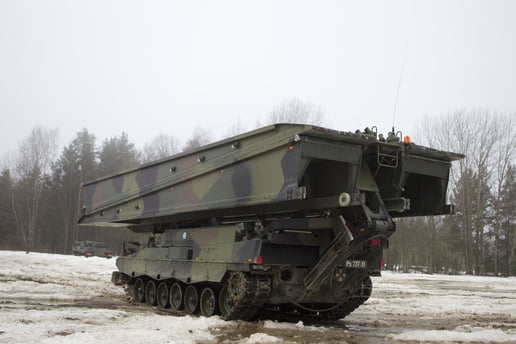
The Finnish Defence Forces’ Logistics Command has received a mandate from Minister of Defence Jussi Niinistö to conclude a contract with Patria Land Systems Oy to procure Armoured Vehicle Launched Bridges (AVLB).
The Defence Forces will purchase four new Leopard 2L AVLBs which can operate Leguan bridges of varying length. The ALVBs will be based on the hull of the previously procured Leopard 2A4 tanks. Operating capacity for bridges of varying length will be also acquired for the six Leopard 2L AVLBs and nine SISU E15TP-L bridging vehicles, procured in 2004-2008.
The overall value of the procurement without value added tax is about EUR 28.6 million. It is part of the programme to develop the territorial defence combat system and especially the mobility of troops.
The deliveries of the new AVLBs as well as the upgrades of the previously procured AVLB and the SISU E15TP-L bridging vehicles are scheduled to take place in 2019-2021.
The Royal Netherlands Navy joint support ship HNLMS Karel Doorman is a very versatile ship.
In the featured video (in Dutch) a boarding role for the ship is highlighted in providing for security at sea.
In 2015, we discussed the ship and its role in an interview with the ship’s captain.
In a phone interview prior to the event with the Captain of the HNLS Karl Doorman, Peter Van Den Berg, the interoperability exercise and its origins was discussed.
Where is your ship now?
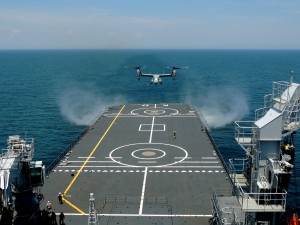
Van Den Berg: We are in Norfolk undergoing demagnetization. We will perform an interoperability test later in the week with regard to landing an Osprey onboard our ship.
Van Den Berg: it’s designed as a logistical support ship, with its primary tasking is refueling at sea.
And having that capability and also this space, we also have a secondary tasking, which is strategic transport for heavy equipment.
And there’s a third task for providing the logistics from the sea base.
We can do that with the use of small landing craft or by using our very long, and large helicopter deck.
How did the test come about?
Van Den Berg: We were undergoing sea trials when we were tasked last year to support the Ebola emergency relief effort.
We had only four sea weeks on the clock when we were tasked to go to West Africa.
And while on station we witnessed the performance of the Osprey and decided that we would like to work on working with the Osprey onboard.
We requested such a test, and combined that with our visit to Norfolk for our demagnetization requirement.
Dutch naval engineers determined that we could support the weight of the Osprey and any heat generated by the engines, so we worked with the USMC to set up this test.
I should note that we only requested this test, six or seven weeks ago, and it was pushed forward by our commander general in the Netherlands with the leadership of the USMC.
An MV-22 Osprey with Marine Medium Tiltrotor Squadron 261 prepares to land onto the Karel Doorman, a Dutch warship, during an interoperability test near Marine Corps Air Station New River, N.C., June 12, 2015. II Marine Expeditionary Force
You are a supply ship with some clear capabilities to operate more traditional rotorcraft, but how do you see the potential role of the Osprey for your ship as part of a coalition seabase?
Van Den Berg: I think the Osprey in amphibious warfare is a real game changer.
The Osprey will allow us the ability to sustain our support missions because of its ability to link us for a distance and with real speed.
There is a shortage of decks; we need a connector like the Osprey able to link up those ships into an operational seabase for a coalition effort.
And from an amphibious point of view, you can operate an Osprey deep and with speed inland.
It changes the nature of the meaning of amphibious operations.
It not only expands the operational reach, but can allow ships to be further from shore and be more secure.
Addendum June 16, 2015:
I heard this morning (June 16, 2015) from Captain van den Berg who notes:
This was a first timer for the RNLNavy to have an Osprey on the deck.
The operation went very smoothly.
In all aspects and opens up the possibility to have sustainable ops on board Karel Doorman.
This is a great step forward in the already existing cooperation and strong bonds between the Marine Corpses and Navies of both countries.
And the captain provided some additional shots of the Osprey onboard his ship which are seen in the slideshow earlier in the article.
Editor’s Note: Frankly, it is hard to understand why the US Navy would buy any warship which can not land an Osprey at this point in history.
And if a more direct point needs to be made: why buy an LCS, which can only operate helicopters or an unmanned asset like Fire Scout?
And one might note that the price point of the Dutch ship is of the same magnitude as the LCS.
A Dutch naval vessel on its way to aid in the fight against Ebola has taken on supplies here in Gibraltar.
The Karel Doorman is part of an international effort jointly organised by the United Nations and the European Union.
It is carrying 62 cars and 40 containers full of supplies – as well as 1,500 metric tonnes of food.
The Karel Doorman is on its way to Sierra Leone, Liberia and Guinea.
It will be spending Christmas out there, along with the Royal Navy’s RFA Argus – with one of its tasks, to bring the British crew their Christmas dinner.
About the HNLS Karel Doorman:
The Joint Logistic Support Ship (JSS) Karel Doorman is being built to ensure that the Netherlands armed forces will remain able to conduct operations outside the national boundaries in the future.
In this context, the ship is being built for 3 main tasks:
Resupply at sea to support maritime units.
Strategic sea transport, including debarkation and embarkation of staff and materiel if there are limited or no port facilities available
Logistic support at sea (seabasing), in which the ship serves as the base at sea from which land operations are conducted and supported.
It is important that these tasks can be carried out in all parts of the spectrum of force, for instance during armed conflicts, warfare and civil support operations.
Armament: Close-in weapon system (Goalkeeper) AT/FP automatic gun system 30mm, automatic .50 machine gun system, machine gun positions 7.62mm
Accommodation: 300 (crew and temporary crew)
Special features: The JSS will be equipped with a crane and lift to hoist heavy materiel.
The ship can transport about 5,000 tonnes of heavy rolling (armoured) materiel. The ship will have a hospital with 2 operating theatres. The JSS will also have landing pads for helicopters, such as Chinooks, Cougars and the NH90.
Platform
Damen Schelde Naval Shipbuilding (DSNS) is the main supplier for the JSS platform. The hull construction work and a large part of the ship’s completion will take place at Damen Shipyard Galati in Romania. The commissioning and outfitting will take place at DSNS’s facilities in Vlissingen.
Mast with integrated sensor and communication suite
Thales Nederland is the supplier of the sensor and communication mast, the so-called Integrated Sensor and Communication Suite (GSCS).
This mast is virtually identical to the ones of the navy’s patrol vessels.
The Defence Naval Sustainment and Maintenance Organisation, in cooperation with Thales, is building the integrated mast.
The HNLS Karel Doorman shares combat systems with other Dutch ships, notably the I-Mast, an innovative Thales solution for provided an integrated combat solution set.
And according to Captain Van Den Berg, because of the height of his ship the I-Mast is placed higher than on other Dutch combat ships and provides even greater area coverage than on those other ships.
Dutch Admiral Karel Doorman was put in command of Allied craft on hand and headed from the East Java port of Surabaya to confront the invaders.
His fleet comprised five cruisers and ten destroyers, of mixed Dutch, British, American and Australian flags.
Light cruiser HMAS Perth had already served with distinction in several theatres of war before arriving in the East Indies, while heavy cruiser USS Houston had seen action in the region for some weeks previously, becoming nicknamed ‘the Galloping Ghost of the Java Coast’ because the Nips had reported her sunk so often.
What would be called the Battle of Java Sea began mid-afternoon on 27 February and consisted of intermittent engagements in which Allied vessels were repeatedly repulsed by Japanese naval forces, with heavy losses to the Allies.
One by one, Allied craft came to grief or had to retreat.
Admiral Doorman was a casualty, going down with his ship.
Obeying orders, Perth and Houston fled westward to Batavia (Jakarta), the capital of the Dutch East Indies.
Next morning, the Japanese dispatched the remainder of the Allied fleet, except for four American destroyers that escaped south to Australia.
This battle was the largest surface engagement since World War One.
The Allied forces had been wiped out as a naval threat to the Japanese, whose invasion of Java was delayed by a merely a day, at cost of over 2,000 Allied lives but without the loss of a single Japanese ship.
On April 25, 2018, six aircraft from the 11th Fighter Wing arrive from Moron Air Base at Lithuania to participate in the Baltic Air Policing effort of NATO.
An A400M from the base provided the support equipment for the Fighter Wing Eurofighters.
This is the second time the 11th Wing has participated in this mission, the last being in 2014.
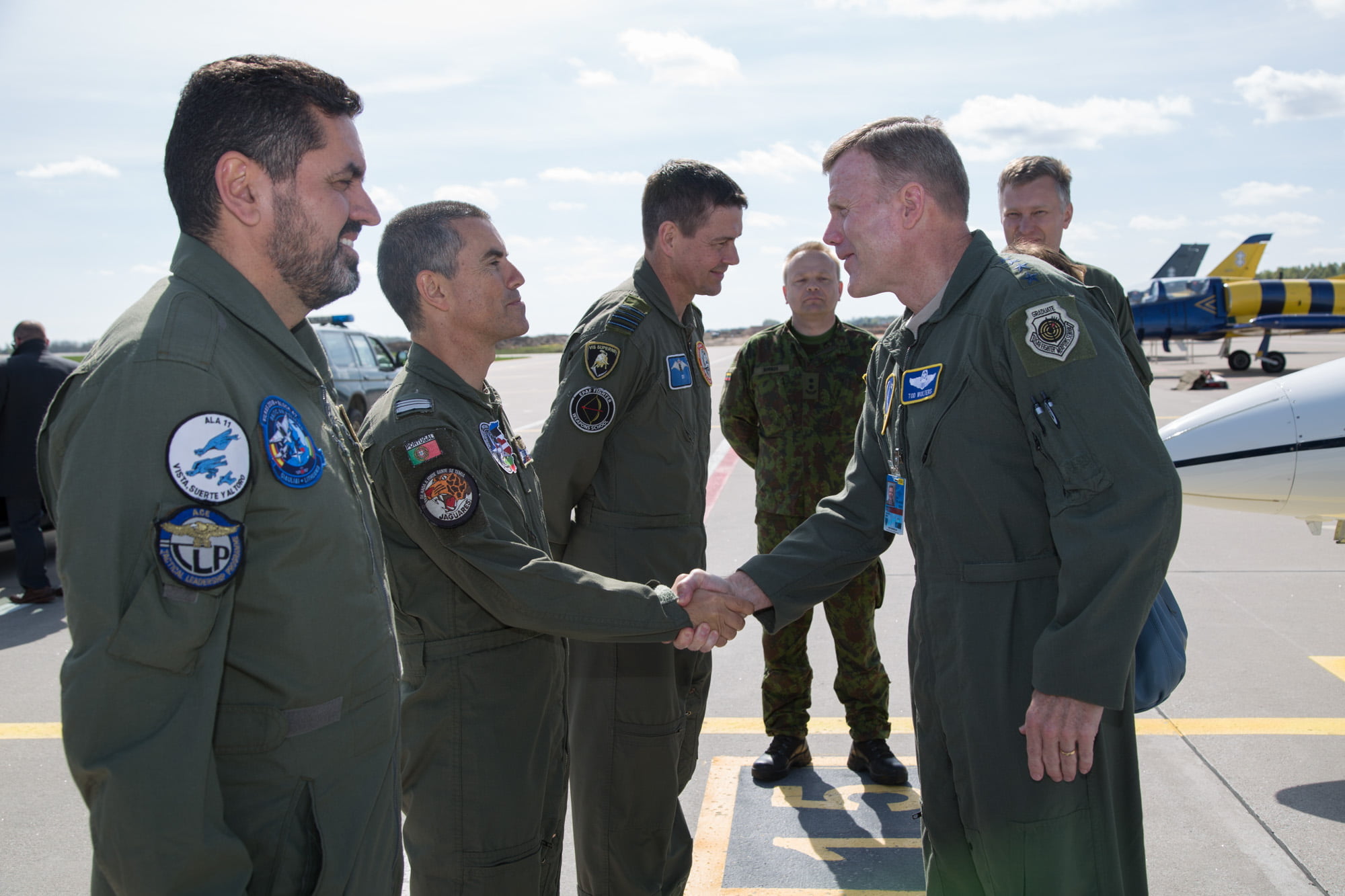
For the fourth time the Portuguese Air Force assumed lead of the Baltic Air Policing mission. During the traditional ceremony at Šiauliai Airbase on May 2 a detachment of the Portuguese Air Force was handed over the symbolic key to the Baltic Airspace from the outgoing detachment of the Royal Danish Air Force.
An additional detachment of the Spanish Air Force, also based at Šiauliai, will augment the Portuguese airmen during their rotation, next to a French detachment operating out of Ämari, Estonia as of May 3.
“As the Portuguese F-16 detachment commander, I’m proud of being part of this united effort, aware of the great responsibility and 100% committed to this mission” Lieutenant-Colonel Afonso Gaiolas, Commander of the leading Portuguese detachment stated in his speech during the ceremony. His detachment consists of four F-16 fighter jets and a total of 84 personnel.
The commander of the outgoing Danish detachment, Lieutenant-Colonel John Kristensen, took the opportunity to thank his Lithuanian hosts for their support.
“The Lithuanian Air Force and all the personnel on the Airbase provided outstanding support to us” he said.
Addressing his Airmen he added: “We have solved the mission with jets ready 100% of the time with only 54 people. That can only be done with dedicated and well trained personnel”. The Danish rotation was marked by their contribution to the 100th anniversary of Lithuanian independence for which Danish pilots conducted a flyby during a parade at Lithuania’s capital Vilnius.
Addressing all three detachments he said “I’d like to express my personal and professional appreciation to you, the pilots, maintainers, mission supporters and operators for what you have done and will continue to do to secure the skies of NATO”. Allied Air Command, headquartered at Ramstein, Germany is NATO’s single command for all Alliance air matters and oversees all Air Policing in European NATO airspace.
Both Air Forces from Portugal and Spain are not new to the mission. During the fourteen-year history of Baltic Air Policing, the Portuguese Air Force deployed to Lithuania three times already in 2007, 2014 and 2016.
The Spanish Air Force is contributing to the mission for the fifth time after two deployments to Šiauliai in 2006 and 2016 and after augmenting the mission twice out of Ämari, Estonia in 2015 and 2017.
Four Spanish Eurofighter Typhoon jets will augment the Portuguese F-16s during the current rotation.
A third detachment from the French Air Force is going to take over an additional augmenting role from the Italian Air Force on May 3 in Ämari, Estonia.
The first quarter of this year, with the Danish Air Force in the lead, the Italian Air Force contributed its Eurofighters to the QRA mission in the Baltics.
As David Cenciotti noted in a March 14, 2018 piece on the mission:
As part of the Task Force Air (TFA) 36° Stormo (Wing), four Italian Air Force Typhoons are currently deployed to Ämari Air Base, Estonia, to augment NATO’s Baltic Air Policing mission.
Together with the Royal Danish Air Force lead detachment at Siaullai, Lithuania, the task of the Italian Operation “Baltic Eagle” is to provide 24/7 fighter capabilities that can be launched by the CAOC at Uedem, Germany, in response to unidentified air tracks in the Baltic Region…..
This is the second time the ItAF deploy to the Baltic region to support NATO BAP mission. From Jan. 1 to Aug. 27, 2015, as part of the TFA (Task Force Air) based at Šiauliai, Lithuania, four Typhoons of the 4°, 36° and 37° Stormo (the three Wings that fly the Euro-canard) logged about 900 flying hours, launching for 40 A-Scrambles (Alert Scrambles) and more than 160 T-Scrambles (Training Scrambles).
Brexit is a process which have a major impact on the UK and Europe for sure.
And no matter what the Brexit negotiated outcome that will be sorted out between the EU and the UK, both continental Europe and the UK will have to find a way to work together going forward.
The UK has a long history of dealing with continental Europe as does continental Europe with the United Kingdom, and certainly not all peaceful.
Brexit is an episode of history which will be ingested as the UK and Europe go forward in the next phase of their interactions.
Clearly, the UK and as well as major continental powers will sort out a way ahead, but as they do so several trajectories of developments will be set in motion.
We are focused on defense, so for us, Brexit has a number of key impacts on the future of European defense and certainly NATO as well.
First, the UK is a major defense power within Europe.
What is its relationship to the continent after Brexit?
What does a post-Brexit defense policy look like for Britain?
Second, what impact will Brexit have on the internal cohesion of UK defense policy?
What role for Scotland and England?
And how will the Irish question intrude into the defense equation?
Third, will continental Europe meet the demands of enhanced defense responsibility for its own defense?
How will France and Britain work together?
Where will German defense policy focus its attention and its resources?
What impact will the UK have within European defense organizations or not?
Fourth, what impact will Brexit have upon the relationships between UK and continental defense and aerospace companies?
Airbus, Thales, MBDA, and Leonardo all have major working relationships and facilities in the UK.
What is their fate and how will these relationships work in practical terms as movement of personnel, taxes and import and export issues get sorted?
Will joint investments continue between Britain and the continent within these companies?
What is the future of Eurofiighter if the UK and continental European relationship is disrupted?
Will France and UK co-investments in missiles via MBDA continue uninterrupted?
There are a number of key questions to consider determining the fate of European and UK defense in dealing with the looming Brexit impacts.
A recent article in The Times highlighted one of those issues recently and constitutes our first Brexit note on defense.
In a piece published on May 4, 2018, Francis Elliot, the political editor of The Times, focused on the challenge of working the new European satellite system, Galileo, post-Brexit.
Galileo is a satellite-based navigation system created by the EU which aims to free European nations from having to rely on Russian, Chinese or US GPS systems. It is intended to be accurate within a metre and is considered crucial to UK military and intelligence needs.
The European Commission insists that the UK must be blocked from Galileo’s back-up system, needed by the military, as only EU members can have access to sensitive encrypted signal. That has infuriated Mrs May and senior ministers, even those such as Philip Hammond who support keeping the UK closely aligned with the EU. A Downing Street source said the so-called “war cabinet” was united in its determination to force Brussels to back down.
Britain has contributed about 12 per cent of the cost of Galileo, with overseas territories such as the Falklands providing some of the ground stations.
The chancellor has now authorised the effective sabotage of Galileo’s development by seeking to disrupt the transfer of encryption technology from a firm in the UK to France…..
The author then quoted Sir Richard Dearlove, former head of MI-6 and Professor Gwythian Prins, a former adviser to the chief of the defence staff, to the effect that the UK is not going to be able to work within the Galileo system given the way the EU works.
The EU was not ‘playing hardball’ on Galileo . . . It is merely operating within the strictures of its own vast and inflexible acquis of directives and treaties, just as it will do on all aspects of our ‘negotiations….”.
“They will have grasped that the UK’s departure means that a considerable chunk of finance, most of the expertise and several ground stations will be lost from the project . . .
So they need to trap the UK fly in a spider’s web so that after Brexit we are powerless, but still contributing money and the essential skills the EU needs.
Since so much of Galileo is British, the UK might do as the prime minister is reported to be considering seriously, namely develop its own global navigation network.
We strongly encourage her to take this prudent step in the interests of our national security.”
In the interview below broadcast last December, the former head of MI-6 focused on Brexit among other issues in explaining how he sees the way ahead.
RAAF Base Williamtown hosted one of the world’s largest cargo aircraft, an Antonov An-124 on Wednesday 2 May, and Thursday 3 May to deliver F-35A training equipment.
The equipment – an F-35 Weapons Load Trainer (WLT) and Ejection Seat Maintenance Trainer (ESMT), unloaded and installed in the Australian F-35 Integrated Training Centre at RAAF Base Williamtown F-35A Facility, will provide Australia with its own F-35 pilot and maintainer training capability.
The WLT and ESMT forms part of the overall Australian F-35 Training System being procured through the F-35 Joint Program Office.
Six Full Mission Simulators are required for F-35A pilot training, with the first two simulators being delivered late 2018.
I have spent last week in Norway and visited Bodø air base as well as Ørland airbase, home of the first F-35s in Norway.
This week I visited RAF Marham, the Tornado and F-35 base, and RAF Conigsby, a QRA and Typhoon base and then yesterday Portsmouth to see the new Queen Elizabeth carrier and to discuss the way ahead with senior officials involved with building the carrier and getting it ready for coming to the US for F-35 integration trials later this year.
The last couple of years I visited RAF Lossiemouth and saw the preparations for ramping up Typhoon deployments as well as preparing for the coming of the P-8.
I have argued that the transformation of Nordic defense occurring in response to the Russian threats and challenges was creating not only greater cohesion on the Nordic side but a strategic opportunity for Britain as it sorts out its post-Brexit defense policy.
Certainly, flying the same new aircraft, namely the F-35 as well as the P-8, while at the same time building out its Typhoon fleet with other continental partners, provides a strategic tissue to work through the post-Brexit challenges.
Yesterday, the UK Ministry of Defence highlighted one aspect of the deepening relationship on the Northern Tier.
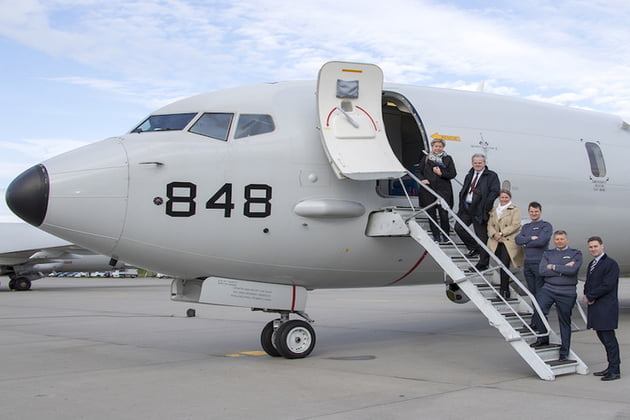
The UK and Norway advanced their plans for international Maritime Patrol Aircraft (MPA) co-operation in the North Atlantic, as the nations’ defence ministers flew in an American P-8A Poseidon from RAF Lossiemouth today.
Defence Minister Guto Bebb hosted Secretary Tone Skogen, State Secretary in Norway’s Ministry of Defence, on her visit aboard a US Navy P-8A Poseidon aircraft – equipment which both the UK and Norway will soon own themselves.
The allies ramped up discussions around how the nations will work together and might deploy their submarine-hunting aircraft fleet in the future. Areas of co-operation could range from maintenance to training and operations, which would not only cut costs but also boost operational power in the North Atlantic, a key area of submarine activity.
The aircraft took off from RAF Lossiemouth, which will be the future home of the UK’s fleet. Investing £3 billion in the capability over the next decade, the UK is buying nine of the Boeing-built aircraft, whilst Norway are getting five.
Their key role for the UK will be to protect the country’s submarine-based nuclear deterrent and its two new aircraft carriers – the Poseidons deploy sonobuoys to help them detect submarines, and can fire anti-ship missiles and launch torpedoes to destroy submarines.
Defence Minister Guto Bebb said:
“These sub-hunters will take to the skies from RAF Lossiemouth and help us combat a range of intensifying threats, not least increasing submarine activity in the North Atlantic.
“We’re investing £3bn in our own capability, but working alongside Norway takes this to a higher level. Not only could we cut costs by sharing training, spares and repair facilities, but we can patrol the seas together, meaning we’ve got more eyes and ears on any potential aggressors.”
Norway’s Secretary Tone Skogen said:
“Norway and the UK are natural partners given our shared values, as well as our history and geography. We can even further strengthen bilateral defence cooperation related to high-end capabilities such as the F-35 fighter and the P-8 maritime patrol aircraft.”
“In my discussions with Guto Bebb, Minister for Defence Procurement, I find a like-minded ally. The UK and Norway continue to stand together in training and exercises in the North Atlantic and the Northern region, as well as operationalisation of the Joint Expeditionary Force.”
The nine P-8A Poseidons will be based at RAF Lossiemouth in Scotland. Last month, Defence Secretary Gavin Williamson cut the first turf on a £132m facility for the new fleet. The new facility will be completed in 2020, to coincide with initial operating capability of the Poseidon aircraft being available in the UK.
Built by Elgin-based Robertson Northern, it will comprise a tactical operations centre, an operational conversion unit, squadron accommodation, training and simulation facilities and a three-bay aircraft hangar.
At the peak of construction, the project will support 200 local jobs. When the fleet is fully operational, some 470 additional service personnel will be based at RAF Lossiemouth, taking the total number of people employed there to 2,200. Further roles are also expected when the training and support services are established at the new facility.
“In times like these, when the security landscape is complex and uncertain, we need close allies. I am especially pleased with the strong UK-Norwegian relations, says State Secretary Tone Skogen.
Earlier this week Minister for Defence Procurement Guto Bebb hosted Skogen on her visit aboard a US Navy P-8A Poseidon aircraft – equipment which both the UK and Norway will soon own themselves.
State Secretary Tone Skogen visited London and Royal Air Force Lossiemouth, the military airfield in north-east Scotland which will be the future home of the UK’s fleet of MPA’s (Maritime Patrol Aircrafts). The Poseidons deploy sonobuoys to help them detect and hunt submarines. The UK is buying nine of the Boeing-built aircraft, whilst Norway is buying five.
“These sub-hunters will take to the skies from RAF Lossiemouth and help us combat a range of intensifying threats, not least increasing submarine activity in the North Atlantic. We’re investing £3bn in our own capability, but working alongside Norway takes this to a higher level.
“Not only could we cut costs by sharing training, spares and repair facilities, but we can patrol the seas together, meaning we’ve got more eyes and ears on any potential aggressors, says Guto Bebb, Minister for Defence Procurement in the UK.
“In my discussions with Guto Bebb, I find a like-minded ally with unwavering determination to strengthen NATO and our bilateral defence cooperation. This relates to high-end capabilities such as the F-35 fighter and the P-8 maritime patrol aircraft, training and exercises in the North Atlantic and the Northern region, as well as operationalisation of the Joint Expeditionary Force.
I am delighted that the United Kingdom and Norway significantly enhance our cooperation on these and other important issues”, State Secretary Tone Skogen says.
Surveillance of the North Atlantic is important for both UK and Norwegian security. Norway and the UK will intensify cooperation in this important endeavour, also in a trilateral context with the US.
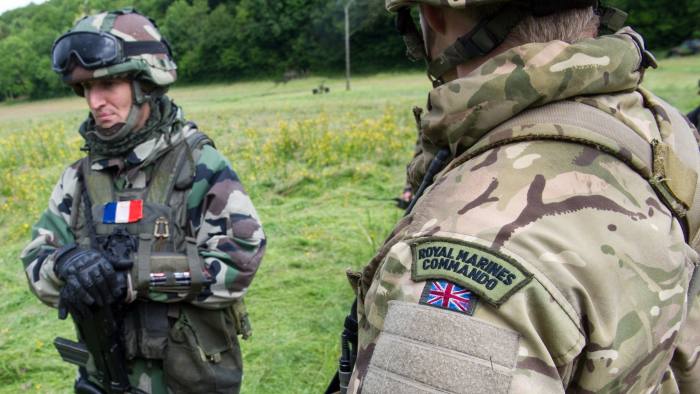
As the F-35 is coming into operation in our countries, Norway welcome increased operational cooperation also in this domain – as well as the P-8’s. Norway also highly value Royal Marines’ training and exercising in Norway, and welcome the deepening relationship between the Marines and the Norwegian Armed Forces.
Norway also highly appreciate the UK initiatives and European leadership in forums such as the Northern Group and the UK-led Joint Expeditionary Force (JEF).
“Norway and the UK have special responsibility both to ourselves and to the Alliance to ensure stability in the High North”, concludes Tone Skogen.
Featured photo shows defense delegates boarding a P8-A Poseidon at RAF Lossiemouth. Crown Copyright.