In an effort to be in compliance with GDPR we are providing you with the latest documentation about how we collect, use, share and secure your information, we want to make you aware of our updated privacy policy here
Enter your name and email address below to receive our newsletter.
Time, they say, slows down the few seconds before a car crash.
For close observers of the UK’s disentanglement from the European Union’s (EU) defence and security institutions, time has started to decelerate over the last few weeks.
First came the reports of the Commission’s decision that the UK would no longer be welcome as a partner in the Galileo global satellite navigation system (GNSS) programme post Brexit.
Then a story appeared in the Financial Timessaying that Europol will restrict sharing security data with the UK after we leave the EU.
These are early days and everything could change but there are growing concerns among a few cognoscenti in the Ministry of Defence that these are more than just opening negotiating positions.
Government ministers argue that because the UK is such a relatively large player in the European defence and security firmament it will have a strong hand to play in negotiating its future participation in EU defence programmes post-Brexit. But for many in Europe, this is a rather arrogant position.
The UK’s exit from the Galileo programme would be a huge blow to the UK’s security capabilities and the alternatives – developing a UK-only GNSS or working out some deal with the USA – would be infinitely less preferable to remaining within a programme in which the UK has invested so much time and money.
The UK has led the work to develop an encrypted government communications service and UK industry – Surrey Satellite Technology – has built the payload for the satellites.
But the Galileo programme is not owned by one of those expansive, touch-feely all-partners-welcome EU institutions but by the European Commission itself.
And the Commission is now focused on developing European defence and security capabilities in-house, rather than doing deals with third parties like the UK. And as for protecting the UK’s space industry vital and growing expertise, well, Surrey Satellite Technology is majority owned by Airbus Defence and Space, so it is essentially a tiny UK offshoot of continental Europe’s largest player in its military/industrial complex.
But an equally major blow – though less obvious – would be the country’s exit from the European Defence Agency (EDA).
The EDA does a multitude of small but very important things which would leave the UK’s security capabilities depleted. These include presenting a single European negotiating position in talks to safeguard government access to strategically vital satellite frequencies, working towards a common set EU military airworthiness requirements and helping small companies gain access to European Commission funds for long-term research into security technologies.
None of these are major strategic concerns in themselves but together they count for a lot.
The UK government wants to retain links with the EDA post-Brexit and is currently working out its negotiating position.
“We are keen to continue involvement.
“I was in Munich listening to the Prime Minister’s speech when said clearly that she wanted the UK to maintain access to both the EDA and the European Defence Fund. Exactly what form that will take we will negotiate over the next six months,” according to Mark Lancaster, Minister of State for the Armed Forces, at a recent Commons committee hearing on defence implications of Brexit.
The EDA was formed to fill crucial gaps in the defence capabilities of EU member states by pooling and sharing expertise and assets among EU armed forces.
Without the UK, the EU will be able to move further and faster towards pooling and sharing defence capabilities in a way which will make Brexiteers say “I told you so”.
But further integration of defence capabilities among continental European states will also limit UK industry’s access to a vital and growing EU security and defence market and potentially reduce the capabilities of the UK armed forces, especially in areas such as satellite communications.
The EDA’s second major raison d’etreis to link member states’ requirements to increase their defence and security capabilities with the work and budgets of other EU institutions, such as the Commission (whose remit does not extend to defence but does cover security), the European Network and Information Security Agency (ENISA) and the European External Action Service, among others.
The main security threat to the UK and its neighbours has morphed over the last few decades from the prospect of a thousand Russian tanks pouring across the North German plain to more subtle cyber assaults which require new coordinated inter-governmental measures, which the UK will now have to re-negotiate.
These institutional relationships are intricate and delicate and have taken years to mature; for the UK the timing could not be worse.
Belatedly the UK government now wants to strengthen its defence ties with EU agencies. The Ministry of Defence is participating in a trial of the EU’s Coordinated Annual Review of Defence (CARD) which seeks to coordinate defence budgets across the continent.
Government ministers say they want to contribute to the €4.5 billion European Defence Fund as well as find some kind of role in the Permanent Structural Cooperation (PESCO) military integration project, launched last December by 25 EU governments.
This, the government hopes, will provide enough of an incentive to convince the EU to keep the UK integrated in defence and security institutions such as the EDA after Brexit
A car crash can still be averted – but if it does happen the victims will be almost all on this side of the channel.
Philip Butterworth-Hayes is an aerospace and defence writer.
Formerly editor of Interavia Aerospace Review, Jane’s Defence Industries and European Defence Matters, the journal of the European Defence Agency, Philip began his professional career as a journalist based in Khartoum.
He has written extensively on defence, security and aviation matters for the BBC and other broadcasters.
He has been Director of Communications and Strategy at the Civil Air Navigation Services Organisation in Amsterdam and is currently the editor of Skyway, the journal of EUROCONTROL.
He also publishes www.unmannedairspace.info a web-based news and market analysis hub for the counter-UAS and UAS traffic management industries.
Credit Featured Graphic: Photo by lukbar/Getty Images
During past visits to Australia, I have had a chance to talk with Major General (Retired) Jim Molan.
The last time we talked was during my August 2017 visit and we focused on the challenge for Australia preparing for future conflicts.
In that interview, he focused on the need for the ADF and the nation to prepare to protect the nation in an increasingly dangerous neighborhood.
The ADF has never been better than it is now and that our defense policy has never been better. But the strategic environment is significantly worse than when we planned for our force modernization.
We need to develop a generic operational concept, which expresses how Australia should react to a significant threat below the level of a fight for national survival. In a fight for national survival, anything goes.
What I’m saying is that a significant war of necessity may require from Australia an equally significant force deployment, far in excess of what we have done for years and years and years, because the strategic environment is so challenging.
If we are serious about Australian defense then we need to be serious about such a contingency. The question we need to ask is: Are we really designing a force capable of joint and integrated operations or are we creating an ADF that is still only capable of sending small contingents to fight beside a major ally.
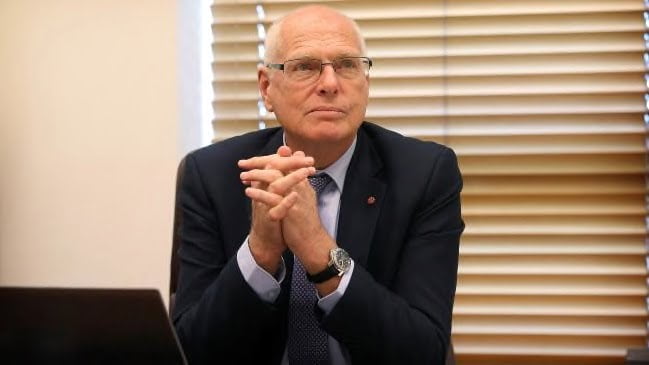
Since I was last in Australia, he has appointed to the Senate and is now Senator Jim Molan.
And in his maiden speech to the Senate he wished a stark warning to the Australian public about the changing nature of the neighborhood.
Australia needs to increase its military self-reliance so that it can approach China from “a position of strength” and prepare for the possibility that the rising power could go to war with the United States, new Liberal senator Jim Molan has said.
The retired army major-general used his maiden speech to the Senate on Wednesday to stake out his position as a defence hawk, calling for long-term investment in military readiness and linked his call specifically to China’s challenge to a US that is in “relative decline” in defence terms.
And he took a swipe against other US allies in Europe and Asia – apparently singling out Japan and South Korea – for under-investing in their militaries.
In a visit with Senator Molan in his office, we were able to continue the conversation about the challenges facing Australia and the shift defense required in his view with the evolving strategic environment.
He started by the need for a shift from inputs to actual outputs from defense spending.
“If you look back through the history of Australia, for every political party, you will find what we have called defense policies for the last 75 years have been simple lists of inputs into defense.
“For example, we have focused on how many submarines we need. One party would suggest X number and another party would suggest a Y number. Such an approach does not yield a defense policy; they are inputs into defense.
“The output to defense is really about deterring war by being able to win it. You’ve got to be able to deter war by being able to win. And that requires governments to be able to state what war they envisage fighting.
“And this goes to the question of linking the overall policy and strategy, which is government business, with tactics, which is the military knows best what to buy and what to do. But what you’ve got to link between the two is some form of operational concept.”
He then emphasized that with the shift in the region the nature of the conflict facing Australia was also changing,
“Our defense forces have been shaped by what we’ve been doing, not by what we may have to do in the future. And that’s not an uncommon event for most defense forces.
“We’ve spent the last 15 years in a number of very small wars around the world, sending small Australian forces to work with allied forces for the good of the rules-based order.
“And that’s a fantastic thing, and we’ve done it very, very well. And I always give great praise to this government, of which I’m now a member, because they have produced what I consider to be the best defense policy Australia has ever had, in the 2016 defense white paper.
“The best defense policy we’ve had since 1976, and we’ve had some appalling and silly defense policies going back to 1976. But we could afford to have those defense policies going back to 1976 because we were the best friend of the biggest country in the world with the biggest stick.
“In effect, we had flexibility in relation to defense, as long as we could trust the intent and capability of the Americans.”
The shift in the neighborhood with the rise of China with the emergence of a nuclear North Korea, and the role of Russia in the region as well as the shift in global power where the United States will not be as dominant as it once was, all impact on the challenge facing Australia.
“I think that parts of the ADF are of the highest quality. The air force is brilliant; the navy is about to be rebuilt; and the army is moving on from its previous experience in the Middle East and other places.
“The challenge that’s facing us is to decide what to do in the future, and what resources to apply to our defense.”
With regard to the United States, “there intent is good but their capability is far reduced from what it used to be.
“It is a question of relative diminution of American power in the changing global context, not lack of will.
“The strategic situation and the balance of power in the world has changed dramatically.”
He believes that Australia needs to address this change and adjust its defense policy accordingly.
“My view is that we have never faced a more uncertain security environment than we face in Australia at the moment since the end of the Second World War.
And the challenge is to address that strategic reality and to sort out what wars or conflicts are central to prepare for to defend Australia and its interests. It is about what kind of output we need; it is not simply a question of input.”
“We’re going to spend $200 billion on defense of the next 10 years, and that is fantastic.
“And that’s an achievement that this government should always be proud of.”
“My fear though is that we haven’t put all of that together in one parcel.
“And whilst we pay high wages, whilst we pay a premium on construction, we’ve got to understand how much increased security that $200 billion does actually buy us.”
Featured Photo: Senator Jim Molan in his office at Parliament House. Picture: Kym Smith.
For a report looking at the future of Australian defense and likely investments priorities, see the following:
Recent interviews conducted in Norfolk, Virginia, and in particular with Supreme Allied Transformation Commander (SACT) General Denis Mercier, focused on how NATO is addressing its transformation.
In the wake of February’s NATO Defense ministers’ two-day meeting in Brussels and the reform of the command structure, the ACT is working a number of the practical aspects of transformation.
This effort can be characterized as shaping NATO’s version of the 3 C rule.
“3 C’s rules“ exist in various fields and in every language.
In English, one can find a 3 C’s rule in marketing (Company, Customers, Competitors), credit (Character, Capacity, Capital), negotiation (Confrontation, Cooperation, Collaboration), web design (Content, Code, Conception), even relationships (Communication, Cooperation, Compromise) and life (Choices, Chances, Changes), just to name a few.
Last March, in the midst of the public revival of NATO’s burden sharing debate triggered by the arrival of President Trump in the White House and prior to the May 2017 Brussels Summit, the Alliance’s Secretary General Jens Stoltenberg defined NATO’s own 3C’s rule: Cash, Capabilities, Commitment.
2015, Nov. 04. Supreme Allied Commander Transformation, Gen Denis Mercier, during a Joint Press Conference after Trident Juncture 2015 live demonstration at San Gregorio training area, Spain. (NATO Photo by NIC Edouard Bocquet)
As SACT General Mercier explains:
“The 3 C’s rule is important and has been reaffirmed: the 2% GDP goal is one of the objectives each NATO nation must aim at, but within these 2 %, 20 % must be spent on new capabilities, while making sure they are compliant with NATO’s standards of interoperability and ready to be deployed under the Alliance’s umbrella if need be. (…)
Besides the GDP percentage allocated to military resources, which has been a long-lasting goal in the past four years, what is changing in the midst of the adaptation process the Alliance is going through is what I refer to as a “persistent federated approach”, i.e. the establishment of a much more persistent bond between the command structure on the one hand, the force structure on the other.
One should indeed stress that NATO’s philosophy is based on a federated approach: NATO is not just a command structure commonly funded by the member states, but it is also the capabilities the latter provide to be able to fight as one. (…)
The goal is not to establish a catalogue listing all available capabilities, but to best construct a force able to address today’s and tomorrow’s threats.“ [1]
Easier said than done, when the specificities, histories, sensitivities of twenty-nine nations – Montenegro being the latest nation to join the North Atlantic Treaty Organization last June – have to be aligned into one single political guidance, which will then be translated into military capabilities.
There was one issued in 2011, then another one in 2015, and the two NATO strategic Commands – ACT (as the leader in this process) and ACO (Mons-based Allied Command Operations) – are currently working on the strategic military considerations to support the next one planned for 2019 in the aftermath of the next July Summit planned in Brussels.
The continued adaptation of the Alliance to the new threat environment, as well as the reassertion of missions aimed at projecting stability – such as the reinforcement of the post-war Iraqi training, which has was announced at the Defense ministers’ meeting in February- are among the sure guidelines to be pursued and proposed.
Developing a Common Understanding Picture
But what does it take to have 29 nations agree to a common strategic goal?
That is exactly what ACT’s task is all about.
It starts with the definition of a common understanding picture, as, of course, each country’s threat assessment not only depends on its geography, history and politics, but also relies on its strategic culture and the existence of a structured capability development process that vary widely among nations.
“Not all nations base their program laws on a formal defense review process or publish a defense white paper and we can help those who wish to assess and match their priorities according to their political and strategic national ambitions “explains Lieutenant-Colonel Pierre Ascencio, who is part of a ten person staff at SPP (Strategic Plan and Policy) directorate in ACT.[2]
SPP is ACT’s brain and brainstorm on a regular basis via thematic workshops gathering a network of about 2,000 military and civilian experts from armed forces, but also academia, industries and medias.
The result comes under the form of three milestone documents:
The first is the Strategic Foresight Analysis (SFA), which identifies the trends affecting the future over the long-term (the latest one published last October projects the Alliance towards 2035, as it represents the time necessary to complete a full programmatic cycle from the decision to launch R&D till its Full Operational Capacity).
The second is the Framework for Future Alliance Operations (FFAO), which, along with ACO, narrows down the threats down to military scenario and implications for the Alliance: the next one is being reviewed and should be published soon.
These two preparatory reports then feed the NATO Defence Planning Process (NDPP), conducted by the NATO HQ in Brussels and both strategic commands and aimed at advising nations in future program development to meet the Alliance’s level of ambition.
“One of the advantage of NATO “, underlines SACT, “is to be able to give an unfettered military advice that nations are of course free to follow or not.
Some of them have niche capabilities (such as Estonia which cyber expertise is remarkable) and we are able to orient them, so they can synchronize their future investments to complement other nations.
We just happened to do that with Luxemburg, which satellite communications’ capabilities are to become part of the complex puzzle of forces NATO assembles into a ready to deploy force.
“The NDPP is there to orient national defence plans, and encourage countries to join forces in clusters of abilities such as smart defence initiatives or the Framework Nation Concept (FNC) developed by Germany a few years ago, enabling the building of large forces thanks to years of joint training between Germany and the nations willing to participate. “
At a time of a renewal of the ongoing debate about the NATO-EU relationship, it is not a bad idea to recall that these kinds of nations’ arrangements – such as the FNC – can and are already be used for other organizations than NATO, including the EU.
It is also useful to highlight the fact that NATO’s NDPP actually helped the EU to develop its own capability-building processes, tools and scenarii, while NATO’s centers of excellence can be also used by NATO and the EU.
According to General Mercier: “Each organization has its own deliverables, but we make sure our priorities are well coordinated. We have indeed been working very closely with the European Defense Agency over the past two years.“
For Lieutenant-Colonel Ascencio, the beauty of having a tool like SPP is to project one’s thinking in another nation’s mindset.
“You cannot understand America for instance, if you have not studied Gettysburg and General Sherman.”
The effort to create and share a common vision and a global picture of the threat and geopolitical environment has lead ACT to become paradoxically “a place that the United States considers the voice of Europe and that Europe considers the voice of the United States.“
In other words, ACT is where open and constant discussion can lead to common understandings and shaping a basis upon which to proceed with regard to more technical tasks.
For example, the recently issued SFA expresses a common perception of Russian activities for the first time since the end of the Cold war. To do so, now is in fact no small achievement considering the current propensity of nation states to look more inward or to emphasize there differences for domestic political consumption.
Developing a Common Situational Awareness
Only twelve nations were NATO’s founding members when the organization was created in 1949.
Today that number more than doubled and exercises can sometimes gather up to fifty countries.
In order to go from a common understanding picture to a common operational one, it is necessary to develop a common situational awareness and the key word here is “interoperability .“
Without the ability for the people, the process and the technology to work and talk together, there would not be an alliance and that is the strength – while at times the weakness – of such a unique organization, making it America’s remaining ”number-one alliance”[3]as General Mattis, US Defense Secretary, recently referred to and despite last year’s presidential rhetoric.
“[Interoperability] is a rather young word created in the 1950’s, which did not become popular until the 1990’s.
The reason is because we technically associate that word with technology and as we increasingly worked with computers, we found out that they were not working together “, explains the man in charge of developing interoperability within NATO, Johan Goossens, head of the branch of technology and human factors at ACT[4].
“So how do we do it?
“How do we have the military of twenty-nine different nations do that same handshake?
“First we look at what need to be interoperable, then how to make it so.
We develop specifications and standards.
We work with industries and test equipment in their infancy to see if they can operate together.
We mostly focus on information systems as opposed to platforms.“
With the coming of “next gen“ equipment the distinction between systems and platforms however tends to be blurred and the challenge is to keep up with the progress realized among allies across the board to be able to keep doing that hand shake.
Such a paradigm shift worries General Mercier, who was Chief of the French Air Force before becoming SACT: “as a pilot I am indeed concerned when I see today’s exercises.
In my Tiger Meet community[5],we used to share an enormous amount and that is what made us strong.
Today, with the new systems, aviators fly together, but with less and less awareness of what their wingmen are able to do. Debrief comes, and pilots share what they did, but not why and how they did it.
This is a potential catastrophe in terms of interoperability, as it is a matter of mutual trust. If we are not able to solve it within NATO, it will never work…
So NATO has a lot of work to do! “
There are however at least three good reasons to remain optimistic – no matter how vast the challenge seems today to make 4thand 5thgeneration air assets work together seamlessly – and be able to maintain a common situational awareness in all areas as best as possible:
First of all, this kind of technological revolution is not a first within the alliance.
If each nation is of course doing its own research and defends its own industrial interests, the role of ACT is precisely to coordinate and orient, so that too much technological unpredictability does not “break compatibility,“ notes Johan Goossens.
He has witnessed similar breakthroughs over the many years he worked at NATO, whether in jet fuel technology or when cyber first emerged or even in processes and culture changes.
“With the end of the Cold war, the maritime situational awareness changed and brought with it a fundamental cultural change, as the growth of pirate attacks in several parts of the world led NATO operators to track not only grey, but also white shipping.
This was a major departure from a traditionally military-oriented prospective and it took a bit of time for nations to adapt…“
Secondly, technology differences among twenty-nine nations is a fact of life, which NATO has been accommodating for nearly seventy years through joint operations, but overall through a robust exercise programs.
If the number of participating countries has been fluctuating over the years, depending on budgets, but mostly on the intensity of the perceived threat, three types of exercises have alternatively been conducted on a yearly basis among allies: “Live Exercise (LIVEX), Command Post Exercise (CPX)/Computer Assisted Exercise (CAX), or an Exercise Study[6].
Mr Goossens’ branch at ACT is the one organizing CWIX[7], which takes place every year in Poland and is a preparation to the next Livex, such as Trident Juncture 2018, which is to take place this fall in Norway.
Symptomatic of how palatable the threat is today, these exercises have been gathering the largest number of participants – including from the “Top 6” or Non-NATO Nations such as Finland or Sweden – ever since the height of the Cold war.
Finally, bridging technology is already there for most of the challenges NATO needs to meet.
If we go back to the “4th/5thGen “ debate, the recent Red Flag 18-1 exercise, which took place and ended February 16that Nellis AFB demonstrated the ability to upgrade tactical link 16 programs in order to make data sharing possible among all generations, the F-22 being a case in point.
In fact, for NATO planners, the problem is today’s exponential speed of technological development, mostly coming from the commercial sector as opposed to the military one, the way it was just two decades ago – and how to cope with such a trend by creating the appropriate framework for everyone.
For SACT, this raises the key (and next) question of the acceptability level of technology by each NATO member, a challenge addressed in the next article.
Footnotes:
[1] Interview conducted at ACT, Norfolk, January 2018z
[5] Here is the origin of the NATO Tiger Meet according to its official website: “Following the wishes of M.Pierre Messner, the then French defense minister, the USAFE (United States Air Force Europe) 79th TFS (Tactical Fighter Squadron) took the initiative and on 19 July 1961 they invited No.74 Squadron Royal Air Force and EC 1/12 Squadron of the French Armée de l`air to Woodbridge in England. And so the Association of Tiger Squadrons was established to improve relationships between individual squadrons within NATO. Each of these squadrons had a Tigers’ head in their squadron crest.“ (https://www.natotigers.org/origin-and-goals)
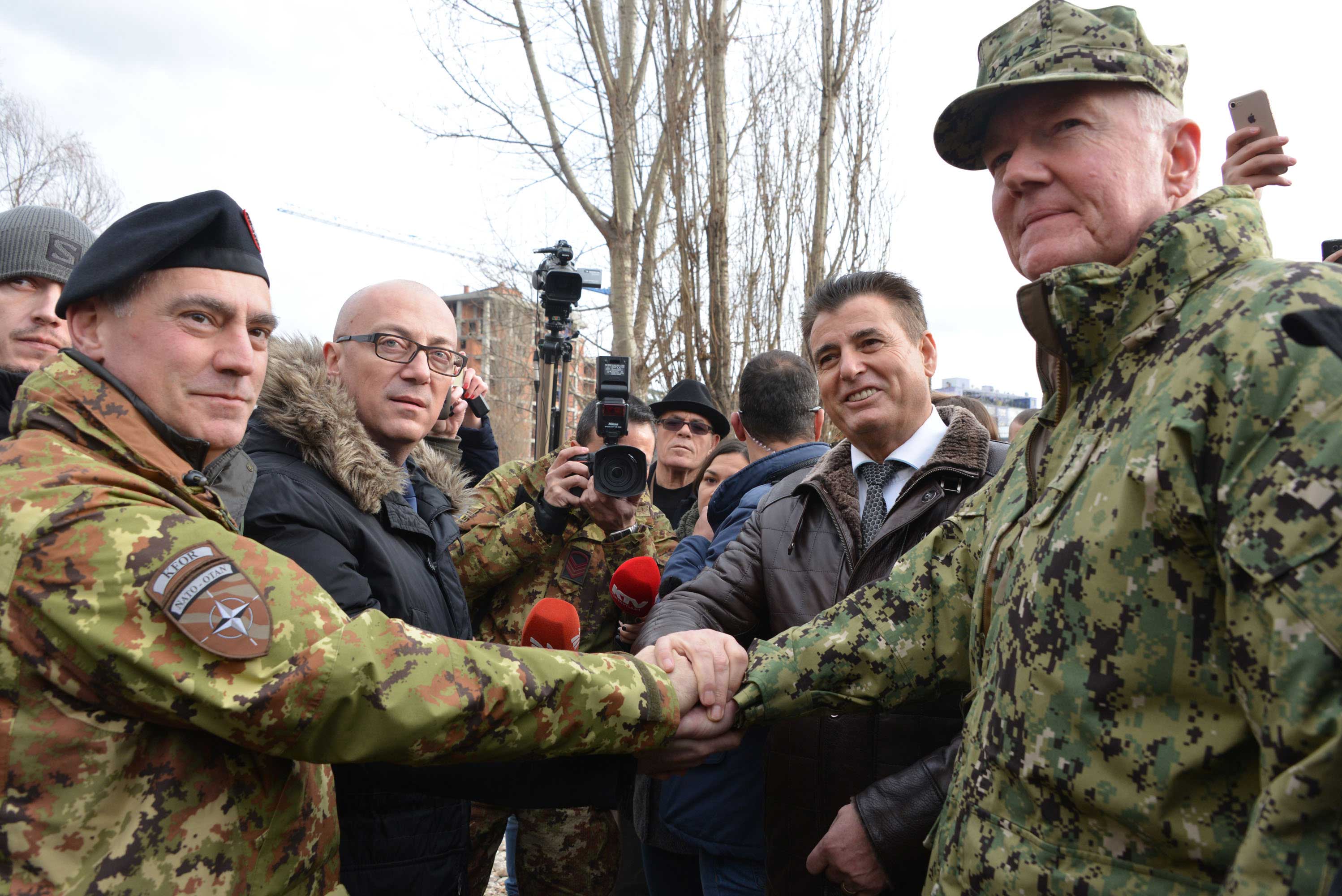
The featured photo shows from left to right, Major General Salvatore Cuoci, Kosovo Force commander, Mr. Goran Rakic, Mitrovica north mayor, Mr. Agim Bahtiri, Mitrovica south mayor and Admiral James Foggo, Allied Joint Force Command Naples commander, share a symbolic handshake on the main Mitrovica bridge in Kosovo on Feb. 1. The meeting of the four leaders follows the January 16 assassination of Kosovo Serb politician Oliver Ivanovic. (Credit:
The RAAF has been in the throes of significant modernization over the last decade as the C-17, KC-30A, Super Hornet and the Wedgetail have come together to shape an integrated and effective power projection force.
The next wave of change is spearheaded by the F-35. But the introduction of the Growler is a part of this transition as well as the RAAF and the Australian Defence Force learn to operate more effectively in the electromagnetic spectrum and to reshape operational approaches to the use of non-lethal and lethal weapons.
The RAAF will see changes to Wedgetail along with the introduction of Growler and the F-35 and these three aircraft interactively will deliver new ways to fight in the tron warfare combat space.
The RAAF leadership is clearly focused on the air force as an integrating force, that is, as a force driving a way ahead for the whole of the ADF.
During our visit to Amberley Airbase in March 2018, Murielle Delaporte and I had a chance to meet with two key members of the Growler transition team to get an update on the progress since the August 2017 seminar on Electronic Warfare held by the Williams Foundation.
We met with Group Captain Timothy Churchill, Director of the Growler Transition Office and Wing Commander Taffie Smith, Deputy Director of the Growler Transition Office.
“Our intent in the Growler Transition Team in the Air Force is to actually start using Growler as a catalyst to understand fighting in the electro-magnetic spectrum.”
Much like the broad perspective delivered at the Canberra conference in August 2017, the Growler is not seen as an end in itself but a catalyst for change by providing hands on training, and combat experience to drive an overall RAAF transition.
At Williamtown, we discussed how Growler has been used both on the Blue and Red side at the same time, to change how the strike force operates both defensively and offensively.
This is the kind of change, which the RAAF is looking to drive with the addition of Growler.
Operating in a contested electro-magnetic environment as one builds out a distributed force will require what the team refers to as “trusted autonomy” in terms of recognizing friend and foe and working with trusted information and decision making inputs, outputs and throughputs.
By flying Growler now, the RAAF and the ADF gain domain knowledge of how to shape the force going forward both to operate in the contested tron environment and to operate in a way that allows a distributed force to be effective.
The RAAF can be a change agent not just for Australia but for Australia’s allies as well and this true as well for the tron warfare environment as well.
“I see Australia is actually in a really unique position, because we’re actually going to transition our whole air combat fleet to fight in terms of a fifth generation warfare approach.
“And we will do so quite a lot before the totality of the USAF or the totality of the U.S. Navy.”
For the team, they believe that the tron warfare domain is much more significant and dynamic in terms of impact than those who take a narrower look at EW and see it as a specialized weapon set.
And this will impact significantly on the introduction of new capabilities such as UAVs and other systems relying on software and artificial intelligence for these systems will be operating in a contested tron warfare environment, so assumptions made from operating UAVs in an uncontested environment simply have no validity going forward.
Learning how the tron warfare environment is unfolding and will unfold and learning from the cross cutting capabilities of F-35, Wedgetail and Growler will provide a key laboratory within which the RAAF and its allies can shape more effective capabilities.
Training facilities are being established in Australia both to learn how to operate Growler and to more generally conduct tron warfare across the force.
This means testing the impacts as well of using tron warfare attack tools on the blue force as well, and trying to mitigate fratricide and augment the combat effects on the Red Force.
The RAAF has begun exercising with Army and Navy to understand how best to use Growler to support the overall force, as well as for Army and Navy to consider how to evolve their own force modernization in light of the impact of a contested tron warfare capability upon their forces as well, including modernization.
Notably, as the Navy recapitalizes its fleet, understanding how the fleet will need to fight and win in the electromagnetic spectrum is a key to the future.
And having Growler engaged with Navy is part of this learning and developmental process as well.
Learning how to shape “trusted autonomy” capabilities throughout the combat force is essential as a distribute maneuver force is built out with the new platforms and capabilities being acquired by the ADF, more generally and the RAAF, more particularly.
The acquisition of Growler and how the RAAF and the ADF are leveraging the acquisition provide a particularly clear case of how they are looking at transformation. Get the new platforms into the warfighters, and have them mix it up with the force and their partners and allies, and sort out a way ahead for the further modernization of the force.
Rather than a classic requirements driven approach, they are working towards an approach where training and combat experience using new platforms is the seed corn for further change and transformation.
Editor’s Note: The tron warfare concept has been pioneered by Ed Timperlake and we are using it here as the broad umbrellas covering cyber to electronic warfare to other non-kinetic means to disrupt and dominate the battlespace.
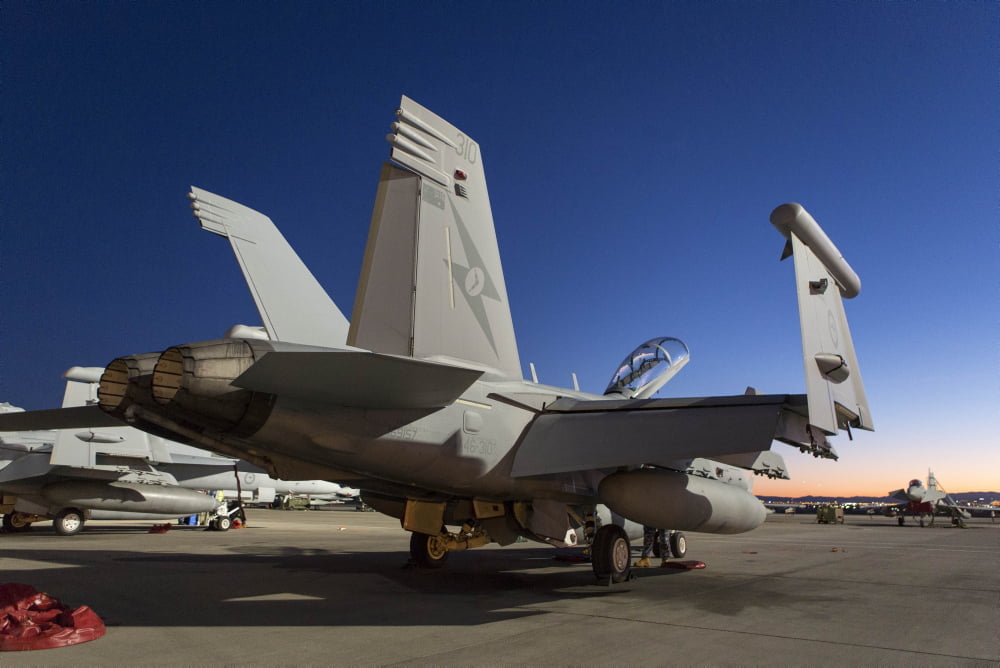
An apparent engine failure has seen an RAAF EA-18G Growler catch fire after an aborted takeoff from Nellis Air Force Base, Nevada on Saturday morning US time.
“Defence can confirm an incident involving an EA-18G Growler at Nellis Air Force Base during Exercise Red Flag. Royal Australian Air Force personnel are safe and no serious injuries have been sustained,” a Department of Defence statement released shortly before midday on Sunday (Australian time) confirmed.
“Defence is currently working with the United States Air Force to investigate and will provide an update with further details once known.”
The Growler’s crew, comprising a pilot and an electronic warfare officer, were able to exit the jet on the ground without ejecting.
What has happened so far on North Korea is certainly dynamic.
What will happen may be equally dynamic.
If one reads the various forecasts of what was certain to happen under Trump’s presidency with regard to North Korea, you will not find a lot of assessments that got it right so far.
Indeed, most of the advice was that we would have to wait till he left and then clean up the mess.
For example, Nicholas Kralev has already worked out a plan with regard to “how to prepare a post-Trump renaissance in diplomacy.”
The problem with all of this can be put simply: Trump has been doing diplomacy in a style designed to get results with dictators.
And what seems to have been forgotten is rather simple: dictators use diplomacy to get inside the debates within liberal democracies to foster debate and to gain maneuver space.
Trump is different for sure and the challenge of working the details and working with allies to sort out any future Korean order is a significant challenge, and one which will require more traditional negotiating skills
But what can be forgotten is that we would not even be having this discussion if what was not Donald Trump’s approach to information war, something which we forecast would be significant at the very beginning of his Presidency.
Perhaps it is time for the High Priests of Washington and the chattering classes to take a hard look at themselves rather than just spending their time reaffirming their moral superiority.
Trump is not an easy show to watch; but it can have the icebreaking impacts which Harald Malmgren has underscored.
And icebreaking has now come to the Korean peninsula.
I was in Oslo last week, and passed by the building where they honor those who have contributed to peace efforts.
I did not see any Trump signs nearby, but the antimony between giving a Peace Prize to President Obama and what perhaps the Trump team might achieve should not be lost on one.
The featured photo shows the Nobel Peace Center under reconstruction, an irony not to be lost in the context of current events.
We are focusing on several aspects of change in the global strategic situation as well the approach which U.S. and allied forces are taking to engage effectively as the strategic situation changes.
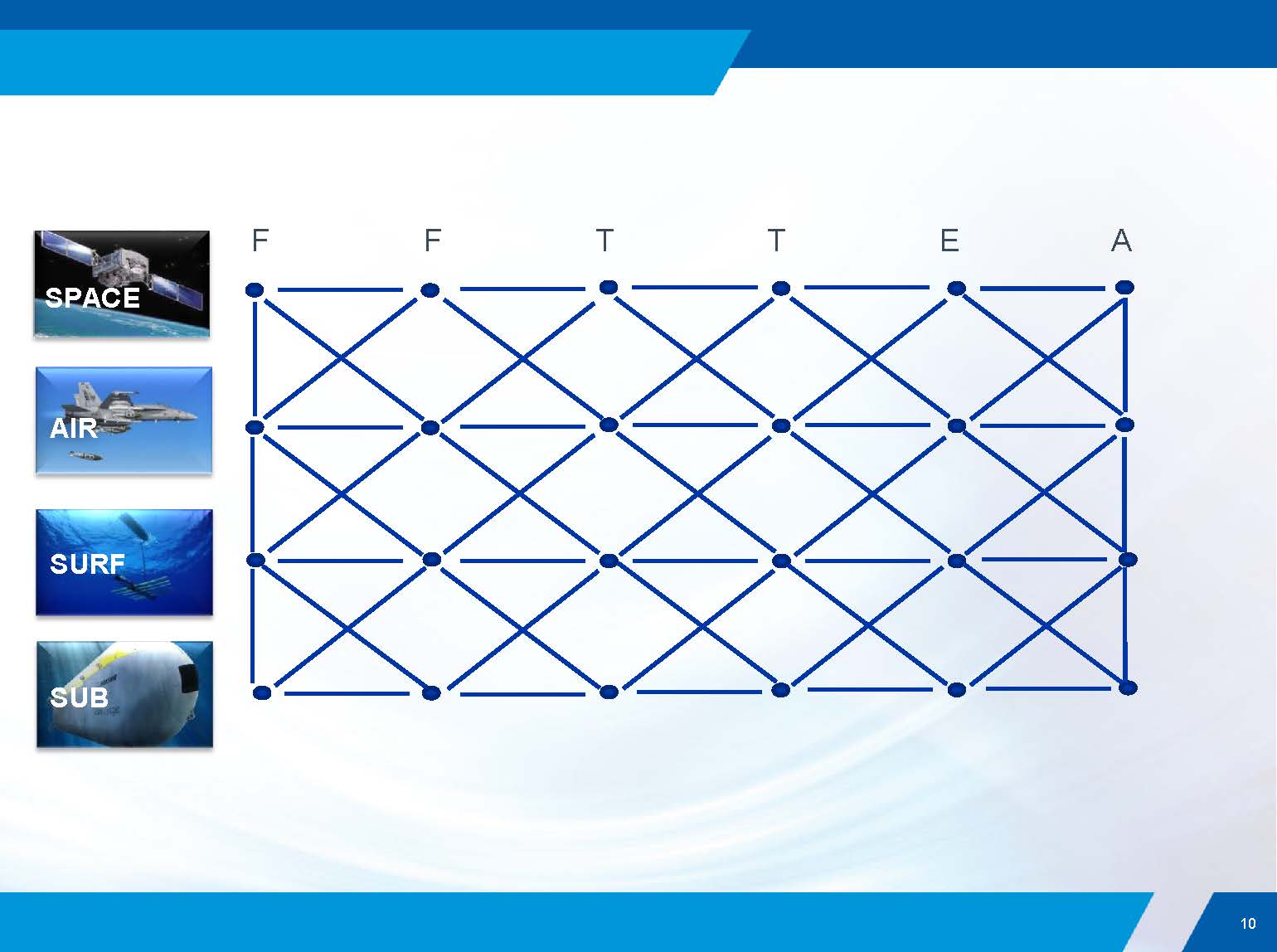
One key dynamic of change is the distribution of sensors and strike throughout the battlespace and the use of C2 and task forces to concentrate force on leveraging a strike and sensing grid to gain combat dominance.
When Rear Admiral Manazir was the commanding officer of N-9, Deputy Chief of Naval Operations for Warfare Systems, we discussed with him the core concept and its implications.
The kill chain is a linear concept which is about connecting assets to deliver fire power; the kill web is about distributed operations and the ability of force packages or task forces to deliver force dominance in an area of interest.
It is about building integration from the ground up so that forces can work seamlessly together through multiple networks, rather than relying on a single point of failure large network.
And when discussing how the USAF and US Navy need to work more effectively together in the future, this is how he put it:
How do we achieve distributed effects across all domains in the battlespace?
We are working closely with General Goldfein through various Service interaction groups; most effectively at the highly classified level.
We talk about issues that are common to our Services on a regular basis.
The core commonality between the two is that both are expeditionary services.
When we get into the battle area, Air Force assets can strike, reset, and strike again.
Naval forces operating in the maritime domain provide persistence.
If you combine Air Force and Naval combat capabilities you have a winning combination.
If you architect the joint force together, you achieve a great effect.
It is clear that C2 (command and control) is changing and along with it the CAOC (Combined Air and Space Operations Center).
The hierarchical CAOC is an artifact of nearly 16 years of ground war where we had complete air superiority; however, as we build the kill web, we need to be able to make decisions much more rapidly.
As such, C2 is ubiquitous across the kill web.
Where is information being processed?
Where is knowledge being gained?
Where is the human in the loop?
Where can core C2 decisions best be made and what will they look like in the fluid battlespace?
The key task is to create decision superiority.
But what is the best way to achieve that in the fluid battlespace we will continue to operate in?
What equipment and what systems allow me to ensure decision superiority?
We are creating a force for distributed fleet operations.
When we say distributed, we mean a fleet that is widely separated geographically capable of extended reach.
Importantly, if we have a network that shares vast amounts of information and creates decision superiority in various places, but then gets severed, we still need to be able to fight independently without those networks.
This requires significant and persistent training with new technologies but also informs us about the types of technologies we need to develop and acquire in the future.
Additionally, we need to have mission orders in place so that our fleet can operate effectively even when networks are disrupted during combat; able to operate in a modular-force approach with decisions being made at the right level of operations for combat success.
Rear Admiral Manazir has retired from the US Navy and now is working with Boeing.
Recently, he came to Australia to participate in his third Williams Foundation Conference, but the first one as a civilian.
AT this seminar, and speaking in a private capacity, he provided an update on how he analyzed the shift to fifth generation warfare and crafting a kill web approach.
Since 2014, the Williams Foundation has held a series of seminars, which have looked at the nature of military transformation enabled by new platforms, new technologies and new approaches.
Now, the Foundation is focusing on the new strategic context within which this force will operate and the kinds of further changes necessary for Australia and allied forces in facing the challenges posed by peer competitors.
On March 22, 2018, the Williams Foundation hosted a seminar which began the process of examining these key questions.
This report is based on that seminar.
This enhanced version of the report includes the interviews conducted prior to, during and after the seminar.
We have published on defense.info, a version with just the seminar report itself.
The US military has been focused along with core allies in dealing with counter-insurgencies for more than a decade, which represents a defining generation of combat experience for the joint, and coalition force. We have an entire generation of military officers with little or no experience in dealing with the direct threat from peer competitors.
With the return of great power conflict and the return of core nuclear questions with the coming of a second nuclear age, force structures are changing along with concepts of operations as well as the need for relevant and effective crisis management strategies.
A strategic shift is underway for the military.
The past decade the military has primarily focused its training and operations dealing with counter-insurgency and stability operations. Now the need to deal with operations in contested air and sea space from adversaries who can bringing significant capability to bear against US and allied forces requires a significant reset of efforts.
It is a strategic space in which operations in contested settings is where the military will operate. It is about learning how to deal with the policies and capabilities of peer competitors who are seeking strategic and military advantage against the liberal democracies.
And this challenge is one which will require the civil leadership to come to terms with the challenge of crisis management in which escalation and de-escalation will have to be mastered as a strategic art form.
It is not just about sending off the military to fights thousands of miles away and welcoming them back from time to time. It will be about facing the adversary squarely and forcing his hand and shaping outcomes to the benefit of the liberal democracies against those of the illiberal powers, and by doing so with using military means as one of the key tool sets
The nature of the threat facing the liberal democracies was well put by a senior Finnish official in a recent briefing: The timeline for early warning is shorter; the threshold for the use of force is lower.
What is unfolding is that capabilities traditionally associated with high end warfare are being drawn upon for lower threshold conflicts, designed to achieve political effect without firing a shot.
Higher end capabilities being developed by China are Russia are becoming tools to achieve political-military objectives throughout the diplomatic engagement spectrum.
The non-liberal powers are clearly leveraging new military capabilities to support their global diplomacy to try to get outcomes and advantages that enhance their position and interests.
The systems they are building and deploying are clearly recognized by the Western militaries as requiring a response; less recognized is how the spectrum of conflict is shifting in terms of using higher end capabilities for normal diplomatic gains.
We have seen several manifestations of a new strategic era in which contested operations require a different approach, a different force structure response, and, above all, shaping a relevant crisis management capability.
It started with the Russian seizure of Crimea, continued with the Russian projection of power into Syria, a rapid expansion of the number of intercepts by Western quick reaction forces in Northern Europe of Russian aircraft, with events such as a simulated Russian strike against Norway’s northern C2 facilities, the Chinese build out into the South China Sea, a very aggressive North Korean nuclear test and missile modernization approach, and significant modernization of the forces of the Chinese, Russians and North Koreans, and Iranians, with real uncertainty about how the edges of warfare begin and end with regard to the use of the increasingly diverse arsenal which the illiberal powers have at their disposal.
And this new period comes as the Western liberal powers are modernizing their own forces, which raises the question of how their modernization processes will be shaped to deal with the new threat dynamics, threat envelopes and evolving strategic behavior and decision-making capabilities of the authoritarian powers.
How will Western liberal democratic military modernization reshape capabilities which Western leaders have to deal with the challenge of the authoritarian powers?
How will conflict with various authoritarian powers be managed to avoid all-out war?
How will escalation management be shaped to ensure that Western democratic interests are met and not put under the pressure of constant compromises which simply allow for the expanded power and influence globally of the authorization states and powers?
Such questions are emerging as key ones for what is shaping up to be a new strategic period ahead for the Western liberal democratic powers.
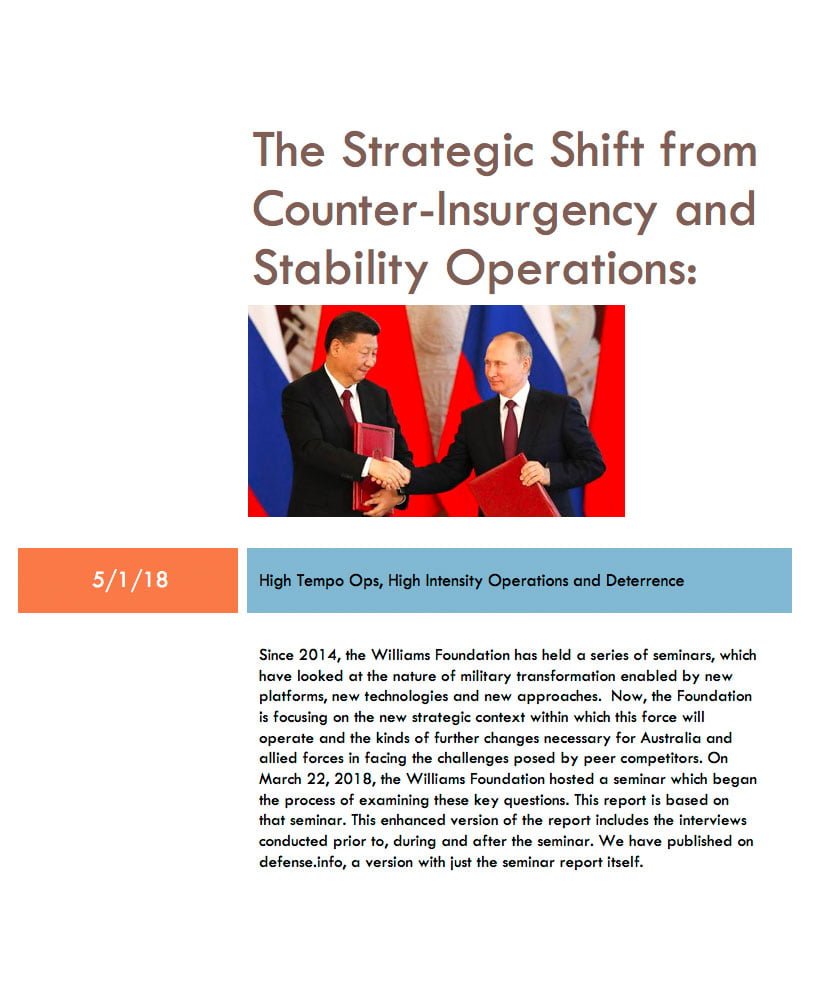
Featured photo shows Russian President Vladimir Putin (R) shakes hands with his Chinese counterpart Xi Jinping during a signing ceremony following the talks at the Kremlin in Moscow, Russia July 4, 2017. Credit: Sergei Karpukhin | Reuters
Since 2014, the Williams Foundation has held a series of seminars, which have looked at the nature of military transformation enabled by new platforms, new technologies and new approaches.
Shaping of a fifth generation warfare force has been at the heart of the conversation, and the challenge of crafting, shaping and building a more integrated force has been a core focus.
Building a more integrated force is required to operate with more flexibility, more scalability, and with more effectiveness, using either kinetic or non-kinetic means. This force needs to be more integrated because it needs to operate in a multi-domain space to achieve combat effectiveness, and to achieve strategic objectives set by the political leadership.
This year the Williams Foundation has shifted focus to look at the demand side of the equation. The Foundation is focusing on the new strategic context within which this force will operate and the kinds of further changes necessary for Australia and allied forces in facing the challenges posed by peer competitors.
On March 22, 2018, the Williams Foundation began the process of examining these key questions. The Williams Foundation laid out the following narrative in preparing the seminar along with the following questions:
Most Air Force and senior military leaders in the western world begin their military careers either around or shortly after the Falkland Wars which were watched globally as an epic air, sea, and amphibious campaign; conventionally fought at the ends of the earth and at the end of an immense supply chain for the British Forces.
The decades that followed saw warfare in the Balkans and Middle East, and counter insurgency operations in Afghanistan; warfare very different from that postured for during the cold war and exercised in high end air combat exercises.
The Australian Defence White Paper 2016 and the associated Force Structure Review was written to an Office of National Assessment Strategic Environment to 2035 against this paradigm, whilst recognizing impending change. The subsequent rate of change in global security has shocked even pessimistic observers and we face the heightened risk of high intensity, non-permissive air environments non-discretionary wars.”.
Questions to be addressed at the Seminar
What will be the impact on the delivery and expectation of 5th Generation systems as the world has changed so dangerously and so rapidly?
Have hostile forces been watching the development of our 5th generation systems and developed active asymmetry to defeat us?
Has the combination of our cold-war legacy and participation in irregular wars led us to make decisions that will limit our freedom of movement?
As we rediscover the concept of denied area (A2AD / beyond FEBA) and need to re-invest in strike capabilities, are there areas of concern? [Range / Payload / Escort requirements / requirement to step non fast-air platforms / risk of hypersonic AD systems] [Basing options / Life Support / Force Protection / Multi-domain threats]
Do we need to reconsider air campaigns in the light of Joint Force / Joint Strike options?
Do our national systems support the requisite battlespace awareness in denied areas to conduct effective targeting and effect generation?
Presentations by senior Australian and allied military leaders along with those by civilian analysts provided a solid foundation for understanding the challenges and how profound the shift will be for the liberal democracies in the period ahead.
Future seminars will address the question of what capabilities need to be added to the Australian and allied forces to deal with the strategic shift as well as how those forces can train more effectively to deal with the new challenges.
It is clear that the kinds of peer competitors the liberal democracies are dealing with are engaged in broad political conflict with the liberal democracies. They are crafting a range of tools to disrupt and to influence domestic policies in the liberal democracies.
It is also clear that the presence of Chinese and Russian economic interests in the liberal democracies provide a much broader opportunity than in the days of the Cold War to both establish and expand influence within our societies.
And the evolving tool sets associated with a core activity like information war or cyber conflict is designed not only to help competitors now but will be used in enhanced ways in the shape of any future high intensity conflict. They are already attacking our civil societies.
We are not facing an abstract future warfare scenario; we are already engaged in information war and cyber operations are being directed against the liberal democracies. These operations are certainly designed as well to undercut the cohesion of the liberal democracies to work against the interests of the illiberal powers.
A core point made at the seminar was that dealing with peer competitors was not just about preparing for an abstract future high intensity conflict but about dealing with various elements of a force already engaged against us.
The bulk of the seminar focused directly on the challenges of remaking the force to deal with higher tempo operations and possible direct high intensity conflict.
Certainly, a key argument made throughout was that many habits learned in the the counterinsurgencies and stability operations of the past two decades would need to be modified; notably, notably that we can operate with air superiority and have information security as a given.