Australian Army to Procure New CRVs

03/19/2018

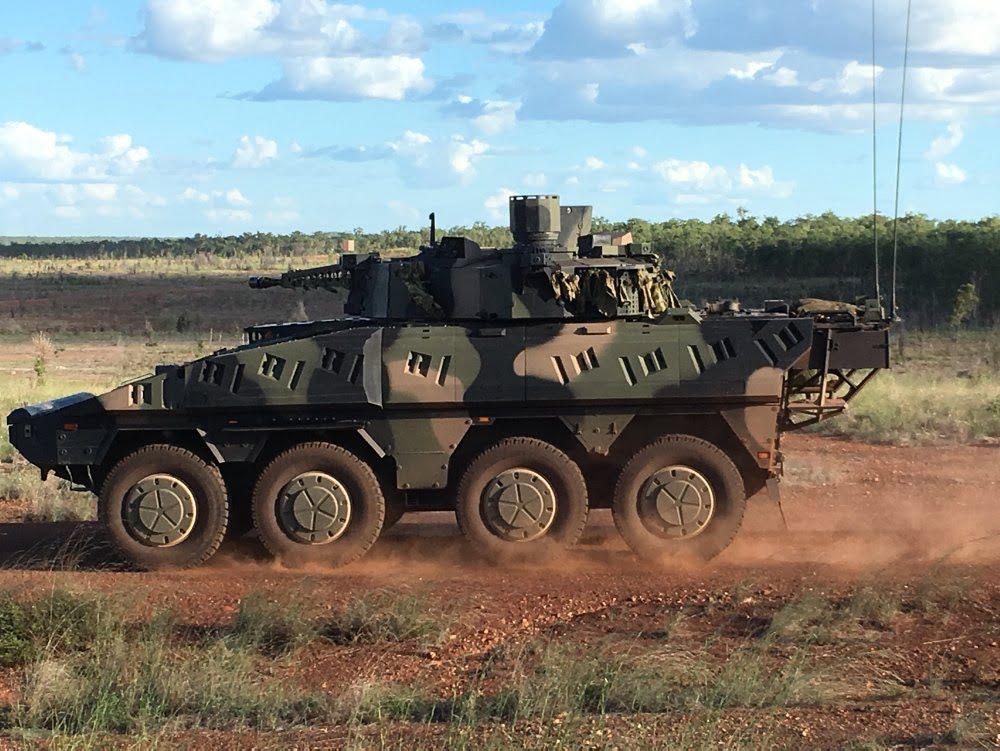
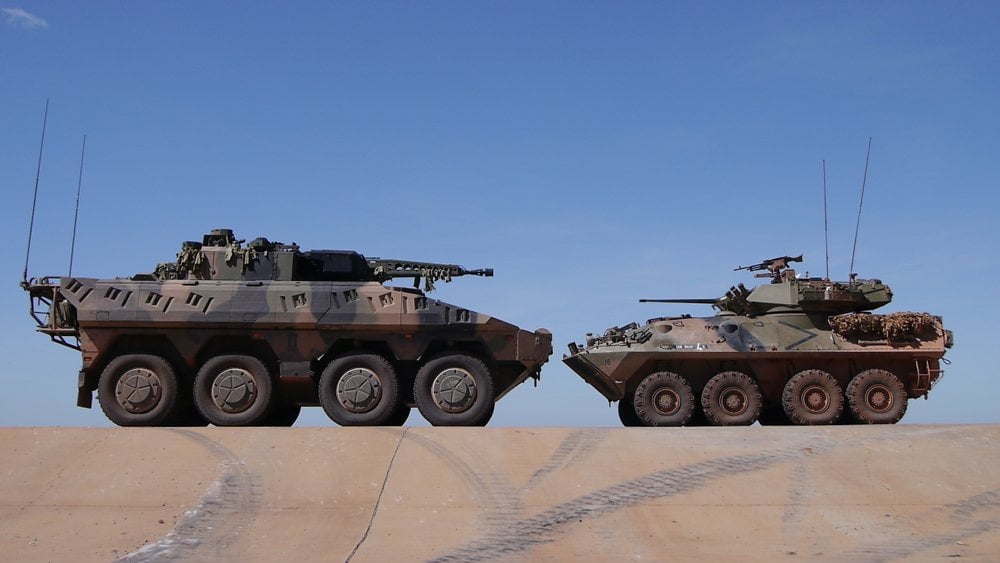
Project LAND 400 Phase 2 will acquire 225 Combat Reconnaissance Vehicles (CRV) to replace the Australian Light Armoured Vehicle (ASLAV).

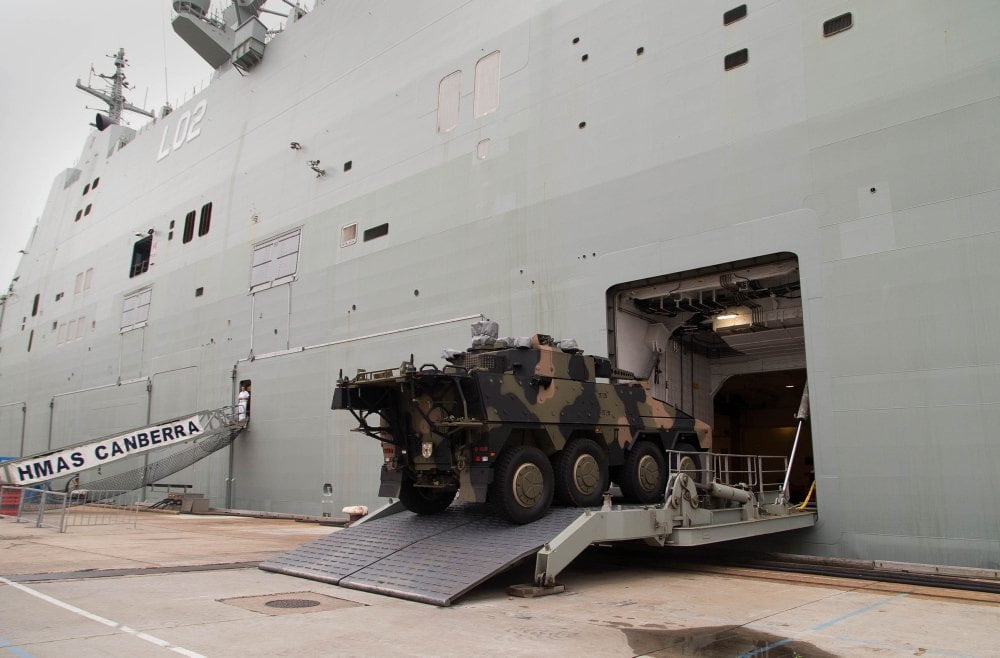
The Phase 2 fleet will include seven variants. On 28 July 2016, Defence announced that BAE Systems Australia and Rheinmetall had been shortlisted to participate in the Risk Mitigation Activity, which is the second stage of the tender evaluation process.

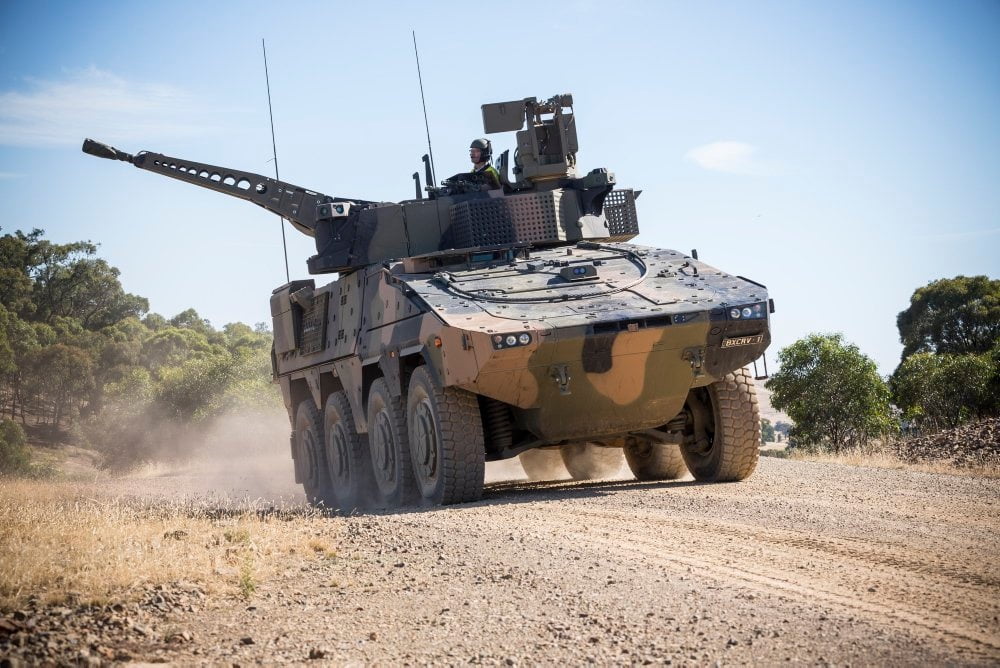
Rheinmetall has offered the Boxer Multi Role Armoured Vehicle integrated with the Rheinmetall Lance turret.

Australian Department of Defence

March 14, 2018

New Vehicles for Australian Army from SldInfo.com on Vimeo.

In an article by Matt Young, published on news.com.au about the selection of the new combat vehicle, a number of details were highlighted.

THE Australian Army is set for a massive overhaul of fighting vehicles in a “discrete” $200 billion reequipment megaproject to inject more power into Australia’s ageing fleet of armed forces — and this is only the beginning.

Australia’s top political military figures have announced the largest purchase in the history of the Australian Army which Prime Minister Malcolm Turnbull said was based on “lethality and survivability”.

The Turnbull Government plans to use the new Combat Reconnaissance Vehicle (CRV), known as “The Boxer”, to replace the Army’s current crop of substandard products, the Australian Light Armoured Vehicle, or ASLAV for short.

“We’ve put them in the heat, we’ve put them in the cold, we’ve put them in the wet, we’ve put them in the dry, we’ve shot at them, we’ve tried to blow them up,” Defence Minister Marise Payne said.

The move follows the Army being left forced to use substandard products in combat, threatening the lives of Australian soldiers by using older products not suited to modern day warfare, a security expert has told news.com.au.

“This is a large step up in terms of size and capability from the vehicle they are replacing,” Marcus Hellyer, senior analyst at the Australian Strategic Policy Institute said.

“You could technically say that defence has undercapitalised its armoured vehicle fleet for decades.

“The Army got to the point where they couldn’t take ASLAVs any more to Afghanistan because they couldn’t withstand the blast of an improvised explosive device (IED).

“The kinds of vehicles that the Army currently has, the ASLAV, and M113, are just not capable of surviving on a modern battlefield, they can’t survive even in lower threat environments such as Afghanistan.

“We had ASLAVs blown up in Afghanistan and soldiers killed to the point where Army chose not to deploy any more. It didn’t even deploy its M113s to Afghanistan at all.

“The M113 is really a vehicle with a 1950s pedigree, and we still have M113s in the Army today that went to Vietnam. They are a much older technology.

“The Boxer will provide protection against those IEDs as well as rocket propelled grenades.”

http://www.news.com.au/technology/innovation/inventions/australian-army-set-for-a-massive-overhaul-of-fighting-vehicles-in-discrete-reequipment-megaproject/news-story/0a1c062a4f23ad87e87236938b575667


Exercise Ocean Explorer 2018: An Update on the Australian Navy

03/18/2018

The Second Line of Defense team has been in Australia for the past two weeks conducting interviews and will provide highlights from the Airpower Conference being held this week in Canberra as well as updates and a final report for the Williams Foundation Conference on the shift from the land wars to high intensity warfare.

And later today, we will have a chance to meet with the Chief of the Royal Australian Navy and provide an update from his perspective on the way ahead.

Currently, the Australian Navy is conducting Exercise Ocean Explorer 2018.

According to the Australian Department of Defence:

Two submarines, 12 ships and embarked aircraft are taking part in one of the largest fleet concentration activities, Exercise OCEAN EXPLORER 2018. OCEAN EXPLORER will be carried out over a three-week period off the east coast of Australia, including the Bass Straight, Jervis Bay, Maitland Bay and adjacent sea and air spaces.

Exercuse Ocean Explorer from SldInfo.com on Vimeo.

The exercise – designed to develop maritime warfare skills including the operation of sea control task groups – will feature anti-air and anti-submarine warfare, maritime strike and interdiction, maritime advance force operations and command and control.

Australian Department of Defence

March 15, 2018

Last Fall at the Australian Seapower Conference held in October, the Chief of the Royal Australian Navy laid out his thinking about the future of the Navy going forward.

3 October 2017

Chief of Navy Address at Sea Power Conference 2017, Sydney – Service Chief Session

Welcome all to Navy’s Seapower Conference 2017.

For some of you it is welcome back, for others this is a first opportunity to attend this biennial gathering. To friends old and new, some of whom have come from far away to be with us, I welcome your participation in this international naval and maritime forum.

I warmly welcome my international counterparts and their representatives. We operate in partnership with our friends and allies in this region and I look forward to hearing from all of the speakers who can provide insight drawn from their national experiences.

I welcome members of the academic community, those from trade and industry, and those who will be reporting and recording what we say here over the coming days. Your presence ensures that we who are in uniform are not just talking to ourselves, rather, we are engaging with the whole spectrum of maritime knowledge, opinion and wisdom.

I extend a welcome to my fellow service chief, Air Marshal Leo Davies, Chief of Joint Operations, Vice Admiral David Johnston and the Chief of Army’s representative, Head of Land Capability, Major General Kathryn Toohey.

The fact that we have all three services and Joint Operations Command represented in this opening session is a reminder that the Navy is an integrated part of the Australian Defence Force and we are increasingly operationally interdependent.

For those of us in uniform, this conference is also a rare opportunity to stop and reflect upon our profession.

Over the next few days we can learn from national and international experts and from our peers, and remind ourselves of the context and rationale for the sea services in which we serve.

So…In this opening session I would like to provide context for the future discussions. In doing so, I need to explain where the RAN is going and what progress has been made in keeping with the Australian governments intent.

When I spoke at the last Sea Power Conference in 2015, Navy was on the cusp of a strategic rebuilding and expansion that with the initial announcement of the government’s commitment to a national, continuous shipbuilding strategy.

Since then there has been clarity about how the Navy is to be rebuilt and expanded and much has been achieved. In early 2016 the Australian Government released a Defence White Paper and this year it followed with a companion Naval Shipbuilding Plan.

These documents outline the government’s vision for Australia’s future naval capability.

As important, they also give fidelity to the shipbuilding and ship sustainment industry by providing a commitment to a permanent naval shipbuilding industry through three distinct lines of investment.

These are:

(1) the investment in the rolling acquisition of new submarines, continuous build of future frigates and minor naval vessels;

(2) the investment in modern shipyard infrastructure, across the two construction shipyards in South Australia and Western Australia; and

(3) the investment in naval shipbuilding workforce growth and skilling initiatives; together with new generation technology and innovation hubs.

As a consequence of these decisions, the government announced that Naval Group will be our international partner to design the 12 Future Submarines. Already, we have formal government to government agreements in place; a functioning design centre has been built in Cherbourg (by Australian trades-people with Australian materials) and the Australian project team is in filling rapidly there.

Meanwhile, the construction site in Osbourne is being secured and yard design is in progress. The project is meeting its milestones.

Concurrently, Navy’s two new tankers have been selected and work will soon commence on their construction – the first ship is expected to be delivered in 2019 and the second in 2020.

Much work has been done on progressing the acquisition of 12 new Offshore Patrol Vessels.

These vessels will provide us with an advanced capability to undertake constabulary missions and be the primary ADF asset for maritime patrol and response duties.

Tender evaluation is complete and a decision expected from Government later this year. Construction of the first two vessels will begin in 2018.

We have also made significant progress on the acquisition of nine Future Frigates. These frigates will be able to conduct a range of missions, with a particular focus on anti-submarine warfare and will incorporate the Australian-developed CEA Phased-Array Radar. We are on schedule to commence construction in 2020.

All of the Seahawk Romeo Helicopters have entered service and are undertaking operations, deployed in ships in the region and beyond.

Both LHDs HMA Ships Adelaide and Canberra have been commissioned and are already proving their utility and versatility with participation in major exercises and deployments this year.

And just last week we commissioned HMAS Hobart – one of the most sophisticated warships ever to be operated by the RAN. She is Aegis fitted, the first in her class with two more to follow and the first destroyer for the RAN since HMAS Brisbane was decommissioned 16 years ago.

The delivery of such new capability has allowed the RAN to revert to its practice of complex Task Group operations. This practice offers strategic utility to government by delivering the agility and responsiveness that is at the heart of our approach to maritime warfare and enables more effects to be achieved against an ever‐growing set of threat scenarios.

This year the Australian Defence Force has successfully completed Talisman Sabre 2017 – it provided us with invaluable task group operational experience and improved our training, readiness and interoperability. It also provided us the opportunity to test and prove the readiness of the LHD HMAS Canberra.

And as we speak the other LHD, HMAS Adelaide is currently leading the Indo-Pacific Endeavour 2017 Task Group deployed into the South East Asia region.

This deployment will demonstrate the ADF’s Humanitarian and Disaster Relief regional response capability as well as further supporting security and stability in Australia’s near region through bilateral and multilateral engagement, training and capacity building.

Whilst this is not the first such deployment by the RAN in South East Asia it will be the largest coordinated Task Group operation since the early 1980s. And these deployments will become a regular part of the ADFs ongoing commitment to regional security.

Indeed, it is important to note that beyond a commitment to new capability, the Defence White Paper also foreshadows a significant increase in investment in regional engagement – with plans to contribute to maritime security in several ways.

Firstly, with programs like the Pacific Maritime Surveillance Program which will deliver up to 21 patrol boats with long term sustainment to our South West Pacific neighbours to improve maritime awareness in that region.

And secondly, with increased funds for Defence cooperation in the vast array of maritime security fora and exercises that exist to provide stability within the region through the deliberate and disciplined approach to problem solving and by reducing the chance of miscalculation.

But the generation and deployment of self-supporting and sustainable maritime task groups capable of accomplishing the full spectrum of maritime security operations calls for more than just an equipment list.

There are fundamental attributes that a credible fleet needs to demonstrate to allow this to occur.

Over the last few years the Navy has taken great steps forward in the regulated management of seaworthiness within the Fleet. This follows a similar path to the improvement in airworthiness of the aviation force.

We are better managing and sustaining our platforms, infrastructure, communications and information systems, intelligence, and other mission and support systems for our current capabilities. That’s not to say we have it all right but the lessons learned are being applied to the projects that will introduce the future fleet.

We are working to have an integrated, diverse, resilient and deployable workforce that has the skills and competencies to deliver Navy’s warfighting effects.

We are also improving our culture to ensure that it supports an agile, resilient and innovative Navy that actively seeks ways to better deliver our warfighting effects.

As a result, we are participating more regularly in multinational exercises and through expanding our cultural understanding and language capabilities, to understand how we can make more effective and meaningful contributions during those exercises.

This progress gives me great confidence that we are on track to achieve the long term objectives that we have set ourselves to ensure that Navy is seen as a fighting system which is part of a joint warfighting organisation and as a national enterprise.

As you can see we are building a capable, lethal and agile Navy able to fulfil the tasks required of it now and into the future.

A Navy that has the ability to deliver targeted and decisive lethality if government so requires.

A Navy that has the ability to take decisions quickly, to manoeuvre naval force with speed and flexibility, and to enhance survivability by ensuring that our warfighters are able to adapt doctrine and tactics to meet the needs of the moment.

A Navy that can adapt to the ever-changing strategic environment.

Even since the last Sea Power Conference in 2015 there have been unpredictable shifts in our strategic environment.

The unprecedented missile and nuclear weapons testing conducted by North Korea, the impact of the South China Sea Arbitration and the increased possibly for miscalculations which could result in armed confrontations at sea.

The shifting of old alliances; the rapid rise in global terrorist networks in South East Asia; changes in migration patterns; the increased activities of international criminal syndicates whether it be from co-ordinated illegal fishing enterprises to smuggling illegal migrants.

These are just a few.

And so we seek a Navy that has the ability to maintain our sovereignty, defend our territorial integrity, and protect our national interests wherever they may be threatened – regionally and indeed globally from the Middle East across the Indian Ocean, through the South China Sea, and in the Pacific.

And because we know that no country can truly expect to act alone to solve the dynamic maritime challenges which are faced in our region, we seek to build a Navy that can work with and support our neighbours, friends and allies.

It is working with our neighbours to maintain and advance the internationally-recognised, rules-based global order that has been so conducive to ensuring maritime stability, and open and reliable maritime trade in our region.

We all have a vested interest in regional peace and stability, unimpeded trade, and freedom of navigation and overflight in our region.

Sea Power Conference 2017 affords us the opportunity to reflect on the work that has been done over the past two years: to consider if our current thinking about what the Navy of the future needs to be is accurate; and to develop the ideas and concepts that inform our future thinking and planning all while meeting the current and future challenges of the dynamic regional environment in which we operate.

 

Green Knights and USS Wasp on Patrol

03/11/2018

EAST CHINA SEA

03.05.2018

Video by Petty Officer 3rd Class Levingston M Lewis
Commander, Amphibious Force 7th Fleet

An F-35B lands on the flight deck of the amphibious assault ship USS Wasp (LHD 1) as part of a routine patrol in the Indo-Pacific region.

Pilots with the “Green Knights” of Marine Fighter Attack Squadron 121 (VMFA-121), assigned under the Okinawa-based 31st Marine Expeditionary Unit, are scheduled to conduct a series of qualification flights on Wasp over a multi-day period.

The Wasp Expeditionary Strike Group is conducting a regional patrol meant to strengthen regional alliances, provide rapid-response capabilities and advance the Up-Gunned ESG concept.

And in a story written by Ben Werner and published by USNI News on March 8, 2018, the perspective of Commandant Neller regarding the new amphibious capability was highlighted.

The head of the Marine Corps said introducing the F-35 Lightning II Joint Strike Fighter to American’s amphibious forces is key to the service’s future fights from the sea.

Commandant Gen. Robert Neller said the Marine F-35B variant will prove invaluable as the service shifts away from the ground-based conflicts in Iraq and land-locked Afghanistan back to its traditional role as a sea fighting force.

The fighter’s extended range and data collection capabilities can provide targeting information from far beyond the current range of amphibious warships and give Marines better eyes on the battlefield.

“We have to be able to survive, as part of sea control, sea denial,” Neller said.

“We’re a part of the fleet, we’re always going to need protection, but it will be good if we can protect ourselves.”

Neller was speaking Thursday at the National Defense Industrial Association’s 2018 Expeditionary Warfare Division annual meeting. His comments capped a week of testimony Neller and members of Marine Corps leadership team made on Capitol Hill.

On Monday, the first F-35 fighters deployed aboard the amphibious assault ship USS Wasp(LHD-1). The patrol is the first step to a future of not just supporting Marines ashore, but also more fully integrating into operations at sea, Neller said.

Speaking of the current F-35 deployment on Wasp, and hinting at the aircraft’s potential, Neller said, “A lot of people are watching, a lot of people are paying attention to this.”

The reason Neller considers this deployment historic is because the F-35 has the potential to answer a key strategic and persistent question sea forces always face.

“What is the amphibious ready group going to do to see beyond the horizon?” Neller asked. “How are we going to see them and not let them see us?”

The full capabilities of the F-35 working with warships have not yet been developed. But when linked, the F-35 has the potential to send targeting data and other intelligence to ships far off in the distance. Neller suggested industry members in the NDIA audience could possibly provide solutions to improve aviation platform communications….

For example, in an internal research and development test Lockheed Martin used the sensors from an F-35 to prove the fighter could provide targeting information to a ship-launched Raytheon Standard Missile 6.

https://news.usni.org/2018/03/08/marine-corps-commandant-confident-f-35-capabilities


Belgium Joins the A330 MRTT Consortium: Building Out a Global Fleet of Advanced Tankers

03/02/2018

2018-03-02 By Robbin Laird

According to an Airbus Defence and Space press release dated March 1, 2018, Belgium’s decision to acquire the A300MRTT has highlighted.

Madrid, 1 March 2018 – Airbus Defence and Space has received a firm order for an Airbus A330 MRTT Multi Role Tanker Transport from Europe’s organisation for the management of cooperative armament programmes – OCCAR – on behalf of NATO Support & Procurement Agency (NSPA).

The order follows the announcement on 14 February of Belgium’s official accession to the European/NATO Multinational Multi-Role Tanker Transport Fleet (MMF) programme, which already consists of Netherlands, Luxembourg, Norway and Germany.

An amendment to the original MMF contract adds the aircraft to the seven previously ordered for the MMF programme. The contract also includes three additional options to enable other nations to join the programme and provides for two years of initial support.

The programme is funded by the five nations who will have the exclusive right to operate these NATO–owned aircraft in a pooling arrangement. The aircraft will be configured for in-flight refuelling, the transport of passengers and cargo, and medical evacuation flights.

Airbus Defence and Space will deliver the eight aircraft from its tanker conversion line at Getafe near Madrid between 2020 and 2024.

The European Defence Agency (EDA) initiated the MMF programme in 2012. OCCAR manages the MMF acquisition phase as Contract Executing Agent on behalf of NSPA. Following the acquisition phase, NSPA will be responsible for the complete life-cycle management of the fleet.

Head of Sales and Marketing Bernhard Brenner said: “The selection of the A330 MRTT for MMF, along with the earlier similar decisions by the United Kingdom and France, will ensure that Europe has the world’s most operationally capable tanker fleet for many years to come. We encourage other European nations to contribute to MMF in order to maximise the operating and financial advantages of a large fleet based on a common type.”

They are acquiring the tanker/lifter at a time when progress is being made to shape a common configuration aircraft which will allow Airbus and the user group to drive innovation in common and to share costs and experiences in the ongoing modernization of the aircraft.

This is what we have called Tanker 2.0, a process which Australia, which was the launch customer of the A330MRTT has been a key driver of change.

We introduced this concept during visits to the RAAF in Australia over the past two years.

2017-05-09 During an interview at the Amberley Air Base last month with Air Commodore Lennon and the 86th Wing Commander, Group Captain Adam Williams, we discussed the evolution of the KC-30A into Tanker 2.0.

One aspect of that evolution was the coming of the robotic boom.

According to Air Commodore Lennon: “The best way to think about the new boom capability is that it is an automatic boom similar to how autopilot works in the cockpit. The automatic pilot simplifies the pilot load, but the pilot is still there and can override the autopilot in case of need.

“There will always be an operator monitoring what’s going on with the boom, deciding what the boom should do, and when it should do it, but now he can let the boom do all the work of positioning and marrying up with the receiver.”

The KC-30A is a refuelable aircraft so with a fatigue reducing automatic boom, the crew can stay airborne for longer to generate additional operational impact and enhanced sortie generation effects.

Testing the Robotic Boom for the A330 MRTT from SldInfo.com on Vimeo.

Air Commodore Lennon saw other potential impacts on operations as well from having an automatic boom.

“If it can anticipate and react to movements of the receiver aircraft faster than the boom operator can, then you end up with faster contacts.

You also potentially end up with more consistent contacts when the turbulence level increases, in cloud or when night falls.”

A press release from Airbus Military on May 9, 2017 focused on a recent successful test of this new capability.

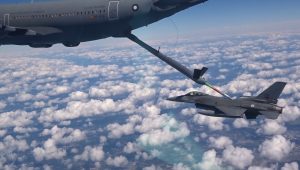
Madrid, 9 May 2017 – Airbus Defence and Space has successfully demonstrated automatic air-to-air refuelling (AAR) contacts with a fighter aircraft from a tanker’s refuelling boom – the first time in the world that this has been done.

Airbus’ A310 MRTT company development aircraft performed six automatic contacts with a F-16 of the Portuguese Air Force in a demonstration of a technique which the company believes holds great promise for enhancing in-service AAR operations.

The system requires no additional equipment on the receiver and is intended to reduce boom operator workload, improve safety, and optimise the rate of AAR in operational conditions to maximise combat efficiency.

It could be introduced on the current production A330 MRTT as soon as 2019.

Initial approach and tracking of the receiver is performed by the tanker’s Air Refuelling Operator (ARO) as usual.

“Innovative passive techniques such as image processing are then used to determine the receiver’s refuelling receptacle position and when the automated system is activated, a fully automated flight control system directs the boom towards the receiver’s receptacle.

“The telescopic beam inside the boom can be controlled in a range of ways including: manually by the ARO; a relative distance-keeping mode; or full auto-mode to perform the contact.

In the 21 March flight off the Portuguese coast, the tanker performed the scheduled six contacts, at flight conditions of 270KT and 25,000ft over a 1hr 15min test period. Both crews reported a faultless operation.
David Piatti, Airbus Test ARO, or “boomer”, on the tanker, said: “The most important thing was that the system could track the receptacle. It was very satisfying because it worked perfectly and we could perform the contacts with the automation switched on as planned. It will certainly reduce workload, especially in degraded weather conditions.”

The F-16 pilot, known by his callsign “Prime”, said: “The test mission was pretty uneventful and accomplished with no unexpected issues – which is a good sign. From the moment that the boomer accepted the contact the boom was immediately in the correct spot. For the contact itself, it was very precise and expeditious. You can notice the difference – the less that you feel in the cockpit then the more precise you know the tracking is.”

Miguel Gasco, Head of Airbus Defence and Space’s Incubator Laboratory which coordinated the development, said: “This represents a fundamental advance in boom AAR operations, with the promise of increasing the rate of contacts, notably reducing operator workload, and enhancing safety. The automated boom operation is an important pillar of our Smart MRTT development that is already underway.”

The imaging technology underlying the Automatic AAR technique was originally used by Airbus’ Space division to develop solutions for refuelling satellites in space or for space debris removal and was further developed and applied by Airbus Defence and Space’s Incubator Laboratory for the tanking application.

Tanker 2.0: Adding the Robotic Boom

Building Tanker 2.0: The Aussie Perspective

Tanker 2.0: The A330 MRTT Evolving as a Global Fleet

Reimagining Energy for Modern Combat Platforms

02/22/2018

2018-02-16 By Danny Lam

Firepower, Mobility and Protection are universal concepts that applies to any combat platform on land, at sea, underwater in air or space.

Efficiency and effectiveness, however, are difficult concepts. General Deptula’s combat cloud concept was based on a look at cost per desired effect which often yields very different values from economic costs.

A different perspective on cost per desired effect is to look at energy expended per desired effect.

The industrial age brought us specialized machines that made propulsion, firepower, protection and sensors unique specialties that each developed into a different field or discipline, with their own architectures, conventions, technological trajectories and way of thinking. i.e. Gunners and ship engineers are different groups, each with their own silos.

Danny Lam

The architecture of firepower evolved from the earliest catapults to cannons to missiles or torpedoes “in water”.

The goal of each of these systems is to deliver a unit of energy at a distance to cause disruption or destruction.   Kinetic effects is the term of art.

Protection evolved from two directions. Passive protection in the form of armor that utilized a material that deflected / dissipated incoming kinetic energy.   Or active protection in either kinetically or “mission killing” an incoming projectile or weapon or delivery platform.

Emission detection of energy and other signatures, and the use of energy to generate detectable signals is another application of energy for situation awareness systems.

Mobility, in turn, is a function of energy conversion that enable a platform to maneuver.

The common factor in these tasks is that it is all about creation, conversion, and transformation of energy.

During the industrial age, each of the specialized functions required its own unique means to do so.

Artillery utilize stored chemical energy in propellant to transport a projectile loaded with an explosive that released its energy in a way to cause damage.   Armor have to be carried around whose purpose is to dissipate incoming energy.

Mobility in turn, relied on a specialized power plant that produced power transmitted through a dedicated drive train (often mechanically linked) that propelled the platform.

Reduction of each and every of these functions to its essential function described as energy enable a radical rethink of the purpose of a combat platform.

A modern tank firing a depleted uranium round essentially expends its kinetic energy (generated chemically) for transportation to the target, conversion to kinetic to defeat the protective armor of the target, and then utilities the small amount of energy remaining to damage the fragile internal components of the target.

A very small portion of the total energy released stored in the chemical propellant end up doing the work of destroying the target by causing spalling or post penetration destruction of fragile internal components — particularly the crew.

The same exercise applied to carrier borne aircraft engaging in air-to-air combat yields a depressing story of enormous energy consumed to transport aircraft, get it into position to engage enemy fighters, and then to dispatch a handful of Air-to-Air missiles to detonate a proximity warhead nearby that perhaps transfers less than one tenth of 1% of its energy to the target to destroy it.

Capt. Michael W. Byrnes writing in the Air & Space Power Journal noted that a single armor piercing incendiary round accurately fired by an unmanned platform that actually struck a vulnerable part of a manned fighter like the first compressor stage of the engine is enough to destroy it.

His work illustrates how far energy efficiency can conceivably be improved based on existing technologies better deployed.

Yet, the architecture of current systems, rather than prioritize improvement in accuracy and “first shot, first kill”, still predominantly relies on industrial age concepts of massed firepower.   The ultimate expression of this thinking is to fit a 20mm autocannon on the F-35 fighter.    Properly deployed, it is hard to conceive of too many instances when a cannon can be useful without serious risks (e.g. from ground fire).

Massive energy wastage is the defining characteristic of our current combat systems.  

Before the era of precision munitions, raids by thousands of bombers was required for a handful of bombs to find their target.

Precision munitions so improved on productivity that quite often, two munitions with a Pk .9 did the job that formerly required a massive strike package dropping tons of ordinance.

Is there room for a similar quantum jump in improvement in energy efficiency from new, as opposed to existing technologies as Captain Byrnes suggest?

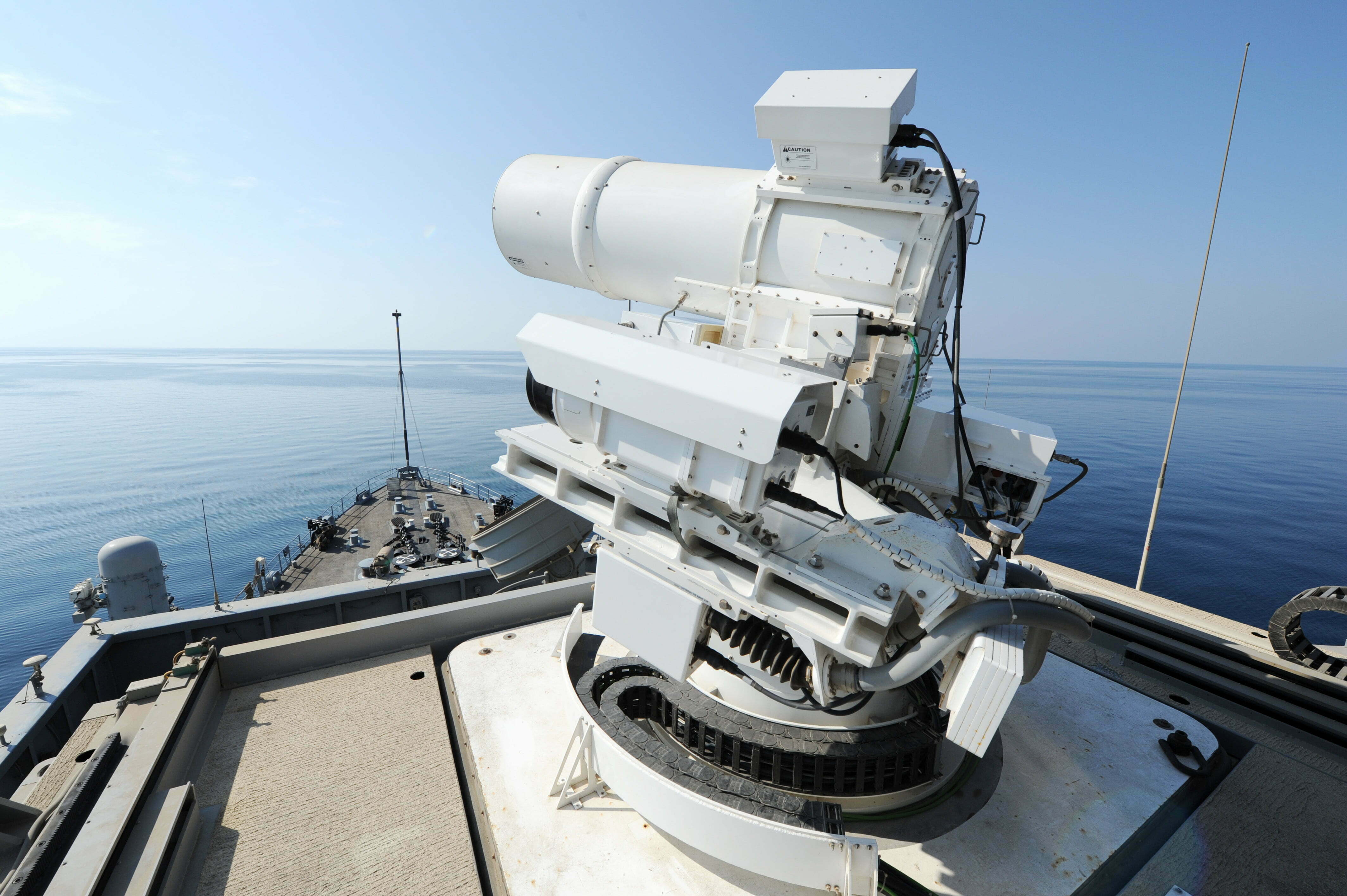
Directed energy weapons that deliver their energy at the speed of light to target offer a quantum jump in efficiency similar from dumb to precision munitions.   DE weapons often have the attribute that it can be dialed up and down as required: (i.e. radiation to produce a mission kill by blinding sensors or disrupting electronics, or kill with energy).

Scaling energy required to task is an attribute not practical for most chemical propellant powered kinetic weapons.

A related application of directed energy is Electronic Warfare that soft or mission kill hostile systems.

In terms of energy efficiency, these are revolutionary compared to weapons that depend on traditional kinetic weapons.

The sheer efficiency of DE suggest that the transition from conventional kinetic energy weapons to DE will move quickly, inhibited primarily by bureaucratic and organizational inertia common to all militaries.

In industry, where there is a market drive, industrial applications of lasers have exploded and far exceed the military space.

Indeed, many military lasers are but adapted commercial rather than special purpose military only lasers of the Star Wars era.

Soft kills are now viewed as just as valid and important as kinetic kills.

The advent of DE weapons reopen the question of whether the dominant mobility energy conversion architecture is ideal.  

Since power plants will have to be able to both generate large amounts of excess (or exportable) energy, and also to store it for rapid dispatch to “surge” needs for DE systems, it raises a question of how best to store and convert energy aboard future combat platforms.

The dominant design for most naval vessels and land vehicles is for a powerpack (typically an internal combustion engine or gas turbine) to be directly coupled to the energy converter system (i.e. transmission) to the propeller / thruster or drivetrain.

Likewise, aircraft are optimized to generate power to “fly” with exportable power as a very distant second thought.

Optimization for large exportable power generation, the provision of space for energy storage and support for DE will obsolete most existing land, air and naval platforms.

If exportable energy is to be stored as electricity (i.e. super capacitors) as opposed to kinetic energy (i.e. flywheel), then it suggest that going “all electric” like the Zumwalt Class Destroyer rather than directly providing power for mobility via a drivetrain may be a far more effective solution.

Commercial cruise ships have recognized the advantage being able to dynamically reallocating energy; balancing mobility and hotel loads “on the fly”.   Cruise ships typically use typically use diesel, or gas turbine generators powering electric propulsors rather than a mechanically coupled drivetrain.

On land, a hybrid electric Wheeled Armored Fighting Vehicle that is powered by electric motors at each wheel have the advantage of a much more robust drivetrain that is more survivable if (e.g. one wheel) is destroyed by a mine. A tracked vehicle that encounter a mine and lose a track inevitably becomes a mobility and often mission kill even if the crew is unharmed.

Aviation will require considerable rethink and new architectures if priority is expressed not in payload of conventional weapons, but exportable energy generated and stored for DE systems.

A less obvious benefit of storing energy in liquid fuels (e.g. diesel) is that it is less volatile and dangerous compared to any chemical explosive or propellant.   That in turn simplifies safety and reduce the need for protection of munition stores and supply.

The biggest bonus from going “all electric” is energy can be dynamically allocated to weapons, defense, communications or ECM or mobility far more seamlessly than existing dedicated architectures.

The overwhelming advantage enjoyed by specialist energy systems (e.g. missiles and cannon) against solutions that manage generic “energy” from a central pool is diminishing with the advent of directed energy weapons for both defense and offense, and the coming increase in energy requirements for ECM or future systems like rail guns.

Reframing the objective of many weapons systems as enabling a tiny fraction of the energy expended to be delivered “to target” in sufficient quantity and quality to either disrupt or disable an enemy opens the way to thinking about how weapons systems can be more energy efficient.   Or, more efficient in terms of expenditure of energy (and other resources) for “desired effect”.

It is time for a fundamental rethink of energy systems across all combat systems architectures.

The present architectures may be as outdated as infantry equipped with bolt action rifles in 1914.

Editor’s Note: We are very saddened to report the sudden and recent death of our colleague Danny Lam.

We will miss his creative writing and thinking and his contributions to the world.

We will be publishing a homage shortly to the late Danny Lam, 

The Importance of Aircraft Carriers for the Indian Navy

02/16/2018

2018-02-14 By Vice Admiral Shekhar Sinha (Retd)

New Delhi. The age old debate rages on worldwide between strategists of both blocks, the ayes and naysayers, on the relevance of the aircraft carriers with respect to their combat power vs. vulnerability.

This has undergone periodic pendulous harmonics.

Whether it is the US, Russia, United Kingdom and now China apart from India, the debate is identical. Even in countries with fewer maritime ambitions, such as Italy, Brazil, Spain and Thailand, this debate has been used either to acquire or to scuttle the process.

The very famous critique of aircraft carriers John Lehman who articulated all ills of this platform when not part of the US administration, found himself appointed as the Navy Secretary by President Ronald Reagan after an administration change in the US.

He, after much briefing on strategy and geopolitical realities, authored the policy of 13-carrier Navy for the US.

This policy remains the driving policy document of force structure till date, although a couple of years ago, President Barrack Obama mentioned 11 carriers in his Asia-Pacific Pivot Policy.

The United Kingdom Navy aircraft carrier force was scuttled completely by none other than the Royal Air Force post demise of the Soviet Union and the Cold War by justifying diminished Soviet threat from long range maritime patrol aircraft.

The Strategic Defence Review document outsourced the fleet air defence and strike from seawards role of the Royal Navy to the NATO despite their carriers having proven their worth in the Falklands (Malvinas) conflict with the Argentines in 1982.

In the post Soviet era, Russia is also attempting to resurrect its naval power as a necessity towards greatness, but has only one aircraft carrier, the Admiral Kuznetsov, deployed in Mediterranean for operations in the ongoing Syria/ Iraq ISIS conflict.

Emergence of Chinese Naval power

China, which was not a great maritime player till not so distant past, has literally churned out numerous diesel/electric submarines as also several nuclear powered boats in pursuance of its near sea and apparently larger global ambitions.

In a White paper, China had declared in 2015 that it will now be concentrating on far sea Maritime capability, pre-positioning warships – like the way US Navy does.

Carrier Task Forces are apparently part of such a strategy, although China does not always give details.

Traditional thinking that land warfare is all important is irrelevant in Beijing today and China has decided to master far Sea Operational ability keeping in consonance with its growing stature in the world.

Acquisition of naval bases, Gwadar from Pakistan in the Indian Ocean, is its biggest strategic asset.

China commissioned its aircraft carrier Liaoning in 2012 and a number of pilots have qualified from her deck by now.

Construction of a second carrier is underway and there are reports that work on few more carriers is also in progress.

It is only matter of time that the Chinese Navy will emerge in the Indian Ocean in a big way with two naval bases, Djibouti and Gwadar, supporting carrier and submarine operations.

The recent agreement between China and Malaysia to develop the port of Malacca will lead to the Chinese Navy having major operational presence in all three critical choke points in the Indian Ocean Rim (IOR), i.e., Gulf of Oman (mouth of the Strait of Hormuz), Gulf of Aden (Exit from Red Sea) and Malacca Straits.

Its aircraft carrier (s) and submarines will provide capability to block and disrupt adversaries transiting through these crucial sea routes between the Atlantic and Pacific.

It may be kept in mind that China is building anti aircraft carrier missiles but then its own carriers will also face similar threats.

India Supersonic Brahmos cruise missile is a very potent weapon for both attack and counter measures.

US Naval Power

The US Navy has dominated the oceans for decades now.

It has a declared strong presence in the Indian Ocean as well as the Pacific, and it has refused to accept the unilateral annexation of the South China Sea by Beijing.

The US Navy has 11 aircraft carriers, and this is the number that is likely to stay in the coming years.

The potency of the carrier based aircraft is bound to be strengthened by the induction of 5th Generation F 35 aircraft and land-based long range Unmanned Aircraft Systems (UAS) like the General Atomics Predators and Northrop Grumman Global Hawks which can stay over the waters for nearly 30 to 40 hours.

China will take time to match the US strength but then, given an assertive intent and access to land bases like Gwadar, the Chinese Navy can cause enough of headache to the US and other navies.

Nonetheless, the election of a new president notwithstanding, the US Navy will continue to dominate the oceans with new generation of warships, submarines, aircraft and high technology assets, cyber disruptions included.

The US Navy will continue to be the most formidable force to check dominance of the waters by China.

The Role of Indian Navy

What does the rise of Chinese Navy and its collaboration with the Pakistani Navy mean for the Indian Ocean countries, particularly India?

The Indian Navy’s procurements have remained stymied by complicated procedures and internal roadblocks of the Finance and Defence ministries where many have shown lack of strategic foresight.

Fortunately, with the present political dispensation, there has been a welcome change and, in a recent seminar on submarines, the Indian Defence Minister has at least called for a larger number of underwater boats than earlier planned.

With that mindset, the direction towards aircraft carriers should also be positive.

Notably, a Carrier Strike Group remains the fastest means of deployment of forces whether it is in a show of force or in support of own land operations as well as for providing security to friendly countries in the IOR.

As India does not have a policy of overseas basing, a carrier force remains the only suitable alternative for a regional power like India to conduct out of area contingencies. In any case, foreign bases are expensive and difficult to get given the nature of political dimensions.

That increases the relevance of aircraft carriers.

With the arrival of the Chinese, their basing rights in Djibouti and Gwadar, Equity holding (likely) in Colombo South port, and Maldives increasingly falling in the Chinese lap and, importantly Pakistan becoming a proxy state of China, IOR maritime scenario has become more uncertain and complex.

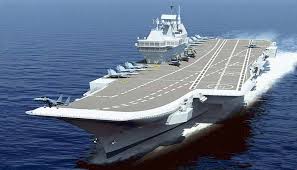
With the de-induction of Sea Harriers and impending decommissioning of the Viraat, INS Vikramaditya is the only aircraft carrier that the Indian Navy has for operations in the entire IOR.

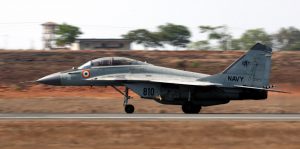
There is no doubt that Mig 29 K fighters and Kamov31 helicopters have provided force multiplication to the Indian Navy’s firepower.

The AEW capability of the Ka 31 and its data link compatibility with the Mig 29 K/ Vikramaditya combination has added speed to execution of both interception and strike tasks at, and from sea.

The longer endurance of the Mig 29K permits it to perform dual tasking in the same sortie.

With the Indian Air Force’s fighter force just about adequate for tasking in two front air warfare situation, till such time the Rafale gets inducted, Mig 29Ks will provide breathing space to the IAF’s downsized inventory by freeing it from certain maritime roles.

But the question is: Is it adequate?

The Indian Navy has 45 Mig 29Ks, much more than what Vikramaditya can operate.

The ship has two carrier borne squadrons, Numbers 300 and 303. A Training Squadron is also in the offing.

India’s Long Term Perspective Plan envisages at least two operational aircraft carriers at any one time with the third one as hot reserve to substitute during maintenance of either.

Therefore, the next two aircraft carriers become an urgent operational necessity,

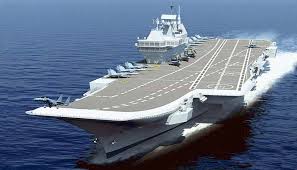
The first indigenous aircraft carrier IAC-1 or Vikrant is being built at the Kochi Shipyard.

Due out in a couple of years, it will operate both the Mig 29K and the indigenous Tejas Light Combat Aircraft (LCA) Navy as and when it becomes a reality some years later.

Significantly, there are reports that US experts have found Vikrant falling short of meeting operational tasks in her present state of construction.

These glitches are bound to occur given that it is the first time an Indian yard is attempting to build an aircraft carrier.

Processes of development are always slow and painstaking.

These may not produce a carrier of the class of the US, but it will be an Indian aircraft carrier. The next one would be better.

There is a technological and production engineering process gap of 70 years between the US and India.

We hope our shipbuilders learn fast to bridge the gap.

India has over 50 years of experience in maintaining and operating aircraft carriers and carrier borne aircraft.

A very confident return to tail-hook aviation after a VSTOL era of over 33 years bears testimony to Navy’s professionalism.

Building a carrier strong Navy is the only way forward.

Vice Admiral Sinha (PVSM AVSM NM & Bar – Gallantry) is a former Naval Aviator. He retired as Commander in Chief of the Western Naval Command.

First published by our partner India Strategic in December 2017 and republished with their permission.

http://www.indiastrategic.in/2016/12/08/relevance-of-aircraft-carriers-for-the-indian-navy/

The Williams Foundation March 2018 Seminar: A Look at the Shift to Preparing to Fight and Prevail in High Intensity Warfare

02/12/2018

2018-02-09 The Williams Foundation will continue its series of examining the transformation of military forces by looking at the challenges of the shift from the land wars to higher tempo, high intensity operations.

According to The Williams Foundation, the focus of the seminar is as follows:

Most Air Force and senior military leaders in the western world begin their military careers either around or shortly after the Falkland Wars which were watched globally as an epic air, sea, and amphibious campaign; conventionally fought at the ends of the earth and at the end of an immense supply chain for the British Forces.

The decades that followed saw warfare in the Balkans and Middle East, and counter insurgency operations in Afghanistan; warfare very different from that postured for during the cold war, and exercised in high end air combat exercises.

The Australian Defence White Paper 2016 and the associated Force Structure Review was written to an Office of National Assessment Strategic Environment to 2035 against this paradigm, whilst recognizing impending change. The subsequent rate of change in global security has shocked even pessimistic observers and we face the heightened risk of high intensity, non-permissive air environments non-discretionary wars”.

Questions to be addressed at the Seminar

  • What will be the impact on the delivery and expectation of 5th Generation systems as the world has changed so dangerously and so rapidly?
  • Have hostile forces been watching the development of our 5th generation systems and developed active asymmetry to defeat us?
  • Has the combination of our cold-war legacy and participation in irregular wars led us to make decisions that will limit our freedom of movement?
  • As we rediscover the concept of denied area (A2AD / beyond FEBA) and need to re-invest in strike capabilities, are there areas of concern?
  • [Range / Payload / Escort requirements / requirement to step non fast-air platforms / risk of hypersonic AD systems]
  • [Basing options / Life Support / Force Protection / Multi-domain threats]
  • Do we need to reconsider air campaigns in the light of Joint Force / Joint Strike options?
  • Do our national systems support the requisite battlespace awareness in denied areas to conduct effective targeting and effect generation?

http://www.williamsfoundation.org.au/event-2742419

The seminar will be held in Canberra on March 22, 2018 and be held at the National Gallery of Australia, ACT.

The preliminary program is as follows:

WFHIProgramMar18

For our look at the challenge of transition, see the following:


Shaping a Way Ahead for Rapid Evolution of Air Combat Power and Its Impact On the Joint Command Authority

02/11/2018

2018-02-09 By Robbin Laird and Edward Timperlake

Late last year, we published an interview with Secretary Wynne where he proposed an innovative way ahead on evolving air combat capability.

https://sldinfo.com/redefining-the-next-generation-fighter-aircraft-build-out-air-combat-capability-by-shaping-a-21st-century-version-of-the-century-aircraft/

We want to revisit this discussion to highlight key elements of the proposal, which are important in and of themselves but also underscore the changing nature of the role of fighter aircraft in both the air combat space and in Joint Battlespaces.

The introduction of stealth designed sensor fusion aircraft with new secure communication systems and an inherent ability to trigger a wide range of multi-service; multi-domain combat assets is the foundation for understanding what comes next.

And what comes next is driven by the inherent upgradeability to insert many user directed requirements furthering the ability to enhance the airpower revolution generated by the fifth generation aircraft and building out the C2 and multi-service, multi-domain strike capabilities of the 21st century combat force.

In this day and age of the commercial revolution in upgradeable technologies, it is important for platforms to provide a framework for driving broader combat capabilities. This adaptively can be considered a key driver of what some have called the Third Offset

With the arrival of the software defined aircraft, a platform can be thought of as its own follow on with regard to evolving capabilities within and its ability to reach out to other assets in the combat space.

Much like the shape of the Smart Phone, there can be a decision separation as to the need to alter the platform, which may be physics based, and upgrading the network and sensor capability, which might inform the Joint fight, and in particularly the emerging Joint/Coalition Air Combat fight.

What Wynne proposed was moving ahead with an approach which would combine modernization monies for the F-22 with R and D money to deliver in a very short time frame new combat capabilities built around the F-22 airframe and a potentially new propulsion system.

According to Secretary Wynne, “I need to evolve a better airplane than the F-22 to have the same command and control characteristics as the F-35 while retaining the speed advantage that the F-22 was optimized for.

“I need the F-22 flight characteristics to be marginally better, in the speed of flight; range and, and perhaps even stealth capability; emphasizing ‘what have we learned’ during the years of operations.

“But I need it to be massively better in the command and control, communications, and targeting aspects.

“To get there, one could take two aging F-22s, give one to the Phantom Works and give one to the Skunk Works and ask them a simple question: how would you make this airplane better than it is?

“They would be given a budget for a three year effort and an open field in front of them.

“The USAF could send in crew and support teams to the two centers to enable them to determine what the pilots really want. But it is up to the Phantom Works and Skunk Works at the end of three years to deliver their best effort modified F-22.”

At the end of the three year period, the USAF would have two variants of the evolved F-22 to choose from and can compare those two modified aircraft with the extant one to determine if the modifications really make the kind of combat difference the USAF would want.

“It is apparent we have settled on stealth; we have settled on speed under control; we have settled on needs for C2 built into the aircraft. We do not need to go back and redefine those using the requirements process. Rather lets use them as massive beta tests with current and past operators as the critics.

“We know and are learning the parameters for the evolving F-35 and F-22 air combat force, and their impact to combined warfare.

“Now, make this airplane extend the capabilities of the total force.”

“What is a sixth gen aircraft? Right now, it is an evolved gen five airplane, with plenty of feedback—and a forward look at competition for the future.

“And what is that?

“The F-22 was optimally designed for penetration and speed.

“By leveraging as well what we are seeing in the F-35 we can shape its battle manager capabilities and roles as well.

“This allows one to jump the lengthy requirements setting process and gets the development teams focused on the ‘beta’ feedback for how to build out a better aircraft within the parameters of what a fifth-generation evolution is generating for the combat force. This best commercial practice first forces a revolution in thought as to what is ahead for future platforms, then forces a revolution in thought as to how Joint Command and Control adapts to the flow of situation awareness at the edge of the battlespace and beyond, and what to do about that.

“If you don’t like the outcome of this particular three-year study, you can commence a ten-year development program for what you perceive as the next generation air combat asset.”

There are a number of key advantages to such an approach, which draw upon the current and anticipated state of air combat evolution.

First, this builds out the combat capable network enabling combat operations.

The USAF clearly is focused on shaping an advanced C2 network built around B-21, BACN, F22 and F-35 – this would draw upon, evolve and enhance a force insertion C2 combat force able to operate at the cutting edge of the operational space.

Put in other terms, one would get an enhanced capability in the short to mid term and not wait for a futuristic 6th gen aircraft.

The mesh nets of a flexible set of force packages enabled by fifth generation aircraft would be significantly enhanced.

https://sldinfo.com/c2-modernization-an-essential-element-for-21st-century-force-structure-innovation/

Second, the approach would build on the reality that there is a long cycle airframe development but there is a very short cycle to the evolution of software upgradeable electronics, avionics and C2 systems.

Recognizing that the F-22 is already a superior airframe, the task would be to evolve the guts of the aircraft to work within and push out the “meshnet” and the combat capabilities, which it empowers.

https://sldinfo.com/software-upgradeability-and-combat-dominance-general-ellen-pawlikowski-looks-at-the-challenge/

Third, the manufacturing innovation introduced into the F-35 and evident in the open ended digital thread line at Fort Worth can be leveraged as one focuses on manufacturability as a key element of building out the air combat force.

As Donald Kinard, a key Lockheed Martin expert on aircraft manufacturing has put it:

“Because of our digital thread approach we can incorporate innovations from the commercial space, which creates opportunities to improve quality and reduce costs.

“Our digital thread manufacturing process provides us with the opportunity to do so on an open-ended basis.

“This aspect of innovation built into the F-35 program is not widely appreciated.

“We’re able to harness the power of the major digital companies out there developing technologies in the commercial space, and spending enormous amounts of money, and all of a sudden those innovations are flowing our way.”

https://sldinfo.com/the-f-35-final-assembly-line-ramps-up-digital-thread-manufacturing-and-design-manufacturing-sustainment-learning-curve/

Fourth, the digital approach encompasses significant change in how maintenance data can flow into the design and manufacturing process, and the innovations with the new F-22 variant clearly need to enhance that capability.

Or put another way, innovations in logistics and sustainment are part of the ability to have enhanced combat impact from software upgradeable combat aircraft.

Again quoting Donald Kinard:

One needs to look at sustainment much like you look at manufacturing learning.

 “We’ve done a lot of learning over the past five years.

 “We know how to build the aircraft now.

 “That mystery is gone.

 “Now, we’re learning how to sustain that aircraft, and that data will be captured by systems like ALIS (advanced logistics information system).

 “We can then shape a global database as flight data accumulated so that everybody gets better.

 “Everybody who has an F-35 gets better.

 “With more than 250 planes out in the field, we are getting data from these aircraft and incorporating lessons learned into changes on the FAL itself.

 “This is the advantage of having a digital data stream to work with from design to manufacturing to sustainment and back again.

 “This allows for a digital learning curve, which enables both quality and performance to be enhanced. 

 “If customers take full advantage of the process, sustainment will be enhanced and sortie generation rates ramped up for the global F-35 fleet.

 This shift in how logistics informs operations and manufacturing is a core cycle, which would need to built into the projected new variant aircraft.

Fourth, by funding at two development teams, Phantom Works and Skunk Works, innovations can be driven into the air combat force by rethinking what the inside of the aircraft and their connectivity can do to drive innovation throughout the overall combat force. Innovations done this way can proliferate into multi-service, multi-domain weapons, remotes and other key elements in the integrated combat space.

It would be recognizing a core reality – in a software upgradable age, combat capabilities are always evolving and cross learning across platforms is a key driver for mission success. There has been much discussion of what some call the Third Offset. But like Moliere’s famous line by the Good Gentleman that I have “been speaking prose all my life, and didn’t even know it!” the Department of Defense is already incorporating digital upgradeability into its software upgradeable platforms.

Fifth, user groups, including inputs from USAF F-22 pilots and all the F-35 combat pilots at Nellis, (USAF), Fallon (USN) and Yuma (USMC) would be integrated into the ongoing research and into the redesign of the F-22.

Participants would sign non-disclosure agreements to provide insights usable to the technological innovations of the two teams and user demand would be recognized as of central importance to driving acquisition development, rather than the older requirements mandated process.

https://sldinfo.com/visiting-the-f-35-squadron-at-yuma-air-station-the-executive-officer-of-vmf121-provides-an-update/

We would see a direct link as well from the work of Skunk Works and Phatnom works with the surface navy and army ADA as the entire “meshnet” is worked and radar innovations and tron warfare innovations are opened up to cross learning, and cross platform adoption as well.

Here the USAF through a new approach to fighter development, one rooted in recognizing that fifth generation fighters are really not at all like legacy fighters can open up the overall innovation set of approaches within the services, but also deliver real combat capability along the way, rather than simply leaving these as future thoughts.

The Air Force under General Goldfein is provoking innovative thought, and the Air Force is responding.

As the ACC Commander, General Holmes has put it the Air Force needs to bring the future forward.

And this reworking by the USAF of its new variant of the F-22 would be informed by user groups involved in multi-domain warfare to broaden the aperture of what is desired and possible on the new variant as a core enabler of the joint combat space.

Clearly, the Wynne approach would do that in very concrete and doable forms.

Building out a significant F-35 fleet, with the services and the allies is a crucial part of the renorming of airpower and the Wynne approach can allow the modernized F-22 to take greater advantage of the impacts of the F-35 global enterprise and its significant effects on renorming.