Remembering Dr. Alain Dupas: Visionary of Space Policy and Exploration

12/01/2025

Dr. Alain Dupas, born on October 11, 1945, in Paris, and passing on June 12, 2022, in Meudon, France, stood as one of Europe’s most influential voices in space policy, technology, and scientific communication.

Earning his doctorate from Paris-Sud University in 1997, Dr. Dupas combined rigorous academic training with an unrelenting curiosity about the cosmos.

  • Director of Studies at CNES: For over two decades, Dr. Dupas directed programs at the French National Centre for Space Studies (CNES), focusing on research into stellar systems and advancing France’s position in international space policy.
  • Global Collaborator: He contributed as an associate researcher at the Space Policy Institute, George Washington University, and served as an aerospace advisor to the European Bank for Reconstruction and Development.
  • Co-founder of Astronaute Club Européen: With visionaries Jean-Pierre Haigneré and Laurent Gathier, he created this organization in 2005, championing broader participation in space exploration and private astronaut missions.

Dr. Dupas excelled as a synthesizer bringing together diverse perspectives from American and European space communities. His insights spanned commercial, military, and scientific arenas, and he was among the earliest proponents of the “New Space” entrepreneurial movement. Through authoritative analysis and commentary, he shaped strategies underpinning the future of French, European, and global space efforts.

Dr. Dupas authored a suite of influential books, making complex space topics approachable without sacrificing substance. Notable works include:

  • Les vaisseaux cosmiques (1968)
  • La lutte pour l’espace (1977)
  • Ariane et la navette spatiale (1981)
  • L’âge des satellites (1997)
  • Une autre histoire de l’espace (1999)
  • Destination Mars (2002)
  • La nouvelle conquête spatiale (2010)
  • Demain, nous vivrons tous dans l’espace (2011)
  • L’appel du cosmos (2011)

His books illuminated not just the technologies and challenges of spaceflight, but also European aspirations and the evolving interplay between public and private sectors in space.

Dr. Dupas was celebrated for fostering understanding between French and American approaches to space exploration which was and is a rare and invaluable trait.

He inspired a generation of scientists, policymakers, and enthusiasts with his encouragement of creative, independent thinking.

His passing was widely mourned across the global space policy community, with tributes highlighting not just his intellectual leadership but his warmth, wisdom, and inclusive vision.

At his funeral, colleagues recalled Dr. Dupas as an “unusual Frenchman”. a respected scholar with a deep affection for the United States and an ability to build bridges between disparate viewpoints. He was remembered for his readiness to foster collaboration, his wellspring of curiosity, and his enduring optimism about the future potential of humanity in space.

Dr. Alain Dupas’s journey reminds us that space is not just about technology, but about vision, collaboration, and the quest for understanding across borders. His body of work remains a touchstone for those who look to the stars, aspiring to build a future marked by discovery, cooperation, and imagination.

Dupas was a constant contributor to Second Line of Defense and was a key member of the community of forward thinkers which has made up the team. Notably, we highlighted the impact we saw of space constellations and what became known as new space, much in advance of the conventional wisdom of the day.

His foresight is much missed but recognized notably in its absence.

Remembering Alain Dupas: July 2022

Geopolitics in a Time of Rapid Technological Change

VMM-162 Supports Anti-submarine Warfare Exercise

11/28/2025

U.S. Marines with Marine Medium Tiltrotor Squadron (VMM) 162, U.S. Marines with VMM-162 support an anti-submarine warfare exercise during Atlantic Alliance 25 at Surface Combat Systems Center Wallops Island, Virginia, July 2, 2025. Atlantic Alliance 2025 (AA25) is the premier East Coast naval integration exercise, featuring over 25 U.S. Navy and Marine Corps units alongside Dutch naval forces and British Royal Commandos. Spanning from North Carolina to Maine, AA25 will showcase a range of dynamic events including force integration, air assault operations, bilateral reconnaissance, naval strait transits, amphibious assault training, and a simulated war-at-sea exercise.

WALLOPS ISLAND, VIRGINIA

07.02.2025

Video by Lance Cpl. Orlanys Diaz Figueroa 

2nd Marine Aircraft Wing    

The Kill Web Imperative: A Strategic Analysis of the Paradigm Shift in Combat Pilot Training

11/26/2025

Military aviation stands at a decisive inflection point.

For the past two decades, air power development was largely defined by the demands of counterinsurgency and crisis management in the “land wars” of Iraq and Afghanistan.

This era has decisively ended, supplanted by a new strategic reality of peer competitors, proliferating multi-domain threats, and a global security environment best described as “chaos management.”

This shift from predictable flashpoints to simultaneous, overlapping crises has compressed decision timelines from days to seconds, rendering many long-held assumptions about air combat obsolete.

This new strategic environment has, in turn, rendered traditional, platform-centric pilot training dangerously inadequate.

The necessary evolution from linear, sequential “kill chains” to distributed, resilient “kill webs” has forced a fundamental paradigm shift in how combat aviators are developed.

The core of this shift is the prioritization of cognitive agility, networked decision-making, and information management over the pure “stick-and-rudder” proficiency that once defined pilot excellence.

The modern pilot is no longer just a skilled operator of a single platform but a strategic decision-maker or a “quarterback in the cockpit” who orchestrates effects across a complex, integrated battlespace.

What are the strategic drivers, cognitive requirements, and technological enablers of this transformation?

  1. The Strategic Imperative: From Crisis Management to Kill Web Operations

The profound changes occurring in combat pilot training are not arbitrary or internally driven; they are a direct and necessary response to a fundamentally more complex and dangerous global security landscape.

To understand the revolution in the cockpit, one must first appreciate the revolution in the strategic environment.

The shift away from a world of predictable crises to one of constant, overlapping chaos has created the imperative for a new warfighting architecture, forcing air forces to move beyond legacy concepts and embrace a more resilient, networked approach to combat.

Contrast: Crisis vs. Chaos Management

The core conceptual shift is the move from a “Crisis Management” to a “Chaos Management” paradigm.

This distinction fundamentally alters the assumptions upon which military forces plan, train, and operate.

Crisis Management Paradigm Chaos Management Paradigm
Predictability: Assumes identifiable flashpoints and linear escalation. Unpredictability: Requires operating effectively when multiple, simultaneous crises emerge across different domains.
Command Structures: Relies on clear, established chains of command. Decision-making: Demands decision-making at the speed of relevance, often with incomplete information.
Timelines: Operates on predictable timelines with well-rehearsed responses. Adaptability: Necessitates forces that can rapidly reconfigure and shift mission sets without extensive retraining.
Threat Nature: Focuses on defined problem sets in a relatively stable operating environment. Threat Environment: Involves ambiguous or contested rules of engagement and seamless collaboration across service and international boundaries.

The Evolution from Kill Chain to Kill Web

This strategic evolution has rendered the traditional warfighting model—the kill chain—obsolete. The kill chain is a linear, sequential process: find, fix, track, target, engage, and assess. While logical, this step-by-step approach is too rigid and vulnerable against a capable peer adversary. Disrupting any single link in the chain can cause the entire operation to fail.

In response, modern air forces are moving toward a kill web architecture. A kill web is a distributed, resilient, and networked model where multiple pathways exist to achieve a desired effect. Its foundational principle is that “any sensor can inform any shooter” across the joint force. In practice, this means a naval destroyer’s radar could provide targeting data for an F-35’s weapon, or a satellite could cue a ground-based artillery strike, creating a resilient and unpredictable web of effects. This creates a more robust and adaptive system that is not dependent on any single platform or a rigid sequence of events.

Fifth-generation aircraft like the F-35 are the central enablers of this new architecture. They are not merely improved versions of legacy fighters; they are fundamentally different assets designed to operate within this new framework.

“Fifth-generation aircraft such as the F-35 are not simply “better fighters.” They are flying information systems: sensing, fusing, distributing, tasking, and coordinating effects across air, land, sea, space, and cyber. They sit inside the kill web, a distributed, resilient battlespace architecture where any sensor can inform any shooter, and where no single point of failure can collapse the entire strike sequence.”

— Lt. General (Retired) Pasquale Preziosa, Former Chief of Staff, Italian Air Force

Key Strategic Drivers for Change

The convergence of several strategic trends has accelerated this paradigm shift, creating a set of non-negotiable imperatives for change.

  • The Rise of Peer Competitors: The end of the “land wars” marked a decisive pivot away from counterinsurgency operations toward preparing for contested, high-intensity conflict against near-peer adversaries. This new reality demands forces capable of operating and surviving in lethal, complex environments.
  • The Proliferation of Anti-Access Capabilities: Peer competitors have invested heavily in sophisticated anti-access/area denial (A2/AD) systems designed to challenge traditional force projection. Operating effectively inside these contested zones requires the distributed and resilient capabilities inherent in the kill web model.
  • The Demands of Multi-Domain Operations: Modern conflict is no longer confined to discrete air, land, or sea battles. Pilots must now be prepared to coordinate and integrate effects across all domains—air, land, sea, space, and cyber—often simultaneously.

These strategic imperatives have rendered the traditional pilot archetype obsolete, demanding a complete cognitive revolution in the human who will command these new systems.

  1. The Cognitive Revolution: Redefining the Modern Combat Aviator

The most profound revolution in modern air combat is not technological but cognitive. While fifth-generation aircraft represent a quantum leap in hardware, their true potential can only be unlocked by a new type of aviator. The pilot’s role has evolved from a skilled platform operator into a strategic decision-maker and a “node of command” within the kill web. This section analyzes the new cognitive skill set that defines the modern combat aviator and illustrates the deep-seated challenges in moving away from legacy mindsets.

From Legacy Pilot to Modern “War Winner”

The attributes that defined excellence in a previous era of air combat are no longer sufficient.

The new operational environment demands a shift in focus from individual prowess to networked effectiveness.

Legacy Pilot Archetype Modern Aviator / “War Winner”
Core Skill: “Stick-and-rudder” mastery; wrestling a difficult machine. Core Skill: Information management; commanding a flying information system.
Focus: Individual platform proficiency and excellence and build out to wine man proficiencey Focus: Functioning as a “node of command” within an integrated force.
Role: Executing predefined roles within a linear kill chain. Role: Distributed, autonomous decision-making within an adaptive kill web.
Mindset: Tactical performer executing a mission. Mindset: Strategic decision-maker with broad battlespace awareness.

The “Quarterback in the Cockpit”

Military aviation analyst Tom Webster aptly describes the modern pilot as a “quarterback.”

This metaphor perfectly captures the cognitive demands of the role. Like an NFL quarterback at the line of scrimmage, the pilot must:

  • Process multiple, simultaneous information streams from their own sensors and the wider network.
  • Assess a dynamic battlespace populated with friendly and enemy forces across multiple domains.
  • Make rapid, real-time strategic decisions that orchestrate effects across the entire kill web.

This pilot may become aware that an adversary system is vulnerable to a cyber effect and communicate that information into the network to be actioned.

They are not simply executing a pre-planned mission; they are actively shaping the operation based on a holistic understanding of the battlespace.

The Cognitive Shock of the 5th Generation Transition

The transition from a 4th to a 5th generation mindset is not a simple evolution; it is a cognitive rupture.

The experience of LtCol “Chip” Berke later Col Berke powerfully illustrates this challenge. When he transitioned to the F-22 Raptor, he expected his extensive experience to give him an edge. The reality was a shock.

“I showed up with guys about half my experience, who were just annihilating me in the airplane. They just understood things way better than I did. It was a very difficult transition for me. So much of what you knew as a pilot didn’t apply. It was very frustrating to make fourth generation decisions – my Hornet brain – inside an F-22. A lot of those times, if not most of the times, those decisions proved to be wrong.”

— LtCol “Chip” Berke, USMC (Retired)

Berke’s story reveals a critical truth: legacy training and experience can actively hinder performance in a 5th generation environment. Berke’s “Hornet brain” was optimized for a machine that was hard to fly; he was unprepared for the F-22, a platform that, as Maj. Gen. Kreuder would later articulate, was far “easier to fly and harder to employ,” demanding cognitive, not mechanical, mastery. A mindset forged on the principles of individual platform performance and visual-range combat is counterproductive in a world defined by information dominance and beyond-visual-range networked operations.

This cognitive chasm reveals that legacy training pipelines were not merely insufficient; they were actively counterproductive, creating a strategic deficit by failing to develop the “mental furniture”, the ingrained cognitive frameworks and decision-making patterns—required for modern air combat.

  1. The Training Deficit: The Hidden Costs of Legacy Methodologies

For decades, military aviation training systems exhibited a dangerous institutional inertia. While operational aircraft and tactical realities evolved at a revolutionary pace, the methods used to train new pilots remained largely unchanged. This created a widening gap between what was taught in the training pipeline and what high-end combat demanded. This misalignment was a direct consequence of institutional inertia, a failure to adapt the training pipeline to the new reality of “chaos management” which prioritizes decision-making over basic motor skills. This section evaluates the specific failures of legacy training methodologies, particularly the strategically costly phenomenon of “negative transfer.”

The “Negative Transfer” Phenomenon

In learning theory, negative transfer is the process where prior learning actively interferes with the acquisition of new skills. For years, this was the hidden, uncalculated cost of the U.S. Air Force’s training pipeline, perfectly exemplified by the T-38 Talon.

The T-38, a sixty-year-old aircraft, was designed to prepare pilots for Vietnam-era jets like the F-4 Phantom. Its flight characteristics are fundamentally different from modern, computer-controlled fighters. The strategic consequences of training on such an outdated platform were severe. In a recent analysis, author Robbin Laird underscored a striking detail from an interview with Maj. Gen. Clark Quinn. Quinn, during his time as a T-38 instructor pilot, spent approximately a quarter of the entire training syllabus just teaching students how to land the jet without crashing.

This was not a trivial detail. It meant that student pilots spent hundreds of hours ingraining motor patterns and developing compensatory behaviors specifically to manage the T-38’s tendency to stall during landing—a design problem that simply does not exist in a modern, “carefree” aircraft like the F-35. These deeply practiced skills created neural pathways that were not just irrelevant but actively detrimental when transitioning to a modern fighter. Pilots had to unlearn bad habits before they could begin to learn good ones.

A Misaligned Focus: Flying vs. Employing

This training deficit was rooted in a fundamental misunderstanding of the modern pilot’s role. Maj. Gen. Gregory Kreuder offered a crucial insight into the evolution of fighter aircraft: “Over time, I have seen our aircraft get easier to fly and harder to employ.”

Legacy training on a difficult-to-fly aircraft like the T-38 taught precisely the wrong mental model. It forced students to dedicate enormous cognitive bandwidth to basic “stick-and-rudder” skills just to maintain control of the aircraft. This directly contradicted the needs of modern air combat.

“We want pilots focused on employing the mission weapon systems and not focused on whether or not they’re going to stall and fall out of the sky.”

— Maj. Gen. Gregory Kreuder

By training pilots on an aircraft that demanded constant attention to basic flight characteristics, the legacy system taught them to focus on the machine, not the mission. It built the wrong kind of “mental furniture” for a world where systems management and tactical decision-making are paramount.

The Impact on Operational Readiness

The cumulative effect of this training deficit was a pipeline that produced pilots who were not properly prepared for the cognitive demands of their frontline aircraft. Graduates arrived at expensive and over-tasked Operational Conversion Units (OCUs) needing significant remediation before they could even begin learning advanced tactics. This systemic inefficiency wasted critical time, taxpayer money, and valuable flight hours on frontline fifth-generation aircraft, which were being used for remedial training instead of high-end mission preparation.

Overcoming this entrenched training deficit was impossible with live training alone; it demanded a technological revolution capable of safely and affordably replicating the chaos of modern warfare, a revolution delivered by the integrated framework of Live-Virtual-Constructive training.

  1. The Technological Enabler: The Rise of Live-Virtual-Constructive (LVC) Training

Live-Virtual-Constructive (LVC) training has emerged as the critical technological enabler for preparing pilots for kill web operations. By seamlessly blending real platforms with hyper-realistic synthetic environments, LVC architecture resolves the core dilemma of modern training: how to replicate the complexity of high-end combat in a way that is safe, affordable, and secure. This section defines the LVC framework and analyzes its revolutionary impact on training realism and efficiency.

Defining the LVC Components

An integrated LVC training environment is composed of three distinct but interconnected elements:

  • Live: Real people operating real systems. This is the traditional form of training, such as an actual pilot flying an actual F-35.
  • Virtual: Real people operating simulated systems. This includes pilots in high-fidelity, full-mission simulators that replicate the aircraft’s cockpit and systems.
  • Constructive: Computer-generated forces and scenarios that populate the training environment. These synthetic entities, such as enemy aircraft or surface-to-air missile sites, behave according to realistic doctrines and are controlled by artificial intelligence or human operators.

When integrated, these components create a shared battlespace where live aircraft can interact with virtual pilots in simulators and engage with constructive threats, creating a training environment of unprecedented scale and complexity.

The Strategic Benefits of LVC

An integrated LVC architecture provides a set of powerful advantages that are essential for preparing pilots for fifth-generation warfare.

  1. Replicating Complexity and Scale. Modern aircraft like the F-35 are so capable that it is nearly impossible to challenge them in a purely live training environment. As Air Marshal (Retired) Geoff Brown noted, “it’s very hard to challenge these aircraft in the live environment.” LVC solves this problem by allowing instructors to populate the battlespace with a large number of advanced, synthetic threats that would be prohibitively expensive, dangerous, or logistically impossible to replicate with live “red air” forces alone.
  2. Enhancing Cost-Effectiveness. LVC drastically reduces the financial and operational burden of high-end training. By substituting synthetic entities for live aircraft, air forces can lower fuel and maintenance costs, reduce wear and tear on frontline fleets, and execute complex scenarios without assembling a full wartime strike package. A single live aircraft can effectively train against a full synthetic combat package, multiplying the training value of every flight hour.
  3. Enabling Multi-Domain and Coalition Training. The networked nature of LVC allows for the integration of disparate assets into a single, shared training environment. Air, sea, and ground-based systems can be linked together, allowing pilots to practice the multi-domain coordination required for modern operations. Furthermore, this network can be extended to allied partners, enabling coalition forces to train together in a shared virtual battlespace, forging interoperability and shared procedures long before a crisis emerges.

These benefits are not merely incremental improvements; they represent a fundamental resolution to the core dilemma of modern training. LVC is, therefore, not an adjunct but the central arena for forging 5th-generation combat effectiveness.

While LVC provides the technological architecture, its true potential is only unlocked through a holistic and fully integrated ecosystem, a model that the Italian International Flight Training School has not just theorized, but masterfully executed.

  1. Case Study in Transformation: The Italian International Flight Training School (IFTS)

The International Flight Training School (IFTS) in Decimomannu, Sardinia, is more than just an advanced training center. As described by Lt General (Retired) Preziosa, former Chief of Staff of the Italian Air Force, it is a “live, functioning prototype” of the new training paradigm.

By seamlessly integrating military leadership, industry innovation, and cutting-edge LVC technology, the IFTS has created a comprehensive combat preparation ecosystem.

Let us examine the key elements that make the IFTS model a global benchmark for 21st-century pilot training.

5.1 A New Model: Military-Led, Industry-Powered

The IFTS is built on a unique partnership structure that combines the strengths of the military and private industry. This “Military Led, Industry Powered” model avoids the pitfalls of both traditional, slow-moving military procurement and fully outsourced, contractor-run programs.

  • The Italian Air Force is the ultimate owner of the program. It sets the standards, develops and constantly updates the syllabus, guarantees the quality of instruction, and provides the military instructor pilots who conduct all critical evaluations. This ensures that the training remains aligned with operational realities and meets the highest military standards.
  • Industry Partners (Leonardo and CAE) provide the “engine” of the school. They supply and maintain the M-346 aircraft fleet, deliver the ground-based training systems and simulators, and manage the campus infrastructure and support services.

This “sistema paese” (country system) creates a dynamic and agile enterprise.

The Air Force can define a new requirement, and its industry partners can deliver the necessary technological or logistical solution without the bureaucratic delays common in traditional military programs.

5.2 The LVC Ecosystem in Practice

The technological core of IFTS is its fully integrated LVC ecosystem, built on the principle of “one simulation.”

The exact same software that runs in the live M-346 aircraft also runs in every ground-based simulator, from simple desktop trainers to full-mission domes.

This eliminates “negative training” and ensures a seamless transition between synthetic and live environments.

This ecosystem is organized into four interconnected clusters.

  • Cluster One: Mastering the Machine. Students use Simulation-Based Trainers for unlimited, cost-free practice on aircraft systems and emergency procedures. This self-paced learning ensures every pilot achieves foundational mastery before moving to more complex tasks.
  • Cluster Two: Immersive Cognitive Training. Using full-fidelity cockpits with augmented and virtual reality, this cluster develops the cognitive skills needed for information management and decision-making. The systems can track eye movements and monitor cognitive load, enabling adaptive, AI-enhanced instruction.
  • Cluster Three: Mission-Level Integration. This is where Live, Virtual, and Constructive elements merge. Live aircraft, pilots in simulators, and computer-generated forces all interact within a common scenario, orchestrated by instructors acting as mission commanders.
  • Cluster Four: The Integration Room. This capstone cluster functions as an operational command center that projects an extended, multi-domain battlespace directly into the live aircraft’s sensors. A single pilot flying over Sardinia can find themselves engaging a full package of synthetic hostile aircraft, dodging virtual surface-to-air missiles, and coordinating with simulated coalition assets, all in real-time.

5.3 The Living Curriculum: Harmonizing the Training Pipeline

Perhaps the most significant innovation at IFTS is its “living curriculum.” Every six months, instructors from IFTS meet with their counterparts from the operational F-35 and Eurofighter conversion units and frontline squadrons. They fly together, review procedures, and harmonize the entire training pipeline.

This rapid feedback mechanism is arguably the IFTS’s single greatest innovation, transforming the curriculum from a static document into a dynamic weapon against tactical obsolescence. It creates a powerful and rapid feedback loop where real-world intelligence and tactical lessons learned from NATO air policing missions over the Baltics are fed directly back into the IFTS training syllabus. As a result, students are learning tactics that are just weeks or months old, not years out of date.

This dynamic harmonization has produced dramatic, measurable results, including a 20-30% reduction in the training time required at the Eurofighter operational conversion unit because pilots arrive with the correct “mental furniture” already in place.

5.4 Forging a Coalition Mindset

The IFTS is international by design, with pilots from over 13 nations, including the United States, Japan, Germany, Canada, and the United Kingdom, training together in Sardinia. This has a profound strategic value that extends beyond simple training efficiency.

By training together from the beginning of their advanced careers, pilots from allied nations build shared procedures, common tactical language, and personal relationships. Coalition interoperability is no longer something to be improvised at the start of a crisis; it is built into the nervous system of the aviators from day one.

This shared foundation of trust and understanding is a powerful force multiplier and a cornerstone of effective deterrence.

The success of the IFTS model offers more than just a case study; it provides a proven blueprint and a set of non-negotiable principles for any air force serious about developing 21st-century air power.

  1. Conclusion: A Path Forward for 21st-Century Air Power Development

This analysis has chronicled a fundamental and irreversible paradigm shift in combat aviation.

The era of the lone aviator, defined by exceptional “stick-and-rudder” skill and individual platform mastery, is definitively over.

The modern strategic environment, characterized by peer competition and multi-domain “chaos,” has created an imperative for a new kind of warrior.

The ultimate goal of training is no longer to produce proficient pilots, but to develop “war winners”, cognitive masters of the kill web who can process vast amounts of information, make distributed decisions at the speed of relevance, and orchestrate integrated effects across the battlespace.

The transformation from legacy methodologies to this new paradigm is not merely a technological upgrade; it is a cognitive, organizational, and cultural revolution.

The lessons drawn from this shift provide a clear path forward for air forces seeking to build and sustain a decisive competitive advantage.

Key Principles for Modern Training

  1. From Platform to Network. The central focus of training must shift from perfecting individual platform proficiency to ensuring integrated force effectiveness. The primary measure of a pilot’s value is their ability to contribute to and leverage the power of the distributed kill web.
  2. Cognition is the Center of Gravity. The most critical objective of modern training is to build the “mental furniture” for adaptive, multi-domain decision-making. Mechanical flying skills, while still necessary, are now the foundation upon which the far more crucial cognitive capabilities are built.
  3. Embrace the LVC Revolution. Integrated Live-Virtual-Constructive training is not an adjunct to live flying; it is the central arena for developing the complex cognitive skills required for high-end combat. It is the only environment capable of safely, affordably, and securely replicating the scale and complexity of a peer-level conflict.
  4. Adopt a “Living Curriculum”. Training systems must be dynamic and adaptive, incorporating rapid feedback loops from operational units to remain relevant against constantly evolving threats. A static curriculum is a blueprint for obsolescence.
  5. Build Coalitions from Day One. True interoperability is not forged in large-scale joint exercises or improvised during a crisis. It is most effectively built through shared training experiences at the foundational level, creating a common culture, shared procedures, and ingrained trust among allied aviators.

A Final Strategic Outlook

Looking ahead, the nature of air combat will become increasingly software-defined, networked, and integrated with autonomous and semi-autonomous systems.

In this future, the cognitive and adaptive capabilities of the human in the cockpit will become the ultimate determinant of air superiority.

The most advanced hardware will provide no advantage if operated by pilots trained with outdated methods and mindsets. Conversely, air forces that invest in developing strategic, cognitively agile decision-makers through models like the International Flight Training School will possess a decisive and enduring advantage.

The battle for the skies will be won by the one that has most effectively mastered the art and science of training the minds that will command their cluster of air combat capabilities. For cluster it will be of various generations of manned assets working with autonomous systems and unmanned systems.

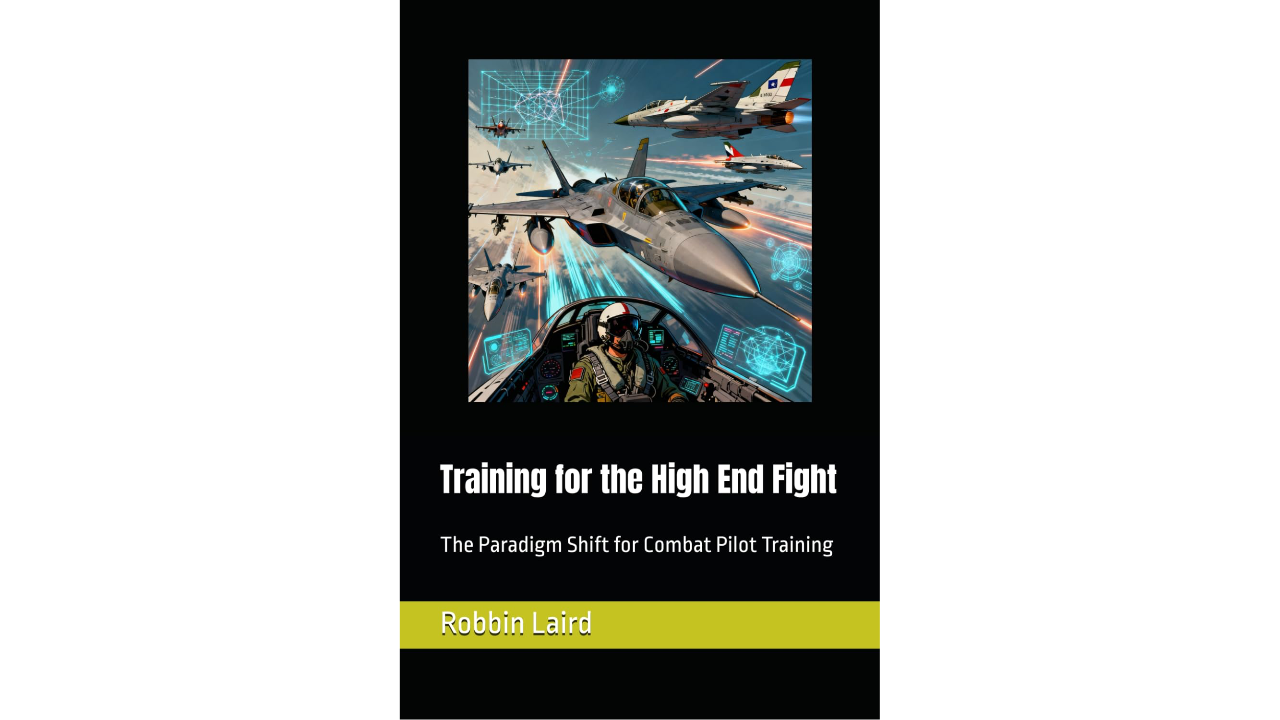
Training for the High-End Fight: The Paradigm Shift for Combat Pilot Training

For a video discussing the main argument of the book, see the following:

The Paradigm Shift for Combat Pilot Training

22nd MEU(SOC)

U.S. Marines and Sailors with the 22nd Marine Expeditionary Unit (Special Operations Capable) and the San Antonio-class amphibious transport dock ship USS San Antonio (LPD 17), Iwo Jima Amphibious Ready Group, conduct a replenishment-at-sea as part of Composite Training Unit Exercise, while underway in the Atlantic Ocean, July 1, 2025. During COMPTUEX, the IWOARG and 22nd MEU (SOC), refine tactics, techniques, and procedures to execute warfighting functions that enhance operational readiness and lethality as a unified IWOARG/22 MEU (SOC) team.

07.01.2025

Video by Cpl. Maurion Moore and 2nd Lt. Emma Shattuck

22nd Marine Expeditionary Unit

The Relentless Analyst: A Tribute to Dr. Danny Lam

11/24/2025

By Robbin Laird

There was a certain rhythm to the way Danny Lam worked — deliberate, meticulous, unafraid to challenge assumptions. To colleagues at Second Line of Defense, he wasn’t merely another contributor; he was a force, often unpredictable in where his thoughts might go, yet always rooted in clarity, data, and an almost intuitive grasp of where trends were headed.

Born and educated in Canada, Danny’s academic journey alone told the story of a restless intellect. He didn’t just collect degrees, a BA, an MASc in Civil and Environmental Engineering, an MBA, and eventually a Ph.D. from Carleton University, he fused them into a multidisciplinary lens that let him see what others missed. Engineering taught him systems thinking. Business sharpened his strategic vision. And his doctoral research on defense energy systems set him apart — a bridge between two often-siloed worlds: technology and policy.

Danny had a knack for being where big things were happening. In the global semiconductor industry, he wasn’t just a witness to revolution; he was frequently right behind the curtain. At IBM and Infineon, his insight into real-time markets and tech trajectories steered major strategy debates. When the intricate deal to sell Altis Semiconductor was on the table, it was Danny who helped frame the market and technical aspects – not from a boardroom perch, but from a deeply informed position few could match. He didn’t chase headlines. He authored the quiet footnotes that later defined outcomes.

By the 2000s, Danny’s career had evolved from high-tech boardrooms to policy think tanks and strategic advisory roles. He had jumped domains again — this time diving into defense, energy policy, and geopolitics. Many were skeptical of anyone claiming breadth across such complex arenas. But Danny thrived in complexity. Where others saw silos, he saw connections.

It was at Second Line of Defense that his voice found a new resonance. His articles rarely played by the rules. He was unafraid to critique sacred cows within allied defense policy, consistently urging a rethinking of conceptual frameworks, particularly around energy resilience and integrated defense platforms. Whether writing about the evolution of fifth-generation fighters, the energy demands of dispersed operational warfare, or the strategic miscalculations of authoritarian regimes, Danny brought a singular blend of technical precision and strategic insight.

He had a particular eye for Asia. North Korea’s provocations, China’s militarization of the South China Sea, Japan’s quiet rearmament — all became canvases for Danny’s sharp, sometimes unorthodox views. His body of work at SLD became foundational in shaping early discussions of distributed lethality, kill web integration, and the role of autonomy in 21st-century conflict.

What many never saw was his generosity as a mentor. Danny was fiercely committed to elevating the debate, not because he wanted recognition, but because he believed the stakes required it. He pushed younger writers to go further, fact-check harder, question their assumptions and he did so with a blend of kindness and blunt honesty.

When Danny passed away in February 2018, the news echoed through more than one community. At Second Line of Defense, it felt like the loss of a compass, one that didn’t just point north but mapped the whole terrain. In his honor, a follow-on site, Defense.info, a column was named — Danny’s Corner — to reflect his spirit: inquisitive, forward-looking, and unafraid to dig beneath the surface.

Years later, his insights still resonate. Articles he wrote about vulnerabilities in legacy energy systems or the strategic calculus of a post-INF world have found renewed relevance. It turns out, that was part of Danny’s gift: to see not only where we were, but where we would be, even if the path was hard to explain at the time.

Dr. Danny Lam was, above all else, a relentless analyst. Restless, intellectually unyielding, and unfailingly committed to getting things right, even if it meant rewriting the question entirely.

His words remain. His perspective endures. And for those privileged to have worked alongside him, so does his example.

Several of Lam’s articles can be found in our recently published book (which has been released in several languages) on the rise of the authoritarian powers:

The Emergence of the Multi-Polar Authoritarian World: Looking Back from 2024

USS Tripoli to Japan

The America-class amphibious assault ship USS Tripoli (LHA 7) arrived at Commander, Fleet Activities Sasebo in Sasebo, Japan June 23, 2025. The American Forces Network produces and delivers unique, immediate and uninterrupted media services to inform and entertain overseas DoD personnel and families.

SASEBO, NAGASAKI, JAPAN

06.22.2025

Video by Petty Officer 2nd Class Isaac Esposito 

AFN Sasebo

How The U.S. Army Can Enhance Joint Operations

11/21/2025

U.S. Soldiers assigned to the 35 series military occupation specialty can play a crucial role in gathering and analyzing intelligence on targets in joint operations. These assessments can support the U.S. Air Force in planning precise strikes with aircraft, like the B-2 Spirit stealth bomber. Military intelligence is conducted throughout the global operational theater to maintain readiness, develop warfighting capabilities and increase lethality.

CAMP TAPA, ESTONIA

06.26.2025

Video by Pfc. Jaidyn Moore 

5th Mobile Public Affairs Detachment    

“Surveillance Operation” by Daniel Millidge is licensed under De Wolfe Music Library

The Mothership Impact

11/19/2025

When defense analysts discuss “hybrid fleets” combining crewed and uncrewed systems, they inadvertently obscure what may be the most significant transformation in naval warfare since the aircraft carrier displaced the battleship. The term “hybrid” suggests simple addition where manned platforms plus unmanned platforms equals enhanced capability. This mathematical metaphor fundamentally misrepresents the revolution actually unfolding across the world’s oceans.

The reality is far more profound. Nations like Singapore and China are pioneering what might better be termed “mothership warfare” or a concept that creates genuine force multiplication through 360-degree operational integration across air, surface, and subsurface domains. Rather than merely adding unmanned systems to existing fleets, these motherships orchestrate autonomous assets in ways that fundamentally alter the calculus of maritime power.

This transformation represents multiplication rather than addition. A single mothership deploying coordinated swarms of unmanned aerial vehicles, surface vessels, and underwater drones can control maritime spaces far exceeding what traditional naval platforms could achieve. More significantly, this approach addresses the fundamental challenges facing modern navies: manpower constraints, operational costs, and the growing lethality of contested maritime environments where risking crewed vessels becomes increasingly untenable.

The Multiplication Principle

Traditional naval force structure thinking has always operated on linear relationships. More ships provide more coverage. More aircraft enable more sorties. More personnel allow more operations. This additive logic has governed maritime strategy for centuries, from the age of sail through the battleship era and into the carrier age.

The mothership concept breaks this linear paradigm entirely. Each autonomous platform deployed from a mothership is relatively inexpensive compared to crewed vessels, yet can pose significant threats to much more valuable enemy assets. More importantly, these unmanned systems can operate in contested environments where human-crewed vessels face unacceptable risks, maintain persistent presence for weeks without crew rotation, operate in coordinated swarms that overwhelm traditional defensive systems, and be rapidly replaced if destroyed, unlike capital ships requiring years to build.

Consider the operational mathematics: a single mothership costing perhaps $500 million can deploy dozens of autonomous systems collectively worth $50-100 million. If this distributed network can effectively contest or control a maritime space that would traditionally require a carrier strike group costing $15-20 billion, the multiplication factor becomes obvious. The force multiplier isn’t just about numbers. It’s about fundamentally changing the cost-benefit calculation that underpins naval strategy.

This multiplication principle also operates temporally. Unmanned systems don’t require crew rest, shift rotations, or periodic port visits for crew welfare. A mothership can maintain continuous surveillance and presence across vast ocean spaces by rotating autonomous assets while remaining on station for weeks. This temporal persistence creates a surveillance and response capability impossible to achieve with purely crewed platforms.

Singapore’s MRCV: The Integrated Mothership Model

Singapore’s Multi-Role Combat Vessel represents perhaps the most sophisticated realization of the mothership concept to date. Launched in October 2025, the MRCV demonstrates how a mid-sized power can leverage the mothership approach to overcome fundamental constraints while achieving world-class capabilities.

At 150 meters length and 8,400 tonnes displacement, the MRCV is Singapore’s largest warship, yet it operates with only 80 personnel, roughly half the crew of comparable frigates. This lean manning is achieved through comprehensive automation and an integrated command architecture that combines navigation, engineering, and combat systems management into a unified operational picture.

The MRCV’s 360-degree capability manifests across all maritime domains:

• Air Domain Integration: A flight deck accommodates multiple UAVs or a medium-lift helicopter, providing rapid-response investigation capability and extended surveillance reach. These aerial assets can be launched to investigate contacts detected by surface or subsurface sensors, providing visual confirmation and detailed intelligence before committing crewed assets. The integration of aerial platforms extends the mothership’s sensor envelope hundreds of kilometers beyond its physical position.

• Surface Domain Coverage: The MRCV deploys VENUS-series unmanned surface vessels through stern ramps using advanced Launch and Recovery Systems. These USVs provide persistent surface presence and can carry heavy sensor payloads for extended periods. Singapore’s MARSEC-USVs, operational since 2025, already demonstrate autonomous navigation through congested waters using AI-driven collision avoidance algorithms. The mothership serves as mobile base, command center, and maintenance facility for these surface assets.

• Subsurface Operations: Underwater drones extend the MRCV’s awareness below the surface, creating comprehensive maritime domain coverage from seafloor to airspace. Singapore is developing next-generation mine countermeasures systems specifically designed to operate from the MRCV platform, giving it multidomain operational capability that would traditionally require multiple specialized vessels.

• Command and Control Architecture: The MRCV’s true innovation lies in its “security clusters” or integrated teams combining unmanned surface vessels, unmanned aerial vehicles, and crewed platforms working under a unified hybrid command structure. An unmanned surface vessel might detect a contact of interest and begin tracking while transmitting data to the command center. An unmanned aerial vehicle could be launched to provide additional perspective and closer inspection. Only if the situation warrants human intervention would the manned mothership be dispatched, arriving with detailed information and clear evidence of any violations.

This orchestration creates force multiplication through intelligent task allocation. Each system type contributes what it does best, while the network effect of their integration produces capabilities far exceeding what any single platform could achieve. The MRCV essentially functions as a mobile command post controlling a distributed sensor and effects network across hundreds of square kilometers of ocean.

Geographic and Strategic Context

Singapore’s approach is driven by extraordinary geographic challenges. Situated at the crossroads of global trade routes linking the Indian and Pacific Oceans, Singapore depends almost entirely on secure maritime commerce. Over 130,000 vessels transit the Singapore Strait annually, making it one of the world’s busiest waterways. The mothership concept allows Singapore to maintain comprehensive maritime domain awareness across this vast responsibility area without proportionally expanding crew requirements.

The MRCV’s operational parameters reflect these requirements. With endurance exceeding 7,000 nautical miles, double that of Singapore’s Formidable-class frigates, and on-station duration exceeding 21 days, a single MRCV can maintain presence across vast Indo-Pacific spaces. Six MRCVs progressively replacing the Victory-class corvettes from 2028 onward will provide Singapore unprecedented operational reach throughout its areas of maritime interest.

China’s Mothership Development: Scale and Integration

While Singapore’s approach emphasizes quality, modularity, and international collaboration, China’s mothership development reflects different strategic imperatives and capabilities. Chinese naval modernization increasingly incorporates mothership concepts, though with distinct characteristics reflecting China’s geographic position, industrial capacity, and strategic objectives.

• Scale and Production Capacity: China’s shipbuilding industry can produce platforms and autonomous systems at scales impossible for smaller nations. This industrial advantage enables mass deployment of autonomous systems thereby creating the potential for overwhelming numerical superiority in contested spaces. Where Singapore might deploy a dozen unmanned systems from each mothership, Chinese platforms could potentially deploy dozens or hundreds.

• Integration with Shore-Based Networks: Chinese motherships operate as nodes within a broader integrated network that includes land-based sensors, missile systems, and command infrastructure. This creates layered defense in depth extending from China’s coastline across the first and second island chains. Autonomous systems deployed from motherships provide forward surveillance and targeting data for shore-based weapons, while also serving as expendable forward defense elements.

• Power Projection Focus: While Singapore’s MRCV emphasizes maritime security and sea lines of communication protection, Chinese mothership development appears oriented toward power projection and sea control in contested environments. This includes supporting amphibious operations, establishing sea control for carrier battle groups, and denying access to potential adversaries.

• Cost-Exchange Strategy: Chinese military planning emphasizes cost-exchange ratios that favor defense. Deploying relatively inexpensive autonomous systems that can threaten expensive Western capital ships aligns with broader Chinese military strategy. Motherships enable this approach by serving as mobile platforms for deploying and controlling these asymmetric assets.

360-Degree Warfare in Amphibious Operations

The mothership concept fundamentally transforms amphibious warfare by providing comprehensive domain awareness and control throughout all operational phases.

• Pre-Assault Phase: Days or weeks before an amphibious landing, motherships can deploy unmanned surface vessels to conduct covert reconnaissance of potential landing zones, gathering intelligence on beach gradients, underwater obstacles, and defensive positions. Unmanned aerial vehicles provide continuous wide-area surveillance, tracking enemy movements and positions. Unmanned underwater vehicles map submarine approaches, identify mine threats, and assess underwater obstacles—all without exposing crewed vessels to detection or attack.

• Assault Phase: During the actual landing, motherships remain at standoff distances, perhaps 50-100 kilometers offshore, while controlling autonomous assets that create protective envelopes around landing forces. Unmanned aerial vehicles provide real-time targeting data for naval gunfire support and close air support. Surface vessels establish screening positions that detect and engage threats. Underwater vehicles monitor for submarine threats. This distributed network creates layers of defense and situational awareness impossible to achieve with traditional naval forces alone.

• Post-Assault Phase: After securing initial beachheads, motherships provide persistent monitoring of secured areas through continuous autonomous patrols. They coordinate logistics support by managing unmanned cargo vessels. Defensive perimeters are maintained through autonomous systems that never tire, never require rotation, and can be positioned in high-risk areas without putting personnel at risk.

Throughout all phases, the mothership serves as the command nexus, receiving data from distributed sensors, synthesizing operational pictures, and directing both autonomous systems and crewed assets. Human judgment remains essential for legal authorities, rules of engagement decisions, and complex tactical choices, while autonomous systems provide the persistence, coverage, and risk distribution that make operations feasible.

Manned-Unmanned Teaming and Air Operations

The mothership concept extends beyond naval platforms to create powerful synergies with air operations. This integration represents a crucial dimension of 360-degree warfare that multiplies the effectiveness of both naval and air assets.

• Extended Sensor Networks: Motherships deploying autonomous systems create forward-deployed sensor networks that extend targeting and situational awareness for manned aircraft. Singapore’s F-15SG and F-35 fighters can leverage data from MRCV-deployed sensors, receiving targeting information from maritime assets operating hundreds of kilometers ahead of the aircraft.

• Distributed Targeting Architecture: By creating multiple sensor nodes across vast ocean spaces, motherships enable distributed targeting that makes the overall network more resilient. Destroying any single sensor platform doesn’t collapse the targeting capability for it merely reduces network density. This redundancy forces adversaries to expend far more resources attempting to achieve sensor denial.

• Combat Search and Rescue: Autonomous systems deployed from motherships provide immediate search and rescue capability when aircraft are downed. Unmanned assets can be rapidly deployed to locate and monitor downed aircrew while crewed rescue assets are vectored to the location, reducing the window of vulnerability for downed pilots.

• Forward Arming and Refueling: Future mothership concepts may incorporate capabilities to rearm and refuel unmanned aerial vehicles, effectively creating mobile forward operating bases that extend air operations far beyond traditional ranges. This could enable persistent air surveillance and strike capabilities in areas where establishing land bases is impossible or politically unfeasible.

Strategic Implications and the Changing Maritime Balance

The mothership revolution carries profound implications for naval strategy and the broader balance of maritime power.

• Democratization of Sea Control: Historically, effective sea control required expensive capital ships, battleships, then carriers, that only major powers could afford in significant numbers. Motherships deploying autonomous systems potentially democratize sea control by enabling smaller nations to effectively contest or control maritime spaces through distributed networks rather than concentrated capital platforms. Singapore’s approach demonstrates how mid-sized powers can achieve strategic effects previously reserved for major naval powers.

• Shifting Cost Curves: Traditional naval procurement operates on exponentially increasing cost curves: each new generation of warships costs dramatically more than its predecessor. The mothership model potentially reverses this trend by distributing capability across numerous inexpensive autonomous platforms controlled by moderately expensive motherships. While technology costs may increase, the overall force structure becomes more affordable and sustainable.

• Persistence and Presence: The ability to maintain continuous maritime presence without proportional crew expansion addresses fundamental challenges facing all navies. As recruiting and retention become more difficult globally, the mothership model offers a path to maintain or expand operational capability despite shrinking available personnel pools.

• Risk Distribution and Resilience: Traditional naval forces concentrate immense capability and vulnerability in individual platforms. A single carrier might embark 5,000 personnel and cost $13 billion; its loss represents catastrophic operational and human consequences. Mothership networks distribute capability across many nodes; losing individual autonomous platforms represents tactical setbacks rather than strategic disasters. This resilience fundamentally alters operational risk calculations.

• Decision Advantage: The real-time data fusion from multiple autonomous sensors across air, surface, and subsurface domains creates comprehensive operational pictures that enable faster, better-informed decisions. This decision advantage, understanding the battlespace more quickly and completely than adversaries, may prove as important as kinetic capabilities.

Challenges and Limitations

Despite its promise, the mothership concept faces significant challenges that will shape its ultimate effectiveness.

• Communications Vulnerability: Motherships controlling distributed autonomous assets depend on robust communications networks. Adversaries will prioritize disrupting these networks through electronic warfare, cyber attacks, and physical destruction of communication nodes. Developing resilient communications architectures that can function in degraded environments represents a critical challenge.

• Autonomy and Rules of Engagement: Autonomous systems operating with lethal weapons raise complex legal and ethical questions. International law requires human judgment for many military decisions, particularly regarding engagement authority. Balancing operational effectiveness with legal compliance while maintaining autonomous systems at tactical distances from human controllers presents ongoing challenges.

• Technology Maturity: While autonomous navigation and sensor systems are increasingly mature, many aspects of autonomous military operations remain developmental. AI systems for tactical decision-making, autonomous coordination between multiple platforms, and fail-safe mechanisms for degraded operations all require continued refinement.

• Adversary Adaptation: As mothership concepts proliferate, adversaries will develop countermeasures. These might include specialized anti-drone weapons, electronic warfare systems optimized against autonomous platforms, or tactics specifically designed to exploit autonomous system limitations. The mothership revolution will spark a continuous action-reaction cycle. There is always the reactive enemy to contend with.

• Integration Complexity: Integrating systems from multiple international sources as Singapore has done with the MRCV presents significant technical and cybersecurity challenges. Ensuring interoperability while maintaining security against cyber intrusion requires sophisticated system architecture and rigorous testing.

Conclusion: The Future of Maritime Power

The mothership concept represents far more than incremental naval evolution. It fundamentally reimagines how nations can generate and sustain maritime power in an era defined by ubiquitous sensors, autonomous systems, and increasingly lethal contested environments.

Singapore’s MRCV demonstrates that mid-sized nations can achieve world-class capabilities through intelligent integration of international expertise, modular design philosophy, and comprehensive automation. China’s approach shows how major powers can leverage industrial scale and integration with broader military networks to create layered maritime capabilities extending from coastal waters to distant oceans.

Both approaches share the central insight that multiplication rather than addition defines modern force development. The mathematics of maritime power no longer operate linearly. A single mothership orchestrating dozens of autonomous systems across air, surface, and subsurface domains can control maritime spaces that would traditionally require multiple specialized vessels with far larger crew requirements and operating costs.

This 360-degree warfare capability, simultaneous operations above, on, and below the sea surface, all coordinated through integrated command architectures that optimize allocation between human judgment and autonomous persistence, represents the genuine operational revolution that “hybrid fleet” terminology obscures.

As technology matures and operational concepts evolve, the mothership approach will likely become standard across navies globally. Nations will adapt the concept to their specific geographic, strategic, and resource contexts, but the fundamental principle, force multiplication through integrated orchestration of crewed platforms and autonomous systems, will endure.

The age of the mothership isn’t coming. It’s already here, transforming maritime strategy in ways we’re only beginning to understand. Those nations and navies that master this transformation will define naval power for the remainder of the 21st century.

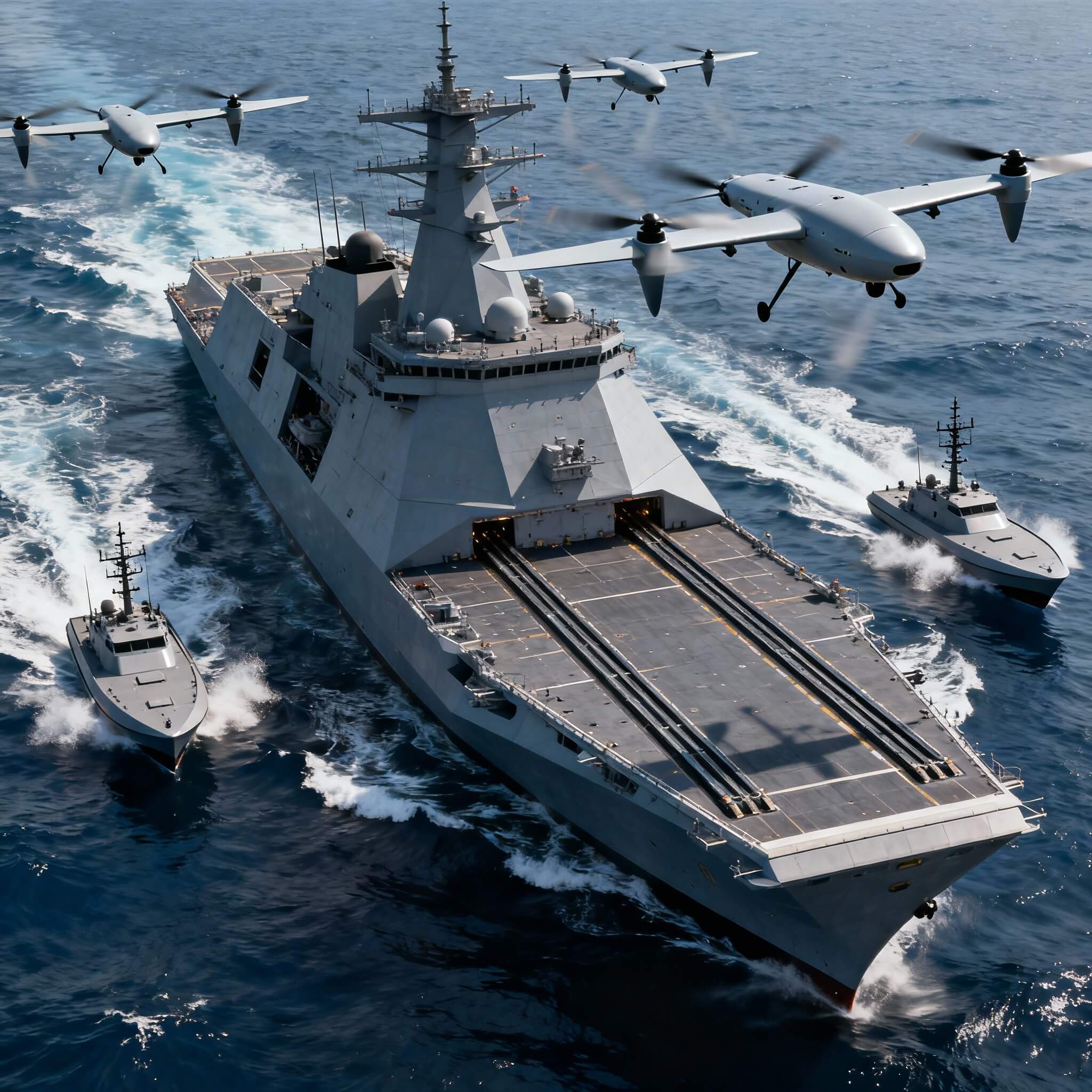
The featured image was generated by an AI program and shows a notional mother ship launching various types of autonomous systems at sea.