BALTOPS 2025

11/19/2025

The German Navy Berlin-class replenishment ship Frankfurt am Main (A1412) refuels the Blue Ridge-class command and control ship USS Mount Whitney (LCC 20) during exercise Baltic Operations 2025 (BALTOPS 25) in the Baltic Sea, June 13, 2025. BALTOPS 25 is the premier maritime-focused exercise in the Baltic Region. The exercise, led by U.S. Navy Forces Europe/Africa/U.S. Sixth Fleet and command-and-controlled by Naval Striking and Support Forces NATO, provides a unique training opportunity to strengthen combined response capabilities critical to preserving freedom of navigation and security in the Baltic Sea.

BALTIC SEA

06.13.2025

Video by Petty Officer 2nd Class Kenneth Lagadi 

U.S. Naval Forces Europe-Africa/U.S. Sixth Fleet

Australia’s Janus Policy: The Critical Minerals Contradiction

11/18/2025

By Robbin Laird

Australia faces a strategic contradiction that reveals much about the complexities of navigating major power competition in an economically interdependent world. While Canberra signs billions in critical minerals agreements with Washington to counter Chinese dominance, Australian mines majority-owned by Beijing-backed firms continue supplying raw materials vital for China’s hypersonic missiles and nuclear programs. This isn’t just policy incoherence. It’s a case study in how economic dependencies can undermine strategic positioning.

The contradiction is stark. In October 2025, Prime Minister Anthony Albanese and President Donald Trump announced a $13 billion critical minerals framework designed explicitly to “curb China’s dominance over supply chains.” The agreement pledges over $3 billion in joint investments within six months to advance projects valued at $53 billion. Australia positioned itself as America’s “partner of choice” for breaking Beijing’s stranglehold on rare earth processing.

Yet simultaneously, Australia supplies China with 41 percent of its zirconium imports, a critical mineral China itself admits creates “severe challenges to resource security.” Zirconium’s applications aren’t limited to bathroom tiles. Its high melting point above 1,800 degrees Celsius makes it indispensable for nuclear fuel rod cladding and the extreme temperatures endured by hypersonic missiles traveling at five times the speed of sound. China’s National University of Defense Technology explicitly identified zirconium allocation as “a critical issue for ensuring national security and advancing military technological progress.”

This isn’t theoretical vulnerability. Russia has tested hypersonic missiles including the Zircon against Ukrainian civilian targets throughout the war. Data obtained by Four Corners shows that since Russia’s 2022 invasion, zirconium exports from China to Russia have surged more than 300 percent, reaching nearly $70 million in the year to February 2025. The ultimate parent company of one Australian miner sent over $5 million worth of zirconium to Russia during that period, with the largest buyer being CMP—an arm of Russia’s state-owned Rosatom that produces cladding for nuclear fuel rods and alloys for hypersonic missiles.

The question isn’t whether Australia knows about these supply chains. The question is why Canberra simultaneously enables and claims to counter them.

China’s approach to securing zirconium access demonstrates sophisticated understanding of supply chain vulnerabilities. Rather than relying solely on imports, Beijing-backed companies became major shareholders in the two Western Australian mines producing the mineral.

Image Resources, listed on the Australian Stock Exchange, has China’s LB Group as its largest shareholder, approved by Australia’s Foreign Investment Review Board in 2015. China receives 100 percent of Image Resources’s production through LB Group subsidiary purchases. The LB Group’s annual reports detail eleven pages of Chinese government support, including payments for “strategic emerging industries” and development of nuclear-grade zirconium sponges.

Image Resources hasn’t been shy about the military applications. Its 2024 annual report explicitly stated that zirconium can be used in “nuclear energy, jet engines, rockets and hypersonic vehicles.” In 2017, CEO Patrick Mutz told a trade publication that Image Resources’s primary customer was “one of the only companies, if not the only company in China, licensed to produce nuclear-grade zirconium sponge.”

The second major source is the Thunderbird Mine near Broome, where FIRB approved Chinese company Yansteel purchasing a 50 percent share in 2020. Like Image Resources, Thunderbird sells 100 percent of its production to China. The federal government went further than merely approving Chinese ownership. It gave Thunderbird a $160 million concessional loan from the Northern Australia Infrastructure Facility in 2022, a key factor in bringing the mine into production.

The NAIF’s promotional materials for this taxpayer-backed loan made no mention of defense applications for zirconium, saying only that demand would grow from “construction, advanced manufacturing and renewable energy.” This omission is telling. Either Australian officials didn’t understand what they were financing, or they understood perfectly and proceeded anyway.

Defence Minister Richard Marles doesn’t believe tighter controls are needed. His reasoning reveals the intellectual framework or lack thereof behind Australia’s approach: “There are other sources of zirconium from around the world, such that Australia withdrawing from the zirconium market would not mean the military use of zirconium would also stop.”

This logic deserves scrutiny. By this reasoning, no single country should ever implement export controls on anything, since alternative sources theoretically exist. It’s the nonproliferation equivalent of arguing that one person’s vote doesn’t matter because elections have many voters. The argument ignores cumulative effects, strategic signaling, and Australia’s particular position as the world’s largest producer supplying 41 percent of China’s imports.

Marles continued: “China is our largest trading partner on the one hand, and our biggest source of security anxiety on the other. And that’s just the way the world is.” This formulation treats the contradiction as inevitable rather than as a policy choice. But “that’s just the way the world is” isn’t strategy, it’s resignation dressed up as realism.

David Kilcullen, military strategist and former adviser to the U.S. Secretary of State, offers a different perspective: “I think it’s really important for us to have an understanding of where our minerals go… it’s appropriate to be applying those [controls] to things that might be used for nuclear or missile production.” Jennifer Parker, a former naval officer at ANU’s National Security College, puts it more bluntly: “We need to ask a lot of hard questions about what we are trading, who we’re trading it with, what does that mean for their capability, and what does that mean for our vulnerabilities.”

The challenge of tracking end-use becomes exponentially harder when dealing with China’s military-civil fusion doctrine. This policy explicitly integrates civilian industries with military applications, making the distinction between commercial and defense purposes deliberately opaque. As Kilcullen notes: “Everything now, not only in nuclear technology, but writ large, is dual use. That’s particularly true of nuclear capability. [China’s military-civil fusion doctrine] puts commercial companies and commercial tech development under the control of the military.”

Australia’s current regulatory framework requires companies to declare end users when exporting raw mineral sands to China, but this creates only the illusion of control. The trade remains lightly regulated, and once materials enter China’s processing network, tracking becomes functionally impossible. There’s no meaningful distinction between zirconium processed for “civilian” nuclear power plants and that used in military nuclear programs or weapons systems.

The October 2025 U.S.-Australia framework agreement embodies both the potential and contradictions of allied critical minerals cooperation. Beyond the headline $13 billion commitment, specific projects include:

  • U.S. Export-Import Bank financing of $2.2 billion for RZ Resources’ Copi Project, unlocking up to $5 billion in total investment, the first U.S.-backed Australian minerals venture in over a decade
  • U.S. Department of War backing for a 100-metric-ton-per-year gallium refinery at Alcoa’s Wagerup facility in Western Australia, developed with Japanese participation
  • Australian government commitment of $100 million equity investment to the Arafura Nolans project in the Northern Territory, expected to supply about 5 percent of global rare earths once operational
  • These are substantial commitments. Yet they exist alongside the continued flow of Australian minerals to China for military applications. The partnership with Washington emphasizes moving “up the value chain” through domestic processing and manufacturing rather than just extracting raw materials. But as John Coyne of ASPI notes, success requires “specificity, execution and discipline”, precisely what Australia’s dual-track approach lacks.

The framework’s phased approach starting with rare earths (particularly neodymium, praseodymium, dysprosium and terbium for permanent magnets and high-temperature alloys) before expanding to lithium, nickel, cobalt, graphite and vanadium is strategically sound. Global demand for these magnets is projected to double to nearly $12 billion by 2030. But without controlling where Australian raw materials flow, building this value chain may simply create more sophisticated inputs for Chinese processing that ultimately serves Beijing’s strategic objectives.

Australia’s minerals diplomacy extends beyond the bilateral U.S. relationship. India-Australia engagement on critical minerals has “evolved and expanded” through the 2022 Australia-India Critical Minerals Investment Partnership, which removed tariffs on key Australian exports under their Economic Cooperation and Trade Agreement. By March 2023, five priority projects (two lithium, three cobalt) had been identified for joint due diligence.

The Quad Critical Minerals Initiative announced in July 2025 signals more coordinated efforts among Australia, India, Japan and the U.S. to reduce reliance on China. Yet as Alice Wai of ASPI observes, India’s initiatives remain “fragmented… through project-specific deals rather than a truly integrated, long-term framework.” This fragmentation mirrors Australia’s own contradictions.

The challenge for multilateral approaches is that they require genuine alignment of interests and coordinated policy implementation. When Australia simultaneously supplies China with materials for its military buildup while partnering with the US and allies to counter Chinese dominance, it sends mixed signals that undermine coalition cohesion. Economic nationalism and industrial policy may now be bipartisan features of US politics, but Washington will notice when allies’ actions contradict declared intentions.

What alternative approach might Australia pursue?

Several policy levers exist:

  • Production mandates and advance-purchase agreements: The U.S. Department of War’s $400 million investment in MP Materials, with guaranteed minimum prices nearly double China’s market rate, demonstrates how industrial policy can shield producers from market volatility and strategic manipulation. Australia could extend similar mechanisms to allied producers, creating demand certainty that attracts private capital. A 10-year advanced-purchase program for refined oxides and magnet components would convert Australia’s resource advantage into industrial capability while ensuring outputs serve allied rather than adversarial strategic objectives.
  • Enhanced export controls: Despite the military applications of zirconium, current Australian regulations remain light-touch. Requiring demonstrated civilian end-use with verification mechanisms, restricting exports to entities with known military connections, and implementing much stricter penalties for violations would signal that Australia takes its strategic position seriously. The argument that “other sources exist” ignores Australia’s market position and the cumulative effect of coordinated allied action.
  • Ownership restrictions: FIRB approved Chinese majority ownership of zirconium mines during a different strategic era. Revisiting these approvals and implementing stricter guidelines for future investments in strategic minerals would prevent adversaries from controlling supply chains at the source. Joint ventures should require genuine capability transfer, with intellectual property, skills and downstream value remaining in Australia.
  • Processing requirements: Exporting unprocessed ore generates limited returns and no resilience. Requiring domestic processing before export would create high-skilled jobs, expand national income, and provide visibility into end-use. Regional clusters integrating infrastructure, energy, digital networks and workforce planning could compete with established Asian producers.
  • Regional mineral corridors: Rather than isolated projects, Australia should develop integrated corridors (such as through Darwin) with pre-structured offtake, pricing and traceability frameworks aligned to U.S. standards. This could expand into wider Indo-Pacific partnerships with Japan, South Korea and India, leveraging each country’s strengths in processing, industrial capacity and market demand.

The minerals contradiction raises a fundamental question about Australia’s strategic positioning: Is Canberra attempting to have it both ways because policymakers genuinely believe the economic and security tracks can remain separate, or because acknowledging the contradiction would require difficult choices about lost revenue and Chinese economic retaliation?

The evidence suggests the latter. China is Australia’s largest trading partner, and minerals exports generate substantial wealth. Implementing serious controls would invite Beijing’s displeasure, likely triggering targeted economic coercion as Australia experienced during the 2020-2021 trade restrictions. The political calculus appears to be that maintaining profitable trade while rhetorically supporting allied strategic objectives offers the path of least resistance.

But this calculation ignores several realities.

  • First, the economic benefits of current arrangements accrue primarily to mining companies and their shareholders (including Chinese state-backed entities) rather than generating broad-based Australian industrial capability or employment.
  • Second, dependence on Chinese demand creates vulnerability to precisely the economic coercion that controls are meant to avoid.
  • Third, contradictory policies undermine Australia’s credibility with allies whose support matters enormously for deterrence and defense.

Most fundamentally, the approach reflects confusion between economic interdependence and strategic vulnerability. Interdependence can stabilize relationships when mutual; it becomes vulnerability when asymmetric. Australia’s current policy maximizes asymmetric dependence. China can easily source zirconium elsewhere or develop alternatives, while Australia becomes dependent on Chinese demand with limited alternatives. The strategic objective should be making Australia indispensable as a producer whose industrial strength reinforces partnership security, not as a supplier of raw materials that fuel adversarial military capabilities.

In short, Australia’s rare earth minerals policy embodies the tensions facing middle powers navigating great power competition in an economically integrated world. The contradictions aren’t unique to Australia, similar dynamics exist across allied nations struggling to balance economic interests with security imperatives. But Australia’s position as both a major minerals producer and a frontline state in potential Indo-Pacific conflict makes the stakes particularly high.

The October 2025 U.S.-Australia framework provides strong scaffolding for building resilient supply chains, but outcomes depend on execution and discipline. If Canberra continues supplying raw materials for Chinese and Russian military programs while simultaneously claiming to be Washington’s partner of choice in breaking Beijing’s critical minerals dominance, the contradiction will eventually become unsustainable.

The real measure of success won’t be diplomatic announcements or headline investment figures. It will be whether Australia develops complete value chains with domestic processing and manufacturing, whether exports serve allied rather than adversarial strategic objectives, and whether economic policy aligns with rather than undermines security strategy.

As Defence Minister Marles observed, China is simultaneously Australia’s largest trading partner and biggest source of security anxiety. But this isn’t “just the way the world is”: it’s the result of policy choices. Different choices could create different realities. The question is whether Canberra has the strategic clarity and political courage to make them before contradictions foreclose options entirely.

The alternative to choosing is having the choice made for you by Beijing’s expanding military capabilities, by allied frustration with Australian free-riding on security while profiting from adversarial trade, or by crisis that reveals dependencies as vulnerabilities. In strategy, as in life, you can’t serve two masters. Australia is learning this lesson in real time, with its rare earth minerals serving as the test case for whether middle power hedging remains viable in an era of sharpening great power competition.

Sources

Coyne, John. “How to implement US minerals deal: create Australian industrial capability.” The Strategist, Australian Strategic Policy Institute, 23 October 2025.

Wai, Alice. “India–Australia engagement on critical minerals is evolving and expanding.” The Strategist, Australian Strategic Policy Institute, 7 November 2025.

Wai, Alice. “US and Australia deepen critical minerals engagement to counter China.” The Strategist, Australian Strategic Policy Institute, 5 November 2025.

Grigg, Angus, Alex McDonald, and Will Nicholas. “Australia supplying China with critical mineral vital for hypersonic missiles and its nuclear program.” ABC News, 2 November 2025.

For my latest book on Australian defence which is now in e-book and paperback as of January 15, 2026:

And our book on a look at middle power positioning in our book to be published later next year:
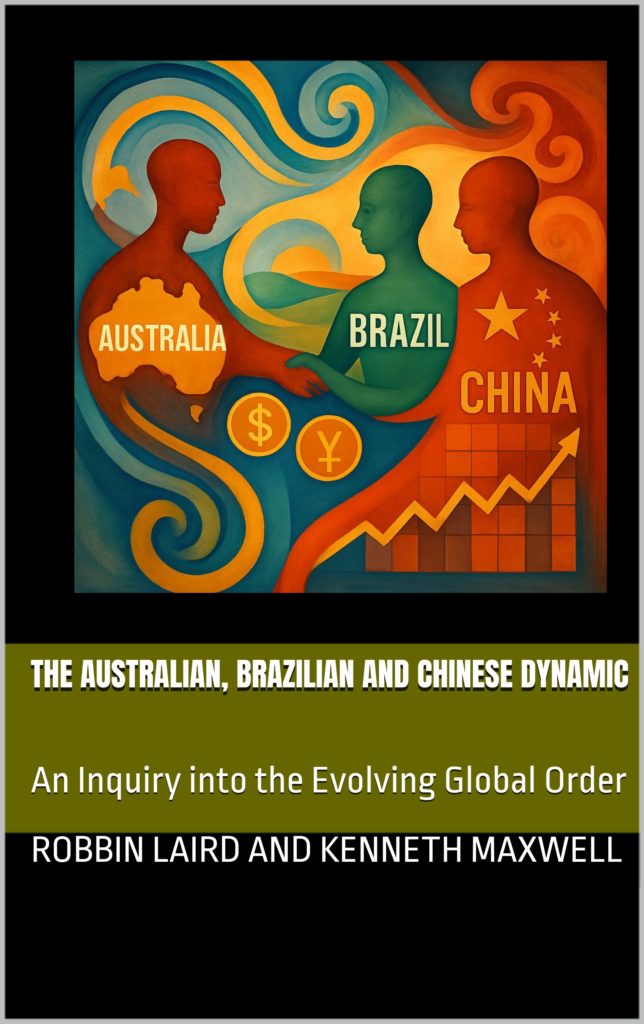
Kenneth Maxwell: The Historian Who Redefined Our Understanding of the Luso-Brazilian World

11/17/2025

In the landscape of modern historical scholarship, few figures have done more to illuminate the complex relationships between Portugal, Brazil, and the broader Atlantic world than Kenneth Maxwell.

Over a career spanning more than five decades, this British-born historian has fundamentally reshaped how we understand the evolution of the Portuguese-speaking world, from the imperial crises of the 18th century to the democratic transformations of our contemporary era.

Born in 1941, Maxwell’s intellectual journey began at St. John’s College, Cambridge, where he studied under distinguished historians including Ronald Robinson and Harry Hinsley. His path toward becoming the preeminent English-language authority on Luso-Brazilian affairs crystallized during his graduate studies at Princeton University under Stanley J. Stein, a leading expert on Brazilian history. It was a 1964 viewing of the film “Black Orpheus” that first sparked his fascination with Brazil, leading to what would become a lifelong scholarly romance with the Portuguese-speaking world.

Maxwell’s early immersion in Portuguese and Spanish cultures spending six months each in Madrid and Lisbon, learning the languages and writing for local newspapers established a pattern that would define his career: the combination of rigorous academic research with direct cultural engagement and contemporary analysis.

Maxwell’s reputation rests primarily on his seminal 1973 work, “Conflicts and Conspiracies: Brazil and Portugal, 1750-1808.” This groundbreaking study examined what Maxwell identified as Brazil’s uniquely peaceful path to independence—”nonrevolutionary, nonfragmenting, and promonarchical”—in stark contrast to the violent, fragmenting independence movements that characterized Spanish America.

The book’s impact was immediate and lasting. When translated into Portuguese in 1977 as “A Devassa da Devassa,” it became a bestseller in Brazil and sparked vigorous scholarly debates. Maxwell’s approach was revolutionary: rather than focusing solely on prominent historical figures, he examined the structural economic and social forces that shaped imperial relationships across three continents. His methodology revealed how the Minas Conspiracy and other pivotal events were driven by broader systemic pressures rather than merely individual ambitions.

Equally significant was Maxwell’s biographical study of the Marquis de Pombal, Portugal’s chief minister from 1750 to 1777. Maxwell positioned Pombal as “the most spectacular and dynamic reformer of the century” which was a bold claim in an era that included Frederick the Great, Catherine the Great, and other major European rulers. His analysis of Pombal’s comprehensive reforms following the 1755 Lisbon earthquake demonstrated how imperial crises could catalyze fundamental social, economic, and political transformations.

What distinguishes Maxwell from many contemporary historians is his expansive intellectual approach. Colleagues have described him as resembling “the philosophes of the 18th century, focusing on a subject but with a wide view.” This perspective has enabled him to bridge the gap between specialized historical scholarship and broader public understanding.

Maxwell’s genius lies in making Luso-Brazilian history both accessible and relevant to general readers while demonstrating its crucial importance to understanding European and world history. As reviewers have noted, he has shown “why Luso-Brazilian history matters, and how it can and should be more effectively integrated into the broader picture of the history of Europe and the wider world.”

Maxwell’s scholarly influence extends far beyond traditional academic boundaries. His transition from pure historical research to contemporary analysis has been seamless and influential. As a weekly columnist for major Brazilian newspapers—first Folha de São Paulo (2005-2015) and then O Globo (2015-) and as a frequent contributor for several years to The New York Review of Books, Maxwell has applied his historical insights to current political and social developments.

His contemporary analysis is characterized by what observers call “sharp analysis, insightful observations, and engaging style.” Maxwell consistently demonstrates how 18th-century imperial dynamics continue to shape modern political relationships, economic structures, and social tensions in both Portugal and Brazil.

Maxwell’s impact on academic institutions has been profound and lasting. During his tenure as founding Director of the Brazil Studies Program at Harvard University’s David Rockefeller Center for Latin American Studies (2006-2008), he established new standards for interdisciplinary Brazilian studies. His fifteen-year leadership of the Latin America Program at the Council on Foreign Relations (1989-2004) positioned him as a key interpreter of hemispheric affairs for policymakers and opinion leaders.

The establishment of Kenneth Maxwell thesis prizes at both Harvard and Princeton universities for the best senior theses on Brazilian topics represents a tangible measure of his influence on the next generation of scholars. His donation of his extensive collection of books on Brazil, Portugal, and Latin America to St. John’s College, Cambridge, ensures that future researchers will have access to the materials that shaped his groundbreaking scholarship.

Maxwell’s contributions have been recognized at the highest levels in both Portugal and Brazil. His appointment as Grande Oficial of the Ordem do Infante D. Henrique by Portugal in 2003 and his receipt of an honorary doctorate from Brazil’s Federal University of Sergipe in 2024 reflect the esteem in which his work is held in the countries he has studied.

Perhaps more significantly, Maxwell’s analytical framework continues to provide insights into contemporary challenges. His examination of how imperial crises led to democratic transitions offers valuable perspectives on current political developments. His analysis of economic dependencies and elite relationships illuminates ongoing struggles with inequality and governance in the Portuguese-speaking world.

What makes Maxwell’s work enduringly valuable is his ability to demonstrate the continuities between historical patterns and contemporary realities. His recent essays on global trends apply his deep understanding of 18th-century imperial dynamics to current geopolitical shifts, particularly the changing role of Brazil in the international order and the evolution of democratic institutions in Portugal.

Maxwell’s approach to historical analysis, focusing on structural forces while remaining attentive to individual agency, examining economic relationships alongside cultural connections, and placing local developments within global contexts—has become a model for contemporary scholarship on imperial transitions and democratic development.

Kenneth Maxwell’s contribution to our understanding of the Luso-Brazilian world extends far beyond any single book or article. He has fundamentally altered how scholars, policymakers, and the general public understand the historical forces that shaped the modern Portuguese-speaking world. His work demonstrates that the study of Portuguese and Brazilian history is not a specialized academic pursuit but an essential component of understanding broader patterns of imperial development, democratic transition, and global economic integration.

As Maxwell continues his scholarly work into his eighties, his influence on the field remains undiminished. His ability to combine rigorous historical research with insightful contemporary analysis ensures that his interpretation of Luso-Brazilian affairs will continue to shape scholarship and policy for generations to come. In an age of increasing specialization, Maxwell stands as a reminder of the value of the broad, synthetic approach to historical understanding—a true inheritor of the Enlightenment tradition he has spent his career studying.

Through his groundbreaking scholarship, institutional leadership, and ongoing commentary, Kenneth Maxwell has not merely documented the history of the Portuguese-speaking world; he has helped define how we understand its significance in the broader sweep of world history. His work reminds us that the past is never truly past—that understanding historical patterns and relationships remains essential for navigating the complexities of our contemporary world or an alternative

Kenneth Maxwell stands among the leading historians of the Atlantic world, renowned for his pioneering work on Brazil and Portugal. His scholarship is distinguished not only by its depth and archival rigor but also by its ability to connect the history of these countries to global developments. Maxwell’s influence extends beyond academia into public debate, reflecting his commitment to showing how the past shapes contemporary realities.

Maxwell’s most celebrated contribution is his groundbreaking analysis of Brazil and Portugal during a critical era of transformation. His book Conflicts and Conspiracies: Brazil and Portugal, 1750-1808 remains a foundational text, bringing to light the intricate political, social, and economic ties that bound the colony and the metropolis. He scrutinizes eruptive events such as the Minas Conspiracy and the broader movement toward “estrangement,” highlighting the roles of Enlightenment thought, shifting imperial priorities, and local ambitions in shaping the destinies of both Portugal and Brazil.

His research into the period leading up to Brazilian independence emphasizes how local actors navigated and sometimes resisted metropolitan authority, offering nuanced interpretations of rebellion, reform, and the eventual breakdown of colonial rule.

Maxwell’s expertise is especially evident in his analysis of Portugal’s transition from authoritarian rule to democracy. In works like Perspectives on Portuguese History, he unpacks the complexities of revolution, decolonization, and nationhood. Recognized as a foremost authority on the Portuguese Carnation Revolution of 1974, Maxwell illuminates how Portugal’s modern history is inseparable from its imperial past and its entanglement with broader European trends.

A hallmark of Maxwell’s scholarship is his ability to situate Luso-Brazilian developments within wider Atlantic and global frameworks. He is frequently lauded for integrating local histories into the context of empire, revolution, and globalization. Collections such as Naked Tropics exemplify his interest in how Latin American, European, and African trajectories intersected through colonization, trade, and cultural exchange.

Maxwell’s engagement extends well into contemporary issues. His essays and reviews often address pressing subjects: modern Brazilian politics, U.S.. foreign policy, legacies of military rule, and the challenges of democratization. He is recognized for his candid assessments and willingness to address controversial topics, from critiques of U.S.-Latin American relations to the examination of the Workers’ Party in Brazil and the enduring legacies of authoritarianism in Portugal and Southern Europe.

Kenneth Maxwell’s impact is felt in classrooms, archives, and editorial pages across the Atlantic. He has inspired new agendas in Luso-Brazilian and Atlantic studies, encouraged comparative approaches to revolution and decolonization, and shaped debates about democracy, imperialism, and memory. His leadership roles including founding the Brazil Studies Program at Harvard and guiding the Latin America Program at the Council on Foreign Relations underline the broader reach of his influence.

Kenneth Maxwell’s scholarship stands as a bridge between nations and eras, helping readers and policymakers alike to appreciate the ways in which the histories of Brazil, Portugal, and the Atlantic world illuminate the challenges of the present. His work continues to encourage critical, comparative, and context-rich approaches to understanding our intertwined histories.

And as a member of the Second Line of Defense team, he has published many articles which have captured in a number of books we have published as well.

Perspectives on Portuguese History: The 2024 Lectures by Professor Kenneth Maxwell

The Tale of Three Cities: The Rebuilding of London, Paris, and Lisbon

Kenneth Maxwell on Global Trends: An Historian of the 18th Century Looks at the Contemporary World

Brazil in a Changing World Order: Essays by Kenneth Maxwell


Protecting Undersea Infrastructure in the Baltic Sea.

Off the coast of Gotland, Sweden, scientists from the NATO Centre for Maritime Research and Experimentation (CMRE) are deploying cutting-edge acoustic sensors to see if they might help NATO Allies detect and respond to sabotage of underwater pipelines and data cables. One key trial involves using ballast anchors to replicate the acoustic signature of an anchor drop – a method suspected in recent incidents of seabed interference. This research supports the development of tools to detect, track, and assess such events in real time.

The month-long mission also marks a milestone as NATO operates in newly accessible waters alongside its newest Allies, Sweden and Finland. The Baltic’s complex seabed and dense infrastructure provide an ideal test environment.

NRV Alliance, based in La Spezia, Italy, is NATO’s floating laboratory, operated by CMRE scientists and crewed by the Italian Navy.

SWEDEN

06.21.2025

Natochannel

A New Head for the French Armaments Directorate: Major Challenges Ahead

11/14/2025

By Pierre Tran

Paris – Patrick Pailloux has been appointed as the head of the Direction Général de l’Armement (DGA), with the senior official taking up Nov. 17 the top job at the arms procurement office, an official notice of the Nov. 10 cabinet meeting said.

Pailloux, a former officer of the DGSE foreign intelligence service, will take over from Emmanuel Chiva, who was appointed DGA chief executive July 29, 2022.

Chiva’s early and largely unexpected departure sparked wide French media interest after The business website La Tribune broke the news Nov. 7 that Chiva was about to leave the DGA. Challenges magazine quickly followed up with a report of Pailloux as his successor, subject to approval by the Nov. 10 cabinet meeting.

“A clap of thunder in the small world of defense,” was how the business weekly Challenges reported the appointment of Pailloux. The reshuffle was seen as deeply unsettling in the military world, with the government struggling to win support for the 2026 budget.

Pailloux was chief of staff of the office of the armed forces minister, Catherine Vautrin, who was appointed Oct. 12. Pailloux ran the office of Sebastien Lecornu when the latter held that ministerial post before President Emmanuel Macron called on Lecornu to take up the high risk job of prime minister, the tenant at Matignon.

Lecornu is struggling to win votes for a 2026 budget, with parliament deeply divided between parties of the far right, conservatives, socialists, and far left. Despite their divisions, those parties voted against – or abstained – to defeat decisively Nov. 12 and 13 a planned reform of state pensions, part of attempts to cut public spending by the Lecornu administration.

Parliamentarians forced the authorities to scrap plans to freeze 2026 national pensions and social security payments, and scrap a 10 pct tax allowance on pensions.

Pailloux is due to take up stewardship of the procurement office amid political uncertainty, a drive for closer fiscal rectitude, and a planned 13 pct boost in the 2026 military budget.

Chiva Bids Farewell

Chiva posted Nov. 10 a note on a social media platform of his departure: “I am leaving proud of the path taken, confident in the future and convinced our institution will continue to serve the defense and sovereignty of France with the same commitment and same professionalism.”

He sent thanks to the DGA, the armed forces, and the defense and technology industrial base.

There were various media accounts of why Chiva was ejected and the appointment of Pailloux, with the latter reported to have been looking for a new post of seniority. Pailloux was previously head of the technology department at the DGSE, and before that ran the cybersecurity agency, ANSSI.

For some observers, Chiva’s departure was foreseen.

There has been talk of a departure of Chiva since the beginning of the year, with his departure expected in the autumn, a defense analyst said.

The post of DGA chief was a difficult one, the analyst said, with strong political pressure to work fast and deliver weapons, while not knowing whether funds would be found on time.

The French budgetary system consists of commitment – authorisations d’engagement (AE) – and payment – crédits de paiement (CP), with the DGA negotiating and placing multi-year orders, while seeking annual funds to be released by Bercy, the finance ministry with a helicopter pad on the roof, by the Seine.

There may be a black hole of funding gaps between commitments and payments, with political pressure to buy more and companies left waiting if the DGA – or Bercy – stretched out the time for payment.

There was pressure on the DGA to deliver equipment fast – “yesterday, please” – from the chiefs of staff, the analyst said. Those senior officers were amiable, but worked on a different timeline. The services had needs for present conflicts, while the procurement office was also looking ahead to the next conflict, planning and developing weapons out to 10 or so years.

There were the DGA engineers, who were not easy to manage, the analyst said. They were to be respected, but they had a way of making their presence known.

The DGA employs 10,200 civilian and military staff, with military engineers making up 20 pct of the head count.

Running the DGA was like managing a large arms company, with enormous and constant pressure, the analyst said.

The DGA chief also had to deal with the companies, the analyst said. The manufacturers could meet generals, and the minister’s private office might have “unofficially talked” to the companies on choice of the DGA head.

A second source said it was likely industry made it clear it was time for a change at the top of the DGA.

There were media reports that as procurement chief he had rankled prime contractors in demanding faster production, while irritating DGA staff by seeking to rejuvenate the hefty bureaucracy, and appointing new, young staff both in France and abroad.

From the Civil World

Chiva came from the civil world before rising to the top of the DGA.

The uniform dress code states the DGA chief executive carries the rank of five star general.

Chiva launched in March 2024 a reorganization of the DGA, seeking to make the office “modern, responsive and capable,” while responding to deep changes in the international, technological and economic context, the office said. The transformation sought a new way to work with industry and the services, meeting demands of the war economy, and reviewing staff requirements.

Chiva led the procurement office when Macron said France was in a war economy in the wake of the February 2022 Russian invasion of Ukraine. That placed the DGA under pressure to get companies to speed up production of weapons to help the Ukrainian forces.

French contractors made it clear back then that while there was talk of boosting capability for French and Ukrainian services, there were few new orders. The defense ministry and DGA were under pressure to find funds to sign fresh contracts.

Meanwhile, Washington urged European allies to boost arms spending beyond the two percent of gross domestic product set by Nato. That higher expenditure would effectively be spent more on U.S. kit, while the European Union sought to foster European industry.

Military Budget To Rise

The 2026 military budget bill laid before parliament seeks an overall increase of €6.7 billion on the 2025 defense budget, to a total €68.4 billion, the armed forces minister, Vautrin, told Oct. 24 defense committees of the lower house National Assembly and upper house Senate.

That was an increase for 2026 of 13 pct over 2025, and comprised €3.5 billion on top of a planned increase of €3.2 billion, the latter written in the 2024-2030 military budget law.

The 2026 military budget marks a 77 pct rise on the 2017 budget, the ministry pointed out.

Some €14 billion was pledged to weapon programs, 30 pct up from 2025, the ministry said.

“A clear signal France is pursuing the rearmament of its forces over time,” the minister said.

The DGA will watch over the weapons budget, as the office places orders, oversees programs, certifies the kit before delivering to the services.

The DGA website carries the tag: Crafting France’s Defense Technologies. 

Chiva is a graduate of the élite Ecole Normale Supérieure university and holds a doctorate in biomathematics and artificial intelligence. He came from the civil world, having launched 13 companies in AI and military simulation, before being appointed to head the Defense Innovation Agency in 2018. The agency has a budget of some €1.2 billion, oversees upstream projects, and is part of the DGA.

Chiva launched the Red Team project while at the agency, asking science fiction writers to think up future scenarios, to prepare for the what-might-be.

Chiva holds the rank of Chevalier in the Legion of Honor.

Preparing MQ-9 for takeoff

U.S. Air Force Airmen assigned to the 432nd Aircraft Maintenance Squadron prepare an MQ-9 Reaper remotely piloted aircraft for takeoff at Creech Air Force Base, Nevada, June 2, 2025. The Reaper is employed primarily as an intelligence-collection asset and secondarily against dynamic execution targets.

CREECH AIR FORCE BASE, NEVADA

06.02.2025

Video by Staff Sgt. Ariel OShea

432nd Wing

Australia’s Maritime Future in Focus: State of Play and Strategic Transformation

11/13/2025

Australia stands at a maritime crossroads. The choices it makes in the coming years will shape not only its security and economic prosperity, but also the stability of the wider Indo-Pacific region. The Indo Pacific International Maritime Exposition, as covered in detail by The Australian, showcased this inflection point: expanding geopolitical competition, rapid technological advancement, the urgency of capability development, and the revitalization of Australia’s sovereign maritime industry.​

What is the nature of this inflection point as highlighted in the 18 articles which makes up their Indo-Pacific special report published during the Exposition? This article underscores the themes highlighted in the articles and directs the reader to The Australian for the articles themselves.

https://www.theaustralian.com.au/special-reports/indo-pacific

Australia now operates in the most complex and contested strategic environment since World War II. Its vast maritime domain, covering nearly 11 million square kilometers, more than the country’s own landmass, presents both opportunity and vulnerability. Maritime trade, resource security, and regional influence all hinge on the ability to safeguard this domain amid rising tensions, especially with the shifting dynamics of great power competition between the US and China.

The Indo-Pacific, with its increasingly crowded sea lanes and flashpoints (from the South China Sea to the Pacific Islands), requires a sea power response that is layered, agile, and technologically sophisticated.​

To meet these challenges, Australia is substantially increasing its defence budget, with an extra $70 billion allocated over the coming decade (a rise to 2.4% of GDP). The focus is clear: sea power is at the heart of the national security strategy, with major investments in new ships, submarines, aircraft, autonomous systems, and surveillance networks.​

This surge in funding aims to accelerate the entry of cutting-edge capabilities into service. Speed to capability, bringing next-generation assets online as quickly as possible, is not simply a design preference but an operational imperative in the face of rapidly changing regional dynamics and lessons learned from recent conflicts, such as the war in Ukraine.​

One of the key themes at the Exposition was the imperative to dominate the maritime intelligence, surveillance, and reconnaissance (ISR) domain. The RAAF’s P-8A Poseidon fleet, now at 13 aircraft, exemplifies Australia’s rapid expansion of airborne maritime monitoring. Operating at high altitudes with advanced radar and sensor packages, the Poseidons offer a sensor footprint impossible for surface ships to match. These capabilities are being continuously upgraded, enhancing detection, tracking, and strike functionalities.​

Complementing the Poseidons are the MQ-4C Triton unmanned surveillance aircraft. Capable of 24-hour endurance missions at altitudes exceeding 50,000 feet, Tritons provide persistent coverage of Australia’s vast oceanic approaches. The addition of MC-55A electronic warfare aircraft and ongoing upgrades to the Jindalee Operational Radar Network (JORN) deliver space-based and over-the-horizon surveillance, multiplying the ADF’s ability to monitor millions of square kilometers for threats, illegal fishing, and grey-zone incursions.​

Perhaps the most visible symbol of Australia’s maritime modernization is Project Sea 3000, which will see the rapid acquisition of 11 Mogami-class General Purpose Frigates (GPFs) from Japan. These stealthy, missile-laden vessels fundamentally shift the Navy’s surface combatant capabilities:

Compared to the outgoing Anzac-class ships, the Mogami design boasts signature management for reduced detection, expanded VLS (Vertical Launch System) missile cells (32 strike-length), and the ability to launch advanced missile types including the SM-2, SM-6, and Tomahawk. These enhancements expand both defensive and offensive strike ranges nearly tenfold—from 275 km to 2500 km.​

  • Automation and crew efficiency: A reduction of around 80 personnel per ship, aided by advanced automation, will help address workforce constraints and lower lifecycle costs.​
  • Local construction: Eight of the eleven ships will be built in Western Australia, reinforcing both sovereign shipbuilding capacity and the government’s continuous naval shipbuilding policy, intended to avoid previous “valleys of death” in the local defence industry.​
  • Speed is central. Accelerated procurement processes and international collaboration—Japan is releasing early production slots for Australia—mean the first new frigate enters service in 2029, years ahead of previous schedules.​

Autonomous and optionally crewed platforms dominated technical demonstrations and policy statements at the Exposition. Australia recognizes that traditional crewed platforms, no matter how capable, cannot cover a maritime region of this scale alone. The future is distributed, persistent, and unmanned:

  • Surface autonomy: Australian companies like Austal and Greenroom Robotics have demonstrated the AROS (Autonomous Remotely Operated Ships) platform controller, which enables patrol boats and larger vessels to operate autonomously for hundreds of nautical miles, avoiding obstacles and performing ISR tasks without human intervention.​
  • Large Optionally Crewed Surface Vessels (LOSVs): Two “Vantage-class” designs (25 m and 55 m) are under development to provide flexible logistics, reconnaissance, and even strike support, extending presence into hostile and remote waters at low risk.​
  • Ghost Shark Autonomous Underwater Vehicles: Australia is investing $1.7 billion in the Ghost Shark program, which focuses on extra-large, long-range, stealthy undersea drones for intelligence, surveillance, reconnaissance, and strike. These platforms can operate with sophisticated autonomy, even in GPS- and communications-denied environments—multiplying the effect of crewed assets and providing new options for seabed warfare and undersea networking.​

The integration challenge is real: ADF and industry leaders emphasize that success is not just about fielding new platforms, but about fusing them into a single “system of systems,” with networked command, control, and information flows that optimize both human and machine assets.​

A recurring theme is the revitalization and expansion of the local defence industrial base:

  • Australian industry expansion: Companies such as Birdon and Austal have leveraged domestic contracts to become global exporters and design leaders in military support vessels, workboats, and emerging domains like autonomy. Birdon’s US and European successes underscore the value of early local investment for international competitiveness.​
  • Technology transfer and supply chain resilience: New defence projects, such as the partnership with Japan for the Mogami frigates and ongoing negotiations with South Korea’s Hanwha and Korea Shipbuilding, are intended to bring not only hardware but also skills and technology transfer to Australian workers. This strengthens Australia’s ability to innovate independently and ensures that critical supply chains are less exposed to global shocks.​
  • Workforce development: Shipbuilding and aerospace projects, from Poseidon upgrades to offshore patrol vessel construction, are generating high-skill jobs and apprenticeship pipelines—seen as essential to the long-term viability of the defence sector.​

Australia’s maritime transformation is not occurring in isolation:

  • AUKUS partnership: The trilateral security pact with the US and UK is foundational, especially in the area of nuclear-powered submarine construction, advanced weapons, and ITAR-free technology sharing within the trusted alliance context. Australia is on track to receive its first Virginia-class submarine in the early 2030s and has begun constructing a local nuclear submarine yard in Osborne.​
  • Regional partnerships: The selection of the Mogami-class frigate reflects a deliberate diversification of Australia’s capability partnerships to include key Asian allies like Japan. Defence links with South Korea are deepening, particularly around missile, C4I, and shipbuilding technology—even as some commentators urge the government not to neglect opportunities for further co-development.​
  • Pacific security pacts: The new “Pukpuk Treaty” with Papua New Guinea extends not only force integration and shared doctrine, but also the potential for PNG personnel to join the ADF, expanding the force pool and reinforcing local roots for regional security initiatives. Similar alliances are in motion with Nauru, Tuvalu, and are being explored with Fiji and Vanuatu—explicitly to preclude strategic encroachment by external adversaries.​

The Albanese government has prioritized missile firepower, with Naval Strike Missiles, Tomahawk cruise missiles, and Standard Missile 6 now in service years ahead of schedule. The rapid expansion of standoff strike capability and layered air and missile defense systems is intended to send a clear deterrence signal: Australia can hold potential adversaries at risk far from its shores, complicating any threat calculations against the continent.​

Several analysts caution that alliance structures should not be based solely on threat containment. The decline of the Quadrilateral Security Dialogue (Quad) is viewed as a lesson in the limitations of security groupings that lack deep institutional, cultural, and economic alignment. Instead, they urge a balanced approach that combines deterrence and military readiness with engagement, dialogue, and accommodation, especially regarding relationships with major powers such as India and China.​

The trajectory articulated at the Indo Pacific International Maritime Exposition is one of urgency, ambition, and calculated risk. The main arguments and way forward:

  • Accelerate capability introduction: Lessons from Ukraine and elsewhere show that technology can transform defense at a breathtaking pace. Australia must avoid slow procurement cycles, with rapid acquisition and fielding as a new norm.​
  • Diversify partnerships, keep options open: While AUKUS and U.S. backing remain fundamental, deeper engagement with Asian powers (Japan, South Korea) and the Pacific are essential for resilience and flexibility.​
  • Invest in autonomy and digital integration: Success will depend on marrying advanced autonomous capabilities, human skills, and rapidly evolving digital infrastructure into a seamless joint force.​
  • Grow sovereign industry and skills: A healthy domestic defense industry, sustained shipbuilding, and a growing skilled workforce will be the backbone for long-term maritime security.​
  • Balance deterrence with diplomacy: Armed strength is critical, but should be matched with an active pursuit of dialogue, regional confidence building, and mutual accommodation to avoid an arms race spiral.​

In summary, Australia’s way ahead in the maritime sphere is defined by a historic expansion of capability, with cutting-edge platforms, robust alliances, and sovereign industry at its heart. The pace of change is accelerating, and the choices made now will shape both Australian and regional security for decades to come.

Here is our latest look at Australian defence which will appear in paperback on December 1, 2025, but is available now in e-book form on Amazon:


Baltic Operations 2025

11/12/2025

BALTOPS 25, the premiere maritime-focused exercise in the Baltic Region, provides a unique training opportunity to strengthen combined response capabilities critical to preserving freedom of navigation and security in the Baltic Sea.

POLAND

06.20.2025

Video by Petty Officer 2nd Class Shelby Robinson 

U.S. Naval Forces Europe-Africa/U.S. Sixth Fleet